What an Inspector Looks For
You've got your heart set on hitting those county roads in your UTV, but that looming inspection before you get your plate can feel like a major hurdle. It’s natural to wonder exactly what the Ohio Bureau of Motor Vehicles (BMV) or deputy registrar is going to check, and what hoops you might need to jump through. This guide is here to demystify the UTV inspection process in Ohio, detailing exactly what an inspector looks for to ensure your machine is ready for public roads.
The Ohio UTV Inspection: Why It Exists and Why ATVs Skip It
The notion of an "inspection" for an off-road vehicle can be a bit perplexing, especially when you see other machines getting plates without what feels like such a rigorous check. In Ohio, this specific inspection requirement for UTVs stems from their classification and the desire to integrate them safely onto public roadways where permitted. It's a critical step that ensures these utility-focused machines meet basic safety standards before they're allowed to share the asphalt with cars and trucks.
The Road-Legal UTV Distinction
Ohio law differentiates between various types of off-road vehicles, and this distinction is key to understanding the inspection process. While all-purpose vehicles (APVs) – a category that includes most ATVs and some smaller UTVs – need to be registered and titled for off-road use, it's generally UTVs that are singled out for a pre-registration inspection if you intend to ride them on public roads. The reason is simple: a UTV, with its side-by-side seating, steering wheel, and often more car-like features, is seen as having a greater potential to mimic a conventional motor vehicle, and therefore, it's expected to meet certain fundamental safety standards before it ventures onto a county or township road.
This isn't about judging your riding skill or the general condition of your machine for trail use; it's strictly about ensuring your UTV is equipped with the necessary safety features to interact predictably and safely within standard road traffic. The state wants to ensure that if a local jurisdiction opens its roads to UTVs, those machines are not a hazard to other motorists or to their own occupants.
What the Inspection Aims to Achieve
The core purpose of the Ohio UTV inspection is road safety. It's about checking for the presence and proper function of specific equipment that is universally expected on vehicles operating on public roads. This includes everything from proper lighting to essential driver controls. Think of it as a gatekeeper to ensure that any UTV granted permission to drive on public thoroughfares can signal its intentions, stop reliably, and be seen by others.
Furthermore, this inspection helps standardize the capabilities of road-legal UTVs across the state. Without it, there could be a wide variance in how UTVs are equipped, leading to confusion and increased risk. While the decision to open roads to UTVs rests with local county commissioners or township trustees, the state ensures that any UTV taking advantage of such ordinances has passed a baseline safety check. For a deeper dive into the specific requirements, you can check out [The Ohio Inspection a UTV Must Pass].
Essential Equipment an Inspector Scrutinizes on Your UTV
When you bring your UTV in for its road-legal inspection in Ohio, the inspector will be looking for a very specific list of components. This isn't a bumper-to-bumper mechanical deep dive like you might get for an older car; instead, it’s a functional check of key safety features. Ensuring these items are present and in good working order before you go can save you a return trip.
Lighting and Visibility
Proper lighting is paramount for any vehicle sharing the road, and your UTV is no exception. The inspector will meticulously check all aspects of your UTV's lighting system. You’ll need a working headlight system that includes both high and low beams, capable of illuminating the road ahead to appropriate distances. These lights must be white and properly aimed.
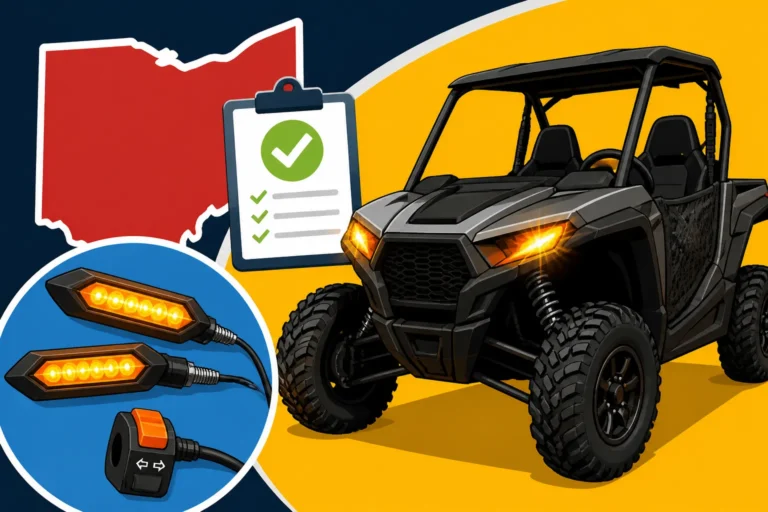
Moving to the rear, your UTV must have functional taillights that are red and clearly visible from behind, as well as brake lights that illuminate brightly when the brake pedal is pressed. And crucially for road use, your UTV will need amber turn signals on both the front and rear, clearly indicating your intention to turn. Many riders turn to aftermarket solutions, and brands like SuperATV offer kits that bundle many of these necessary lighting components, making compliance a bit easier. Reflectors, typically red in the rear and amber on the sides, will also be checked to ensure your UTV is visible even when its lights are off.
Mirrors, Windshield, and Wipers
Visibility from your UTV is just as critical as your UTV's visibility to others. Inspectors will require at least one rear-view mirror located on the driver's side of the UTV, providing an unobstructed view of the road behind. A center-mounted rearview mirror is also highly recommended and often a good idea for overall awareness, even if not strictly mandated as the primary mirror.
Your UTV must also have a windshield made of safety glass, capable of providing clear forward vision without distortion or damage. If your UTV didn't come with a safety-glass windshield or a wiper, you'll need to install one. There are many options out there, including full windshield and wiper kits from companies like SuperATV, designed specifically for various UTV models. Along with the windshield, a functional windshield wiper system will be required to maintain visibility in inclement weather. [Wipers and Glass on an Ohio UTV] covers this in more detail.
Brakes, Tires, and Horn
A reliable braking system is non-negotiable for road travel. The inspector will confirm that your UTV has service brakes on all wheels that are capable of bringing the vehicle to a safe, controlled stop. This check typically involves a visual inspection for proper function, adequate brake pad material, and no obvious leaks or damage. A separate parking brake (or emergency brake) will also be checked for functionality, ensuring it can hold the UTV stationary.
Tires are another crucial component. While specific tread patterns might not be mandated, the tires must be in good condition, free from excessive wear, cracks, or damage, and properly inflated. They need to be suitable for road use, which generally means not having excessively aggressive lugs that could damage pavement or provide poor handling on hard surfaces. Lastly, a working horn capable of emitting an audible signal is a fundamental safety device for alerting others on the road.
Seatbelts and Occupant Protection
For any UTV that will carry passengers on public roads, seatbelts are a must. Every seating position designed for an occupant must be equipped with a functional seatbelt. The inspector will verify that these seatbelts latch securely, are free from fraying or damage, and retract properly. This is a critical safety feature designed to keep occupants secure in the event of a sudden stop or collision.
While not always a specific "inspection item" in the same vein as lights, the inherent roll-over protective structure (ROPS) of your UTV is what makes it suitable for this type of use. The inspection tacitly relies on the UTV's design to offer a level of occupant protection that an ATV simply doesn't. You can learn more about all the [Ohio UTV Road Equipment List] requirements to be fully prepared.
Documentation and Roadworthiness Beyond Equipment
Beyond the physical components on your UTV, the inspection process also touches on aspects of your machine’s identity and overall condition. While it’s primarily an equipment check, having your paperwork in order and presenting a well-maintained machine can make the process smoother and avoid unnecessary delays.
Proof of Ownership and Identification
When you arrive for your inspection, be sure to have your UTV's title or Manufacturer's Certificate of Origin (MCO) readily available. The inspector will need to verify the Vehicle Identification Number (VIN) on your UTV against the VIN listed on your ownership documents. This step is crucial to ensure that the machine being inspected is indeed the one legally documented. A discrepancy here can halt the process entirely.
This check also helps guard against stolen vehicles being registered for road use. It's a foundational step in linking your specific machine to its legal ownership. Without clear and matching documentation, you won't be able to proceed with registration, even if your UTV is perfectly equipped.
General Vehicle Condition
While Ohio's UTV road-legal inspection isn't as exhaustive as a full vehicle safety inspection for a car, inspectors will still observe the general condition of your machine. This means your UTV shouldn't have obvious structural damage, severely worn parts, or anything that would clearly compromise its safe operation on public roads. For instance, excessively loose steering components, major fluid leaks, or glaring frame damage could raise a red flag.
The expectation is that you are presenting a vehicle that is in a reasonable state of repair. It's not just about having the right lights; it's also about those lights being securely mounted, or the tires being actually attached to the wheels. Presenting a UTV that looks neglected or appears to have critical mechanical issues can lead to a failed inspection, even if all the required individual items are present. It's always best to give your UTV a thorough once-over before heading to the inspection station. For details on various rules, read [Ohio UTV Equipment Rules Explained].
What Happens After the Inspection and What If You Fail?
The inspection is a critical gateway for getting your UTV legally on Ohio roads. What happens next, and how you handle potential roadblocks, is just as important as knowing what the inspector looks for. Understanding these steps will help you navigate the process efficiently, whether your machine passes with flying colors or needs a little more work.
Passing the Inspection
Congratulations! If your UTV successfully passes the inspection, the inspecting agent will typically provide you with documentation confirming its compliance. This form is your golden ticket to the next step: registering and titling your UTV for road use. You'll then take this paperwork, along with your title and proof of insurance, to your local county title office and then a deputy registrar office to complete the registration process.
It’s important to keep this inspection certificate or approval documentation with your registration paperwork. It signifies that your UTV has met the necessary safety requirements for road operation in Ohio, and you’re now eligible to receive your plate and validation sticker. Always remember that even after passing inspection, you'll still need to carry proof of registration and insurance when riding on public roads. [Proof of Insurance on an Ohio Road] explains this further.
What to Do If Your UTV Fails
It's not uncommon for UTVs to fail an inspection on the first attempt. Perhaps a turn signal bulb was out, the horn didn't work, or your windshield wasn't up to safety glass standards. The good news is that a failed inspection usually comes with a clear explanation of what needs to be fixed. The inspector will typically give you a list of deficiencies that must be addressed before your UTV can be approved.
Your next steps involve making the necessary repairs or upgrades. This might mean purchasing new lights, installing a compliant windshield, or simply fixing a wiring issue. For many riders, this is where aftermarket parts come in handy. Retailers like SuperATV offer a vast selection of UTV parts and accessories that are specifically designed to meet or exceed OEM standards, making it easier to find the compliant components you need to pass your re-inspection. Once you've made the required corrections, you'll need to schedule another inspection to verify that all issues have been resolved. Don't get discouraged if you don't pass on the first try; view it as an opportunity to make your UTV even safer for the roads!
Here’s a quick overview of the key items an inspector will check:
| Component | Requirement |
|---|---|
| Headlights | White, high/low beam, properly aimed, functional |
| Taillights | Red, visible from rear, functional |
| Brake Lights | Red, illuminate upon braking, functional |
| Turn Signals | Amber, front and rear, functional |
| Reflectors | Red rear, amber side, visible |
| Rear-View Mirror | At least one on driver's side, unobstructed view |
| Windshield | Safety glass, clear, free from damage |
| Windshield Wiper | Functional, clears visibility |
| Service Brakes | Functional on all wheels, capable of safe stop |
| Parking Brake | Functional, holds UTV stationary |
| Tires | Good condition, adequate tread, properly inflated, suitable for road use |
| Horn | Functional, audible signal |
| Seatbelts | Functional for all seating positions |
| VIN | Must match title/MCO, visible |
| General Condition | No obvious structural damage or critical mechanical issues |
Disclaimer
This article is for general informational purposes only and does not constitute professional advice. Laws, prices and regulations vary by location and change over time. Consult a qualified professional for guidance on your specific situation.