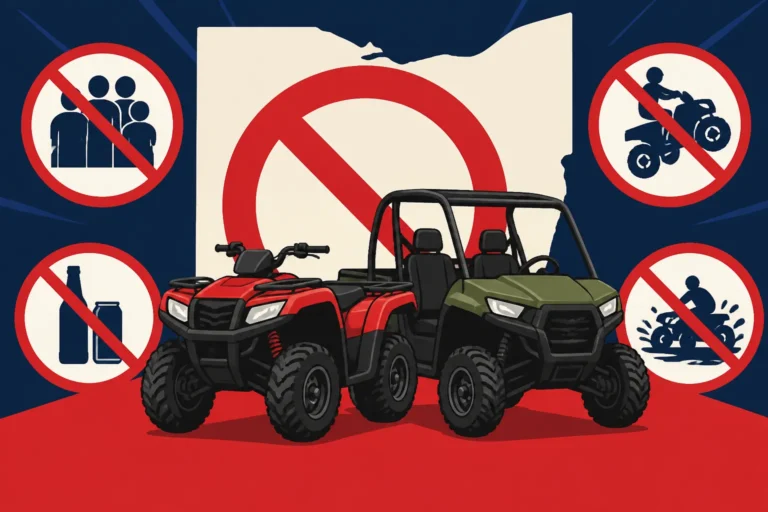
Ohio Rules for Riding a Township Road
It's incredibly frustrating, isn't it? You've got your all-purpose vehicle (APV), maybe a shiny new side-by-side or a trusty quad, and all you want to do is get from your driveway to the local gas station, or perhaps connect two different sections of trail by taking a short hop down a township road. But then the nagging questions start: Is it even legal? What do I need to do? Ohio's rules for riding APVs on public roads can feel like a tangled mess of "maybes" and "depends on wheres." This guide is here to untangle that knot, breaking down exactly what Ohio law says about riding your APV on township roads, from how roads become open to what equipment your machine needs.
Understanding Ohio's Local Control Over APV Roads
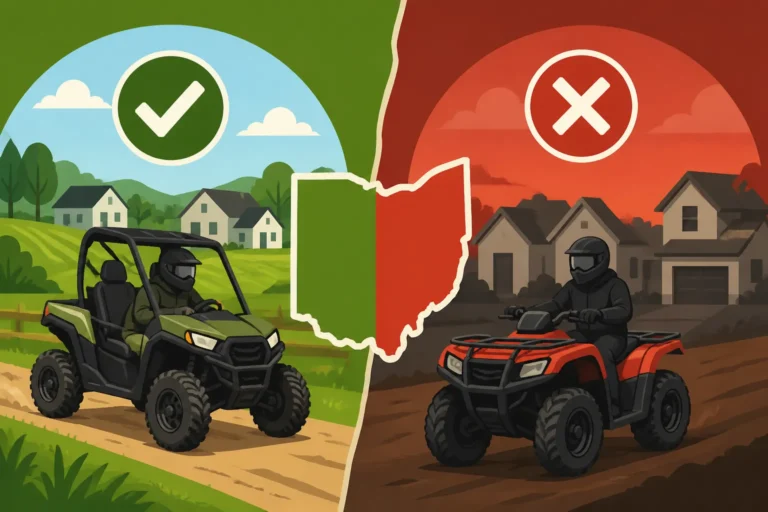
One of the biggest sources of confusion for riders in Ohio is the idea of "street legal" for ATVs and UTVs. Unlike traditional cars and trucks, APVs aren't automatically allowed on most public roads in Ohio. Instead, the power to open roads to these machines rests primarily with local governments – specifically, county commissioners for county roads and township trustees for township roads. This local control means that one township might have miles of open roads, while the neighboring township keeps all its roads closed to APVs, creating a patchwork of access that can be incredibly difficult to navigate if you're not clued in.
Imagine you live in a rural area of Ohio, and your property abuts a township road. You hear a rumor that the township has "opened" its roads, but what does that actually mean? It means the township trustees, who are elected officials responsible for the local governance of the township, have taken specific action. They have to pass a resolution, a formal declaration, that specifically allows APVs on certain or all roads under their jurisdiction. Without that resolution, those roads remain off-limits, no matter how quiet or remote they might seem.
The Township Trustees' Role in Opening Roads
Township trustees are the unsung heroes, or sometimes the gatekeepers, of local APV access. When riders in a particular area want to use township roads to connect trails or access services, they often need to approach their township trustees. This isn't a simple request; it involves formal procedures. The trustees must hold public meetings, consider local input, and then vote on a resolution. This resolution will outline which specific roads are open, if there are any time restrictions, and what speed limits might apply. It's a critical step, as their decision directly impacts where you can and cannot ride legally.
It's not just a matter of saying "yes" or "no." The trustees also have to consider safety, road wear, and the concerns of other residents. They might choose to open only certain roads, perhaps those that are less traveled or connect directly to established trail systems. Some townships might even differentiate between ATVs and UTVs, or impose specific operating hours. It’s a complex decision for them, balancing the recreational desires of some residents with the overall peace and safety of the community. Before you ever load up your machine, knowing if your specific township has passed such a resolution is the absolute first step. You can often find this information by contacting your township clerk or checking the township's official website. You might find a document similar to [A Township Trustees' Resolution in Ohio] outlining their decision.
How a Resolution Changes the Game
Once a township resolution is passed and officially enacted, it completely changes the legal landscape for APV riders on those specific roads. Before the resolution, riding an APV on a township road would be considered illegal road use, potentially leading to citations and fines. With the resolution, those roads become fair game, provided you adhere to all the other rules regarding equipment, licensing, and operation. This is why knowing which townships have taken this step is so important.
The resolution doesn't just grant permission; it also often lays out the framework for how APVs can be operated. This could include things like designated riding hours, speed limits, and even specific equipment requirements beyond what the state mandates for general APV registration. For instance, a township might require a slow-moving vehicle sign or specific lighting even if the state's basic definition of an APV doesn't. Riders need to be aware that simply because a road is "open" doesn't mean it's a free-for-all; there are still rules to follow, and the local law enforcement will be looking for compliance. Understanding the specific nuances of a given township’s resolution is as important as knowing that it exists in the first place. You might want to learn [How to Find an Ohio Township Resolution] for your area.
Why the State Defaults to "Closed"
Ohio's approach is designed around the idea that APVs are primarily recreational off-road vehicles. The default position of state law is that APVs are not intended for public road use. This is a common point of frustration for riders who see their UTVs as perfectly capable of handling a gravel road. The state grants local control to allow townships and counties to make decisions based on their unique geography, traffic patterns, and community preferences. If the state were to issue a blanket "APVs are street legal," it would ignore the vast differences between, say, a quiet rural road in southeastern Ohio and a bustling suburban street near a major city.
This "closed by default" policy places the burden of opening roads squarely on local governments. It requires them to actively opt-in, rather than forcing them to opt-out. This system aims to ensure that local concerns, such as road safety, noise levels, and the compatibility of APVs with other road traffic, are thoroughly addressed at the most granular level. While it might seem cumbersome for riders, it's an intentional legislative choice to empower local communities to manage their roadways responsibly. So, if you're not sure about a specific township road, the safest assumption, legally speaking, is that it's closed unless you can confirm otherwise through an official resolution. You'll often hear discussions about [Why Ohio Has No Statewide Road Right].
Essential Equipment and Rider Requirements for Township Roads
Even if your township trustees have opened the roads to APVs, you can't just hop on and go. Ohio law, along with potential local ordinances, dictates specific equipment your machine must have and certain requirements you, as the operator, must meet. Skipping these steps isn't just a minor oversight; it can lead to citations, fines, and even a forced end to your ride. Think of it like this: your APV needs to become a bit more "road-ready" than it might be for just hitting the trails.
Many riders invest in accessories to make their machines more versatile, and this is where quality aftermarket parts come in handy. Products from brands like SuperATV, for instance, offer a wide range of turn signal kits, mirrors, and lighting upgrades specifically designed for APVs, making it easier to meet these requirements.
Required Machine Equipment for Township Roads
When your APV rolls onto an open township road, it needs to be equipped with certain safety features. Ohio law generally requires several items, though UTVs often have a few extra stipulations compared to ATVs. At a minimum, your APV must have:
- Headlights: Capable of illuminating objects at least 200 feet ahead. This means properly functioning, bright lights are non-negotiable, especially for dusk or dawn riding.
- Taillights: Visible from at least 500 feet to the rear. Crucial for ensuring you're seen by other vehicles.
- Brake Lights: Activated when the brakes are applied, signaling to anyone behind you that you're slowing down or stopping.
- Muffler: In good working order, keeping noise levels within reasonable limits. Ohio has specific [Ohio Muffler Requirements for APVs].
- Spark Arrester: To prevent wildfires, particularly important when riding in dry conditions or near vegetation. This is often an OEM requirement, but check its condition.
- Rearview Mirror: Essential for situational awareness, allowing you to see traffic approaching from behind.
- Turn Signals: While not always strictly mandated for ATVs in some off-road contexts, they become vital for safe road use, indicating your intentions to other drivers. Many riders choose aftermarket SuperATV kits to add this functionality cleanly and effectively.
For UTVs, the rules can be a bit more stringent, often requiring a windshield (though it doesn't always have to be safety glass unless specified by a local ordinance or if you're trying to meet full 'street legal' criteria for higher speed roads, which township roads typically aren't), and sometimes even a horn. It's critical to remember that specific township resolutions can add requirements beyond these state minimums, so always check local ordinances. You'll find that [Ohio APV Road Equipment List] and [Ohio UTV Road Equipment List] often differentiate.
Driver's License, Insurance, and Supervision Rules
Operating an APV on an open township road in Ohio is not like riding on private land or a dedicated trail park. The state treats it much more like operating a motor vehicle on a public roadway, meaning you, the driver, have specific responsibilities and need certain credentials.
- Driver's License: Any person operating an APV on a public road, including open township roads, must possess a valid driver's license. This means a regular Class D (car) license is sufficient, but you cannot be riding on a suspended or revoked license. This is a non-negotiable requirement. Even if you're just cruising a quiet back road, a deputy can ask to see your license. Learn more about [Ohio Driver's License Rules for APVs].
- Insurance: This is another crucial piece of the puzzle. Ohio requires proof of financial responsibility (i.e., insurance) for any motor vehicle operating on its public roads. Your standard car insurance policy typically does not cover your ATV or UTV for road use, or even necessarily for off-road use. You'll likely need a specific off-road vehicle insurance policy that includes liability coverage for public road operation. This protects you financially in case of an accident. Always carry proof of insurance with you, as it's one of the first things law enforcement will ask for. The minimum coverage for liability is generally the same as for an automobile. Understand the [Ohio APV Insurance Requirement] thoroughly before you ride.
- Supervision Rules for Minors: Ohio law has specific age restrictions and supervision requirements for APV riders, especially those under 16. Generally, a person must be at least 12 years old to operate an APV. However, on public roads, the rules become stricter. A person under 16 cannot operate an APV on a public road unless they are under the direct supervision of a licensed adult and are actively participating in an organized event or engaged in agricultural operations. For general recreational road riding, it's best to assume that operators must be 16 with a valid driver's license. For comprehensive details, review [Ohio Rules for Riders Under 16].
Helmets, Eye Protection, and Passengers
Riding an APV on an open township road also comes with specific safety gear requirements and rules regarding passengers, all designed to protect you and your companions.
- Helmets: While Ohio does not have a universal helmet law for all APV riding, it does mandate helmet use for operators and passengers under 18 years of age when riding on public roads. This includes open township roads. Beyond the legal requirement, wearing a DOT-compliant helmet is always a wise choice for any type of riding, offering vital head protection in the event of a mishap. Even if you're over 18, it's highly recommended. Familiarize yourself with [Ohio Helmet Law for APV Riders].
- Eye Protection: Regardless of age, all APV operators and passengers on public roads must wear eye protection. This could be a face shield on a helmet, goggles, or safety glasses. This protects your eyes from dust, debris, insects, and other hazards you'll encounter at speed. This rule is often overlooked but strictly enforced for safety reasons. You can find more details in [Ohio Eye Protection Requirement].
- Passengers: The rules for carrying passengers on an APV are critical and often tied to the machine's design. An APV is generally designed for a single operator unless it has a designated passenger seat with handholds and footrests. Carrying a passenger on a single-rider ATV is not only illegal but extremely dangerous, as it can compromise the machine's balance and handling. UTVs, by their nature, are designed for multiple occupants and usually have seats and seatbelts for passengers. Always ensure that passengers are safely seated, belted (if applicable), and wearing appropriate safety gear. It's imperative to review [Ohio Rules for a Passenger on an APV] before you head out with company.
Navigating Open Township Roads and Common Restrictions
So, your township roads are open, your machine is equipped, and you're legally ready to roll. Great! But the journey isn't over yet. There are still crucial rules about how you can ride on these roads, what speed limits apply, and what to do if you encounter other types of roads or law enforcement. These aren't just suggestions; they are enforceable laws designed to ensure safety for everyone sharing the roadways.
Understanding these operational nuances can mean the difference between an enjoyable ride and an unexpected citation. The goal is always to ride responsibly and respectfully, blending in as much as possible with other road users, even though your vehicle is quite different.
Speed Limits and Posted Roads
Just because a township road is open to APVs doesn't mean you can treat it like a private trail. Standard road rules, particularly regarding speed, still apply.
- Posted Speed Limits: If a township road has a posted speed limit, you must obey it. This is non-negotiable for all vehicles, including APVs. These signs are there for a reason, reflecting the road's design, traffic patterns, and potential hazards. A deputy will enforce these just as strictly for an APV as they would for a car.
- Unposted Roads and Default Limits: This is where it gets a little tricky. Many rural township roads are unposted. Ohio law states that on an unposted roadway, the default speed limit is 55 mph. However, this general rule often has a critical exception when it comes to APVs on township roads. Many township resolutions that open roads to APVs specifically cap the speed limit for these machines at a much lower rate, often 35 mph, regardless of the default 55 mph limit. This is a common safety measure to account for the different handling characteristics of APVs compared to cars. Therefore, if you're riding an APV on an unposted township road, assume the APV-specific limit (often 35 mph) unless your township's resolution explicitly states otherwise. Riding faster than this designated limit for APVs can absolutely lead to a citation. Be sure to check [Can You Ride an APV on an Unposted Ohio Road?] and [Why an Ohio UTV Stops at Thirty-Five] for more context.
Riding the Berm and Crossing State Routes
There are specific actions related to how you physically operate your APV on an open township road, particularly regarding where you can ride on the pavement and how you might interact with state routes.
- Riding the Berm: Ohio law generally permits APVs to ride on the berm or shoulder of a roadway if it's safe to do so. This can be particularly useful on narrow township roads where you want to give other vehicles more room. However, this isn't a blanket permission to ride entirely off the paved surface everywhere. The berm must be suitable for riding, meaning it's clear of obstructions, reasonably smooth, and not so soft that it creates a hazard or damages the roadway. The intent is to allow APVs to safely coexist with other traffic, not to create a separate, unmaintained path. Remember to consult [Riding the Berm Beside an Ohio Lane] for further guidance.
- Crossing State Routes: This is a critically important point. Even if a township road is open to APVs, state routes (those designated with an "SR" number, like SR 550) are generally not open to APV travel. You cannot simply ride down a state route. However, you are often permitted to cross a state route at an intersection, provided you do so safely and directly. This means stopping, looking both ways, and proceeding across the intersection when it's clear, just as you would in a car. You cannot travel along a state route for any distance. Violating this rule can lead to significant penalties, as state route access is controlled by the Ohio Department of Transportation, not local townships. Always be aware of [Ohio Rules for Crossing a State Route].
What Happens If You Get Stopped
No one wants to see flashing lights in their rearview mirror, but if a deputy or state patrol officer pulls you over while you're riding your APV on an open township road, knowing what to expect and how to respond can make a big difference.
- Stay Calm and Comply: The most important thing is to remain calm, pull over safely, and cooperate with the officer. Turn off your engine, keep your hands visible, and follow any instructions given.
- Provide Documentation: The officer will likely ask for your driver's license, proof of insurance, and your APV's registration card. These are mandatory documents for operating on public roads, so having them readily accessible is crucial. If your machine is a UTV that required an inspection to be plated for road use, be prepared to answer questions about its equipment. This is where having your machine properly equipped with items like those from SuperATV and paperwork in order pays off.
- Potential Violations: If you are found to be in violation of any of the rules discussed – no license, no insurance, improper equipment, exceeding the speed limit, or riding where APVs are not permitted – you will likely receive a citation. These citations carry fines and can even result in your machine being impounded in severe cases or if you're operating without proper registration or insurance.
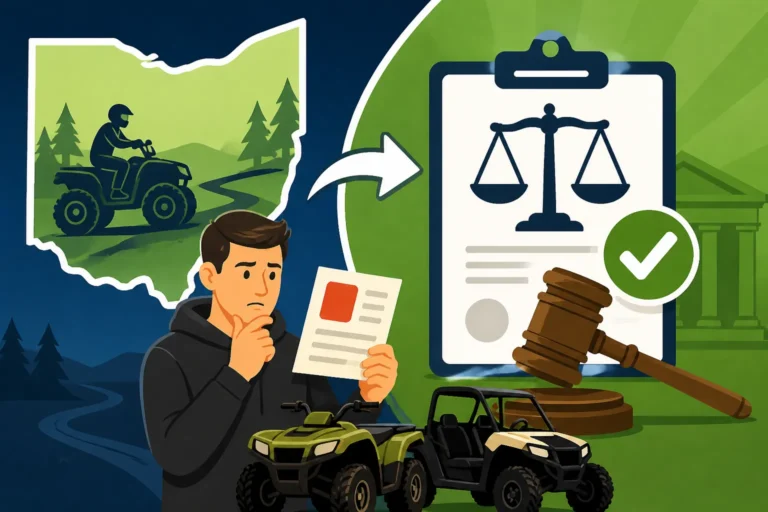
- Know Your Township's Rules: Sometimes, an officer from outside the immediate area might not be fully aware of a specific township's resolution. While you should never argue, politely and respectfully explaining that the township has passed a resolution opening its roads (if you are certain it has) might be helpful. However, ultimately, the officer has the final say, and if you receive a citation you believe is unwarranted, you'll need to address it through the court system. For more information, you can read [What to Expect When a Deputy Stops Your APV].
Disclaimer
This article is for general informational purposes only and does not constitute professional advice. Laws, prices and regulations vary by location and change over time. Consult a qualified professional for guidance on your specific situation.