What Ohio Law Prohibits on an APV
It’s a common scenario: you’ve got your all-purpose vehicle (APV)—maybe it’s a shiny new quad, or perhaps a rugged side-by-side that’s perfect for farm work or trail adventures. You know it’s not a car, but sometimes, just sometimes, you wish you could legally zip down that short stretch of county road to get to the next trail, or even just cross a highway to reach a buddy’s property. The truth is, Ohio law is pretty clear on what you can't do with an APV on public roads, and understanding these prohibitions can save you a lot of grief, fines, and even serious accidents. This guide is here to unravel those complexities, helping you understand the strict boundaries and essential rules surrounding APV use on Ohio's roads.
The Core Principle: APVs Are NOT Road Vehicles by Default
Let's cut right to the chase: In Ohio, an all-purpose vehicle (APV) is fundamentally designed and intended for off-road use. This isn't just a suggestion; it's the bedrock principle that underpins virtually every rule and prohibition concerning APVs and public roads. When the legislature crafted these laws, they weren't thinking about how to make your quad commute-friendly; they were thinking about how to keep off-road machines off paved surfaces and out of the flow of conventional traffic.
Ohio's Foundational Stance on Off-Road Vehicles
The very nature of an APV—its knobby tires, high ground clearance, lack of traditional safety features like crumple zones, and usually a less robust braking system compared to a car—makes it unsuitable for sustained road travel. Ohio law reflects this by creating a distinct category for these vehicles, separate from cars, trucks, and even motorcycles. This separation isn't meant to be inconvenient; it's a recognition of the different operational characteristics and safety profiles. Think about it: a machine designed to climb over rocks and churn through mud simply isn't engineered for high-speed asphalt driving alongside sedans and semi-trucks.
This foundational stance means that any allowance for APVs on roads is always an exception to the rule, rather than the rule itself. These exceptions are typically granted by local authorities and come with a host of additional requirements and restrictions. Without such a specific local ordinance in place, your default assumption should always be that road use is prohibited. It's not about being a killjoy; it's about acknowledging the inherent design limitations and the vastly different safety standards that apply to APVs.
The Definition of an APV Under Ohio Law
Understanding what an APV is according to Ohio Revised Code is crucial to grasping what's prohibited. Ohio law defines an APV fairly broadly, encompassing vehicles like ATVs, side-by-sides (UTVs), and even dirt bikes, provided they meet certain criteria regarding weight, width, and intended use. Specifically, an APV is generally described as a motor vehicle that is not a car, truck, or motorcycle, and is designed to travel on land other than public roads. It often has characteristics like a seat designed to be straddled by the operator or a bench seat for multiple passengers, handlebars for steering, and is typically under a certain weight and width threshold, though these can vary slightly based on the specific type of machine.
This distinct classification means that the rules governing APVs are entirely separate from those for other motor vehicles. You can't assume that if something is legal for your car, it's legal for your APV. For instance, the registration process for an APV is distinct, requiring a specific plate that signifies its off-road primary purpose, even if it might occasionally be used on permitted roads. This legal distinction clarifies that an APV isn't just a smaller, simpler car; it's an entirely different class of vehicle with its own set of permitted and prohibited uses, especially when it comes to shared public infrastructure like roads. For a deeper dive, check out [How Ohio Law Defines an APV].
Where APVs Are Explicitly Prohibited on Ohio Roads
While local jurisdictions have the power to open certain roads to APVs, there are some places where these machines are universally, absolutely, and unequivocally prohibited. These are non-negotiable zones where riding an APV, regardless of local ordinances or your machine's equipment, will land you in hot water.
State Routes and Interstates: Absolute No-Go Zones
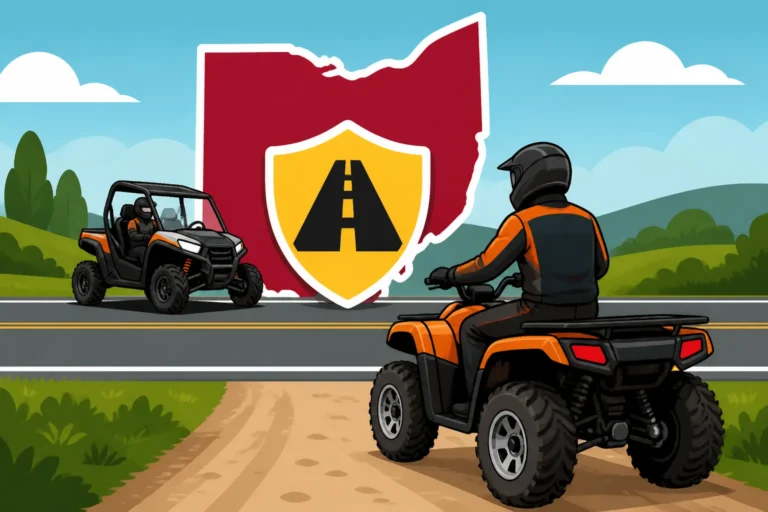
Let's make this crystal clear: You cannot, under any circumstances, operate an APV on state routes or interstates in Ohio. These high-speed, multi-lane arteries are designed for conventional motor vehicle traffic moving at significant speeds. The very idea of an APV, with its often lower top speed, different handling characteristics, and lack of comprehensive safety features, trying to integrate into this traffic flow is a recipe for disaster.
Ohio law is unambiguous on this point. There are no exceptions, no local resolutions that can override this prohibition. Whether it's a major highway like I-70 or a state route like SR-33, these roads are off-limits. The risks are simply too high—for the APV operator, for passengers, and for other motorists. Imagine trying to merge onto a highway with traffic flying by at 70 mph on a machine that tops out at 45 mph. It's a terrifying thought, and it's why the law explicitly forbids it. Violating this rule can result in significant fines, potential impoundment of your machine, and could even lead to criminal charges if an accident occurs. For more details on why these specific roads are closed, you can read [Why State Routes Stay Closed in Ohio] and [Why Interstates Stay Closed in Ohio].
Unposted Roads and the Default Speed Limit
Another common misconception revolves around "unposted" roads. Many riders mistakenly believe that if a county or township road doesn't have a visible speed limit sign, it must be open to APVs, or that the speed limit is low enough to be safe. This is a dangerous assumption that can lead to unexpected legal trouble. Ohio law dictates that any unposted road within a county or township, outside of municipal limits, defaults to a speed limit of 55 miles per hour.
This default 55 mph limit immediately triggers a prohibition for APVs. Even in areas where townships or counties do pass resolutions to open their roads to APVs, those resolutions invariably specify that only roads with a speed limit of 35 mph or less are permissible. The reasoning is sound: an APV is not built to safely operate at 55 mph, nor can it generally keep pace with traffic at that speed. Attempting to ride an APV on an unposted road, even if it feels quiet and remote, means you are technically on a 55 mph road, which is off-limits. Always confirm the posted speed limit—and the presence of a local resolution—before even considering riding on a public road. Don't fall into the trap of assuming an unposted road is automatically safe or legal for your APV. For further clarification on this, see [Can You Ride an APV on an Unposted Ohio Road?] and [Why Fifty-Five Closes an Unposted Road].
Crossing Roads: Limited Exceptions and Strict Rules
While operating an APV along state routes or interstates is a definite no, there are limited exceptions for crossing certain roads. However, these are not free rein to cross wherever and whenever you please; they are governed by very strict rules designed to ensure safety.
Typically, you are permitted to cross a highway, state route, or other prohibited road only at an intersection and only when it is safe to do so. This means coming to a complete stop, looking both ways, and yielding to all vehicular traffic. You must proceed directly across the road, without riding along the shoulder or berm, and enter a legal riding area on the other side. You cannot use the crossing as an excuse to travel down the prohibited road for any distance. The idea is to minimize the time your APV spends in active traffic lanes. This privilege is entirely dependent on clear visibility, safe conditions, and strict adherence to traffic laws. It’s a moment of quick transition, not a leisurely traverse. Failing to follow these rules during a crossing can lead to the same penalties as illegally operating on the road itself. For more information, consult [Crossing a Highway on an APV in Ohio].
Equipment Prohibitions: What Your APV Lacks for Road Use
Beyond where you can't ride, Ohio law also prohibits APVs from road use if they lack specific equipment. Most off-the-shelf ATVs and UTVs are not factory-equipped with the features necessary to safely and legally share roads with traditional motor vehicles, even in areas where local ordinances permit it. This is a critical distinction, as having an open road isn't enough; your machine must also meet certain standards.
The Missing Road-Legal Essentials for ATVs
Standard ATVs are minimalist machines, built for agility and rugged off-road performance. They typically come with basic headlights, taillights, and sometimes brake lights. What they almost universally lack, however, are the items considered essential for road safety and communication with other drivers. This includes turn signals to indicate intended direction, rearview mirrors to see traffic approaching from behind, and a windshield made of safety glass with functional wipers. These items are fundamental for road-legal vehicles, allowing drivers to signal intentions, maintain situational awareness, and see clearly in adverse weather.
Because ATVs lack these features, they are generally prohibited from sustained road use, even on roads that have been opened by local resolution. The law simply doesn't deem them safe enough without these basic signaling and visibility components. While some aftermarket kits exist, modifying an ATV to meet these standards can be complex and expensive, and the vehicle would still need to be inspected (if applicable to the specific local ordinance) to ensure compliance. Most riders accept that their ATV is an off-road only machine for this very reason. To understand the full list of requirements, you can check [Ohio APV Road Equipment List].
UTVs and the Inspection Hurdle: Why Many Don't Qualify
Side-by-sides, or UTVs, present a slightly different scenario. They often come closer to resembling a conventional vehicle, sometimes featuring steering wheels, seatbelts, and even basic roofs. This has led many to believe they are inherently more "road-ready." However, Ohio law places specific, rigorous equipment requirements on UTVs if they are to be operated on public roads (where permitted by local ordinance), including a mandatory inspection.
For a UTV to be considered road-legal on a permitted road, it must often pass an inspection that verifies the presence and functionality of numerous items. This can include, but isn't limited to:
- Headlights, taillights, and brake lights
- Turn signals for both front and rear
- A rearview mirror and often side mirrors
- A horn
- A windshield made of safety glass, usually with wipers
- Seatbelts for all occupants
- Proper tires
- A spark arrester and muffler
Many stock UTVs, even high-end models, will not come with all these features from the factory. For example, while a UTV might have a basic plastic windshield, it might not be safety glass as required for road use, or it might lack wipers. This is where aftermarket companies like SuperATV come into play, offering accessories like DOT-approved glass windshields, wiper kits, turn signal kits, and mirrors that can help a UTV meet these stringent requirements. However, simply installing parts isn't enough; the UTV must still undergo and pass the specific inspection. Without passing this inspection, a UTV, even if modified, is prohibited from road use, regardless of any local ordinance. You can learn more about these requirements and the inspection process by reading [Ohio UTV Road Equipment List] and [The Ohio Inspection a UTV Must Pass].
Behavioral Prohibitions: How You Cannot Ride an APV on Ohio Roads
Beyond where and what equipment, there are crucial prohibitions related to how you operate an APV, especially concerning the rider's conduct and eligibility. These rules are in place for safety, for the protection of all road users, and to maintain public order.
Age and Supervision Restrictions for Riders
Ohio law is very clear about who can operate an APV, and these rules become even more critical when there's any potential for road interaction. Generally, riders under the age of 16 are subject to significant restrictions. While a 12-year-old might be able to ride an APV on private land with parental supervision, the rules tighten considerably on public lands or any roads.
Specifically, a person under 16 years of age is typically prohibited from operating an APV on any public road, even those opened by local resolution. There are also strict rules about supervision for younger riders on trails and public lands. For instance, a rider between 12 and 15 years old often needs to be accompanied by a licensed adult on designated public trails. These age and supervision requirements are not arbitrary; they are based on the developing judgment, experience, and physical capabilities of young riders. An APV can be a powerful machine, and operating it safely, particularly around other vehicles, requires a level of maturity that comes with age and experience. Ignoring these age prohibitions can result in citations for both the minor and the supervising adult. For more information on this, refer to [Ohio Minimum Age to Ride an APV] and [Ohio Rules for Riders Under 16].
Impaired Riding and Open Container Laws
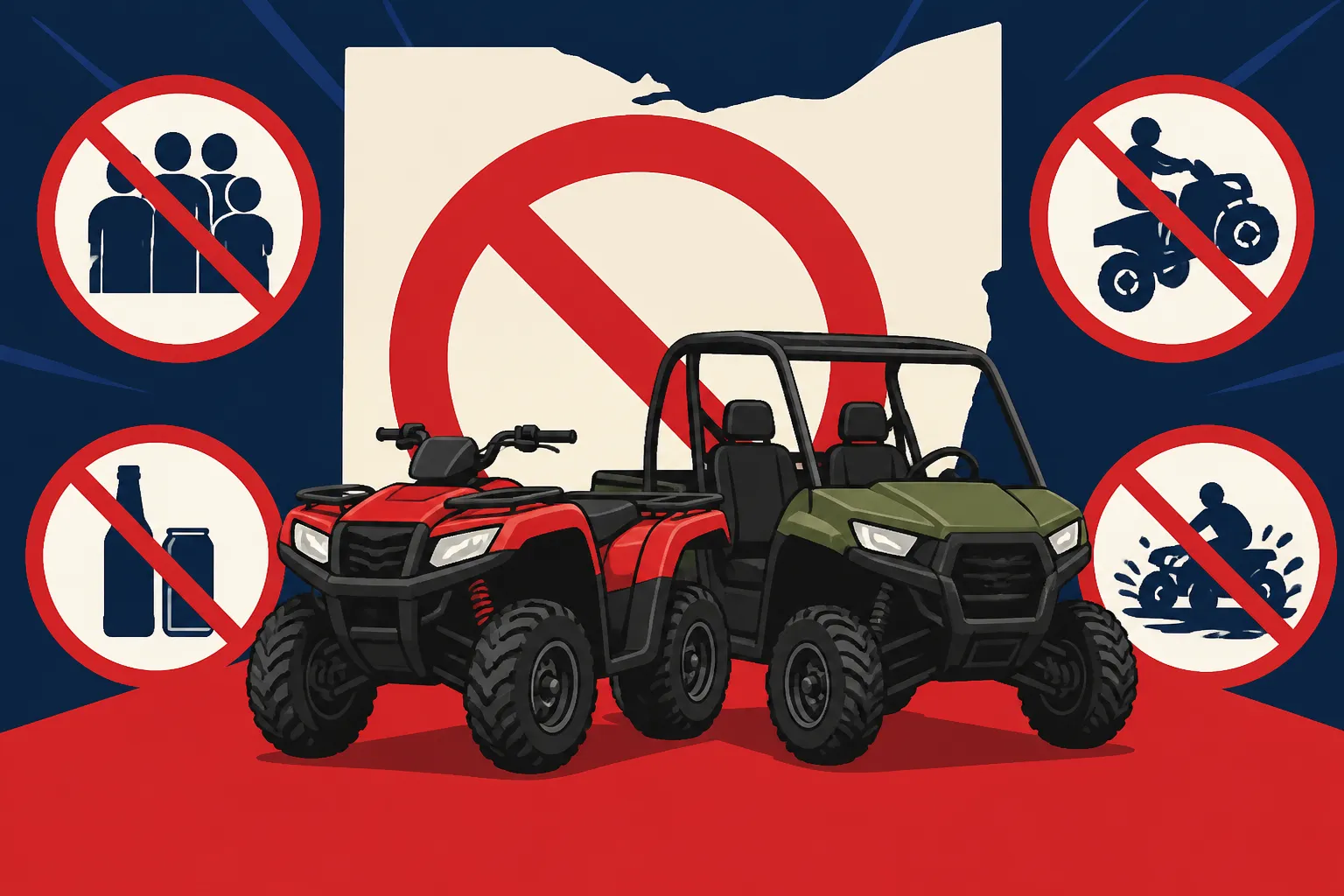
Just like with cars, operating an APV under the influence of alcohol or drugs is strictly prohibited in Ohio. The notion that "it's just an ATV, not a car" does not provide a legal loophole here. Ohio's DUI (Driving Under the Influence) laws apply equally to APVs, whether you are on a public road, a designated trail, or even private property if the public has access. The consequences of an APV DUI are severe and can mirror those for a car DUI, including fines, license suspension, and potential jail time.
Furthermore, Ohio's open container laws also extend to APVs. This means you cannot have an open container of alcohol in your APV while operating it, regardless of whether you are actively consuming it. These prohibitions are in place because impaired operation drastically increases the risk of accidents, injuries, and fatalities. The responsive nature and sometimes unpredictable terrain associated with APV riding make clear judgment even more paramount. Even if you're out having fun, safety and sobriety are non-negotiable. Don't let a good time turn into a legal nightmare. For detailed information, see [Ohio DUI Rules for APV Riders] and [Ohio Open Container Rules on an APV].
Reckless Operation and Public Safety
Beyond specific rules, Ohio law broadly prohibits reckless or negligent operation of an APV, particularly in a manner that endangers persons or property. This covers a wide range of behaviors that might seem like harmless fun off-road but become dangerous and illegal on or near public roads. Wheelies, excessive speed, driving in a manner that causes damage to property, or operating the machine without due regard for the safety of others are all examples of reckless operation.
Even if you are on a road that is legally open to APVs, you are still expected to operate your machine responsibly and safely, adhering to all traffic laws that apply. This means following posted speed limits, obeying stop signs and traffic signals, and yielding to pedestrians and other vehicles. An APV, especially a powerful one equipped with SuperATV upgrades, demands respect and responsible handling. Engaging in reckless behavior not only puts yourself and others at risk but can also jeopardize the future of APV riding in areas that have been opened to them, as such incidents can lead to local authorities reconsidering their resolutions. The goal is always to promote safe and enjoyable riding for everyone.
Specific Road Use Prohibitions: What is Never Allowed (Even on Open Roads)
Even on those rare roads where APVs are legally permitted by local resolution and your machine meets all equipment requirements, there are still specific actions and configurations that remain strictly prohibited. These are often related to the inherent design limitations of APVs or to general safety principles that cannot be waived.
Passenger Limitations on ATVs and Specific Machines
One of the most frequently misunderstood prohibitions pertains to carrying passengers on ATVs. Most standard ATVs are designed and manufactured for a single rider only. Their seating configuration, balance, and suspension are not meant to accommodate an additional person. Therefore, carrying a passenger on a single-rider ATV on any public road (even a permitted one) or public trail is generally prohibited. This includes having a child ride in front of you or standing on the rear rack. It's a significant safety risk that can lead to loss of control, especially when navigating turns or uneven terrain.
However, this prohibition does not typically extend to purpose-built, multi-passenger machines like many UTVs (side-by-sides). These vehicles are specifically designed with seating and safety restraints for multiple occupants. The key is to know your machine: if it was manufactured as a "one-up" ATV, stick to riding solo. Always check the manufacturer's specifications and the specific language of Ohio law regarding your particular APV model. If a UTV is designed for multiple passengers, ensure each passenger has a designated seat and is properly restrained. For details, refer to [Ohio Rules for a Passenger on an APV].
Speed and Weight Restrictions on Open Roads
Even when a local government passes a resolution to open certain roads to APVs, these resolutions almost always come with specific stipulations regarding speed. As mentioned earlier, a common requirement is that APVs are only permitted on roads where the posted speed limit is 35 miles per hour or less. This effectively prohibits APVs from using faster county or township roads, even if they aren't state routes. Exceeding this 35 mph limit, even on an otherwise open road, would constitute illegal operation and could result in a citation. This limitation acknowledges that APVs, while capable of speed, are not designed for sustained high-speed road travel and cannot safely interact with faster-moving vehicles.
Beyond speed, there can also be prohibitions related to the physical dimensions or weight of the APV. While Ohio state forests have a [Ohio's 62-Inch State Forest Width Limit] for their trails, road-use ordinances don't typically enforce a universal width limit like that. However, extremely wide or heavy machines might pose issues for narrow township roads or could potentially violate general vehicle weight limits if hauling oversized loads, though this is less common for recreational APVs. The overarching principle is that APVs must operate within safe parameters that prevent them from becoming a hazard to themselves or other road users. As such, local resolutions can further define these limits. For specific speed considerations, see [Why an Ohio UTV Stops at Thirty-Five].
Here's a quick comparison of common prohibitions versus conditional allowances:
| Feature/Action | Generally Prohibited (Always) | Conditionally Allowed (Requires Local Resolution & Equipment) |
|---|---|---|
| Road Type | State Routes, Interstates, Roads > 35 MPH | Township/County Roads ≤ 35 MPH |
| Crossing Roads | Anywhere other than intersections; riding along berm/shoulder | At intersections, safely and directly across |
| ATV Passengers | On single-rider ATVs (for any road/trail use) | On multi-passenger UTVs designed for it |
| Equipment | Lack of turn signals, mirrors, safety glass windshield/wipers | Full road-legal equipment (turn signals, mirrors, DOT windshield, etc.) |
| Rider Age | Under 16 years on public roads | 16+ years with valid driver's license (for UTVs on road) |
| Impairment | Any operation under the influence | Never Allowed |
| Speed | Exceeding posted limits; exceeding 35 MPH limit for APVs | Adhering to posted limits (max 35 MPH for APVs) |
| Reckless Driving | Any dangerous or negligent operation | Never Allowed |
Understanding these prohibitions isn't about discouraging APV use; it's about ensuring it's done safely and legally within Ohio. Always check local ordinances, equip your machine properly, and ride responsibly.
Disclaimer
This article is for general informational purposes only and does not constitute professional advice. Laws, prices and regulations vary by location and change over time. Consult a qualified professional for guidance on your specific situation.