Ohio Rules for Riding the Berm
One of the most common questions I hear from fellow Ohio ATV and UTV enthusiasts is about riding the edge of the road, that gravelly, grassy, or dirt strip known as the berm. It seems like such a convenient way to connect trails, bypass a short stretch of pavement, or even get from your property to a riding area without loading up the trailer. But let's be honest, the laws around All-Purpose Vehicles (APVs) on Ohio's roads are often as clear as a mud puddle after a spring rain, and trying to figure out if you can legally ride the berm can be incredibly frustrating. This guide is here to cut through that confusion, breaking down exactly what Ohio law says about riding the berm, where you might find open roads, and what you absolutely need to know to stay legal and safe.
Understanding "The Berm" in Ohio's Context
When we talk about "the berm" in the context of riding an ATV or UTV, we're usually picturing that strip of ground immediately adjacent to the paved or graveled travel lanes of a public road. It's not quite the roadway itself, but it's not always private property either. This distinction is critical in Ohio, as the legalities of riding your machine depend heavily on whether you are considered to be on the roadway, alongside the roadway, or venturing into areas where your machine simply doesn't belong.
What is the "Berm" and Why Do Riders Use It?
The berm is that marginal strip of land bordering the main travel surface of a road. Depending on the road, it could be a well-maintained gravel shoulder, a narrow strip of grass, or even a rough, uneven dirt path. For APV riders, the appeal of the berm is undeniable. Imagine you're riding a fantastic network of trails, but there's a mile-long gap between two sections, or you need to cross a paved road to get to the next adventure. Rather than loading your machine back onto a trailer for a five-minute drive, riding the berm seems like a natural, logical solution. It keeps your knobby tires off the pristine asphalt, potentially reducing wear and tear on your machine and the road itself, and it often feels safer, as you're not directly in the flow of traffic. However, this perceived practicality doesn't always align with Ohio's intricate legal framework.
Ohio's Legal Definition of a Roadway
Ohio law carefully defines what constitutes a "roadway" or "highway" versus other adjacent areas. Generally, a "roadway" refers to that portion of a highway that is improved, designed, or ordinarily used for vehicular travel. This means the paved or graveled section where cars and trucks primarily operate. The "berm" typically falls into the category of a "shoulder" or "right-of-way." While still part of the public domain in most cases, it's not the primary travel lane. This distinction is paramount because Ohio's APV laws often differentiate between operating a machine on the roadway versus alongside it. Understanding where the legal line is drawn between the asphalt, the gravel shoulder, and the roadside ditch can save you from a costly citation or even an accident. It's not always intuitive, and what might look like a rideable path could technically be a ditch, which carries different legal implications.
The Difference Between Riding On a Road and Alongside It
This is arguably the most important distinction for APV riders in Ohio. Operating an APV on a public road means you are directly in the flow of traffic, using the paved or graveled lanes intended for cars. This is generally prohibited unless specific local ordinances allow it, and even then, your machine must meet rigorous street-legal requirements, especially for UTVs. Riding alongside a road, on the other hand, means you are on the berm, shoulder, or right-of-way, attempting to stay out of the direct path of vehicular traffic. While this feels less impactful, it is still governed by specific regulations. The legal permission to ride on a road does not automatically grant permission to ride alongside it, and vice versa. Many local resolutions that open roads to APVs will contain specific language about whether the machine must operate on the road or if riding the shoulder (the berm) is permissible. It's not a blanket rule; it's a detail you absolutely must check for your specific riding location.
Ohio's General Stance on APVs and Road Use
Ohio's approach to All-Purpose Vehicles (APVs) on public roads is often described as restrictive, placing the burden of permission on local authorities rather than granting a broad statewide right. This means you can't just assume you can ride your ATV or UTV on any public road, or even its berm, simply because you've seen someone else do it, or because it seems like a logical way to connect trails.
The Default: No Statewide Road Right
It's crucial to understand that in Ohio, the default position is that ATVs and UTVs are not permitted on public roads. There is no statewide law granting riders the right to operate their machines on streets, roads, or highways. This includes riding on the paved surface, the gravel shoulder, or the grassy berm. This default rule is a significant hurdle for many riders who might be used to more lenient regulations in other states or who simply want to use their machines for short trips to trailheads or local stores. This means that if you haven't explicitly verified that a specific road or area is open to APV use, you should assume it is not. Ignorance of the law is not a valid defense if you're cited.
How Local Jurisdictions Open Roads
While there's no statewide right to ride APVs on roads, Ohio law does empower local government bodies—specifically county commissioners for county roads and township trustees for township roads—to pass resolutions that permit APVs on specific roadways within their jurisdiction. This is how many areas have opened up their roads to ATV and UTV traffic. These resolutions are not uniform; they can vary wildly from one county to the next, and even between adjacent townships within the same county. Some resolutions might open all roads under their control, while others might designate only certain roads or set specific days and hours for riding. These local resolutions are the lifeline for road-legal APV use in Ohio, including any provisions for riding the berm. It’s important to note that these resolutions often come with a host of conditions, such as requirements for machine equipment, rider licensing, and insurance.
Restrictions on State Routes and Interstates
One area where there is almost universal agreement and prohibition is on state routes and interstates. Ohio Revised Code (ORC) generally prohibits APVs on these high-speed, high-traffic thoroughfares. State routes are identified by the route shield and usually maintained by the Ohio Department of Transportation (ODOT). Interstates, of course, are federal highways. Regardless of any local county or township resolution, these roads are typically off-limits for APVs. Even if a township opens its roads, that resolution doesn't extend to any state routes that pass through it. The only exception, and it’s a very limited one, might be a quick, direct [Crossing a Highway on an APV in Ohio] at a designated intersection, if specifically allowed by local ordinance and if it’s done safely and legally. Attempting to ride the berm alongside a state route or, even more dangerously, an interstate, is almost certainly illegal and extremely hazardous. These roads are simply not designed for the slower speeds and different handling characteristics of APVs, and the risk of a serious accident is astronomically high.
Specific Rules for Riding Alongside an Ohio Road (The Berm)
Given that Ohio doesn't have a statewide "street-legal" blanket for APVs, understanding where and how you can ride alongside a road—on the berm—becomes a highly localized exercise. It's not enough for a road to be open; you need to know if the berm of that road is open, and under what conditions.
When Berm Riding is Explicitly Allowed or Forbidden
The ability to ride the berm hinges entirely on the specific language of the county or township resolution that has opened roads to APVs. Some resolutions might explicitly state that APVs are permitted to operate "on the roadway or on the berm or shoulder thereof." This is the golden ticket, indicating that berm riding is allowed in that jurisdiction, provided all other conditions (registration, insurance, equipment) are met. However, many resolutions are silent on the berm, or even explicitly state that APVs must operate "on the improved portion of the roadway." In such cases, riding the berm could be interpreted as illegal, even if the road itself is open. This ambiguity is where many riders get into trouble, assuming "road open" means "shoulder open." It's critical to read the actual text of the resolution carefully. For example, if a resolution says vehicles must operate "in the same manner as a motor vehicle," that usually implies on the travel lane, not alongside it.
Rules for Crossing Roads While Berm Riding
Even when riding the berm is permitted, there will be rules for how you interact with intersecting roads. Generally, if you're riding the berm and encounter a crossroad, you'll need to follow traffic laws as if you were in a car. This means stopping at stop signs, yielding to traffic, and signaling turns where required and possible. The crucial part is how you cross. Most local ordinances, even those that allow berm riding, will specify that when crossing a road, you must do so perpendicular to the flow of traffic, as directly and safely as possible. You can't just meander across or continue along the berm if it becomes part of another roadway. This is particularly true when you are trying to cross a state route, which might be otherwise closed to APV traffic. A township might open its roads and allow berm riding, but its jurisdiction stops at the state route. You might be allowed a direct, perpendicular crossing, but only at designated intersections, and you'll still need to follow all traffic signals and yield requirements. Always remember, a quick [Crossing a Two-Lane Safely] involves constant vigilance and adherence to traffic laws.
Distinguishing Between Berm, Ditch, and Private Property
One common misconception is that if it's not the paved road, it's fair game. This is far from the truth. The berm is distinct from the ditch, and both are distinct from private property. The berm or shoulder is generally intended to provide a recovery area for vehicles or space for pedestrians. A ditch, on the other hand, is designed for water drainage and often has steep, uneven terrain that can be dangerous for an APV and may cause damage to the machine or the ditch itself. Riding in the ditch is almost universally prohibited and can lead to damage to your machine, environmental harm, or even a citation for reckless operation or property damage. Beyond the public right-of-way (which typically includes the berm and often the ditch area), lies private property. Venturing onto private property without explicit permission from the landowner is trespassing, a serious offense that can lead to fines, impoundment of your machine, and strained relationships with landowners. It's a fundamental rule: always get written permission before riding on private land. The nuances of [Riding Off and Alongside an Ohio Road] are complex, so be sure you understand the boundaries.
Local Control: County and Township Authority over Berm Riding
The patchwork nature of Ohio's APV road laws means that local county commissioners and township trustees hold significant power in determining where and how you can ride your machine, including on the berm. This local control is both a blessing and a curse: it allows communities to tailor rules to their specific needs, but it also creates a dizzying array of regulations that can be hard for riders to track.
The Power of Local Resolutions to Permit Berm Riding
As mentioned, it is through specific resolutions passed by county commissioners or township trustees that APVs gain legal access to public roads, or their berms. These resolutions are formal legal documents that outline the scope and limitations of APV use. They can specify which roads are open, what hours of the day or days of the week are permitted, what safety equipment is required on the machine, and whether a rider needs a valid driver's license and insurance. Crucially, these resolutions also dictate if riding on the berm or shoulder is allowed. Some forward-thinking counties and townships understand that riders often prefer to stay off the paved surface and will include language that explicitly permits berm riding. Others might stick to basic road access, leaving berm riding in a gray area or implicitly forbidding it by only allowing "on-road" operation. For instance, in Washington County, Resolution 2024-1114 opened every road the commissioners control, which is fantastic for riders, but you'd still need to consult the specific text to see if berm riding is permitted or just on-road use.
Finding Out Which Roads Are Open to Berm Riding
This is often the most challenging part for riders. Because there's no central database or statewide map showing every open road or permitted berm in Ohio, you have to do your homework. The best starting point is the county or township government website for the area you plan to ride in. Look for sections related to resolutions, ordinances, or public notices. Often, the minutes of county commissioner or township trustee meetings will indicate if such resolutions have been proposed or passed. If you can't find it online, don't hesitate to call the county recorder's office or the township clerk. They are the keepers of these official documents and can usually point you to the correct resolution or even provide a copy. Be specific in your questions: don't just ask "Are ATVs allowed on roads?" but rather "Does your resolution permit riding APVs on the berm or shoulder of your roads?" Understanding [How to Find an Ohio Township Resolution] is key to riding legally.
Uniformity (or Lack Thereof) Across Jurisdictions
Prepare for inconsistency. It's entirely possible to ride legally on the berm of a township road in Muskingum Township, only to cross into an adjacent township like Newport, where berm riding is strictly prohibited. This lack of uniformity is a common frustration for riders and highlights the importance of thorough pre-ride research. A county might open all its county roads, but a township within that county might decide to keep its township roads closed, or vice versa. The reasons for these differences are varied: local politics, population density, trail availability, past incidents, or simply differing opinions among local officials. This means you can't rely on word-of-mouth or anecdotal evidence. Always verify the rules for every jurisdiction you intend to ride in. This situation is why the question [Why One Township Says Yes and the Next Says No] is so common among the Ohio APV community.
Essential Safety Practices and Equipment for Berm Riding
Even when berm riding is legally permitted, it comes with inherent risks. Unlike dedicated trails, public road berms are not designed for off-road vehicle travel and often share space with pedestrians, mailboxes, and hidden obstacles. Ensuring your safety, and the safety of others, requires diligent adherence to safety practices and proper equipment.
Visibility and Lighting Requirements
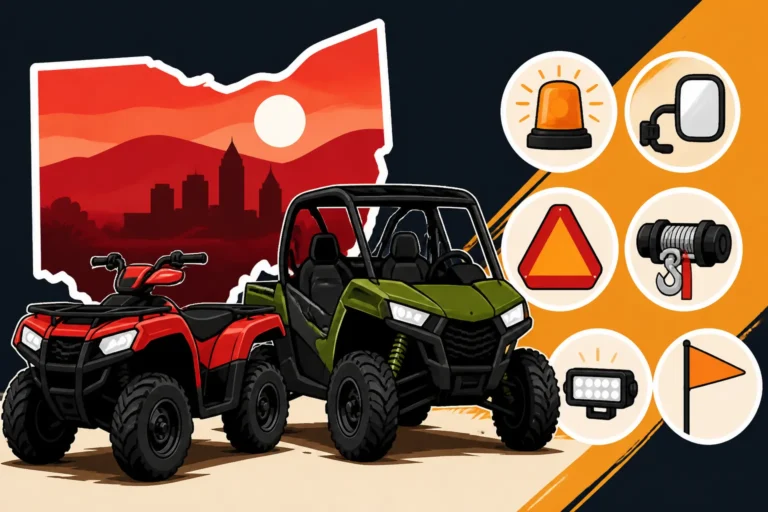
Visibility is paramount when riding near public roads. Even on the berm, you are still in close proximity to vehicular traffic, and drivers may not be expecting to see an APV. Your machine needs to be as visible as possible, especially during dawn, dusk, or in inclement weather. This means having functional headlights, taillights, and brake lights. Many local ordinances, when permitting road or berm use, will also require additional lighting such as turn signals, and sometimes even a horn. Reflectors, front and rear, are also a good idea. Consider aftermarket LED light bars or auxiliary lights for increased conspicuity. Companies like SuperATV offer a range of lighting solutions, from bright LED headlights to comprehensive turn signal kits, that can greatly enhance your machine's visibility on or near roads. These upgrades aren't just about compliance; they're about ensuring you're seen by others who may not be paying attention. It is crucial to understand [Ohio Lighting Requirements for APVs] before you even think about hitting the berm.
Rider Gear and Helmets
Ohio has specific laws regarding helmets and eye protection for APV riders, which apply whether you're on a trail or riding a permitted road or berm. For riders under 18, a helmet is always required. While not universally mandated for adults on private land or some trails, if you're riding on public roads or their berms where APVs are permitted, many local resolutions will require all riders, regardless of age, to wear a DOT-compliant helmet. Eye protection is also a must to shield your eyes from dust, debris, and insects, which are even more prevalent near roads. Wearing sturdy over-the-ankle boots, long pants, a long-sleeved shirt, and gloves can significantly reduce the risk of injury in a fall or collision. These aren't just suggestions; they are critical components of responsible riding. Knowing [Ohio Helmet Law for APV Riders] is non-negotiable for your safety.
Safe Riding Practices on the Berm
Riding the berm requires a completely different mindset than trail riding. Your primary focus shifts from navigating obstacles to maintaining awareness of vehicular traffic, pedestrians, and potential road hazards.
- Speed: Keep your speed low. The berm can be uneven, littered with gravel, hidden debris, or soft spots. High speeds increase the risk of losing control.
- Awareness: Constantly scan for approaching vehicles from both directions, especially when riding around blind curves or over hills. Be prepared to pull further off the berm or stop if necessary.
- Pedestrians and Property: Be mindful of residents, children playing, and mailboxes. Reduce speed and yield to pedestrians. Never ride too close to private property, and respect marked boundaries.
- Road Hazards: The berm can hide potholes, soft shoulders, drainage culverts, or trash. Road debris that might not bother a car tire could puncture an APV tire or cause a loss of control.
- Weather: Rain can turn a dirt berm into slick mud, and ice can make even a gravel shoulder treacherous. Adjust your riding style and speed accordingly, or avoid berm riding altogether in adverse conditions.
- Single File: If riding in a group, ride in single file and leave plenty of space between machines to react to unexpected situations.
- Passing: Never pass vehicles on the berm; wait for a safe opportunity to merge onto the road if permitted, or yield and allow vehicles to pass you.
Legal Requirements Beyond the Berm Itself
Riding the berm, even where permitted by local resolution, isn't just about staying on the dirt strip. It also triggers a whole host of other legal requirements that apply to your machine, your licensing, and your insurance. Neglecting these can result in citations, fines, and impoundment of your vehicle, even if you are technically riding in an "open" area.
APV Registration and Plating
Any All-Purpose Vehicle (ATV or UTV) that is operated on public roads or the public right-of-way (which includes the berm) in Ohio must be registered with the Ohio Bureau of Motor Vehicles (BMV) and display a valid APV license plate. This isn't optional; it's a fundamental requirement. The process for [Registering an APV in Ohio] involves visiting your local Deputy Registrar's office, providing proof of ownership (like a title or Certificate of Origin), and paying the necessary fees. The plate issued is typically a small, distinctive orange plate, and it must be clearly visible on the rear of your machine. Riding on the berm without a valid Ohio APV plate is the quickest way to get a ticket, even if you are otherwise in an area where APVs are permitted. Think of your plate as your passport to legal riding on public land.
Driver's License and Insurance
If you're operating an APV on any public road or its berm where permitted, you generally need a valid driver's license. This means a standard Ohio driver's license, just as if you were driving a car. You can't operate an APV on public land with only a learner's permit or without any license at all, unless you are under 16 and riding with a licensed adult as per specific youth riding rules which usually apply to designated trails, not public roads. Furthermore, Ohio law mandates that if an APV is operated on a public road or its right-of-way, it must carry liability insurance, similar to an automobile. This insurance provides coverage for damages or injuries you might cause to others while operating your machine. You should carry proof of this insurance with you at all times when riding on public roads or berms. Without [Ohio APV Registration and Insurance Proof], you're inviting serious legal trouble in the event of a stop or an accident.
UTV Specific Inspection for Road Use
Here's where UTVs often face an additional layer of complexity compared to ATVs when it comes to road or berm use. If a county or township resolution permits UTVs to operate on the actual paved or graveled roadway, then the UTV often needs to undergo a safety inspection to ensure it meets certain minimum equipment standards for roadworthiness. This inspection is performed by the Ohio State Highway Patrol or a licensed peace officer. It checks for things like working headlights, taillights, brake lights, turn signals, mirrors, a horn, a windshield, and sometimes even DOT-approved tires. This is a crucial distinction: ATVs typically don't require this inspection even when riding on open roads or berms, but many UTVs do if they are truly operating on the road. While riding the berm might sometimes exempt a UTV from all aspects of this inspection depending on how the local resolution is worded, it's safer to assume that if you're near a road where traffic flows, these additional safety features are expected. Understanding [Ohio UTV Inspection Before Registration] is paramount if you plan on extended road segments, even if it's just to connect trails via the berm.
Consequences of Illegal Berm Riding and Enforcement
Riding an APV on a public road or its berm where it's not permitted, or doing so without the proper registration, insurance, or equipment, is a violation of Ohio law. The consequences can range from a minor inconvenience to significant financial penalties and even the loss of your machine. Law enforcement officers, particularly those from the Ohio State Highway Patrol and local sheriff's departments, are generally well-versed in APV regulations and will enforce them.
Potential Fines and Citations
The most immediate consequence of illegal berm riding is a citation. The specific fine can vary depending on the exact violation (e.g., unregistered vehicle, no insurance, improper equipment, trespassing, reckless operation) and the local jurisdiction. However, these fines are generally comparable to those for traffic infractions involving automobiles. A single citation can easily run into hundreds of dollars. For example, riding an unregistered APV can result in a significant fine. If you accumulate multiple violations, the costs can quickly skyrocket. Remember, these citations are not just a slap on the wrist; they are formal legal documents that require payment or a court appearance, and ignoring them can lead to further penalties, including license suspension. Knowing [Ohio Fines for an Unregistered APV] is important, as it's one of the most common tickets issued.
Vehicle Impoundment and Other Penalties
In more serious cases, especially for repeat offenses, reckless operation, or operating a machine without a valid license or insurance, law enforcement has the authority to impound your All-Purpose Vehicle. Having your machine impounded is a costly and inconvenient ordeal. You'll be responsible for towing fees, daily storage fees, and potentially other administrative charges before you can even get your machine back, assuming you resolve the underlying violations. Furthermore, serious or repeated violations could lead to other penalties, such as points on your driver's license (if applicable), suspension of your driving privileges, or even criminal charges in cases involving property damage or injury. It's a risk simply not worth taking. Always choose to trailer your machine if there's any doubt about legal access.
Understanding Deputy Discretion
While laws are clearly written, the enforcement of those laws can sometimes involve a degree of discretion on the part of the individual officer. Some deputies might issue a warning for a first-time, minor infraction, especially if the rider is polite and cooperative. Others might be less lenient, particularly if they've had previous issues with APV riders in the area, if the riding was particularly egregious or dangerous, or if you're not compliant with basic requirements like a visible plate. It's never a good idea to rely on an officer's discretion. Your best defense is always to be fully compliant with all laws and regulations: have your machine registered and plated, carry proof of insurance and your driver's license, and operate your machine safely and respectfully. When an officer pulls you over, what they're looking for covers a broad range of checks, and understanding [What an Ohio Deputy Checks Roadside] can help you be prepared.
Responsible Trail Connections and Alternatives to Berm Riding
Given the complexities and potential risks associated with riding the berm, it's always wise to consider the safest and most legal alternatives for connecting trails or accessing points. While some areas may permit berm riding, it's not a universal solution, and there are often better ways to enjoy your APV without the stress of navigating nuanced local laws or risking a citation.
Utilizing Designated Trail Connectors
Some forward-thinking trail systems and land managers understand the need for riders to connect different segments of trails or access local services. They have, in certain areas, created designated trail connectors. These might be specifically marked short stretches of road, dedicated APV paths, or easements that allow legal passage between trails. An excellent example of this thinking can be found in areas around the Wayne National Forest or even some private riding parks that have worked with local townships. Always look at official trail maps and signs. If a map shows a "connector route" or a road section explicitly marked for APV use, that's your clearest indication of legal passage. These designated connectors remove the ambiguity of berm riding and provide a safe, legal route.
Trailering to Access Points
Without a doubt, the safest and most universally accepted method for accessing trails or moving between non-contiguous riding areas is to trailer your machine. Yes, it can be a bit more work to load and unload, but it completely removes the headache of deciphering local ordinances, worrying about citations, or putting yourself in a potentially dangerous situation on or near a public road. Trailering ensures you are always riding legally on designated trails or private property with permission. It also opens up a wider range of riding opportunities, as you're not limited to areas that happen to have road access or berm riding permissions. Many riders keep their trailer hitched to their tow vehicle for the duration of a trip, making quick moves between trailheads much easier. This is the gold standard for responsible APV riding in Ohio.
Advocating for More APV-Friendly Regulations
If you believe that the laws regarding APV access to roads or berms in your area are too restrictive or unclear, consider becoming an advocate for change. Local governments are often responsive to their constituents. Get involved with local ATV/UTV clubs, as these organizations often have a strong voice and can lobby local officials effectively. Attend township trustee meetings or county commissioner meetings and express your views respectfully. Propose solutions, share data on economic benefits, and highlight the safety aspects of designated routes versus illegal riding. By working together with local officials and other riders, it's possible to expand legal riding opportunities, including clearer guidelines for berm use or the creation of more official trail connectors. Positive change often starts with active community engagement and a clear, unified voice from the riding community.
Disclaimer
This article is for general informational purposes only and does not constitute professional advice. Laws, prices and regulations vary by location and change over time. Consult a qualified professional for guidance on your specific situation.