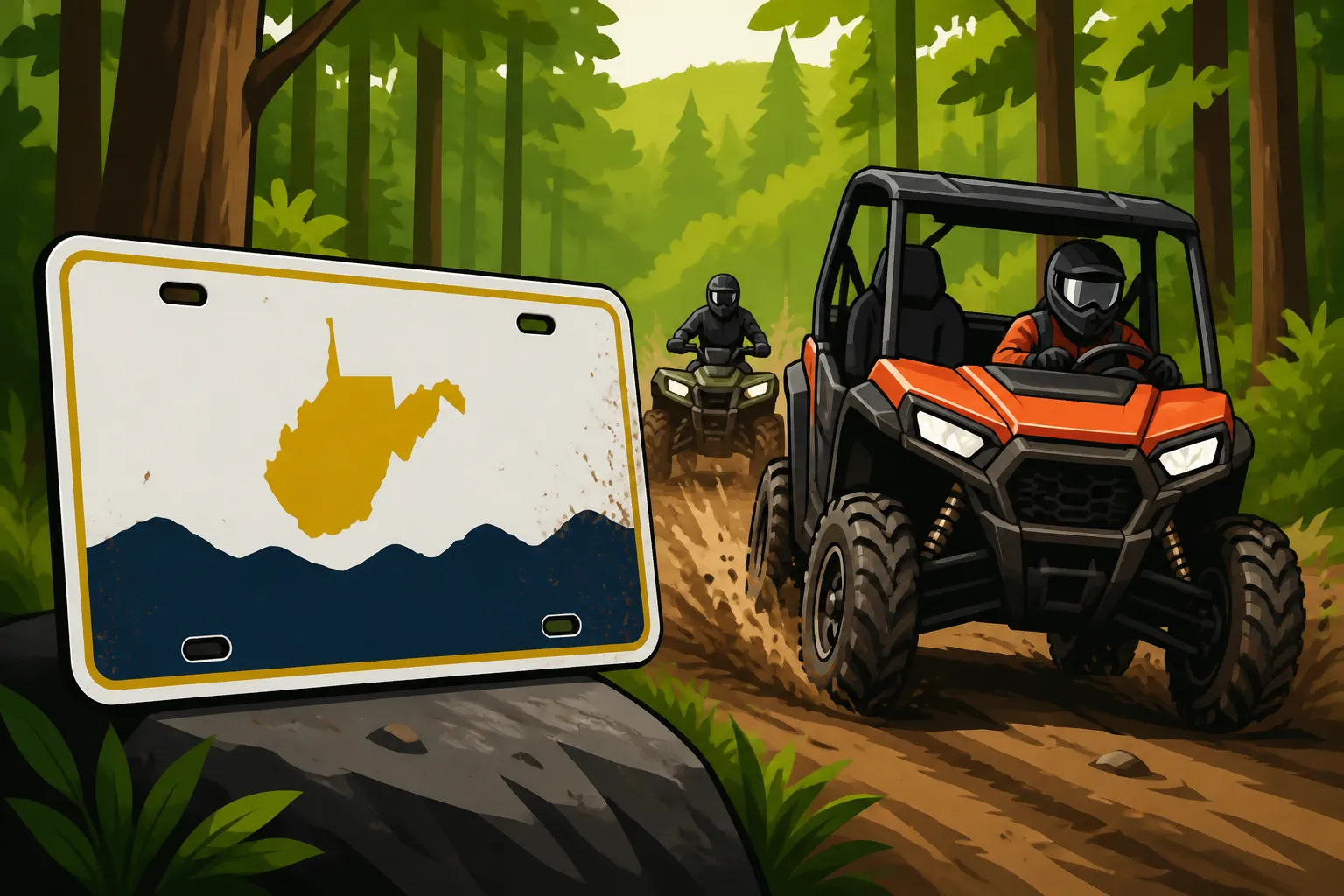
A West Virginia Plate in an Ohio Forest
A West Virginia plate may be enough to ride some Ohio trails, but it does not automatically cover every machine, trail system, or permit requirement. The key questions are whether the machine’s registration is current and recognized, where in Ohio you plan to ride, and whether that area requires a separate pass. Sort those out before loading up to avoid a trip that ends at the trailhead.
Does a West Virginia plate work on Ohio trails?
In many cases, an Ohio visitor can ride an Ohio trail with a machine properly registered in the visitor’s home state. That is the point of reciprocity: Ohio may recognize valid out-of-state registration rather than requiring a visitor to obtain Ohio registration as well. A West Virginia plate can therefore be useful proof, provided the registration is current and applies to the machine you brought.
Reciprocity is not a blanket approval for every vehicle or every place. It does not make an unregistered machine legal, replace a trail-specific pass, or give permission to ride on a closed route. The plate and registration also need to belong to the machine, and the machine must meet the rules for the area where you ride. See Ohio Reciprocity With West Virginia for the state-to-state question and Ohio Reciprocity for Out-of-State Machines for the broader rules.
Before leaving West Virginia, check that you have the registration document as well as the plate. A plate alone may not make it easy to show that the registration is valid and connected to the machine. Keep the paperwork where you can access it, and make sure the plate is mounted and visible rather than buried under a rack, cargo, or mud.
| What to check | Why it matters |
|---|---|
| Registration is current | An expired registration may not qualify for reciprocity |
| Registration matches the machine | The plate and paperwork should identify the machine being ridden |
| Machine type is covered | A registration for one category may not establish compliance for another |
| Trail system accepts out-of-state registration | Ohio state forest trails and Wayne National Forest have different requirements |
| Separate trail pass is handled | A valid state plate does not replace a required forest pass |
| Safety and access rules are met | Registration does not override age, equipment, width, hours, or route restrictions |
If West Virginia does not require registration for a particular machine or type of use, do not assume that the absence of a home-state requirement carries over to Ohio. Ohio’s rules may require a visitor permit in that situation. Check The Ohio Temporary Permit for Visitors and What a Visitor From a Registering State Must Show before traveling. The useful distinction is whether your machine is actually registered under West Virginia’s rules, not simply whether it has a plate-like marker or another document.
For visitors whose machine has a valid West Virginia registration, the practical approach is to bring both the plate and registration paperwork and verify that the Ohio riding area recognizes that registration. The current details should be confirmed with the official source for the particular trail system. That small check is especially worthwhile if the machine is homebuilt, imported, used mainly on private land, or registered in a category that does not closely match an Ohio APV.
Ohio state forests and Wayne National Forest are different
“Ohio forest trails” can mean more than one kind of riding area. Ohio state forest trails and Wayne National Forest trails have separate access rules. A West Virginia registration may satisfy the vehicle-registration part of a trip, but it does not remove the need to identify which land manager operates the trail.
Ohio’s state forest APV areas include Maumee, Perry, Pike, and Richland Furnace. For a visitor, the main point is to check that the selected forest is open to the machine and that the machine fits the area’s limits. Ohio’s state forest system has a 62-inch width limit for machines on its designated APV trails. A wide side-by-side may not qualify even if it has valid West Virginia registration. More detail is available in Ohio’s Four State Forest APV Areas and Ohio’s 62 Inch State Forest Limit.
Wayne National Forest is federal land, not one of Ohio’s state forests. Its trail access uses a separate OHV permit system. A West Virginia plate may address the state registration question, but it does not serve as the Wayne National Forest OHV pass. Riders should check How the Wayne National Forest OHV Permit Works and Which Trails a Wayne Forest Pass Opens before setting out.
| Riding area | What a West Virginia registration may address | What else to verify |
|---|---|---|
| Ohio state forest APV trails | Whether the machine has recognized out-of-state registration | Forest opening, width limit, trail rules, rider safety requirements |
| Wayne National Forest OHV trails | State registration for the machine, if accepted | Required Wayne OHV pass, permitted routes, rider and machine rules |
| Private riding park | The machine’s state registration, if requested by the park | Park admission, registration policy, age rules, equipment and site-specific restrictions |
A rider planning to visit both state forest trails and Wayne National Forest should treat them as separate destinations, even if both are part of one trip. Check the applicable permit and access rules for each. A pass for one system should not be assumed to work for another, and trail openings or seasonal closures can differ.
This distinction also helps avoid a common misunderstanding: “I have a plate” answers only part of the question. It does not show that a particular trail is open, that the machine fits a width limit, or that the rider has any required pass. Before you haul the machine, use the official trail information for the exact forest and route you intend to ride.
What to bring and check before riding
A short pre-trip check is more reliable than trying to resolve registration questions at a trailhead. Keep the proof of registration with the machine, make sure the plate is readable, and confirm any separate permit before departure.
- Check the West Virginia registration. Confirm it is current and corresponds to the machine. If the machine has changed owners or its identifying details do not match the paperwork, resolve that before traveling.
- Confirm the Ohio area’s reciprocity rules. Check the current guidance for visitors and make sure the particular registration type qualifies. Which States’ Registrations Ohio Accepts on Its Trails can help frame the question.
- Identify the land manager. Determine whether you are going to an Ohio state forest, Wayne National Forest, or a private park. Do not rely on a general map label or a nearby town name to identify who manages the trail.
- Check the machine’s fit. For Ohio state forest trails, compare the machine’s width with the applicable limit. Also check whether the route allows the machine type you plan to bring.
- Get any separate pass. For Wayne National Forest, verify how the OHV permit is obtained, who needs one, and which trails it covers. Check current requirements with the official forest information before buying or traveling.
- Review safety and rider rules. Ohio forest riding can involve helmet and eye-protection requirements, age restrictions, supervision rules, and designated operating hours. See Helmets and Eye Protection on Ohio Forest Trails and Ohio Forest Access for Riders Under 16.
- Check closures and conditions. A valid registration does not authorize riding on a temporarily closed trail. Look for current notices, seasonal schedules, and any restrictions affecting the route.
Carry the registration document in a secure, accessible place. A phone photo can be a useful backup, but do not assume it will replace the required document or be accepted in every situation. A paper copy avoids relying on cell service or a charged phone in a forest area.
Keep the machine’s identifying information consistent across the plate, registration, and any pass application. If you are borrowing or renting a machine, ask the owner or rental operator what paperwork and permits are provided, and what you are responsible for carrying. Do not assume another person’s registration or pass automatically covers you.
Common problems to avoid
Assuming the plate is the trail permit. A West Virginia plate can help establish that the machine is registered, but Wayne National Forest has its own OHV permit requirements. Check the current permit instructions separately.
Relying on an expired or mismatched registration. A plate that is physically attached to a machine does not prove that its registration is current or connected to that machine. Bring the registration document and compare its details before traveling.
Treating all Ohio forests as one system. State forest routes and Wayne National Forest routes are not interchangeable. Check the correct land manager’s rules, including what pass is required and which trails are open.
Overlooking the 62-inch limit. Registration does not make an oversized machine eligible for Ohio state forest trails with a width restriction. Measure the machine as required by the relevant rules rather than estimating from its model name.
Assuming a short visit creates an exemption. A weekend trip still has to meet the registration and permit rules that apply. If the machine is not registered in West Virginia, or you are unsure whether its registration is recognized, check whether an Ohio visitor permit is required before driving to the trail.
Confusing road permission with trail access. A valid plate does not authorize riding along a public road, crossing a road wherever convenient, or using private land without permission. Trail access and road use are separate legal questions. For a forest ride, stay on designated routes and follow posted signs.
The safest summary is straightforward: a current West Virginia registration may satisfy Ohio’s out-of-state registration requirement for an eligible machine, but it is not a universal trail pass. Confirm the rules for the exact Ohio riding area, carry proof of registration, and obtain any separate permit required by the land manager. Those checks can prevent both a wasted trip and a citation.
Disclaimer
This article is for general informational purposes only and does not constitute professional advice. Laws, prices and regulations vary by location and change over time. Consult a qualified professional for guidance on your specific situation.