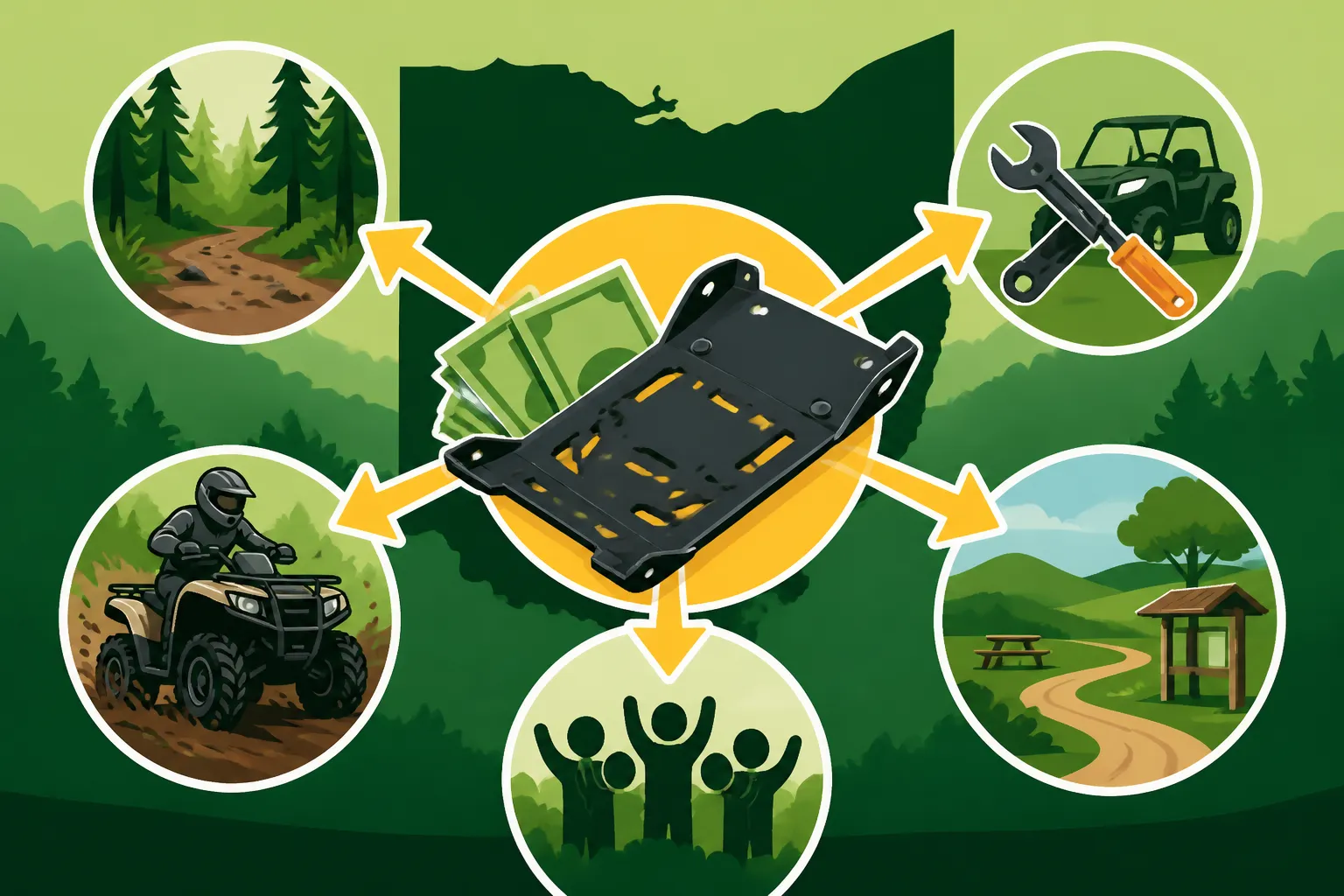
Where the Money From APV Plate Sales Goes
An APV plate fee is easy to mistake for a direct trail charge. Ohio’s rules identify where the registration money goes, but they do not assign each plate payment to a named trail or project. Here’s what the deposit means, what it does not prove, and how to distinguish it from other permits and paperwork.
Where APV plate money goes
According to the Ohio General Assembly, as of November 2026, after the Bureau of Motor Vehicles retains up to five dollars for registration costs, the remainder of the fee is deposited into the state treasury to the credit of the state recreational vehicle fund.
That gives riders a clear answer about the destination: the remaining registration money is credited to a fund designated for recreational vehicles. It does not, by itself, show how much of the fund is spent on a particular forest, trail, maintenance job, or other project. The distinction matters. A deposit to a named fund is not the same thing as a published, plate-by-plate accounting of where every dollar goes.
| Part of the registration fee | What the stated rule says | What it does not establish |
|---|---|---|
| BMV retention | The BMV may retain up to five dollars for registration costs, according to the Ohio General Assembly. | It does not state the BMV’s actual retained amount for every transaction. |
| Remaining fee | The balance is deposited into the state treasury to the credit of the state recreational vehicle fund, according to the Ohio General Assembly. | It does not identify a specific trail or project that receives a particular payment. |
| Fund spending | The money is credited to a named state fund, according to the Ohio General Assembly. | The stated rule alone does not provide a project-by-project spending breakdown. |
In practical terms, the fee has a registration-related administrative component and a remainder credited to the recreational vehicle fund. The rule does not say the whole payment goes to the fund, because the BMV can retain money for registration costs. Nor does it say the fund’s balance is divided evenly among riders or locations.
It is also worth separating two different questions: where the money is credited, and what the fund ultimately pays for. The first is answered by the deposit rule. To understand specific uses or allocations, riders need information about the fund’s spending, not just the registration rule. For a companion explanation of the funding question, see What the State Recreational Vehicle Fund Pays For and Where Ohio Registration Money Is Spent.
What that funding connection does and does not mean for trails
Ohio has designated state forest areas for certain off-highway vehicles, but the existence of those riding areas does not prove that a particular registration payment funded a particular trail. The Ohio Department of Natural Resources identifies Maumee, Richland Furnace, Pike, and Perry State Forests as having trails accessible to specific off-highway vehicles. That establishes where eligible riding opportunities exist, not how much money any one location receives.
The Ohio Division of Forestry says vehicles in state forest areas require a State Recreational Vehicle Registration with the BMV. That makes registration a requirement for access to those areas, but it is still important not to collapse registration, trail access, and spending into one claim. A rider can reasonably say that the required registration contributes money to a fund with a recreational-vehicle purpose. Without a project-level allocation, the rider cannot responsibly claim that a particular plate payment built a bridge, repaired a section of trail, or paid for a specific facility.
The distinction is useful when evaluating claims about the value of registration. “The money is credited to a state recreational vehicle fund” describes the accounting destination. “This specific trail was paid for by APV plates” is a much narrower claim and needs separate evidence.
State forest access also comes with its own operating rules. The Ohio Department of Natural Resources sets a maximum vehicle width of 62 inches for permitted APVs on designated state forest trails. It also says those areas are open for riding during daylight hours from one-half hour before sunrise until one-half hour after sunset. These details help explain what riders are paying into a system that supports recreational vehicle use, but they are operating rules, not a breakdown of fund expenditures.
The rules vary by location and season. The Ohio Department of Natural Resources says APV areas and trails at Pike, Perry, and Richland Furnace State Forests close annually during the winter season, while Maumee State Forest’s APV area remains open during winter to allow for snowmobile use. The agency also says state forest APV areas remain open during regular deer gun season to provide access for people with disabilities. Before planning a ride, check current access conditions and the rules for the specific area. Ohio’s Four State Forest APV Areas offers related information about those riding locations.
A plate fee should not be treated as a guarantee that every designated trail is open whenever a rider wants to use it. Seasonal closures, vehicle eligibility, and local operating rules still apply. For a broader explanation of how registration relates to state forest access, see Why the Ohio Plate Is the Trail Permit and Do You Need a Permit for Ohio State Forest Trails?.
Keep registration, title fees, and other permits separate
The phrase “APV plate sales” can make it sound as if every amount paid during a vehicle transaction is part of the same fund deposit. It is better to identify the charge before drawing that conclusion. Registration, titling, and other permits serve different purposes, and the stated deposit rule concerns the remainder of the registration fee after the BMV’s permitted retention.
Under Ohio law, all-purpose vehicles and off-highway motorcycles are classified as motor vehicles and must be titled, according to the Ohio BMV. The Ohio BMV says titling an APV requires completing form BMV 3722 at the county title office. Those title steps are related to owning and documenting the vehicle, but the registration-fund rule should not be read as a statement about where title charges go. For the registration steps and documents, see Ohio APV Registration Paperwork. For the distinction between registration and title costs, see Ohio APV Registration Cost.
Snowmobiles are a useful comparison because their classification differs. The Ohio BMV says snowmobiles are not considered motor vehicles and do not require titles. That does not mean snowmobile rules and APV rules are interchangeable; it shows why riders should check which vehicle category applies before assuming that one fee or requirement covers another.
A visitor may also encounter a permit that is not the same thing as an Ohio APV registration. The Ohio Department of Natural Resources says out-of-state riders from states without reciprocity must obtain an annual Temporary Operating Permit from the BMV. That requirement concerns a visitor’s operating authorization. It should not be described as the same payment as the standard Ohio plate registration or as a direct measure of how much of an Ohio resident’s plate fee goes into the state recreational vehicle fund. For visitor questions, see Ohio Reciprocity for Out-of-State Machines.
There is another separate permit context on wildlife lands. The Ohio Division of Wildlife identifies 15 designated APV access areas statewide that it manages. The agency says All Purpose Vehicle Use Permit holders are exempt from the firearm discharge prohibition on designated access roads, and qualified APV permit holders can also hunt from their APV on private property. These permit rules address access and hunting circumstances; they do not change the stated destination of the BMV registration fee.
Keeping these categories separate prevents a common misunderstanding: paying for one registration or permit does not necessarily satisfy every access, title, or operating requirement. Before a trip, verify which documentation applies to the vehicle, the land, and the rider’s home state. The overview in Ohio APV Permits Explained can help sort out the different permit questions.
How to check what a fee covers
When reviewing a charge or a claim about APV funding, start with the name of the payment. A registration fee, a title charge, and a temporary operating permit are not automatically interchangeable. Then look for a statement that explains the amount’s destination or purpose. In this case, the Ohio General Assembly’s rule says the BMV may retain up to five dollars for registration costs and that the remainder is credited to the state recreational vehicle fund.
A practical way to assess a funding claim is to ask:
- Is the payment a registration fee, title charge, or separate permit?
- Does the rule describe the money’s destination, or does it identify a specific project?
- Is the claim about the fund as a whole, or about a particular forest or trail?
- Does the information explain the BMV’s retained portion as well as the balance?
- Are access and operating rules being confused with the question of how funds are spent?
These questions help avoid overstating what the deposit rule proves. The fund credit supports the statement that registration revenue is assigned to a recreational-vehicle fund. It does not establish an exact spending amount for an individual rider’s plate, nor does it name a trail project that received that rider’s payment.
For riders, the useful takeaway is straightforward: an APV registration is more than a plate to display where required, but the public funding claim should remain precise. Say that the balance after the BMV’s allowed registration-cost retention is credited to the state recreational vehicle fund. Do not assume, without a separate allocation record, that a specific part of the payment went to the forest or trail you plan to ride.
Before paying or renewing, confirm the current registration requirements and identify each line item. If your main question is the registration amount itself, Ohio APV Registration Cost covers that separate issue. If the question is what documents to bring or where to complete the process, consult Ohio APV Registration Paperwork. This keeps the discussion about funding grounded in what the rule actually says, while leaving room to check separate information about fund expenditures and trail improvements.
Sources
- Ohio BMV — Ohio BMV (checked November 3, 2026)
- Ohio Department of Natural Resources — APV Trails in State Forests (checked November 3, 2026)
- Ohio Division of Wildlife — APV Riding (checked November 3, 2026)
Disclaimer
This article is for general informational purposes only and does not constitute professional advice. Laws, prices and regulations vary by location and change over time. Consult a qualified professional for guidance on your specific situation.