Ohio Rules for Riding Off the Trail
Riding beyond a marked route can look harmless when a shortcut or old track is easy to follow, but in Ohio it can turn a legal trail ride into a violation. The key is to know who manages the land, which routes are open, and what to do when a trail is blocked. Here’s how to stay on the right side of the rules.
What “off the trail” means in Ohio
For an ATV or UTV rider, “off the trail” generally means leaving a route the land manager has opened for motorized riding. That includes cutting across vegetation, riding around a closed gate, following an unmarked track, or making a new route through the woods. A visible path is not automatically an authorized trail.
The rule depends on where you are riding. State forests, national forests, wildlife areas, parks, and private land may have different managers and rules. The important point is that permission to ride somewhere does not automatically mean permission to ride anywhere on that property. On public riding areas, the designated route is the route to follow.
| Situation | Safer assumption | What to do |
|---|---|---|
| A marked trail continues ahead | It is the intended route, unless a closure notice says otherwise | Stay on it and follow posted signs |
| A faint track branches off | It may be unauthorized or closed | Do not follow it unless the manager confirms it is open |
| A fallen tree blocks the route | Going around it may take you off the authorized trail | Stop, turn back if possible, and report the obstruction |
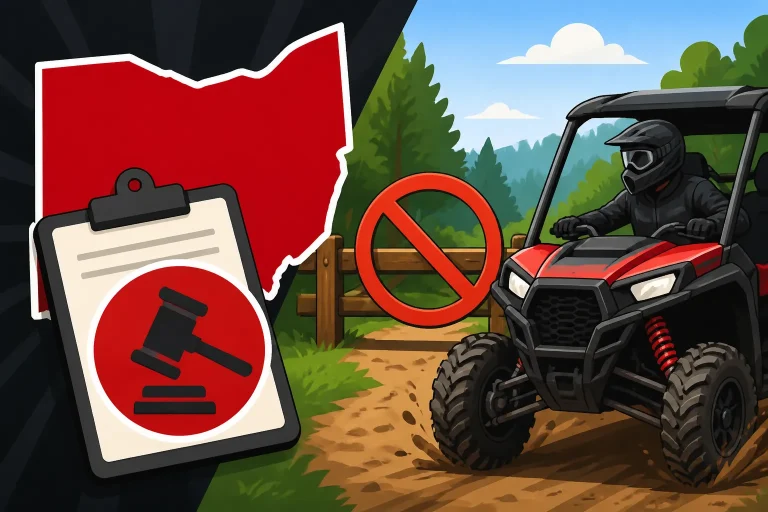
| A gate or closure sign blocks the way | The route is closed, even if tracks pass around it | Do not bypass the barrier |
| A private road or field looks rideable | Appearance does not establish permission | Get the landowner’s permission and check applicable restrictions |
| A trail is muddy or damaged | Riding around the bad section can widen the impact and create a new route | Turn around or use a route the manager identifies as open |
On designated public riding trails, “off trail” is not limited to going deep into the woods. A short detour around a puddle, a fallen branch, or a narrow spot can still leave the permitted route. The impact may be small, but the rider has still chosen a path that may not be authorized.
For a closer look at the basic rule, see Ohio Rules for Riding Off a Marked Trail. Rules can differ between land types, so also check Ohio Rules for Riding State Forest Land or Ohio Rules for Riding a National Forest when planning a ride on those properties.
Why public trails are limited to marked routes
A public riding area is not necessarily open for riding across all of its land. The manager may designate a network of roads and trails and keep surrounding ground closed to motorized vehicles. Routes can be limited to protect soil, water, wildlife habitat, other visitors, and nearby private property.
A trail may also pass near areas that are not open to riding. A clearing, old haul road, utility track, or worn path can look like a continuation of the trail without being part of the authorized network. Do not use tire marks as proof that a route is open. Someone may have ridden there unlawfully, or the route may have been closed since the tracks were made.
Closures and boundaries can change. A route shown on a map may be temporarily closed because of maintenance, weather, timber work, or another land-management need. Before loading up, check current information from the property manager and pay attention to signs at the trailhead and along the route. Ohio Trail Closures to Check First and Ohio Trail Maps From ODNR can help with planning, but signs and current notices matter when you arrive.
A trail that is difficult is not a reason to make a new one
Wet ground, erosion, steep slopes, and standing water can tempt riders to detour. But riding beside a trail can crush vegetation, widen the disturbed area, and create ruts that carry water and sediment. A shortcut can also lead into a sensitive area or across a boundary that is not obvious from the seat of a machine.
The practical response is to stop before leaving the trail. If the route is passable without creating a dangerous situation, proceed carefully as the manager’s rules allow. If it is blocked or unsafe, turn back to a known open route or contact the land manager. Do not assume that a detour is allowed simply because other riders have made one.
A closed gate deserves the same caution. Riding around it, lifting it, or using a gap beside it can defeat the closure and may put a rider into an area that is closed for a specific reason. If a closure notice is unclear, do not test it by continuing. Ask the responsible office or ranger district.
Do not create a route around a closure
A closure can apply to one trail segment rather than the entire riding area. That does not make the blocked section optional. Follow any posted detour or return the way you came. If there is no approved detour, stop and get reliable direction rather than improvising across the woods.
If you encounter an obstruction, note the nearest trail marker or other location detail. A phone map, GPS unit, or a paper map kept in a protective holder can make it easier to describe where the problem is. For gear, an offline map device or a handlebar map holder available through Amazon may help keep navigation information accessible, but it cannot tell you that an unmarked route is legally open.
Private land, old roads, and other tempting routes
Private property calls for a separate check. A visible two-track, farm lane, or old mining road does not mean the owner has invited ATV or UTV traffic. Get clear permission from the landowner before riding there, and confirm what the permission covers: the specific route, the dates, the machines allowed, and whether passengers or a group may come along.
Permission to cross one part of a property is not necessarily permission to explore the rest. Stay within the route the owner approved, respect gates and posted boundaries, and do not assume permission transfers to another rider. See Ohio Rules for Riding Private Property and Ohio Landowner Permission Requirements for more on the permission question.
Even when a landowner says yes, other restrictions may still matter. A protected area, a public-road rule, a local restriction, or a land-use condition may limit what is allowed. Ask the landowner where the approved route begins and ends, and check whether any public-land or road rules apply. If you are unsure whether the ground is private or public, do not ride across it while trying to find out.
Old industrial and mining tracks can be especially misleading. Some are private, some may be part of a managed riding area, and others may be unsafe or closed. A route’s appearance, age, or lack of a gate does not establish the right to ride it. For more background, see Riding a Reclaimed Strip Mine Road.
Wildlife areas and parks also should not be treated as open riding land by default. A road that is open to regular vehicles or used by maintenance staff may not be open to ATVs or UTVs. Look for rules from the specific property manager and follow posted restrictions. If the property does not clearly identify a motorized route, ask before riding.
A useful rule is to identify the land manager before the ride, not after reaching a confusing junction. Different adjoining properties can have different boundaries and rules. A trail may be open on one side of a boundary and closed on the other.
What to do when the route is unclear
When you reach an unmarked branch, a damaged section, or a confusing boundary, pause rather than guessing. A few minutes spent checking the map or calling the property office can prevent a much bigger problem.
- Stop on the authorized route. Avoid riding farther into the unknown area while trying to figure out where you are.
- Check signs and trail markers. Look for closure notices, route numbers, arrows, or boundary signs. Do not treat missing signs as permission to explore.
- Compare your location with a current map. Use the map supplied by the land manager when available. A phone map can help with orientation, but a generic map may show roads and tracks that are not open to off-road riding.
- Turn back if you cannot confirm the route. Returning to a known trail is usually safer than following an uncertain spur.
- Contact the responsible manager. Give the trail name or number and the nearest marker, intersection, or trailhead. Ask whether the route is open and whether an approved detour exists.
- Report damage or a blockage. A brief report can help the manager address a fallen tree, missing marker, or damaged section before other riders encounter it.
If a machine becomes stuck or breaks down, focus first on rider safety. Do not use the emergency as a reason to drive through a closed area or create a new route if another safe option exists. Contact the land manager or emergency services when appropriate, and explain your location as clearly as you can.
Riders should also remember that their plate or registration does not grant access to every piece of public land. It does not turn an unmarked track into an open trail, and it does not override a closure. A registration requirement and a land manager’s route rules are separate things.
If an officer or land manager asks about your route, stay calm and explain where you entered and which signs or maps you relied on. The details of any violation depend on the location and circumstances; avoid assuming that a short detour will be treated as harmless. What a State Forest Officer Can Cite You For covers the kinds of issues a rider may encounter on state forest land, while Ohio Trespass Law and Off-Road Riders is useful when the boundary or landowner’s permission is in question.
A practical pre-ride check
A good way to avoid accidental off-trail riding is to plan for the points where uncertainty is most likely: junctions, property boundaries, washouts, and trail closures. Before leaving home, identify the manager and check the current route information. At the trailhead, read the posted rules and note any closures. During the ride, stay on marked routes and turn back when the legal path is unclear.
Before you unload, confirm:
- The riding area is open to your type of machine.
- The route is open on the day you plan to ride.
- Your machine meets the property’s applicable requirements.
- You have the manager’s current map or route information.
- You have permission for any private land you plan to cross.
- You know how to contact the property manager if a route is blocked.
If a track looks inviting but does not appear on the authorized route map, treat it as closed until the manager confirms otherwise. That simple habit protects access for other riders and reduces the chance of damaging land or crossing onto property without permission.
Disclaimer
This article is for general informational purposes only and does not constitute professional advice. Laws, prices and regulations vary by location and change over time. Consult a qualified professional for guidance on your specific situation.