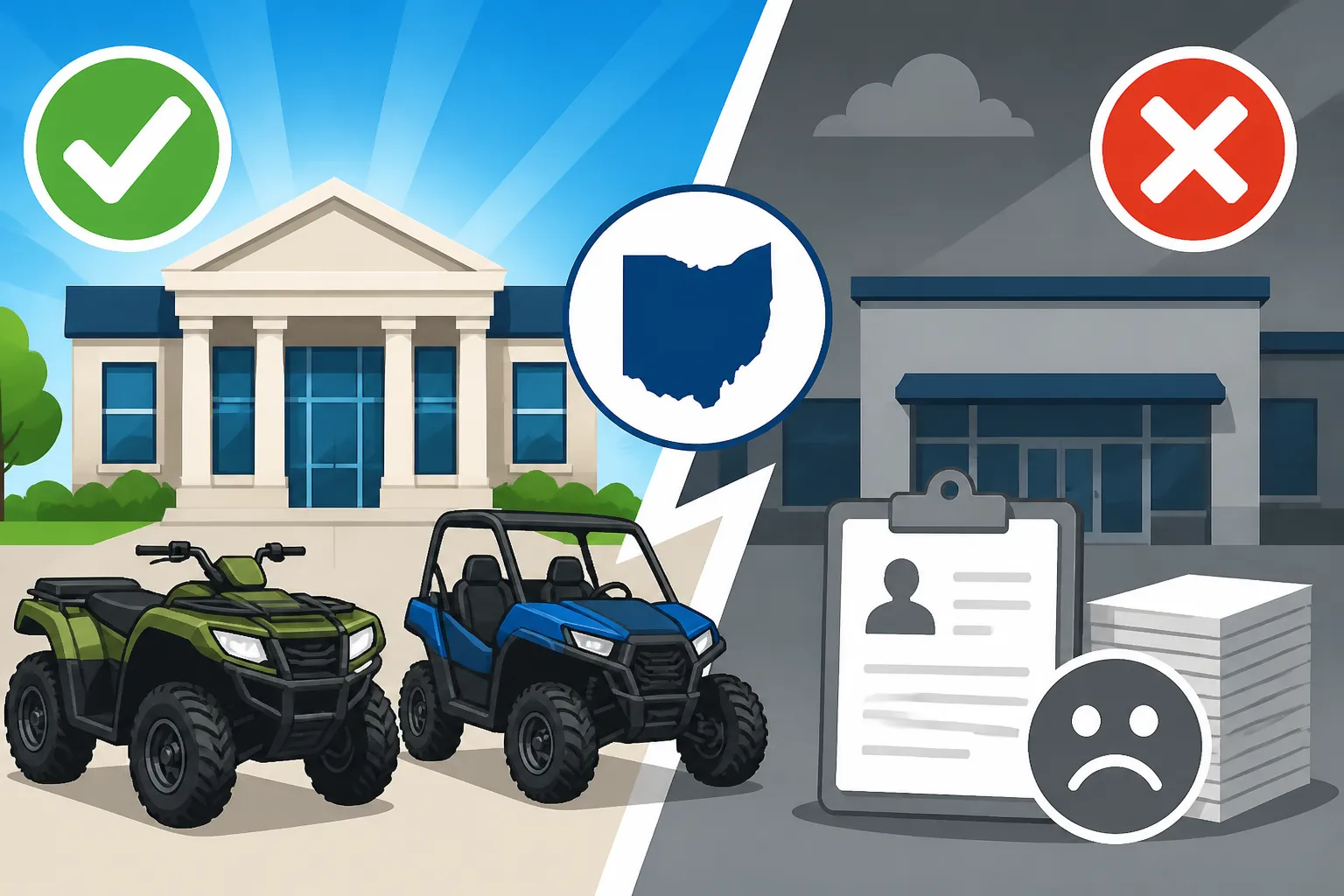
Why a County Title Office and Not the BMV
It's incredibly common for folks new to the world of off-road vehicles in Ohio to feel a bit lost when it comes to paperwork. You get your shiny new (or new-to-you) all-purpose vehicle – maybe a quad, a side-by-side, or even a dirt bike that fits Ohio's APV definition – and your first thought is probably, "Time to head to the BMV!" But then you find yourself staring at an unfamiliar process, realizing that the Department of Motor Vehicles isn't actually where you'll get your title. This guide is here to clear up that confusion, explaining exactly why your Ohio APV title comes from a county title office, run by the Clerk of Courts, and not the Ohio Bureau of Motor Vehicles.
Understanding Ohio's APV Titling Landscape
The distinction between where you title your all-purpose vehicle (APV) and where you register it can be a real head-scratcher for many riders in Ohio. It seems intuitive to think that all things related to vehicles, from titles to plates, would come from one central state agency. However, Ohio operates with a system that has distinct responsibilities for different government offices, and understanding this separation is key to a smooth process for your APV.
The Distinct Roles of the BMV and Clerk of Courts
In Ohio, the Bureau of Motor Vehicles (BMV) is primarily responsible for vehicle registration and issuing license plates and driver's licenses. Think of them as the gatekeepers for allowing vehicles onto public roads (where permitted) and for identifying vehicles for annual fees. They're where you go to get your APV plate and validation sticker, and where you renew it every three years.
However, when it comes to establishing legal ownership of a vehicle – that crucial piece of paper that says you are the owner – that falls under the jurisdiction of the County Clerk of Courts Title Office. This isn't just for APVs; it's the same for cars, trucks, motorcycles, and boats. The Clerk of Courts is the official custodian of all vehicle titles in their respective county, ensuring that transfers of ownership are properly recorded and that a clear chain of title is maintained. This separation ensures checks and balances, creating a more robust system for verifying vehicle ownership and preventing fraud.
Why APVs Have a Separate Process
The reason APVs follow this bifurcated path isn't unique to them; it's the standard operating procedure for almost all motorized vehicles in Ohio that require a title. The state treats your APV, whether it's a quad, side-by-side, or dirt bike, as a titled property much like a car. Because of this, the process for establishing initial ownership and transferring that ownership mirrors what you'd do for a road-going vehicle. The BMV focuses on the "permission to operate" aspect, while the Clerk of Courts focuses on the "who owns it" aspect.
This system might feel like an extra step, but it’s designed to provide a clear, indisputable record of who legally owns the machine. This is vital for everything from insurance claims to deterring theft, and it creates a uniform process that applies across various vehicle types. You can learn more about [Titling an APV at an Ohio Clerk of Courts].
The Legal Framework Behind the Separation
Ohio Revised Code (ORC) is the backbone of these regulations, clearly defining the responsibilities of various state and county entities. While the BMV is defined by statutes relating to vehicle registration, driver licensing, and motor vehicle laws, the Clerk of Courts' role in titling is specifically outlined in other sections of the ORC. These statutes empower the Clerk of Courts in each county to issue and transfer certificates of title for all types of vehicles, including APVs.
This division of labor isn't arbitrary; it's a reflection of historical legislative decisions aimed at creating a robust system for property ownership and vehicle use. Understanding that these are two distinct, statutorily defined functions will save you a lot of frustration and wasted trips. The process is a bit like buying a house: you get your deed (title) from one government office (recorder's office, analogous to Clerk of Courts), but you pay your property taxes (registration fees, analogous to BMV) to another.
Your Journey to Titling an APV in Ohio
Navigating the paperwork for your APV can feel a bit like a treasure hunt, but once you know where to go and what to bring, it's actually quite straightforward. The key is understanding the sequence of events and having your ducks in a row before you head out. This isn't a process you want to rush, as missing a single document can send you right back home.
Where to Start: The County Title Office
Your first stop for establishing legal ownership of your APV is your local County Clerk of Courts Title Office. This is not a Deputy Registrar agency, which often shares a building or storefront with BMV services. The title office is a separate entity, typically located within the county courthouse or in a dedicated title office building. Each of Ohio's 88 counties has one, and you'll want to go to the one in the county where you reside.
These offices are staffed by knowledgeable professionals whose sole job is to process vehicle titles. They understand the nuances of new titles, transfers, liens, and all the intricacies that come with legal ownership. They are the experts in verifying your proof of purchase and issuing that all-important piece of paper that declares you the legal owner of your APV. Knowing [Where to Title an APV in Ohio] is the crucial first step.
What to Bring: Essential Documents for Titling
To title your APV, you'll need to gather specific documents. The exact requirements can vary slightly depending on whether your APV is new or used, but here's a general checklist of what you'll typically need to present at the Clerk of Courts Title Office:
- Proof of Ownership:
- New APV: This will be the Manufacturer's Certificate of Origin (MCO) or Manufacturer's Statement of Origin (MSO). This document is crucial as it establishes the APV's origin and has never been previously titled.
- Used APV: You'll need the original Ohio Certificate of Title, signed over to you by the previous owner, or an out-of-state title that is properly assigned. If the previous owner never titled it in Ohio, things can get a bit more complicated, sometimes requiring additional steps to establish a clear chain of ownership. You should always insist on getting the title when you buy a used machine.
- Proof of Purchase Price: This is often documented on the MCO/MSO or the assigned title, but a separate bill of sale is always a good idea, especially for used vehicles. This is where resources like LawDepot can be incredibly helpful for creating a clear and legally sound [An Ohio Bill of Sale for an APV].
- Identification: A valid driver's license or state ID.
- Social Security Number: You'll need to provide this for the titling application.
- Ohio Form BMV 3722: This is the Application for Certificate of Title. While you can usually get this form at the title office, filling it out beforehand can save you time. Understanding [Ohio Form BMV 3722 Explained] can help streamline your visit.
- Payment for Fees: Be prepared to pay the title fee and any other associated costs. For more information on the fees, check out [Ohio APV Title Cost].
The Titling Process: A Step-by-Step Walkthrough
Once you have all your documents ready, the process itself is fairly straightforward:
- Visit the Title Office: Head to your county's Clerk of Courts Title Office during business hours. It's often a good idea to call ahead or check their website for specific hours and any potential requirements for appointments.
- Submit Documents: Present your MCO/MSO or the properly assigned previous title, along with your proof of purchase, ID, and the completed Ohio Form BMV 3722.
- Review and Verification: The title clerk will review all your documents to ensure everything is correct and properly filled out. They will verify signatures, check for liens, and confirm the vehicle information.
- Pay Fees: You will pay the required titling fee. Remember, the title office handles the title fee, not the registration fee.
- Receive Your Title: Once processed, you'll typically receive your new Ohio Certificate of Title on the spot. It's a paper title, and it's your official proof of ownership. Keep it in a safe place, not in the APV itself.
This process legally establishes you as the owner. Only after you have your title can you proceed to the next step: registering your APV with the BMV to get your plate and sticker, which is necessary for legal riding on designated trails and roads where permitted.
The Costs Involved in Titling Your APV
Dealing with vehicle paperwork almost always involves some fees, and titling your APV in Ohio is no exception. It's helpful to understand what you're paying for and why, so there are no surprises when you're standing at the counter. These fees contribute to the administration of the titling system and, indirectly, to other state services.
Ohio APV Title Cost Breakdown
The primary cost you'll encounter at the Clerk of Courts Title Office is the title fee itself. This is a standard fee set by the state for issuing a new certificate of title or transferring an existing one. While I can't provide current figures, it's a fixed amount that applies across all vehicle types, including your APV. It's a one-time charge per title issuance.
This fee covers the administrative costs associated with recording your ownership, maintaining the statewide title database, and printing the physical title document. It's a fundamental part of the legal process of establishing and transferring vehicle ownership in Ohio. To find the current figure, you should always check with your local County Clerk of Courts Title Office or the Ohio BMV website. Don't forget to ask [What an Ohio APV Title Costs] when you call.
Understanding the "Deputy Registrar Fee" Connection
Now, here's where some of the confusion between the BMV and the Clerk of Courts can arise regarding fees. While the Clerk of Courts Title Office is where you get your title, you might notice a "Deputy Registrar Fee" if you also go to register your APV at a Deputy Registrar location (which is where you get your plates). The Deputy Registrar locations are agents of the BMV, and they often collect a small service fee for their efforts in processing registrations, plate renewals, and sometimes even temporary tags.
It's important to understand that you pay the title fee at the Clerk of Courts Title Office and then, separately, you will pay the registration fee and any associated Deputy Registrar service fee when you go to a Deputy Registrar location to get your APV plate. These are two distinct transactions at two distinct types of offices, even though they are both essential steps for your APV. The [Ohio's $3.50 Deputy Registrar Fee] is specifically for registration services, not for the title itself.
Potential Additional Fees
Beyond the standard title fee, there might be a few other costs to be aware of, depending on your specific situation:
- Lien Notation Fee: If you financed your APV, the lienholder (the bank or credit union) will need to be noted on the title. There's typically a small fee for recording this lien. This ensures that the lienholder's interest in the vehicle is legally recognized.
- Duplicate Title Fee: If you ever lose your original title and need a replacement, there will be a fee to issue a duplicate. This is why it's so important to keep your original title in a safe, secure place.
- Sales Tax: While not a fee paid to the title office directly as part of the titling process, sales tax on your APV purchase is usually paid at the time of titling or registration, depending on whether you bought from a dealer or a private party. If you purchased from a private seller, you will likely pay the sales tax at the title office when you apply for your title. If you bought from a licensed dealer, they typically collect the sales tax at the point of sale. You can delve into [Ohio APV Registration and Sales Tax] for more information.
Being prepared for these potential costs will ensure your titling experience is as smooth as possible, without any unexpected financial hiccups.
Common Pitfalls and How to Avoid Them
Even with all the right information, it's easy to make a wrong turn in the APV titling process, especially if you're not familiar with Ohio's specific system. Understanding the common mistakes others make can help you steer clear of unnecessary delays and frustration.
The Mistake of Going Straight to the BMV
One of the most frequent errors people make is assuming the Ohio Bureau of Motor Vehicles (BMV) handles everything for vehicles, including titling. It's a natural assumption, as the BMV is the state agency most commonly associated with cars and driving. However, as we've discussed, the BMV's role for APVs is limited to registration and issuing plates.
If you walk into a Deputy Registrar agency (which often has BMV signage) asking to title your APV, they will almost certainly direct you to the County Clerk of Courts Title Office. This can be a frustrating and time-consuming detour, especially if you've already driven a distance or taken time off work. To avoid this, always remember: for titling your APV, go to the Clerk of Courts Title Office. For registration and your physical plate, that's when you visit a Deputy Registrar. This distinction is paramount to navigating the process correctly. You can even read Why a County Title Office and Not the BMV for a deeper dive.
Issues with Proof of Ownership
Another common stumbling block is insufficient or incorrect proof of ownership. This is particularly prevalent when buying a used APV from a private seller. People might accept a handwritten bill of sale, a receipt, or a title that hasn't been properly assigned (i.e., the seller hasn't signed it over correctly).
The Clerk of Courts Title Office requires clear, undeniable proof that you are the legal successor in ownership. For a new APV, this means a pristine Manufacturer's Certificate of Origin (MCO). For a used APV, it means the original, physical title, signed over by the previous owner exactly as their name appears on the title, with the odometer reading (if applicable) and sale price filled in. If the title has any alterations, erasures, or is missing crucial information, the title office may reject it, requiring you to go back to the seller to correct the issue or, in some cases, pursue a more complex and costly process to establish ownership. Always ensure you have the correct and properly completed paperwork.
Buying a Used APV: Title Transfer Challenges
Buying a used APV can present its own set of challenges regarding the title transfer. Beyond simply having the properly signed title, you might encounter situations such as:
- Lost Title: The seller might claim they lost the title. In Ohio, the seller is responsible for obtaining a duplicate title before they can legally transfer ownership to you. Do not buy an APV if the seller does not have the title in hand, or is unwilling to get a duplicate. This could lead to significant headaches for you down the line.
- Open Titles: An "open title" is one that has been signed by the previous owner but with the buyer's name left blank. While this might seem convenient for some, it's actually illegal and can lead to problems with the chain of ownership and potential legal liabilities. The title office will likely reject an open title.
- Lien on Title: Before buying any used APV, it's crucial to [Checking a VIN Before an Ohio Purchase] to see if there are any outstanding liens on the title. If there's a lien, the seller must satisfy that lien (pay off their loan) before they can legally transfer a clear title to you. The title office will not transfer ownership if there's an active lien unless the lienholder provides a release.
To mitigate these risks when purchasing a used machine, always meet the seller at the Clerk of Courts Title Office to complete the transfer in person. This way, you can ensure the title is properly assigned and transferred directly into your name, and any issues can be resolved on the spot. This is especially important when [Buying a Used APV in Ohio].
Beyond Titling: Your Next Steps
Once you've successfully navigated the titling process and have that shiny new Ohio Certificate of Title in your hand, you're not quite done. Titling is the crucial first step, but there are other important considerations to ensure your APV is legal, safe, and ready for adventure.
Registering Your APV After Titling
Having your title proves ownership, but it doesn't give you permission to ride on public lands or designated trails that require registration. That's where the Ohio Bureau of Motor Vehicles (BMV) and its network of Deputy Registrar agencies come in. After you have your title from the Clerk of Courts, your next step is to head to any Deputy Registrar office to [Registering an APV in Ohio].
At the Deputy Registrar, you'll need to present your new title and proof of identification. You'll fill out an application for registration, pay the required registration fee (which covers a three-year cycle in Ohio), and any Deputy Registrar service fees. In return, you'll receive your APV license plate and a validation sticker. This plate must be displayed prominently on your APV, typically on the rear, to show that it is legally registered. This plate also serves as your trail permit for Ohio's state forests, which is a great bonus!
Keeping Your Title Safe and Accessible
Your Ohio Certificate of Title is one of the most important documents you own for your APV. It's the ultimate proof of legal ownership, and without it, selling your machine or proving ownership after theft can become incredibly difficult. Therefore, it's absolutely crucial to keep it in a safe, secure place.
Do not carry your original title on your APV. If you lose it on the trail, or if your machine is stolen with the title on it, you're looking at a bureaucratic nightmare. Instead, keep it in a secure location at home, like a fireproof safe, a secure filing cabinet, or a safe deposit box. Some people prefer to keep a photocopy or a clear photograph of their title on their phone or with their registration paperwork, just for reference, but the original should always be stored securely.
The Importance of a Bill of Sale
While the title is the ultimate proof of ownership, a comprehensive bill of sale is an incredibly valuable document, especially when buying or selling a used APV. It provides detailed information about the transaction, protecting both the buyer and the seller. A good bill of sale should include:
- The full names and addresses of both the buyer and the seller.
- The date of the sale.
- A detailed description of the APV, including make, model, year, and crucially, the Vehicle Identification Number (VIN).
- The agreed-upon purchase price.
- A statement that the vehicle is sold "as-is" (if applicable), which is common for private sales.
- Signatures of both parties.
Having a clear [An Ohio Bill of Sale for an APV] helps to avoid disputes about the sale price, condition of the machine, or transfer date. It also provides an additional layer of documentation for tax purposes and can be critical if there's any discrepancy with the title information. Resources like LawDepot can provide customizable bill of sale templates that ensure you include all the necessary legal language, giving you peace of mind whether you're the buyer or the seller. For folks who are [Selling an APV in Ohio], a robust bill of sale is a must-have. You might also consider using LawDepot for other legal forms, like power of attorney, if you need someone else to handle the title transfer on your behalf.
Here's a quick reference table to help clarify the roles:
| Task | Responsible Office | Primary Function | What You Get |
|---|---|---|---|
| Titling an APV | County Clerk of Courts Title Office | Establishes legal ownership and records transfers | Ohio Certificate of Title |
| Registering an APV | Ohio BMV (Deputy Registrar) | Grants permission to operate; collects fees | APV License Plate & Validation Sticker |
| Issuing Driver's Licenses | Ohio BMV (Deputy Registrar) | Authorizes individuals to operate vehicles | Driver's License or State ID |
| Processing Liens on Titles | County Clerk of Courts Title Office | Records financial interests on titled property | Lien notation on Title |
| Renewing APV Registration | Ohio BMV (Deputy Registrar) | Extends operating permission | New Validation Sticker for your existing plate |
| Providing Legal Bill of Sale Forms | Third-party services (e.g., LawDepot) | Creates legally sound purchase/sale agreements | Customizable Bill of Sale document |
This overview should help you confidently navigate the process, ensuring your Ohio APV is properly titled and registered, ready for whatever adventures await you on the trails!
Disclaimer
This article is for general informational purposes only and does not constitute professional advice. Laws, prices and regulations vary by location and change over time. Consult a qualified professional for guidance on your specific situation.