Ohio Rules for Riding a Utility Corridor
We all know that feeling, right? You're cruising down a county road, maybe heading to a favorite trail, and you spot it: a long, straight, cleared path cutting through the woods or fields, seemingly just begging to be ridden. It looks like a perfect, untamed trail, a shortcut, or even a new adventure waiting to happen. For many Ohio ATV and UTV enthusiasts, these utility corridors — whether they host power lines, pipelines, or other infrastructure — can look like an open invitation. But here’s the harsh reality: what looks like a trail is very rarely legal to ride. This guide is here to untangle the complexities of riding on utility corridors in Ohio, explaining the legalities, the risks, and the only proper way to potentially gain access.
The Allure of the Utility Corridor: Why Riders See Opportunity
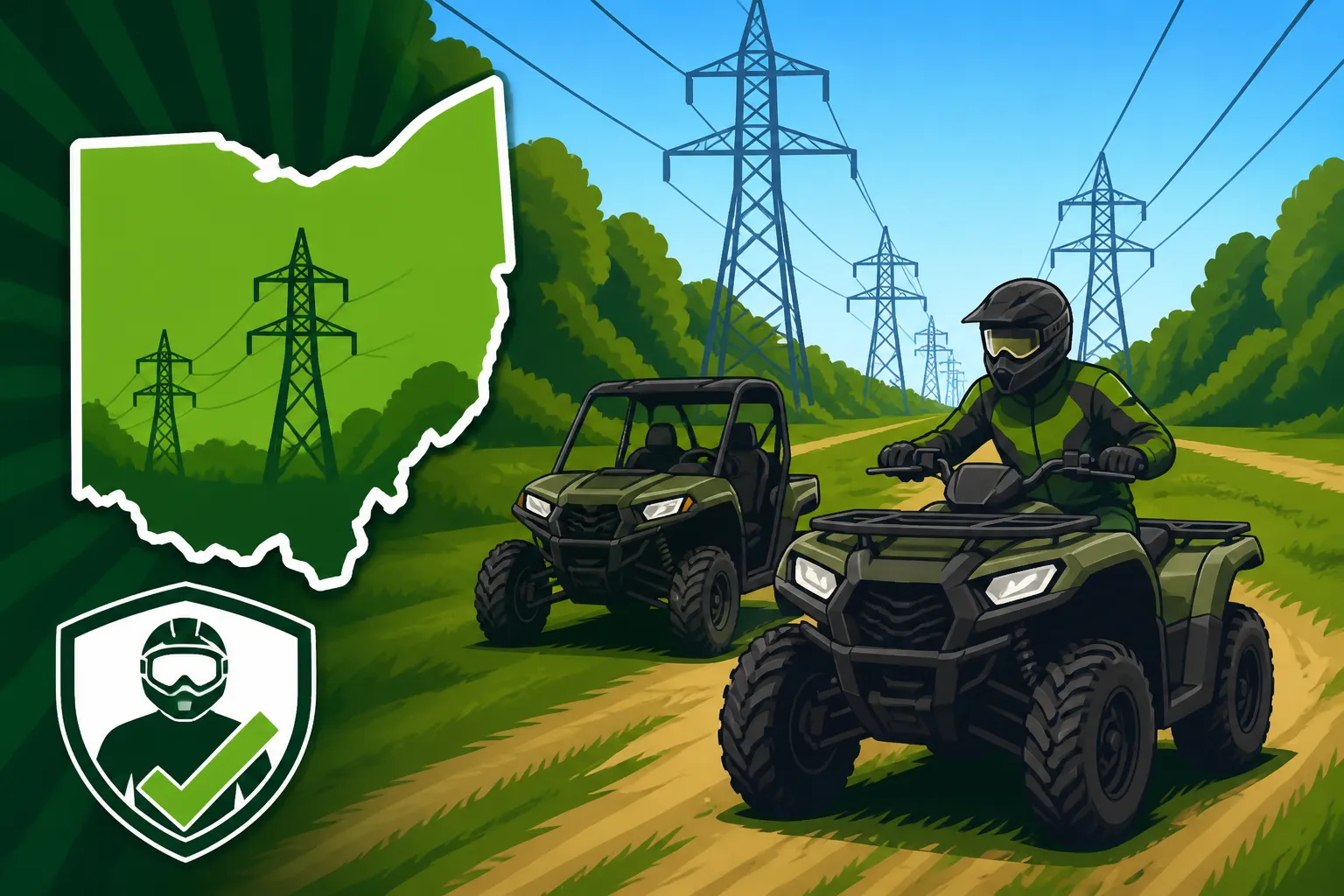
It’s completely understandable why utility corridors catch the eye of off-road riders. They often present wide, clear pathways that seem purpose-built for ATVs and UTVs. Picture this: you're exploring a new area, perhaps scouting for a hunting spot, and suddenly, a straight line of mown grass or gravel appears, stretching for miles, winding over hills and through valleys where regular roads don't exist. It looks like an unspoiled ribbon of adventure, a direct contrast to the often narrow, designated trails you find in state forests.
These corridors are typically kept clear of dense vegetation to prevent interference with power lines or to allow easy access for maintenance crews working on pipelines or communication cables. This clearing naturally creates a path that resembles a well-maintained trail. For riders seeking new experiences beyond the established parks or [Ohio's Four State Forest APV Areas], the sight of a utility corridor can spark a sense of exploration and the thought that "this must be open."
What's more, some areas might even show signs of past unauthorized use – perhaps a faint tire track, or a makeshift ramp over a small ditch. This can give the impression that "everyone rides here," subtly encouraging others to follow suit. You might have your rig decked out with the latest from SuperATV, ready for any challenge, and seeing what looks like an open path just fuels that desire to put your machine to the test. It's a natural instinct for many riders to see an open space and assume it's fair game, especially when official riding areas can feel limited or far away. But, as we'll delve into, the visual appeal often hides a complicated legal truth.
The Misconception of "Open" Land
One of the biggest misunderstandings regarding utility corridors stems from the idea that if land isn't explicitly fenced or posted with "No Trespassing" signs everywhere, it's fair game. This simply isn't true, especially with these types of properties. Utility companies, while needing access for maintenance, do not typically designate these corridors for public recreational use. The "open" appearance is for their operational needs, not for your weekend ride.
Think about it from their perspective: they're trying to keep vital infrastructure safe and accessible. Public recreational use, especially with off-road vehicles, can lead to damage, litter, safety hazards, and increased liability for the utility company. It's not about being unfriendly to riders; it's about protecting their assets and managing risk. The idea that a cleared path automatically implies public access is a common, but dangerous, misconception that can lead to significant trouble for riders.
The Temptation of a Shortcut or Backroad
Beyond looking like an adventure, utility corridors often appear to offer practical advantages. They might seem like a perfect shortcut between two points, avoiding longer road routes or providing a more direct path to a fishing spot or a friend's property. Imagine you're riding in a rural area, and the official roads take a meandering, inconvenient route, but a straight power line cut seems to go exactly where you want to be.
This temptation to use a utility corridor as a shortcut is strong, particularly for riders who are familiar with an area and know where these lines run. However, even if it saves you time or fuel, using these corridors without permission is still trespassing. The land underneath those power lines or over those pipelines isn't public property in the sense that a state forest trail is. It's either privately owned land with an easement granted to the utility, or it's directly owned by the utility company itself, and neither scenario typically allows for recreational riding.
Unpacking the Legal Realities: Easements, Ownership, and Access
This is where things get a bit sticky, and it's super important to understand the legal distinctions. When we talk about utility corridors, we're almost always talking about land that is either privately owned by an individual or entity, or owned directly by the utility company. The crucial factor isn't what the land looks like, but who holds the rights to it and for what purpose.
Most utility corridors in Ohio exist because a utility company has obtained an "easement" across private property. An easement is a legal right to use another person's land for a specific purpose. For example, a power company might have an easement to install and maintain power lines across a farmer's field. This means the utility company has the right to access that strip of land to do their work, but the farmer still owns the land. They just can't build a barn directly under the power lines, for instance.
This also means that you, as a recreational rider, generally have no more right to be on that land than you would on any other part of the farmer's property. The easement grants rights to the utility, not to the general public. It's a common point of confusion, but a critical one to grasp if you want to stay on the right side of the law.
The Difference Between Easements and Public Land
Let's break this down further. When you ride on a designated public trail, like those in the Wayne National Forest, you're on public land managed for public recreation. The government owns the land, and they've created rules for how the public can use it. This is straightforward.
An easement is entirely different. It’s a limited right granted by a landowner to another party (the utility company) for a very specific purpose. The landowner retains all other rights, including the right to exclude others, and they are usually still responsible for the property. When you ride on an easement, you're not riding on public land, even if it's a utility corridor. You're riding on someone else's private property, and that utility easement doesn't automatically extend an invitation to you. This is why understanding [Ohio Landowner Permission Requirements] is so critical.
Consider a scenario: a gas pipeline company has an easement through Mr. Smith's back forty. They have the right to inspect and maintain the pipeline. They can drive their service vehicles along the cleared path. But Mr. Smith still owns that land. If you decide to ride your ATV down that pipeline corridor, you are trespassing on Mr. Smith's property, even though the gas company also has rights there. The gas company isn't going to bail you out; in fact, they might be just as eager to have you removed as Mr. Smith, due to liability and safety concerns.
Who Controls Access?
Ultimately, access to a utility corridor is controlled by the property owner. If the land is privately owned with an easement, the landowner generally controls recreational access. If the utility company outright owns the corridor, then the utility company controls access. In either case, it's not you.
This means that even if a utility company doesn't actively patrol or post every inch of their easements, it doesn't grant implicit permission. Their focus is on maintaining their infrastructure, not necessarily on policing recreational use, though they will act if issues arise. They might even have agreements with local law enforcement to address trespassing. So, just because you haven't been caught yet doesn't mean you're riding legally. It just means you haven't been caught yet. The best practice, always, is to assume no access unless you have explicit, written permission from the property owner.
What Ohio Law Explicitly Says About Utility Corridor Riding
Ohio law is pretty clear on the matter of private property, and utility corridors fall squarely under these rules. There isn't a special carve-out in Ohio Revised Code that says, "Hey, if it's a power line, go ahead and ride!" Instead, the general laws regarding trespassing apply, and these laws are designed to protect property owners' rights.
Ohio law defines trespassing as entering or remaining on the land or premises of another without privilege to do so. A "privilege" typically means permission, either explicit or implied, or a legal right. As we've discussed, a utility easement doesn't give you a privilege to be there. This means if you're caught riding on a utility corridor without permission from the property owner (or the utility company if they own the land outright), you could face legal consequences.
It's tempting to think that "no signs, no problem," but that's a dangerous assumption. Many rural property owners don't feel the need to plaster their land with "No Trespassing" signs because, legally, it's considered private whether marked or not. The burden is on you, the rider, to know whose land you're on and whether you have permission to be there. You can learn more about this in [Ohio Trespass Law and Off-Road Riders].
Trespass Laws and APVs
When it comes to ATVs and UTVs, Ohio law doesn't differentiate between someone walking across private land and someone riding an APV across it. If you don't have permission, you're trespassing. However, riding an APV might actually escalate the situation in the eyes of the law or the landowner.
An ATV or UTV can cause more perceived damage than a hiker, especially if the ground is soft, leading to ruts or erosion. This can turn a simple trespassing complaint into something more serious, potentially involving civil claims for damages in addition to criminal charges. Property owners might be more inclined to pursue legal action if their land is being visibly altered or damaged by unauthorized vehicles. Even if your machine is equipped with top-notch accessories from SuperATV designed for tough conditions, that doesn't grant you permission to be on private land.
Other Potential Violations
Beyond simple trespassing, riding on utility corridors could lead to other legal issues. For instance, if you damage any utility equipment—a marker, a small access road, or even the vegetation that the utility company meticulously manages—you could be liable for repair costs. While rare, it's not unheard of for damage to occur, especially in challenging terrain or if riders are unfamiliar with the specific layout of a corridor.
You might also be cited for littering if you leave anything behind, or even for reckless operation if you're riding in a manner deemed unsafe near critical infrastructure. Remember, these corridors are working environments for utility crews, and their safety could be compromised by unauthorized recreational activity. Ohio has specific regulations on [What Ohio Law Prohibits on an APV] that can encompass such activities.
How to Seek Permission for Riding on Utility Corridors (And Why It's Crucial)
Alright, so we've established that the default answer for riding on utility corridors is a resounding "no" unless you have explicit permission. But what if you really believe a certain corridor would be perfect for riding, and you want to do it legally? The process involves identifying the true property owner and respectfully asking for permission. This is the only way to potentially turn a "no" into a "yes" and avoid serious trouble.
First things first: identify the landowner. This is usually the trickiest part. Utility companies often have easements across dozens, if not hundreds, of private parcels. Your local county auditor's website is your best friend here. You can often look up property ownership by parcel number or by searching maps. If the utility company owns the land outright, their name will be listed as the owner. If it's a private individual with a utility easement, that individual's name will be listed.
Once you know who owns the specific stretch of corridor you're interested in, the next step is to make contact. This needs to be done respectfully and professionally.
Approaching Private Landowners
If the land is privately owned, your best bet is to approach the individual landowner. Introduce yourself, explain your hobby, and ask if they would consider allowing you to ride on their specific portion of the utility corridor. Be prepared for a "no," and don't take it personally. Many landowners are wary of liability, property damage, or simply don't want anyone on their land.
Here are some tips for approaching a landowner:
- Be Polite and Respectful: First impressions matter.
- Explain Your Intentions Clearly: "I'm an ATV rider, and I noticed the power line goes through your property. I was wondering if you ever allow riding on that section?"
- Offer to Show Proof of Insurance: This can help alleviate their liability concerns. Mentioning you have [Ohio APV Registration and Insurance Proof] shows you're a responsible rider.
- Assure Them of Respect for Their Property: Promise to stay on the cleared corridor, not to litter, and to close any gates.
- Suggest Limited Access: Perhaps only for certain days, or with a small group.
- Offer a Benefit: While not always necessary, some riders offer to help with small tasks, like clearing brush along the corridor in exchange for riding privileges.
- Get It in Writing: If they agree, get written permission! A simple signed note stating that you have permission to ride on their property (specifically the utility corridor) during certain times can save you a lot of grief later.
Approaching Utility Companies
If the utility company owns the land outright, or if you're dealing with a very large corridor that crosses many properties, you might need to contact the utility company directly. Be forewarned: this is often an uphill battle. Most utility companies have blanket policies against public recreational use of their corridors due to safety, security, and liability concerns.
You'll likely need to go through their customer service or land management department. Explain exactly where you want to ride and what you're asking for. Again, be prepared for a "no." If they do consider it, they might have stringent requirements, potentially requiring waivers, specific insurance, or a formal agreement. Always check with the utility company for any specific equipment requirements or restrictions, even if your machine is equipped with top-notch accessories from SuperATV designed for tough conditions.
Table: Perceived vs. Actual Access on Utility Corridors
| Feature/Aspect | Perceived Access (Rider's Initial Thought) | Actual Legal Reality (Ohio Law) |
|---|---|---|
| Appearance | Looks like an open trail, clear path | Cleared for utility maintenance/access, not public recreation. |
| Ownership | Unclear, possibly public or "no one's" | Almost always private land (individual or utility company) with a specific utility easement. |
| Permission Needed | "No signs, no problem" | Explicit, written permission required from the actual property owner (landowner or utility company). |
| Legal Status | Assumed open for use | Unauthorized use is trespassing, a criminal offense. |
| Liability | Not considered | Rider is liable for damage/injury. Landowner/utility has liability concerns about public access. |
| Regulatory Body | None perceived | Local sheriff/police, Ohio DNR (if state land adjacent), utility company security, landowners. |
| Consequences | Minor inconvenience if caught | Fines, impoundment of vehicle, civil lawsuits for damage, criminal record. |
Why Permission is Crucial
Getting explicit permission isn't just about avoiding a ticket; it's about respecting private property rights and maintaining good relationships within the riding community. Unauthorized riding contributes to the negative stereotypes sometimes associated with off-roaders and makes it harder for legitimate riding opportunities to open up.
Moreover, if you have an accident on a utility corridor without permission, your insurance might not cover you. You could be facing not only medical bills but also legal fees if the landowner decides to sue. It's simply not worth the risk. Always remember that riding [Riding Private Ground in Ohio] demands respect and permission.
The Steep Consequences of Unauthorized Riding
Let's not sugarcoat it: riding without permission on utility corridors can land you in a world of trouble. While the initial allure might be strong, the potential downsides far outweigh any momentary thrill or convenience. Law enforcement, landowners, and utility companies are increasingly vigilant about unauthorized use of these areas, and the consequences can range from costly fines to confiscation of your machine and even criminal charges.
Imagine this scenario: you're enjoying a ride down what you think is a harmless power line cut. Suddenly, a county sheriff's deputy or even a utility company vehicle pulls up. Your heart sinks. What seemed like a free and clear ride instantly becomes a very expensive and stressful encounter. These companies have significant investments in infrastructure, which you wouldn't want to accidentally damage, no matter how tough your SuperATV skid plates are.
Fines and Penalties
The most immediate consequence is typically a trespassing citation. In Ohio, criminal trespassing can be a misdemeanor offense, carrying fines and potentially court costs. While the exact fine can vary, it's safe to say it will be a lot more expensive than a day pass at a private riding park. Repeat offenses, or trespassing coupled with property damage, can lead to more severe penalties.
It’s not just the monetary fine, either. A criminal record, even for a misdemeanor, can impact future employment, housing, or other opportunities. You might think it's "just a ticket," but it can have longer-lasting repercussions than you realize. You can find more information about how these fines add up in articles like [Ohio Fines for an Unregistered APV] or [What an Ohio APV Ticket on a Township Road Costs], though those focus on roads, the principle of penalties for illegal operation applies.
Vehicle Impoundment
In some cases, especially with repeat offenders or if the landowner is particularly frustrated, law enforcement can impound your ATV or UTV. Getting your machine back can be a complicated and expensive process, involving impound fees, daily storage charges, and any fines or court orders that need to be satisfied. This could leave you without your machine for an extended period, adding to your financial and logistical headache.
Losing access to your machine for weeks or months, and then having to pay hundreds or thousands of dollars to get it back, is a harsh lesson. It certainly takes all the fun out of what started as an "adventure."
Civil Liability and Property Damage
Beyond criminal charges, you could also face civil lawsuits. If you cause any damage to the landowner's property (even minor ruts in a field) or to utility infrastructure, the property owner or utility company can sue you for the cost of repairs. This could include damage to fences, crops, access roads, or even the land itself due to erosion from tire tracks.
Imagine hitting a hidden pipeline marker or damaging a critical fiber optic cable. The repair costs for such incidents can be astronomical. Even if your machine is equipped for rugged terrain, the legal and financial burden for damages could be substantial. This is why having comprehensive [Ohio APV Insurance Requirements] is important, although even the best policy might not cover damages incurred while committing an illegal act like trespassing.
Loss of Future Riding Opportunities
Every instance of unauthorized riding, especially on private land or utility corridors, feeds into a negative public perception of off-road riders. This makes landowners and public officials less likely to open up legitimate riding areas or grant permission for organized events. When a utility company or private landowner has a bad experience, they're much less likely to ever consider allowing anyone to ride, even if approached respectfully in the future.
This "bad apple" effect impacts the entire riding community. If we want more places to ride in Ohio, we need to be responsible stewards of the land and respect property rights, whether it's clearly marked or not. The responsibility is on us to ensure we are always riding legally and ethically.
Disclaimer
This article is for general informational purposes only and does not constitute professional advice. Laws, prices and regulations vary by location and change over time. Consult a qualified professional for guidance on your specific situation.