Ohio Fines for Illegal APV Road Use
Riding your all-purpose vehicle (APV) on Ohio's roads can feel like navigating a maze, and making a wrong turn often leads to frustration and costly penalties. It’s a common misconception that if you own an ATV or UTV, you can just hop on any paved surface for a quick jaunt. Unfortunately, Ohio law has very specific rules for where and how APVs can be operated on public roads, and misunderstanding these regulations can result in significant fines and legal headaches. This guide aims to clear up the confusion, detailing the common violations, the fines associated with illegal APV road use, and crucial steps to help you avoid those unwelcome tickets and ensure your rides are safe and compliant.
Understanding Ohio's APV Road Rules
Before we dive into the fines, it's essential to grasp why these rules exist in the first place. Ohio's definition of an All-Purpose Vehicle (APV) — which includes ATVs, side-by-sides, and dirt bikes — largely distinguishes them from traditional motor vehicles designed for road use. They lack many of the safety features and equipment that cars and trucks possess, making their operation on public roads a matter of public safety.
The "All-Purpose Vehicle" Distinction
Ohio law defines an APV as a vehicle that is primarily designed to travel over unimproved terrain and that has a width of 75 inches or less, a dry weight of less than 2,000 pounds, and travels on non-highway tires. This definition is crucial because it dictates a separate set of rules compared to other vehicles. Unlike a car, an APV isn't inherently designed for highway speeds or traffic. The state views these machines as recreational vehicles first and foremost, and their road use is heavily restricted. If you're wondering [Why Ohio Says All-Purpose Vehicle], it's because this broad category helps the state apply consistent regulations across various types of off-road machines.
Limited Road Access for APVs
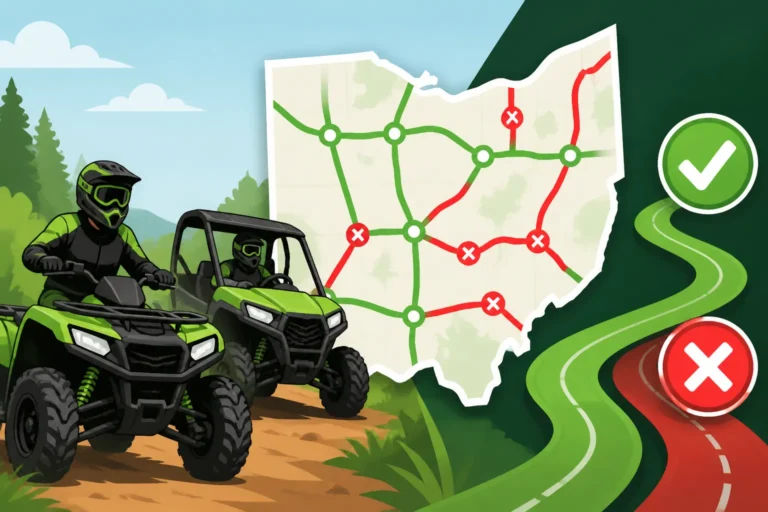
Generally, APVs are not permitted on state routes, interstates, or limited-access highways. The limited road access is a major point of confusion for many riders. While some counties and townships have passed resolutions to open certain roads to APV traffic, this isn't a statewide blanket allowance. Each local jurisdiction makes its own decisions, often for roads with lower speed limits, less traffic, and specific safety considerations. This patchwork of rules means what's legal in one township might be illegal just across the county line. Understanding which roads are actually open to you is paramount. You might find it helpful to research [Ohio Counties That Allow APVs on Roads] or [Ohio Townships That Allow APVs on Roads] before planning your route.
Common Violations Leading to Fines
When a deputy pulls you over on an APV, it's usually for one of a few key reasons. These violations often stem from a lack of understanding of the local rules or a failure to properly equip your machine. The consequences can range from a simple monetary penalty to more severe legal actions.
Riding on Prohibited Roads
This is arguably the most common reason riders face fines. Pulling onto a state route or an interstate with your ATV, even for a short distance, is almost universally prohibited and will likely result in a citation. Even on township or county roads, if that particular stretch hasn't been specifically designated for APV use by a local resolution, you're breaking the law. Imagine you’re riding through a scenic rural area, and you see an inviting stretch of asphalt connecting two trail systems. Without confirming local ordinances, that short ride could cost you. An officer won't care about your intentions; they'll only see the violation.
Operating Without Proper Registration and Plates
Just like a car, if you're taking your APV onto any public road where it's legally permitted, it generally needs to be properly registered with the Ohio Bureau of Motor Vehicles (BMV) and display a valid APV plate and validation sticker. This is a non-negotiable requirement. An unregistered machine, even if ridden on a legally open road, is still a violation. The fines for [Ohio Fines for an Unregistered APV] can quickly add up, often involving not just a ticket but also potential court costs. Ensure your plate is always visible, securely mounted, and not obscured by mud or gear.
Lacking Required Safety Equipment or Road-Legal Upgrades
While ATVs generally don't require an inspection for registration, UTVs seeking to become road-legal in areas where permitted must pass a stringent inspection. This inspection checks for vital safety equipment like headlights, tail lights, brake lights, turn signals, mirrors, a horn, and a windshield. Brands like SuperATV offer a wide array of aftermarket kits that can help bring your UTV into compliance with these specific road-legal requirements, from full windshields to DOT-approved turn signal kits.
If you're riding an APV on a road where it is allowed, but your machine lacks specific required equipment — for instance, riding after dark without proper headlights or taillights, or not having turn signals where required by local ordinance — you could still face a fine. An officer checks for more than just a plate; they're looking for [Ohio Equipment Rules for an APV on a Road] and [Ohio Equipment Rules for a UTV on a Road].
Impaired Driving and Reckless Operation
Operating an APV under the influence of alcohol or drugs on any public land or road, even a private lane accessible to the public, carries the same severe penalties as operating a car under the influence. This includes significant fines, license suspension, and potential jail time. Similarly, reckless operation – such as excessive speed, stunts, or endangering others – is not tolerated and will result in hefty fines and potential loss of riding privileges. These aren't minor infractions; they are serious offenses with lasting consequences.
Rider Age and Supervision Violations
Ohio has specific rules regarding rider age and supervision, especially for minors. If an underage rider is caught operating an APV on a public road without proper supervision or not meeting age requirements for specific areas, the supervising adult (if present) or the owner of the machine could face fines. For example, if you're supervising a younger rider on an open township road, remember that [Ohio Rules for a Rider Aged 15] might differ from those for an adult, and proper adult supervision is often mandated.
The Financial and Legal Impact of a Citation
Receiving a citation for illegal APV road use in Ohio isn't just about paying a ticket. There are broader financial and legal ramifications that can extend beyond the initial fine.
Monetary Penalties and Court Costs
The actual dollar amount of a fine for illegal APV road use can vary significantly based on the specific violation, the county or township where it occurred, and the discretion of the issuing officer and the court. While I cannot provide specific figures, understand that these fines are designed to be deterrents. In addition to the base fine, you'll almost always incur court costs, which are administrative fees associated with processing your case through the judicial system. These can sometimes be as much as, or even more than, the original fine itself. For instance, [What an APV Ticket on a Township Road Costs] isn't just the initial sum; it’s the total of the fine plus all associated court fees.
Here's a simplified look at potential consequences:
| Violation Category | Initial Impact (No Specific Costs) | Secondary Impact |
|---|---|---|
| Unregistered APV | Monetary fine, court costs | Potential vehicle impoundment, difficulty with future registration |
| Prohibited Road Use | Monetary fine, court costs | Increased insurance premiums, loss of riding privileges |
| Equipment Violation | Monetary fine | Ordered to fix equipment, re-inspection |
| Impaired Operation | Significant monetary fine, court costs, license suspension | Jail time, permanent criminal record, insurance cancellation |
| Age/Supervision | Monetary fine for adult/owner | Restrictions on future riding, educational mandates |
| Reckless Operation | Monetary fine, court costs | Points on driver's license, insurance rate hikes |
Vehicle Impoundment
In more severe cases, or for repeat offenders, your APV could be impounded. This means your machine is towed and stored at an impound lot, and you will be responsible for all towing and storage fees in addition to any fines. Releasing an impounded vehicle can be a lengthy and expensive process, adding considerable stress and cost to an already unfortunate situation.
Impact on Driving Record and Insurance
While an APV violation might not always directly affect your standard driver's license points, certain offenses, especially those involving reckless behavior or impaired operation, can indeed lead to points on your license and higher insurance premiums for all your vehicles. If you have [Ohio APV Insurance Requirements] because you ride on roads, a history of violations could make it difficult to obtain or afford coverage. Insurance companies assess risk, and a rider with a history of citations is seen as a higher risk.
Criminal Charges
While most illegal road use is a traffic infraction, some violations can escalate to criminal charges. Operating an APV under the influence (OVI) is a criminal offense in Ohio, carrying severe legal consequences beyond just fines. Similarly, repeat offenses or extremely reckless behavior could lead to more serious legal action, including misdemeanors or even felonies depending on the circumstances and any harm caused.
Avoiding Fines: Proactive Steps for Ohio APV Riders
The best way to deal with fines is to avoid them altogether. Being proactive and informed can save you a lot of grief and money. It all comes down to knowing the rules and preparing your machine appropriately.
Research Local Ordinances Diligently
Never assume a road is open to APVs. Before you even load your machine onto the trailer, make sure you know exactly where you're allowed to ride. Call the county engineer's office or the township clerk's office. Many townships will have a resolution available on their website detailing which roads are open and under what conditions. [How to Find an Ohio Township Resolution] is a critical skill for any rider looking to legally use public roads. Remember, a common rule is [An Ohio Road Posted Thirty-Five or Less] might be open, but an unposted road that defaults to fifty-five miles per hour is generally not.
Ensure Your APV is Properly Registered and Plated
If you plan on riding on any public road, even those legally opened by local resolution, your APV must be registered and display its plate. Visit your local Deputy Registrar's office to [Registering an APV in Ohio]. This process ensures your machine is recognized by the state and that you have all the necessary paperwork. Don't forget that [Ohio APV Plates and Validation Stickers] must be current and clearly displayed.
Equip Your Machine for Road Use When Necessary
If you're riding in an area that allows APVs on roads, ensure your machine meets all equipment requirements, especially if it's a UTV that had to pass an inspection. This might include:
- Headlights, tail lights, and brake lights
- Turn signals
- A horn
- Rearview mirrors
- A windshield (for UTVs)
- A functional muffler and spark arrester
For UTVs especially, the [Ohio UTV Inspection Before Registration] is designed to ensure these features are present and operational. If you’re modifying your machine to meet these requirements, consider reputable aftermarket suppliers. For instance, SuperATV provides a comprehensive selection of DOT-approved parts, from signal kits to rearview mirrors, that can help ensure your machine is road-ready and compliant with Ohio regulations.
Carry Essential Documentation
Always carry your valid driver's license (if required for road use), APV registration card, and proof of insurance (if riding on roads that mandate it). While it might be tempting to just keep a photo on your phone, an officer will typically request physical documentation. [What Happens If You Ride Without Your Registration Card] could lead to further delays and potential citations. Many riders find a waterproof pouch or a secured compartment on their machine helpful for keeping these documents safe and readily accessible.
Understand Driver's License and Helmet Requirements
For APV operation on public roads, you will generally need a valid driver's license. [Do You Need a Driver's License on Township Roads?] The answer is almost always yes. Additionally, Ohio has helmet laws that apply to APV riders, particularly on state forest trails and often when riding on public roads. Always wear a DOT-compliant helmet and appropriate eye protection to ensure your safety and avoid citations. [Ohio Helmet Rules for APV Riders] are in place for your protection and an officer will certainly check for compliance.
By staying informed, preparing your machine, and adhering to local and state laws, you can greatly reduce your risk of receiving costly fines and enjoy your Ohio APV adventures responsibly.
Disclaimer
This article is for general informational purposes only and does not constitute professional advice. Laws, prices and regulations vary by location and change over time. Consult a qualified professional for guidance on your specific situation.