The Ohio Temporary Permit for Visitors
The Ohio Temporary Permit for Visitors
A visitor can arrive in Ohio with a machine that is legal at home and still be unsure what paperwork is needed for Ohio trails. The key question is whether the home state requires registration and whether Ohio recognizes the registration the machine already carries. This article explains when a temporary permit may be needed, what it does not authorize, and what to confirm before traveling.
What Ohio’s Temporary Permit Does
Ohio has a temporary operating permit for certain nonresident riders. It is generally relevant when the visitor’s home jurisdiction does not require the machine to be registered, so the rider cannot rely on a current home-state registration as proof of legal status in Ohio.
That is different from an ordinary Ohio registration. Ohio’s registration is associated with an Ohio plate and validation sticker, and it serves as the state’s authorization for an eligible machine to be operated where such registration is required. A visitor permit is a temporary option for a qualifying nonresident; it does not mean the machine has been permanently registered in Ohio.
The permit is also not a universal pass to ride anywhere. It addresses a registration requirement. It does not open private land, authorize travel on a closed trail, replace a separate access pass where one is required, or make an off-highway vehicle street legal. Those are separate questions.
If you are unsure whether your home registration is accepted, start with Does Ohio Honor Out-of-State Registration? and Ohio Reciprocity for Out-of-State Machines. Reciprocity depends on the rules that apply to the visitor’s machine and home jurisdiction, so do not assume a registration or document accepted elsewhere automatically covers every type of Ohio riding.
The basic distinction
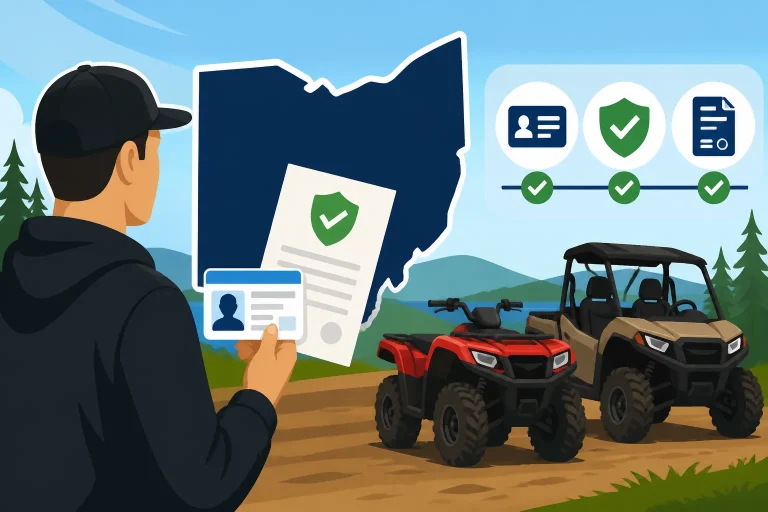
Think of a visitor’s paperwork in three parts:
- Registration or temporary operating authority: Shows that the machine meets the applicable registration requirement.
- Access permission: Covers any additional permit required for a particular riding area.
- Permission to use a road or property: Depends on the road’s status, local rules, and the landowner’s permission.
The temporary permit relates to the first part. It does not take the place of the other two.
That distinction matters most for visitors planning to ride more than one kind of property. A permit that addresses Ohio registration does not, by itself, establish that a forest road is open, that a private trail park admits the machine, or that a county or township allows APVs on its roads.
Why a visitor might need a permit
A rider whose state requires machine registration may be able to rely on valid home-state registration if Ohio recognizes it for the planned use. A visitor from a state that does not require registration may have no comparable registration document to show. Ohio’s temporary permit is intended for that kind of situation.
The exact eligibility rules, duration, application method, and current cost should be confirmed before you travel. Those details can change, and the permit’s term may not match the length of your trip. For the current duration, see How Long an Ohio Visitor Permit Lasts. For the relevant visitor categories, What a Visitor From a Registering State Must Show and What a Visitor From a Non-Registering State Must Buy explain the distinction.
Who Needs It and Who Does Not
Do not decide based only on the machine’s make, model, or the fact that it is called an ATV or UTV at home. Start with the registration rules in the place where the machine is based, then check how Ohio treats that paperwork for the kind of riding you plan to do.
| Visitor’s situation | Likely paperwork question | What to confirm |
|---|---|---|
| Home jurisdiction requires registration and the machine has current registration | Can the machine’s home-state registration be used in Ohio? | Whether Ohio recognizes it for the planned riding location and machine type |
| Home jurisdiction does not require registration | Is an Ohio nonresident temporary permit required? | Eligibility, term, how to obtain it, and what documents to carry |
| Machine has expired, incomplete, or mismatched paperwork | Is the existing document valid for this machine and rider? | Renewal or correction before traveling; do not assume a receipt or old card is enough |
| Machine is rented in Ohio | Who provides the registration documents? | Whether the machine is already registered and what separate access pass is needed |
| Machine will be used on roads as well as trails | Does registration also allow road use? | Road-opening rules, equipment, insurance, and driver requirements |
| Machine will be used on federal or other separately managed land | Does the riding area require its own pass? | Site-specific access rules and any additional permit |
These are starting points, not a substitute for checking the current rules. A state may register some off-highway machines but not others, or its rules may depend on where a machine is used. If your state has no registration system for your machine, that does not automatically mean you can ride in Ohio without paperwork; it is precisely the kind of situation in which you should ask about the temporary permit.
Visitors with current home-state registration
If your home jurisdiction requires registration and your machine has valid registration, you may not need the Ohio visitor permit. But “registered at home” is not the end of the check. Confirm that Ohio accepts the registration for your machine and planned use, and find out what proof you must carry.
Check that the document is current and clearly identifies the machine. If the registration is electronic, ask whether a digital copy is acceptable or whether you should bring a printed copy. If you are borrowing the machine, make sure you can show the owner’s registration and any other documents required for the ride.
The distinction between home-state registration and an Ohio permit is covered further in Which States’ Registrations Ohio Accepts on Its Trails. A visitor should verify the current rule rather than rely on a friend’s past trip or on a general statement that Ohio has reciprocity.
Visitors from a state without a registration requirement
If your home jurisdiction does not require registration for the machine, you may need Ohio’s temporary operating permit to satisfy Ohio’s registration requirement. Confirm this before setting out, rather than waiting until you reach a trailhead. You will want to know whether the permit can be obtained in advance, what information is needed, and whether the permit must be displayed or carried in a particular way.
Do not confuse a lack of home-state registration with a waiver of Ohio’s rules. A state’s decision not to register a type of machine does not necessarily exempt a visiting rider from Ohio’s requirements.
Rental machines and borrowed machines
A rental machine may already have the registration or other documentation required for Ohio use. Ask the rental operator what paperwork is included, and check whether the answer covers only registration or also covers the riding area’s separate access requirements. Do not assume that a rental agreement is itself an Ohio registration document.
For a borrowed machine, ask the owner for current registration information and permission to use it. If the owner’s state does not require registration, ask whether the machine needs the Ohio visitor permit. Carry the relevant paperwork with you, not only a photo of a document stored on someone else’s phone.
How to Prepare Before Traveling
A short check before departure can prevent a long delay at a trailhead. The most useful approach is to identify the machine, establish its registration status, and confirm the rules for every place on your itinerary.
- Identify the machine and its home jurisdiction. Write down the machine type, who owns it, where it is registered or based, and whether that jurisdiction requires registration for it.
- Check the machine’s current documents. Make sure the registration has not expired and that the identifying information matches the machine. If the machine was recently bought or transferred, resolve any paperwork gap before the trip.
- Ask whether Ohio accepts the home registration. Ask about the specific machine and use, not just whether Ohio has reciprocity in general. If the home jurisdiction does not require registration, ask whether you must obtain an Ohio temporary permit.
- Confirm the permit’s current requirements. Verify eligibility, application or purchase options, the permit term, what information is needed, the current cost, and how the permit must be carried or displayed.
- Check each riding area separately. Find out whether it requires a separate pass, has machine-width limits, seasonal closures, age rules, or other conditions.
- Keep the documents accessible during the ride. Carry whatever proof the rules require in a way that protects it from water and dirt. If you also keep a phone copy, treat it as a backup unless the authority confirms that a digital copy is accepted.
What to have ready when asking
A useful question to an official office or riding-area administrator includes enough detail to get an answer that applies to your circumstances. Be ready to provide:
- The machine’s type and identifying information
- The state or jurisdiction where it is based
- Whether that jurisdiction requires registration for the machine
- Whether the machine has current registration or another document
- Whether you are the owner, borrowing it, or renting it
- Where in Ohio you plan to ride
- Whether you also intend to use any public roads
These details matter because “I’m bringing an ATV from out of state” can describe very different situations. A properly registered machine from a state with an established registration system is not the same case as an unregistered machine from a state that does not require registration.
Confirm details with the right office
For registration questions, check with the appropriate Ohio registration office or official state information source before traveling. For access rules, check with the agency or land manager responsible for the specific area. If your trip includes both state forest trails and Wayne National Forest, check the rules for both; they are not interchangeable.
Keep a record of the answer you receive, including the date and the office or agency contacted. That is not a substitute for the required documents, but it can help you remember what was confirmed and spot a misunderstanding before you arrive.
If the machine’s title or ownership documents are incomplete, address that separately. A visitor operating permit does not cure a title problem or prove ownership. For buying or bringing a machine across state lines, Registering an Out-of-State Machine in Ohio provides related background.
Where the Permit Lets You Ride—and Where It Does Not
A temporary permit addresses Ohio’s registration requirement for a qualifying visitor. It does not give the rider blanket access to Ohio land or roads. Before each ride, check the rules of the property or route itself.
State forest trails
Ohio state forest riding areas have their own operating rules. In general, a valid Ohio registration or accepted out-of-state documentation may be part of what allows a machine to use designated trails. A temporary permit may serve the registration purpose for an eligible visitor, but you still need to confirm that the particular area is open and that the machine meets its requirements.
Do not treat a state forest as open riding land. Use designated routes, check closures and operating hours, and verify limits that could affect your machine, such as width. Riders under the applicable age threshold may also have supervision or equipment requirements. Do You Need a Permit for Ohio State Forest Trails? explains the relationship between registration and trail access.
Wayne National Forest
Wayne National Forest is managed separately from Ohio’s state forest riding areas. Ohio registration paperwork, including an applicable temporary permit, should not be assumed to cover every federal forest requirement. Wayne National Forest may require its own OHV pass, and that access requirement is separate from registration.
Before riding, check which pass applies to the dates and people in your group, what routes it covers, and how it must be displayed. A pass for a federal riding area is not a substitute for required Ohio registration; conversely, an Ohio permit should not be treated as a substitute for a required forest pass. See The $20 Three-Day Wayne National Forest Pass and Why the Ohio Plate Is the Trail Permit for the difference between these kinds of authorization. Check current pass information directly with the responsible agency.
Private parks and private property
A state permit does not grant access to privately owned land. A private riding park can set its own admission and operating conditions, and a landowner’s permission is needed to ride private property. Before unloading, confirm that the site accepts your machine and that its registration documents meet the park’s requirements.
If a trail connects with private land or passes near a gate, do not assume the route is open just because a map shows a track. Permission and access conditions apply to the land itself, not just to the machine’s registration status.
Public roads
Registration is not the same as road authorization. Ohio’s rules for riding on a road can depend on whether a county, township, or other local authority has opened that road to APVs, as well as on equipment, insurance, licensing, and other requirements. A temporary visitor permit does not automatically make an ATV or UTV street legal.
Plan to trailer the machine to a legal riding area unless you have confirmed that the exact road or route is open and that the machine and rider satisfy all applicable conditions. For more on the separate issue, see Where Ohio Law Allows APVs on Roads.
Common Mistakes and a Simple Trip Checklist
Many problems come from treating different documents as if they were interchangeable. A little separation between the questions makes the paperwork easier to manage.
Mistakes to avoid
- Assuming every out-of-state registration is accepted. Verify the rule for your state, machine, and planned use.
- Assuming no home registration means no Ohio paperwork. A visitor from a non-registering jurisdiction may need an Ohio temporary permit.
- Assuming the temporary permit is an access pass. Check for separate passes or site-specific rules, especially when visiting separately managed land.
- Assuming registration allows road use. Road access is a different legal question and may depend on local decisions and equipment.
- Relying on an old trip’s information. Permit terms, application procedures, trail rules, and access conditions can change. Confirm the current details before departure.
- Leaving the documents in the tow vehicle. If the rules require proof while operating, keep the required documents with the machine or rider.
- Waiting until arrival to resolve a paperwork problem. A missing registration card, expired document, or unclear home-state rule can disrupt the trip.
Before you load the trailer
Use this checklist to keep the separate requirements straight:
- Is the machine’s home registration current, or does the home jurisdiction not require one?
- Has Ohio confirmed whether the home document is accepted?
- If needed, have you confirmed how to get the temporary permit and its current term?
- Do you know what proof must be carried or displayed?
- Does each riding area require an additional pass?
- Are the planned routes open to your machine and its width?
- Have you checked road access separately from trail access?
- Do you have any required insurance, identification, or supervision arrangements?
- Have you checked for closures and current site rules close to the ride date?
A “yes” to the first registration question does not answer the access or road questions. Treat the checklist as several small checks, not one general permission to ride.
Frequently Asked Questions
Does every out-of-state visitor need an Ohio temporary permit?
No. A visitor with valid home-state registration may be able to rely on it if Ohio recognizes that registration for the planned use. A visitor whose home jurisdiction does not require registration may need the Ohio temporary permit. Confirm your situation before riding.
Does the temporary permit cover a Wayne National Forest pass?
No. Ohio registration or temporary operating authority and a Wayne National Forest OHV pass serve different purposes. Check the current forest pass rules separately.
Does the permit let me ride Ohio roads?
No, not by itself. Road use depends on the road’s status and other requirements, which may include local authorization, equipment, insurance, and licensing.
How long does the visitor permit last, and what does it cost?
The term and current cost should be confirmed with an official Ohio source before you apply. Do not assume the permit covers the full trip or that an amount quoted for an earlier visit is still current.
What if I am renting a machine in Ohio?
Ask the rental operator what registration documents come with the machine and whether the operator handles any separate riding-area pass. A rental contract alone should not be assumed to answer every registration or access question.
Disclaimer
This article is for general informational purposes only and does not constitute professional advice. Laws, prices and regulations vary by location and change over time. Consult a qualified professional for guidance on your specific situation.