What Ohio Charges Visitors to Ride
Visitors often expect one Ohio permit to cover every trail, only to discover that state forests and Wayne National Forest have different requirements. The practical answer depends on where you plan to ride and whether your home state registers off-highway machines. This guide explains which charges may apply, when a temporary Ohio permit is needed, and what to check before you unload.
Start With the Riding Area, Not the State Line
Ohio does not charge every visiting ATV or UTV rider the same way. Your total depends on two separate questions:
- Does your machine have registration or a permit that Ohio accepts?
- Does the land where you plan to ride require an additional access pass?
The first question concerns your machine’s legal registration status. The second concerns a particular riding area. A valid home-state registration may satisfy Ohio’s registration requirement through reciprocity, but it does not necessarily cover a federal forest permit or give you permission to ride on land that is closed to motorized use.
For a visitor, it helps to sort riding into three broad settings:
- Ohio state forest trails: Ohio generally uses the registered machine’s plate as its APV trail credential. A separate Ohio state-forest trail pass is not the usual charge.
- Wayne National Forest OHV trails: A separate Wayne National Forest OHV permit may be required in addition to valid machine registration.
- Private parks and other property: The owner or operator sets access rules and may charge its own admission or riding fee. State registration does not replace those requirements.
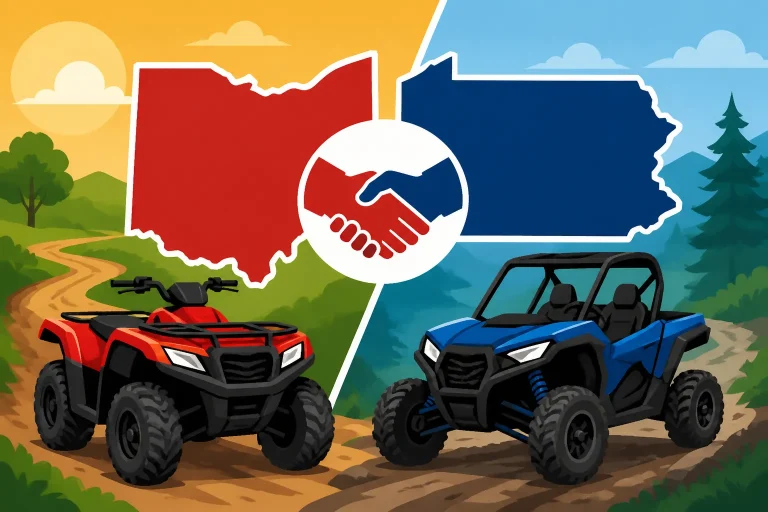
That is why two visitors can arrive in Ohio with similar machines and face different costs. One may ride only an Ohio state forest trail using an accepted out-of-state registration. Another may need an Ohio temporary permit because their home state does not register comparable machines, then pay for a Wayne Forest pass as well.
A useful way to start is to identify the exact trail system, then check its current rules and your machine’s paperwork. For the broader reciprocity picture, see Ohio APV Reciprocity With Other States and Which States’ Registrations Ohio Accepts on Its Trails.
| Where you plan to ride | What may satisfy the registration requirement | Possible additional charge |
|---|---|---|
| Ohio state forest trail | Ohio APV registration or an out-of-state registration Ohio accepts | Usually no separate state-forest trail pass; verify current rules |
| Wayne National Forest OHV trail | Valid Ohio or accepted out-of-state registration, or an applicable Ohio visitor permit | Wayne National Forest OHV permit |
| Private riding park | Whatever registration or documentation the park requires | Park admission, riding fee, or other operator charges |
| Public road | Registration alone is not enough to establish road access | Local road-use rules, equipment, insurance, license and other requirements may apply |
The table is a starting point, not a substitute for checking the particular trail. A permit or plate does not turn every road, forest track, wildlife area, or public property into an authorized ATV route.
Check Whether Ohio Accepts Your Home-State Registration
Ohio has a reciprocity system for visiting riders. If your home state registers the type of machine you are bringing and your registration is valid, Ohio may accept it for riding where that registration is required. The important point is that reciprocity depends on the laws and paperwork that apply to your machine, not simply on the fact that you have a plate from another state.
Before traveling, check the following:
- The registration is current and belongs to the machine you are bringing.
- The machine’s type is covered by the registration. An ATV, UTV, dirt bike, or other off-highway machine may be classified differently under different state systems.
- You can show proof of registration if an officer or trail official asks.
- Your home-state rules do not limit where or how you may use the machine in Ohio.
- The Ohio riding area accepts the registration for its own access requirements.
A street-vehicle license plate is not necessarily the same thing as off-highway registration. Likewise, a purchase receipt, bill of sale, insurance card, or title should not be treated as a substitute for current registration unless the relevant authority specifically says it is acceptable.
Carry the registration document, not just a photograph of the plate. A clear phone photo may help if paperwork is misplaced, but it may not satisfy a requirement to produce an original or other specified proof. Check what the trail authority expects, and keep the document protected from mud and rain. For more detail about what to carry, see What a Visitor From a Registering State Must Show.
What if your state does not register ATVs or UTVs?
Some states do not register the same types of off-highway machines that Ohio treats as APVs. Others may require a permit or sticker rather than issuing a plate. If your home state does not provide a registration that Ohio accepts, do not assume the absence of a home-state requirement gives you automatic permission to ride in Ohio.
Ohio may require a nonresident temporary operating permit in that situation. The visitor permit addresses Ohio’s registration requirement for a qualifying visit; it is not a general-purpose trail pass. It also does not replace a separate permit required by a particular land manager.
The distinction matters at Wayne National Forest. A visitor without accepted home-state registration may need to meet Ohio’s registration requirement through the applicable temporary permit, and the forest may still require its own OHV pass. Think of these as two separate checkboxes, rather than two names for the same fee.
For an overview of visitor situations, see What a Visitor From a Non-Registering State Must Buy. If your situation is unusual—for example, your state issues a permit but no plate, or the machine’s class is unclear—ask an Ohio registration office and the trail authority before making the trip.
Reciprocity does not settle every riding rule
Accepted registration does not mean Ohio has adopted every rule from your home state. Ohio rules may govern rider conduct, helmets, age and supervision, operating hours, trail width, and use of public land. The land manager may impose additional conditions.
That is especially important for visitors who plan to ride more than one kind of property. A machine that is properly registered might still be too wide for a particular state forest trail. A road-use plate or local road authorization does not automatically allow a machine on a forest trail, and a trail permit does not automatically allow road use. Review Ohio Rules for Riding a National Forest before using Wayne trails, and confirm the separate rules for any other property on your itinerary.
When an Ohio Temporary Permit May Be Part of the Cost
An Ohio temporary operating permit is generally relevant to a visitor whose home-state registration is not available or is not accepted for the machine. It provides a way to meet Ohio’s registration requirement for a limited visit, subject to the permit’s terms. It is not a permanent registration, an Ohio title, or permission to ride anywhere you choose.
The permit’s duration, cost, availability, and application details can change. Confirm the current requirements with an official Ohio registration source before you travel. The official process may also depend on the machine and the documents you can provide. Do not rely on an old receipt, a forum post, or a friend’s experience from a previous trip to establish the current fee or permit term.
If you need one, make sure you understand:
- Who qualifies: The permit is intended for a nonresident visitor in a qualifying situation, not as a substitute for a registration that your home state requires you to maintain.
- Which machine it covers: Confirm whether a separate permit is needed for each machine and whether the machine’s class is eligible.
- How long it is valid: The permit is time-limited. Check its actual start and end dates and whether it covers the days you expect to ride.
- Where it can be used: A temporary Ohio permit addresses Ohio’s registration requirement; it does not by itself grant access to every public or private riding area.
- What documentation is required: Ask whether you need proof of ownership, identity, the machine’s identifying number, or other paperwork.
- Where to obtain it: Confirm the current issuing location and whether you need to arrange it before reaching the trail.
A temporary permit is not the same as a Wayne National Forest OHV pass. Nor should you assume it covers a passenger, another machine, or a second rider’s registration obligation. Read the permit’s terms and ask the issuing office to resolve anything unclear before you leave home.
You can use The Ohio Temporary Permit for Visitors as a focused guide to the visitor permit, but confirm current fees and conditions through the official channel. The article What a Visitor From a Non-Registering State Must Buy is also useful if your home state does not issue off-highway registrations comparable to Ohio’s.
Don’t confuse a visitor permit with registration paperwork
A visitor permit is intended to address a temporary operating requirement. It does not take the place of an ownership document when one is needed, and it does not resolve a problem with a machine’s title or vehicle identification number.
If you are borrowing the machine, make sure the owner has given you the paperwork and permission you need. If you bought it shortly before the trip, a sales receipt may not be enough to establish that all registration requirements have been met. When ownership or title status is uncertain, sort that out before hauling the machine to a trailhead.
Treat the displayed proof as part of the permit
Find out whether the permit must be carried, displayed, or both. If a plate or other physical credential is issued, follow the instructions about where it belongs and how it must remain visible. Keep any paper copy with the machine or rider as directed.
A permit number saved in a phone is a useful backup, but do not assume a phone image replaces whatever the rule requires. Mud, poor reception, a dead battery, or a damaged phone can turn a simple roadside check into a longer conversation. Carry the required physical proof and keep a backup copy separately.
Wayne National Forest Can Add a Separate Pass
Wayne National Forest is the main reason visitors should not assume an accepted Ohio registration is the only cost. The forest has its own OHV permit system for designated motorized trails. In general, the forest permit is an access requirement that sits alongside the machine’s registration requirement, rather than replacing it.
That means a visitor may need both:
- Valid Ohio registration, accepted home-state registration, or an applicable Ohio temporary permit; and
- The required Wayne National Forest OHV permit for each person or machine covered by the current forest rules.
Check the forest’s current permit rules carefully. The conditions can specify who needs a pass, which riding dates it covers, where it can be used, and how it must be displayed. The rules may treat operators and passengers differently, so do not assume one rider’s pass covers everyone on the machine. Confirm the requirements for each person in your group before buying.
The forest pass is not a statewide Ohio ATV permit. It does not replace Ohio registration on an Ohio state forest trail, authorize riding on private property, or open a route that the forest has closed. It applies to the locations and uses specified by the forest.
For a deeper explanation of the separate forest requirement, see How the Wayne National Forest OHV Permit Works. To check approved purchasing channels, use Where Wayne Passes Are Sold. Confirm current prices, pass options, and availability with the forest or its authorized sellers before departure; pass terms and sales arrangements can change.
Budget for the whole group
If several people are traveling together, calculate the forest-pass requirement person by person rather than assuming a pass belongs to the machine. A passenger may have a separate obligation under the forest’s rules even if they are not operating the ATV. The same caution applies when a group shares machines or plans to switch riders during the day.
A simple planning list helps:
- Write down every machine you will bring.
- Note the state registration or visitor permit associated with each one.
- List each operator and passenger who will ride on Wayne trails.
- Check the forest’s current pass requirement for each person and riding day.
- Confirm whether the pass must be purchased in advance or can be obtained locally.
- Save receipts and follow display instructions.
If the group includes children, do not assume age alone removes every requirement. Check the forest’s current rules for minors and passengers. The state’s rider-age and supervision rules may also apply, so review those separately before putting a young rider on a machine.
A forest pass does not open every nearby trail
The word “Wayne” can refer to a large national forest area, not one continuous off-road course. Riding is limited to designated routes and open areas, and seasonal or temporary closures can affect a trip. A pass is not permission to ride a logging road, a gated route, or an unmarked track just because it appears on a map or is visible from a public road.
Before unloading, check the current trail map, closures, and notices from the forest. A route that was open on your last visit may not be available now. Likewise, a state forest trail in the region may have a different access rule from a nearby Wayne National Forest trail. Match your permit to the land manager, not just to the nearest town or trailhead.
What Visitors May Pay For
There is no single “Ohio visitor fee” that covers every situation. Think of the total as a set of possible charges, with each one tied to a separate requirement. The table below helps you identify the likely categories without relying on a fee amount that may have changed.
| Cost or requirement | When it may apply | What it does not cover |
|---|---|---|
| Ohio temporary operating permit | Your home-state registration is not available or is not accepted for your machine, and Ohio requires a visitor permit | Wayne Forest access, private-park admission, road access, or a permanent title |
| Wayne National Forest OHV pass | You ride a designated Wayne National Forest OHV trail under the forest’s pass rules | Ohio registration, state forest access, or permission to use closed routes |
| Private-park admission or riding fee | You choose a privately operated riding park | Registration required by law or access to public land |
| Machine registration in your home state | Your state requires registration and Ohio accepts it through reciprocity | A separate forest pass or compliance with Ohio’s riding rules |
| Ohio title or ownership paperwork | You are establishing ownership or handling a purchase, rather than simply visiting with a properly documented machine | Trail admission or a short-term riding pass |
| Road-related requirements | You plan to ride on a road where local law allows it | Permission to ride on a trail or forest route |
For many visitors with accepted home-state registration, the key additional charge on a trip to Wayne trails is the forest permit. For someone whose state does not register the machine in a way Ohio accepts, an Ohio visitor permit may be another cost. A private park can add its own admission charge regardless of whether you already have the correct public-land paperwork.
A visitor riding only on an Ohio state forest trail may not have a separate Ohio trail-pass charge if the machine has the required Ohio registration or accepted out-of-state registration. Ohio uses the plate as the trail credential in this setting; see Why the Ohio Plate Is the Trail Permit. But “no separate trail pass” does not mean “no costs at all.” You may have paid for registration in your home state, and you still need to meet all trail, safety, and equipment rules.
Fees are only one part of the trip budget
A permit is often the easiest expense to overlook because other costs are more visible. Visitors may also need to plan for fuel, lodging, machine transport, meals, protective equipment, and any private-park fees. Those are not Ohio registration charges, but they can affect the actual cost of a riding weekend.
Keep permit spending separate from travel spending. That makes it easier to see whether a charge is from Ohio, the forest, a private operator, or a retailer. Keep confirmation emails and receipts together with registration documents, especially if you buy a pass before leaving home.
Amazon may be convenient for replacing basic items such as goggles, tie-down straps, or a first-aid pouch before a trip, but ordering gear there does not satisfy a permit requirement. Check that any helmet and eye protection you plan to use meet the rules for the land where you will ride. If you shop on Amazon, compare the product’s specifications with the applicable requirement rather than relying only on a product title.
Plan Your Visit Before Loading the Trailer
A little checking before departure can prevent the most frustrating kind of delay: arriving at a trailhead with the wrong credential or discovering that the route is closed. Use this sequence for a visit.
- Choose the exact riding area. Identify whether the destination is an Ohio state forest, Wayne National Forest, a private park, or another property. If the trip includes multiple areas, list each one separately.
- Check the machine’s home-state status. Confirm that registration is current and applies to the machine’s class. If your state does not register it, or you are unsure whether Ohio accepts its documentation, investigate the visitor-permit option.
- Confirm the required proof. Find out what documents you need to carry and what needs to be displayed on the machine. Do not rely on an old sticker, a dealer receipt, or a phone photo unless the authority says it is acceptable.
- Check for a separate land-manager pass. If you are riding Wayne National Forest trails, confirm the current pass requirement for everyone in your group and the machines involved.
- Check closures and seasonal rules. Confirm that your intended route is open and suitable for your machine. Trail access can vary by location, season, conditions, and closures.
- Review rider and machine rules. Check age and supervision requirements, helmets and eye protection, machine-width limits, riding hours, and any equipment requirements that apply to your destination.
- Verify current fees and purchase options. Use the relevant official Ohio or land-manager source for current amounts and terms. For a private park, check directly with the operator.
- Pack documents where they will stay dry. Carry registration, permits, receipts, and any ownership paperwork you may need. Keep a backup copy in a separate place.
If you plan to visit both Ohio state forests and Wayne National Forest, do not assume that one system’s credential automatically covers the other. Check each place independently. For state forest access rules, Do You Need a Permit for Ohio State Forest Trails? can help clarify the plate-based system; for Wayne, use the separate forest-pass guidance.
Call when your paperwork does not fit the usual case
A quick question to the right office is worthwhile if the registration name, machine class, plate, or ownership paperwork is unusual. That includes machines registered in a state that uses a nontraditional permit, vehicles with an uncertain classification, borrowed machines, recently purchased machines, and machines with incomplete title paperwork.
Be specific when you ask. Give the machine’s type, home state, registration document type, and destination. “Is my ATV legal in Ohio?” may be too broad to produce a useful answer. A clearer question is whether a particular home-state credential satisfies Ohio’s registration requirement for a particular machine at a particular riding area.
Ask the trail authority separately about trail access. An Ohio registration office can explain the state credential, but it may not be able to confirm a current forest closure or a private park’s admission policy. Likewise, a forest office can explain its pass but may not resolve a title or registration issue.
Make a plan for the return trip, too
Keep your pass and registration in the condition they were in when you arrived. Do not remove a required plate or sticker because the machine is going back onto a trailer. Follow the credential’s instructions until the trip is over, and keep receipts in case you need to explain when or where a pass was purchased.
If you cross a state line on the way home, remember that another state may have its own reciprocity rules. Ohio’s acceptance of your home-state credential does not determine what a neighboring state accepts. Check that state’s rules if your planned route includes riding there, rather than assuming Ohio’s requirements apply across the border.
Avoid the Mistakes That Create Extra Costs
Most visitor problems come from treating different documents as interchangeable. They are not. Keep the following distinctions in mind.
Registration is not the same as a forest pass
Registration establishes the machine’s operating status under the applicable system. A forest pass authorizes access under a particular land manager’s rules. You may need one, both, or neither depending on where you ride and what credentials you already have.
A visitor permit is not a permanent registration
A short-term Ohio permit is limited by its terms. It is not a way to avoid your home state’s registration obligations or a substitute for completing title and ownership steps. Confirm the permit’s scope before you rely on it.
A pass is not permission to ride anywhere
Neither a plate nor a pass makes a closed route legal to ride. Stay on designated trails, follow gates and posted signs, and respect private property. A trail visible on a digital map may cross land where motorized riding is not allowed.
A road-use rule is not a trail-use rule
A road that permits certain APVs under local conditions is not automatically a trail. Conversely, a trail permit does not authorize riding along a public road. Road use can involve separate local rules, equipment, insurance, licensing, and route restrictions. Check the relevant rules before using any road connection.
Old fee information can mislead
Registration charges, permit prices, pass terms, and purchasing arrangements can change. Avoid planning around a fee mentioned in an old online discussion or a past trip receipt. Confirm the current amount directly with the issuing authority or land manager. If a charge is unclear, ask what it covers and whether it applies per machine, per rider, per day, or for another period.
Do not assume every passenger is covered
A driver’s permit or pass may not cover a passenger, particularly on federal forest trails. Check the current rules for each person who will ride, including passengers and minors. If two riders will swap machines, ask whether the pass follows the person, the vehicle, or a specific use period.
One final practical habit: keep the state registration paperwork and the land-manager pass in separate, labeled sleeves. That makes it easier to show the right document at a trailhead or roadside check, and it helps you avoid mistaking a forest receipt for proof of registration. A short pre-trip check is usually cheaper—in time and frustration—than fixing a paperwork issue after you arrive.
Disclaimer
This article is for general informational purposes only and does not constitute professional advice. Laws, prices and regulations vary by location and change over time. Consult a qualified professional for guidance on your specific situation.