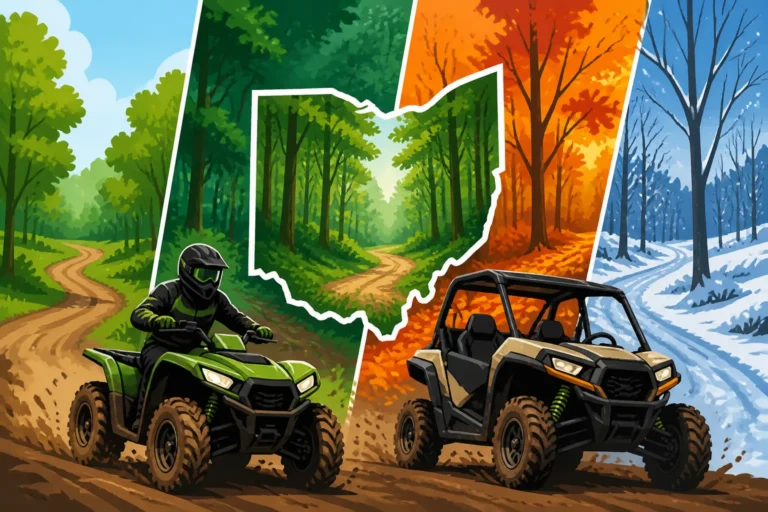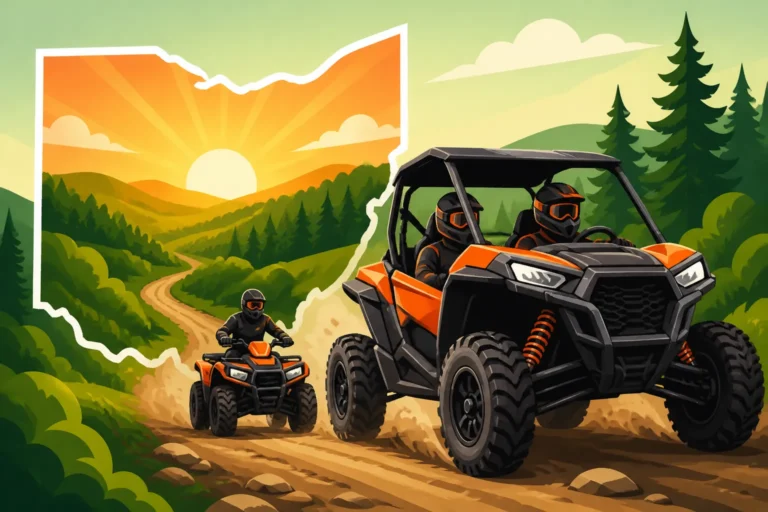
Ohio Trails Open in July
Ohio’s July riding season is a good fit for long daylight hours and dry-weather trail plans, but summer heat, thunderstorms, and temporary closures can still disrupt a trip. This guide explains which Ohio riding areas are generally open in July, how state forest trails differ from Wayne National Forest routes, and what to check before loading your machine.
Ohio ATV trails that are generally open in July
Ohio’s designated riding areas are usually in their regular riding season by July. That does not mean every route is guaranteed to be open on the day you arrive: weather damage, maintenance, land access, or a posted closure can change your plan. Check current official notices before you leave home.
State forest trails in July
Ohio’s state forest riding areas include Maumee, Perry, Pike, and Richland Furnace. Their trails follow seasonal schedules, and July falls within the usual riding season for these areas. Maumee is treated differently from the other state forest systems because it is generally available year-round, though individual trail conditions or restrictions can still affect access.
The trails are not interchangeable. A route that feels comfortable on a smaller quad may be tiring in a wider machine or after a heavy rain. Before choosing a destination, check its posted rules, trail layout, and width limits. Ohio’s state forest system has a 62-inch machine-width limit, so measure your machine rather than relying on a brochure description or a guess.
For a first July ride, a designated trail system is a more dependable choice than assuming an attractive forest road is open to ATVs. Some public lands allow other recreation but do not permit off-highway machines. [Ohio's Four State Forest APV Areas] explains the main state forest riding areas, while [Ohio's 62-Inch State Forest Width Limit] can help you determine whether your machine fits the rules.
Wayne National Forest riding areas
Wayne National Forest has several designated off-highway vehicle systems in southeast Ohio, including Monday Creek, Hanging Rock, and Pine Creek. These are separate from the state forest riding areas, so do not assume that a state forest plate or permit is the only requirement you need for a Wayne trip. Review the current Wayne National Forest rules and access requirements before setting out.
The systems are spread across the region, so your starting point matters. Monday Creek is near Nelsonville, Hanging Rock is in the southern part of the Wayne area, and Pine Creek is in the Ironton District. Decide which trail system you’re actually visiting before you plan fuel, lodging, or a meeting spot; “riding Wayne” can mean a substantial drive between different trailheads.
A map app can be useful for finding a route and keeping your group oriented, but it should not replace official land-manager information. onX Offroad can help with trip planning and navigation, while current notices from the forest office should guide decisions about closures, permitted routes, and local conditions. For system-specific background, see [Wayne National Forest's Three Ohio Systems] and [Ohio Trail Maps From ODNR].
Know the difference between a trail and an open road
An Ohio riding area is not permission to ride every road, field, or unmarked track nearby. Stay on signed routes and check the rules for the specific land you are visiting. A road that looks like a continuation of a trail may be outside the riding area, closed to machines, or subject to different access rules.
This distinction matters around trailheads and in rural parts of southeast Ohio, where private property, forest land, and public roads can sit close together. Don’t follow tire marks off a signed route just because another rider has been there. [Ohio Rules for Riding a State Forest] and [Ohio Rules for Riding a National Forest] cover the different land-management contexts.
How to plan a July ride around heat, storms, and crowds
July offers long days, but that doesn’t make every hour comfortable or every trail condition predictable. A little planning can help you avoid the most common summer frustrations: arriving at a closed entrance, riding through punishing heat without enough water, or getting caught far from the trailer during a storm.
Check openings and conditions before you tow
Before leaving, check the relevant land manager’s trail information and contact the local office if anything is unclear. Look for trail closures, construction or timber activity, access changes, and weather-related notices. A general map can show where a trail system is, but it may not tell you whether a particular segment is open that day.
The same habit applies after a storm. Heavy rain can leave clay slick, deepen ruts, or make a route difficult to pass. Even if the trail system remains officially open, conditions may be unpleasant or unsafe for your machine and riding ability. [Ohio Trail Conditions Before You Ride] and [Ohio Trail Closures to Check First] are useful starting points for building a pre-trip check into your routine.
If you use onX Offroad to plan, save the area before you lose cell service and confirm that the route you intend to ride matches the marked trail network. Treat app information as a navigation aid, not as confirmation that a route is open. In forested and hilly areas, cell coverage can be unreliable, so tell someone your plan and meeting time before you head out.
Start early and plan for summer heat
A July ride is often more comfortable if you get on the trail earlier in the day. Heat can build quickly, especially when you’re wearing protective gear and moving slowly through technical sections. Take water, schedule breaks, and pay attention to fatigue. A rider who feels fine at the staging area may feel very different after several hours of dust, humidity, and concentration.
Make your plan fit the least experienced rider in the group. If someone is new to riding, choose a shorter outing with room for breaks rather than committing to a long loop simply because the daylight allows it. Set a turnaround time before you start. That gives the group a clear point to head back even if everyone is having fun and the trail keeps tempting you onward.
Pack for a day that might change. Bring drinking water, snacks, basic tools, a first-aid kit, and a charged phone or other dependable communication option. Keep your registration and required documents accessible. A paper map or offline navigation option can be especially helpful if a phone signal drops in a valley.
Expect busier weekends and shared trails
Summer weekends can bring more riders to popular trailheads. Arriving early can make parking and unloading less stressful, and it gives you more choice about where to stage. If you’re riding with a group, agree on a lead rider, a sweep rider, and a clear place to regroup before moving out.
On a narrow trail, slow down when approaching others and leave room to pass safely where the route allows. Be especially patient around beginners and families. Dust can reduce visibility, and a rider around a blind bend may not know you’re coming. Keep your speed under control and avoid kicking up unnecessary dust near other people.
A busy weekend is also a good reason not to improvise. Stay on marked routes, keep the group together, and don’t follow someone else onto an unsigned track. For more on choosing timing and preparing for crowds, see [Ohio Trails That Fill Up on Weekends] and [Ohio Trail Etiquette on Narrow Trails].
Compare Ohio riding options before choosing a destination
Your best July destination depends on your machine, the kind of ride you want, and how much time you have. Use this overview to narrow your choices, then confirm details with the relevant land manager.
| Riding area | General July outlook | Useful planning point |
|---|---|---|
| Maumee State Forest | Generally available beyond the usual seasonal window | Check for local trail or access notices before going |
| Perry State Forest | Usually within the regular summer riding season | Confirm machine-width rules and current conditions |
| Pike State Forest | Usually within the regular summer riding season | Check route information and trailhead access |
| Richland Furnace State Forest | Usually within the regular summer riding season | Verify current openings and posted restrictions |
| Monday Creek | Usually a summer option in Wayne National Forest | Check Wayne-specific access requirements and closures |
| Hanging Rock | Usually a summer option in Wayne National Forest | Plan around the correct trailhead and local conditions |
| Pine Creek | Usually a summer option in Wayne National Forest | Confirm the route and access information for the Ironton District |
“Usually” is important here. Seasonal schedules give you a starting point, not a guarantee about a specific weekend. Weather, maintenance, and land-management decisions can affect access, so verify details close to your trip.
Choose based on machine size and riding experience
A machine’s width can narrow your choices before you even look at trail difficulty. If you ride a side-by-side, measure it carefully and check the applicable limit for the area you plan to visit. A machine that fits one riding venue may not be allowed on another. [Ohio Trails for a Wide Machine] can help you think through this issue before you make the drive.
Also be honest about your group’s comfort level. A challenging route can become a long, stressful day if a newer rider is struggling, the weather turns, or the group has no easy way to shorten its plan. Choose an area and route that match the least experienced person—not only the strongest machine.
Keep state forest and Wayne requirements separate
A common planning mistake is assuming that a requirement for one riding area applies everywhere. State forest access and Wayne National Forest access may involve different rules, permits, or visitor requirements. Check the instructions for the specific destination, not a general post about Ohio ATV riding.
If your group includes visitors from out of state, check what registration or permit information they need to carry. If you are renting, ask the rental provider which documents and equipment are included and whether you need to arrange anything separately. The responsibility to follow the land manager’s rules still rests with the rider. [Ohio APV Reciprocity With Other States] and [Ohio Temporary Permit for a Visitor] are useful for sorting out visitor questions.
A practical checklist for a July Ohio ride
A simple checklist can prevent a lot of last-minute frustration. You do not need to pack your garage, but you should know where you are riding, what the rules require, and how you’ll handle a change in conditions.
Before leaving home
- Choose a specific riding area and identify its trailhead.
- Check official access notices, seasonal schedules, and closures.
- Confirm that your machine meets the area’s width and equipment rules.
- Check registration, permit, and visitor requirements for that destination.
- Review the forecast and consider how recent rain may have affected conditions.
- Download or save navigation information for offline use.
- Share your destination and expected return time with someone who is not riding.
If you use onX Offroad, prepare your map before you lose service and make sure your group understands how to return to the staging area. Keep official maps or land-manager directions available as a separate reference. A phone with a map is helpful, but it is not a substitute for knowing the trailhead name and the planned route.
At the trailhead
Before unloading, read the posted notices and check for temporary restrictions. Make sure the group knows where vehicles are parked and where to regroup if riders become separated. Confirm that everyone has water, protective gear, and any required paperwork.
Take a moment to inspect the machine. Check tires, brakes, lights, fuel, and any loose cargo before entering the trail. A small problem noticed in the parking area is usually easier to deal with than the same problem several miles into a ride.
On the trail and after the ride
Stay on marked routes, yield thoughtfully, and keep a pace that allows you to react to other riders and changing terrain. Turn back if heat, weather, trail conditions, or mechanical trouble makes continuing a poor choice. Reaching the end of a planned loop is not more important than getting everyone back safely.
After the ride, check for mud packed around the radiator and moving parts, and look over tires, brakes, and the underside of the machine. Summer mud can hide damage, while dust can build up in filters. A quick cleanup and inspection can make the next ride easier to start.
For seasonal planning beyond July, [Ohio Trail Opening Day] and [Ohio Trail Closing Day] explain why the riding calendar matters. If your July plans change because of rain or closures, [Ohio Trails Open in Winter] can help you explore other seasonal options.
Disclaimer
This article is for general informational purposes only and does not constitute professional advice. Laws, prices and regulations vary by location and change over time. Consult a qualified professional for guidance on your specific situation.