Ohio Trails After Heavy Rain
A storm can turn a familiar Ohio trail into a slick, rutted route before you reach the first climb. The tricky part is knowing whether the ground is merely wet or too vulnerable to ride without causing damage or getting stuck. This guide explains how to assess conditions, make a safer go-or-no-go decision, and adjust your ride after heavy rain.
Why Heavy Rain Changes Ohio Trail Conditions
Soil, slopes, and drainage make a difference
Rain does not affect every trail in the same way. A firm, well-drained surface may remain rideable after a shower, while a nearby low spot holds water for hours or longer. On Ohio trails, changes in slope, soil, shade, and drainage can make conditions vary sharply within a single ride.
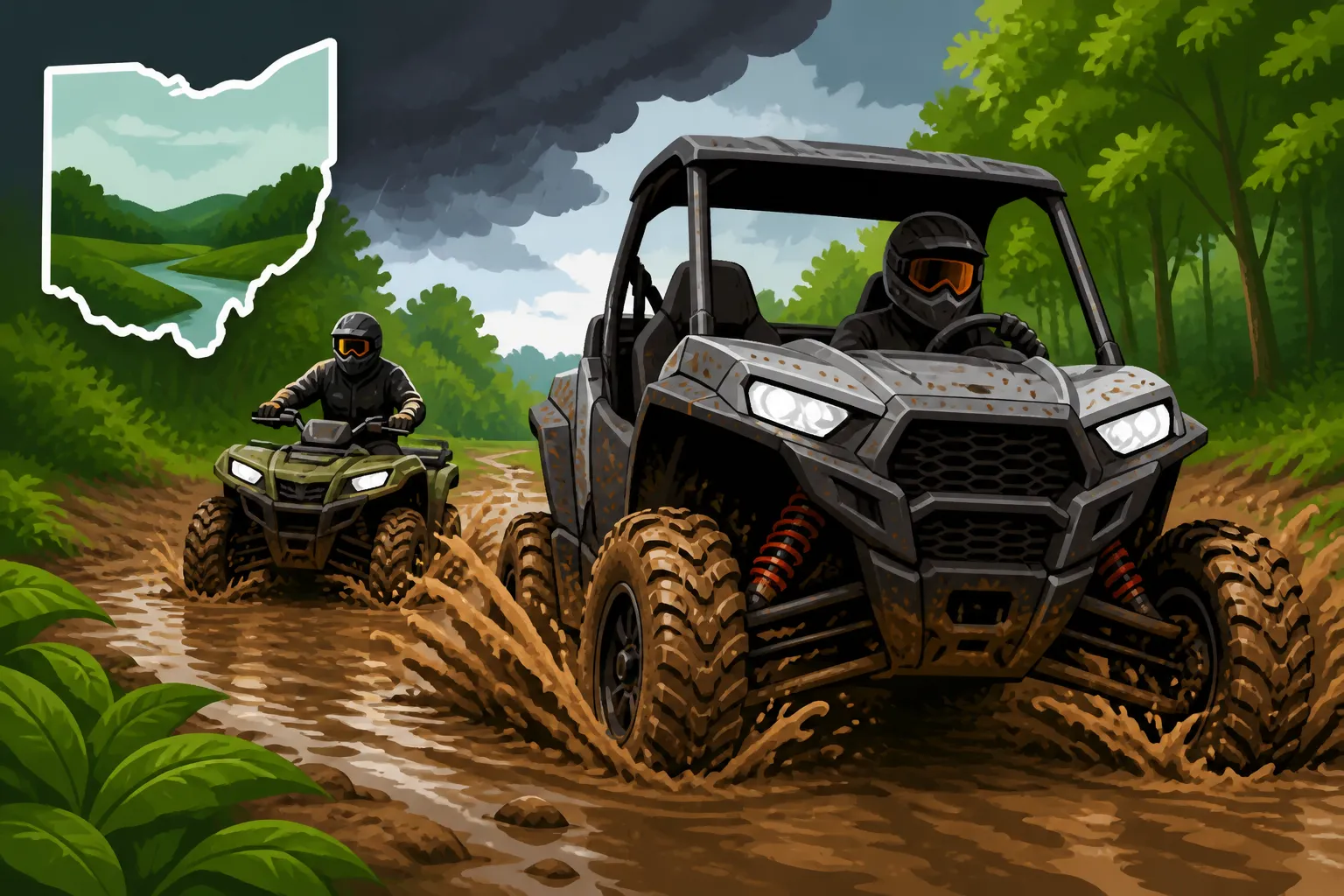
Clay is especially frustrating when it gets saturated. It can lose traction and cling to tires, fenders, and undercarriages, making even a modest incline feel difficult. On hills, a tire that spins instead of gripping can dig into the surface and create ruts. See [Clay That Turns to Grease] for more on why certain wet surfaces become so unpredictable.
Water can damage a trail after the rain stops
A trail may look manageable at the entrance but still be vulnerable farther in. Water can collect in dips, run down slopes, or cross the trail in places that were dry on your last visit. Even after rainfall ends, saturated ground may take time to firm up, particularly in shaded areas and low-lying sections.
Riding through soft ground can deepen existing ruts or create new ones. The damage is not always obvious from the seat: a single pass might leave a groove that channels later rainfall and makes erosion worse. If you see water flowing along the trail rather than across it, or soil shifting under your tires, treat that as a sign to turn around. [Ruts Left by a Wet Weekend] explains how repeated traffic can leave lasting trail damage.
Trail type and location affect what you encounter
Ohio’s riding areas include wooded routes, hills, reclaimed ground, and trail sections with different drainage patterns. Conditions at one part of a system do not guarantee conditions elsewhere. A route near the trailhead may be firm while a hollow, shaded stretch farther in stays wet.
That is one reason riders should avoid assuming that conditions at one system match conditions at another. Places such as Monday Creek, Hanging Rock, and Pine Creek are in different parts of southern Ohio, and local weather and ground conditions can differ. Before heading out, check the relevant land manager’s updates and look for [Ohio Trail Conditions Before You Ride]. If you are planning around steep terrain, [Ohio Trails With Hills] can also help you think through how slopes change the demands of a ride.
How to Decide Whether to Ride
Check conditions before loading the machine
Start with the latest information available from the organization responsible for the riding area. Look for closure notices, alerts about storm damage, seasonal restrictions, and any direction to avoid saturated ground. A trail that appears on a map is not necessarily open or suitable to ride on the day you arrive.
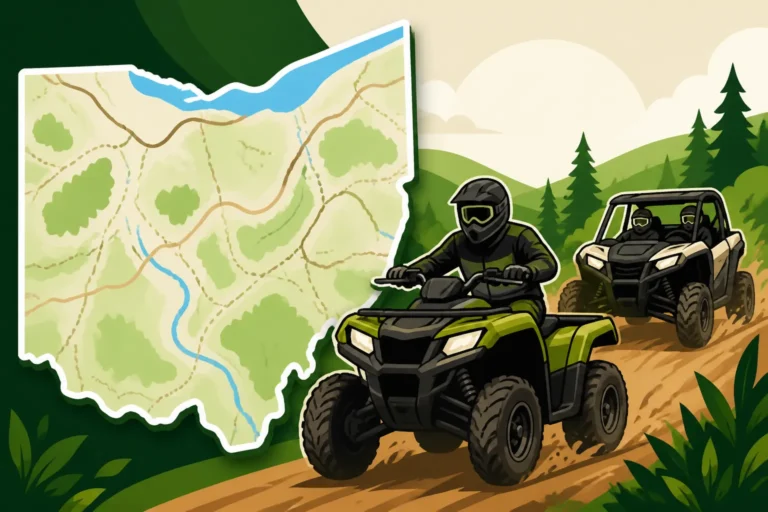
Mapping apps can help you understand where a route goes and how it fits into your plan. For example, onX Offroad can be useful for reviewing route information before a trip, but a map should not override a closure notice or a land manager’s instruction. Check current official information separately, especially after a major storm. You can also review [Ohio Trail Closures to Check First] before leaving home.
Consider the drive as well as the trail. Heavy rain may leave access roads, staging areas, and parking surfaces soft or muddy. If a truck or trailer could damage the lot or become stuck, postponing the trip is usually a better choice than trying to force your way in.
Read what the ground is telling you
When you arrive, pause before unloading. Look at the trail entrance, nearby low spots, tire marks, standing water, and the way the surface reacts to foot traffic. If the ground is already deeply marked by a few vehicles, your machine is unlikely to improve it.
A brief walk can reveal problems that are hard to judge from a seat. Pay attention to water running down the trail, soft edges beside existing ruts, exposed roots, and areas where the soil has started to wash away. If walking across a section leaves a deep imprint or your boot slides on a greasy slope, the trail may not be ready for more traffic.
The first stretch of a route can serve as a cautious check, but it should not become an excuse to keep going once conditions are clearly poor. If your tires begin spinning, the machine slides sideways, or you need repeated throttle to climb a small rise, stop and turn back rather than widening the trail to find firmer ground.
Use a simple go-or-no-go check
It helps to make the decision before excitement takes over. A group that has driven a long way may feel pressure to ride anyway, but travel time is not a reason to risk a damaged machine, an injury, or avoidable trail damage. Agree in advance that anyone can call off the ride if the conditions are not safe.
| What you notice | What it may mean | A sensible response |
|---|---|---|
| Shallow puddles on firm ground | Surface water without obvious soil movement | Proceed cautiously if the route is open and the surface stays firm |
| Tires leave deep tracks | The ground is soft and vulnerable | Turn around or choose a different activity |
| Water is flowing along the trail | Drainage may be compromised and erosion can worsen | Do not ride through the affected section |
| Tires spin on a gentle slope | Traction is poor and a rut may form quickly | Stop, avoid repeated attempts, and retreat if safe |
| Closure sign or official warning | The route is not open for riding | Follow the direction and leave the area |
This is a practical field check, not a substitute for official notices or your own judgment. If you cannot tell whether a route is open, or conditions change as you proceed, err on the side of stopping. For a deeper look at the decision after a stretch of wet weather, see [Riding After a Week of Rain].
How to Ride Responsibly If Conditions Are Suitable
Slow down and leave room to react
A wet trail can reduce traction and make braking less predictable. Keep your speed low enough to respond to a washout, a branch, standing water, or another rider around a bend. Leave more space than usual between machines so you are not forced to brake suddenly on a slick surface.
Use smooth inputs. Abrupt acceleration can spin the tires, while hard braking or sharp steering can make the machine slide. On a slope, avoid stopping where the surface is visibly soft if there is a safe alternative. If you do stop, do not use repeated throttle to claw your way out of a slippery patch.
Give your group enough time to handle obstacles one at a time. A rider who is negotiating a wet hill or narrow section should not feel rushed by machines close behind. Clear communication matters, particularly where sightlines are short and the route curves through trees.
Do not create a new line around mud
A tempting response to a muddy stretch is to ride around it. That can widen the trail, flatten vegetation, or lead into an area that is not part of the marked route. The alternative line may also be more dangerous than the original: it could slope toward a ditch, expose hidden rocks, or carry you onto private or restricted land.
If a muddy section is too difficult to cross without spinning or digging, turn around when you can do so safely. Do not widen the route by steering around the problem, and do not use a winch or another machine to pull a vehicle across ground that is clearly soft and vulnerable. Follow the marked route and any signs from the land manager.
This approach is especially important on narrow trails, where passing around one wet spot can disturb the edges for everyone. [Ohio Trail Etiquette on Narrow Trails] covers the courtesy and caution that help prevent one rider’s workaround from becoming a bigger problem for the group.
Adjust the plan for the group and the machine
A route that is manageable for one experienced rider on a suitable machine may be a poor choice for a mixed group. Young riders, passengers, newer operators, and machines with different tire setups all change how much time and space the group needs. On wet ground, a machine that feels stable on a dry climb may behave very differently.
Before setting out, agree on a turnaround point and a way to communicate if the group gets separated. Keep the ride within the ability of the least experienced rider, not the most confident one. If someone is uncomfortable with the traction or visibility, treat that concern seriously rather than asking them to push through.
Avoid treating a winch, aggressive tires, or a powerful machine as permission to tackle vulnerable ground. Recovery equipment can help in an emergency, but it does not make a saturated trail suitable for traffic. The goal is to return without injury, avoid unnecessary recovery, and leave the route in a condition other riders can use.
What to Bring and What to Watch for on the Trail
Prepare for changing weather and visibility
Rain can return, and clouds or dense tree cover may make it harder to see the surface. Carry weather-appropriate clothing, water, a charged phone, and a way to contact someone if your group has trouble. Cell coverage can vary by location, so do not assume you will be able to call for help from every part of a riding area.
A map can help with orientation, but do not rely on a screen alone. Save or review route information in advance if your mapping tool supports it, and keep an eye on signs at the trailhead. onX Offroad may help you plan and follow a route, while official notices and trail signage remain the authority on closures and permitted access.
Pack for a slower ride than usual. You may need extra time to navigate carefully, turn back, or wait for another rider. A plan that depends on covering a long distance quickly leaves little room for muddy sections, delays, or changing conditions.
Watch for hazards made harder to see by water
Puddles can conceal holes, rocks, or branches, and a shallow-looking crossing may have a soft edge. Do not charge into water simply because another rider crossed it. If you cannot judge the depth or the condition of the ground beneath it, choose a safe alternative or turn back.
Wet leaves and mud can hide roots and uneven ground. On hills, a downhill section may demand more control than the climb that brought you there. Keep a conservative pace, stay on the marked route, and do not ride so close behind another machine that you have no time to react if it slides or stops.
After heavy rain, also look for fresh debris, damaged trail edges, and signs of erosion. A route that was open before a storm may have a newly unsafe section. If you find damage or a hazard, do not try to repair the trail yourself unless the land manager has specifically authorized that work. Report the issue through the appropriate trail or land-management contact.
Know when to stop, turn around, or report a problem
A safe turnaround is a normal part of trail riding, not a failed trip. Turn back if a route is closed, the surface is breaking apart, your machine repeatedly loses traction, or a group member is no longer comfortable. The sooner you make that call, the less likely you are to become stuck beyond a difficult section.
Avoid turning around on a steep or narrow slope if doing so would put the machine at risk. Move to a safe, stable spot when possible, communicate with your group, and use the route you know is manageable. If conditions have changed enough that the return route is also questionable, prioritize safety and contact the appropriate authority for guidance.
When you report a problem, describe the location as clearly as you can, including a nearby trail marker, intersection, or recognizable feature. A note about flowing water, a washout, or a blocked section is more useful than a general message that the trail is muddy. Do not post a workaround that encourages riders to bypass a closure or travel off the marked route.
Planning a Better Ride After Rain
Choose flexibility over a rigid itinerary
A good wet-weather plan includes more than one option. You might choose a shorter loop, a different area with better drainage, or a non-riding day if conditions are poor. Be willing to change plans even after arriving: a trailhead is a place to assess the situation, not a promise that the ride must go ahead.
Check the forecast for the riding area itself, not just the town where you live. Conditions can vary across Ohio, and rain in one county does not tell you exactly what a trail farther away is experiencing. A mapping tool such as onX Offroad may help you understand the route and nearby access points, but contact official sources for current status before committing to a destination.
If you are planning around public forest trails, check relevant seasonal information as well as storm updates. Some closures are unrelated to rain, and an area that looks accessible on a map may have restrictions. [Ohio Trails Closed in Spring] is useful background when a ride falls near a seasonal transition.
Make the next trip easier with a short after-ride review
Once you return, note what you encountered while it is fresh in your mind. Record which sections were firm, where water collected, whether the staging area was muddy, and where the group turned around. This helps you plan more realistically next time and gives you a better sense of how that particular area responds to rain.
Clean and inspect your machine after riding in wet or muddy conditions, following the manufacturer’s maintenance guidance. Pay attention to mud packed around moving parts and cooling areas, and look for damage from hidden obstacles. A careful wash and inspection can prevent a small problem from being missed until the next ride.
Most importantly, leave enough time for the ground to recover when it needs it. Waiting for conditions to improve may feel disappointing when the weekend is already planned, but it protects the trail and helps keep the route enjoyable for the next visit. A responsible rider does not just ask whether a machine can get through; they also ask whether riding there today is a good choice for the trail.
Disclaimer
This article is for general informational purposes only and does not constitute professional advice. Laws, prices and regulations vary by location and change over time. Consult a qualified professional for guidance on your specific situation.