Measuring Against the State Forest Width Limit
A side-by-side can fit between the trees in your driveway and still be too wide for an Ohio state forest trail. The 62-inch limit can catch riders off guard, especially after adding tires, spacers, or accessories. This guide explains how to measure your machine carefully, what to include, and what to check before hauling it to a trailhead.
What Ohio’s 62-inch width limit means
Measure the machine, not just its advertised class
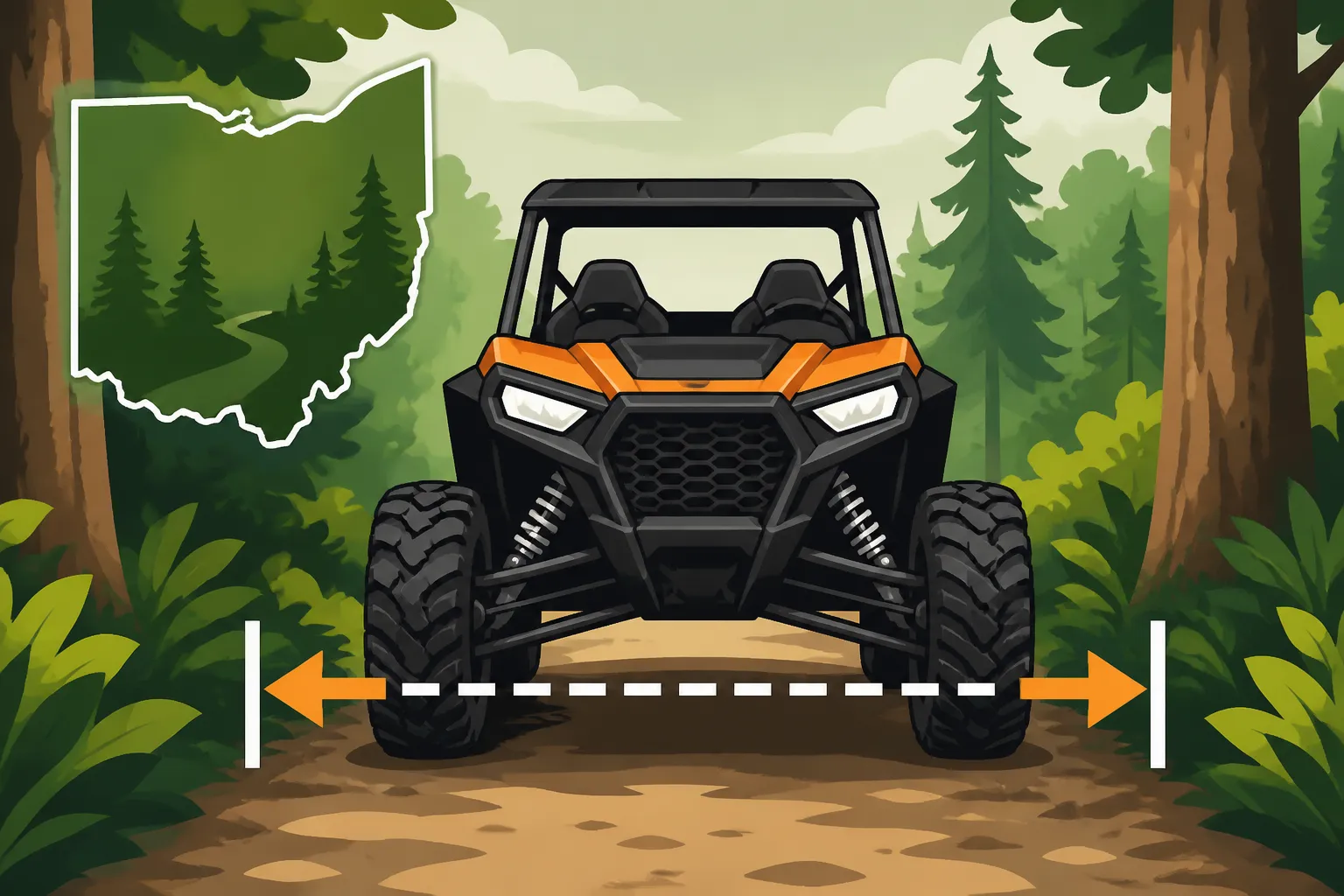
Ohio state forest trails have a 62-inch width limit for machines. That figure is a practical go-or-no-go check before a ride: if your machine is wider than the limit, do not assume it can use a state forest route just because it is registered, described as a trail machine, or fits on other trails.
The width printed in a brochure or product listing is a useful starting point, not always a safe final answer. Manufacturers may publish dimensions that reflect a particular trim, tire, or configuration. A previous owner may also have changed the machine. Wheel spacers, wider wheels, replacement tires, and other modifications can affect the actual width.
This matters most with side-by-sides, but it can matter with ATVs too. A quad that appears compact may have been widened with aftermarket parts. If you are choosing a machine mainly for Ohio forest riding, compare its actual setup with the limit before you buy. [Best Machine Width for Ohio Forests] is a useful companion topic if you are still deciding what size machine fits your plans.
Think about where the widest points are
The easiest mistake is measuring only the body panels. The widest points may be the outside edges of the tires, fenders, wheel arches, or installed accessories. A wide tire can extend past a fender; a fender flare may project beyond the tire. The important task is to identify the widest part of the machine as it is configured for riding.
Measure the vehicle in the condition you plan to take on the trail. If you regularly ride with a cargo rack attachment or another removable component, decide whether you will bring it and include it in your check. A plow or other bolt-on equipment may change the machine’s overall footprint, even if you remove it before trail riding.
Treat the limit conservatively. If your measurements are close to 62 inches, recheck them rather than rounding down. A small measuring error, a tire that bulges beyond its listed size, or an accessory you forgot to account for could change the result. For broader trail and machine considerations, see [Ohio's 62 Inch State Forest Width Limit].
How to measure your ATV or UTV at home
Set up the machine on level ground
Park on a hard, level surface such as a concrete garage floor or a flat driveway. Make sure the tires are set up as you intend to ride, and straighten the steering so the front wheels point directly ahead. If one front tire is turned outward, it may create an artificially wide reading.
Have a helper hold one end of a tape measure if the machine is too wide to measure comfortably alone. Measure across the machine from one outermost point to the opposite outermost point, keeping the tape straight and level. Do not let it sag or run diagonally around bodywork; either can produce a misleading result.
Repeat the measurement at the areas that might be widest. Check across the front tires and fenders, then across the rear tires and fenders. If an accessory, mirror, or other fixed part sticks out farther than those areas, measure that too. Write down the largest reading, not the one that looks most convenient.
Use a repeatable method and record what you find
A simple measurement is more useful when you can reproduce it. Note where the tape began and ended, which setup was on the vehicle, and the widest reading you found. Take a second measurement from the same points, and ask someone else to check if your result is close to the limit.
Here is a practical checklist:
- Park on level ground and straighten the steering.
- Identify possible widest points, including tires, fenders, and installed equipment.
- Measure across the front and rear at the widest points.
- Repeat each measurement and compare the results.
- Record the largest measurement and the machine’s current setup.
- Recheck after changing tires, wheels, spacers, or accessories.
If you use a digital trail map to plan a trip, remember that route planning and vehicle-width compliance are separate checks. Tools such as onX Offroad can help you organize route information, but a map does not establish whether your machine meets the width limit. Keep your own measurement record alongside your trip notes.
| Measurement or setup | What to check | Why it matters |
|---|---|---|
| Front end | Tire edges, fenders, and any protruding parts | Steering position can affect the reading |
| Rear end | Tire edges, fenders, and installed attachments | Rear tires or accessories may be the widest point |
| Tires and wheels | Actual installed size and position | Replacement parts can change overall width |
| Spacers | Whether they push wheels outward | The machine may be wider than its original configuration |
| Add-on equipment | Whether it stays on for the ride | Accessories can extend beyond the body |
| Close measurement | Repeat the check and measure conservatively | A small error can change whether the machine is within the limit |
Modifications and common measuring mistakes
Recheck after changing tires, wheels, or spacers
A machine’s width is not necessarily permanent. Wider tires, a different wheel offset, or wheel spacers can move the tire edges outward. Even if the body has not changed, the overall width may have. That is why a measurement made when you first bought the machine should not be treated as valid forever.
For example, imagine a UTV measured before its owner installed wider tires. The original measurement may no longer describe the machine that is now being loaded onto the trailer. Similarly, a quad that has been modified for stability or mud riding may have a wider stance than its factory configuration. Measure after the modification rather than relying on an old note or a model specification.
Keep the approach consistent: check the actual machine, not a friend’s similar model or an online listing for a different trim. If you are shopping for a wider side-by-side, consider in advance whether that limits your choices of Ohio forest routes. [Where to Ride a Side-by-Side Over 62 Inches Wide] addresses the planning question for machines that exceed the limit.
Avoid easy-to-miss measuring errors
Measuring from the outside of the body panels alone can understate the width if tires or accessories extend farther. Measuring with the wheels turned can overstate or distort it. Measuring on a sloped driveway may also make it harder to hold the tape level and compare both sides fairly.
Do not assume the machine is compliant because it can pass through a gate or because it has ridden on another trail system. Trail access rules can differ by land manager and location. A machine’s registration status also does not answer whether it meets a particular forest trail restriction. Before riding, read [Ohio Rules for Riding State Forest Land] and check the applicable trail information.
If you use onX Offroad to keep track of destinations or organize a planned outing, make a separate note of the machine’s measured width and configuration. That helps prevent a common mix-up: a route may look suitable on a map while the vehicle is not eligible to use the trail. For mapping and route decisions, you can also review [Ohio Trail Maps From ODNR] and [Ohio Trail Conditions Before You Ride].
What to do if your machine is close to or over the limit
If your measurement is close, verify before you travel
A reading very near the limit deserves another check. Confirm that the machine is on level ground, the steering is straight, and the tape is measuring between the actual outermost points. Repeat the measurement at the front and rear, and make sure any equipment you intend to bring is included.
If the repeated readings differ, do not pick the smaller one simply because it is more convenient. Check your technique or ask another person to measure it. When the result remains borderline, contact the appropriate land manager or check official Ohio trail guidance before setting out. [Ohio Trail Conditions Before You Ride] can help remind you to check conditions and access details rather than relying on a past visit.
Also check for route-specific information. A trail map may identify riding areas, but it does not replace posted restrictions or current instructions at a trailhead. Conditions, closures, and access details can change. onX Offroad may be useful as one part of trip planning, but use official land-manager information for rules and restrictions.
If it is over the limit, choose a compatible riding area
If your machine measures more than 62 inches, do not try to squeeze onto a state forest trail or assume that careful driving makes the width restriction irrelevant. Plan a different ride at a location that allows your machine’s width, and confirm the rules with that site before hauling there. [Ohio Trails for a Wide Machine] can help you explore the issue, while [Where to Ride a Side-by-Side Over 62 Inches Wide] is especially relevant if you ride a larger UTV.
You may also be able to change the machine’s configuration, but do not assume that removing one accessory will solve the problem. If wider tires or spacers are the reason it exceeds the limit, any modification should be made safely and in a way that suits the vehicle. Measure again after the work, rather than guessing from the parts removed.
For a family or group with machines of different widths, check each vehicle individually. A trail that works for the narrower ATV may not work for a wider side-by-side. Planning that distinction before you leave avoids the frustrating choice between turning around at the trailhead and taking a machine somewhere it is not permitted.
Disclaimer
This article is for general informational purposes only and does not constitute professional advice. Laws, prices and regulations vary by location and change over time. Consult a qualified professional for guidance on your specific situation.