Ohio’s Perry State Forest Trails
Perry State Forest is a tempting destination for an Ohio ATV or UTV day, but the ride goes more smoothly when you know what kind of trail system to expect, which rules apply, and what to check before unloading. This guide covers planning, machine fit, seasonal conditions, safety, navigation, and nearby trip logistics so you can spend less time guessing and more time riding responsibly.
What to expect on Perry State Forest trails
The setting and the riding experience
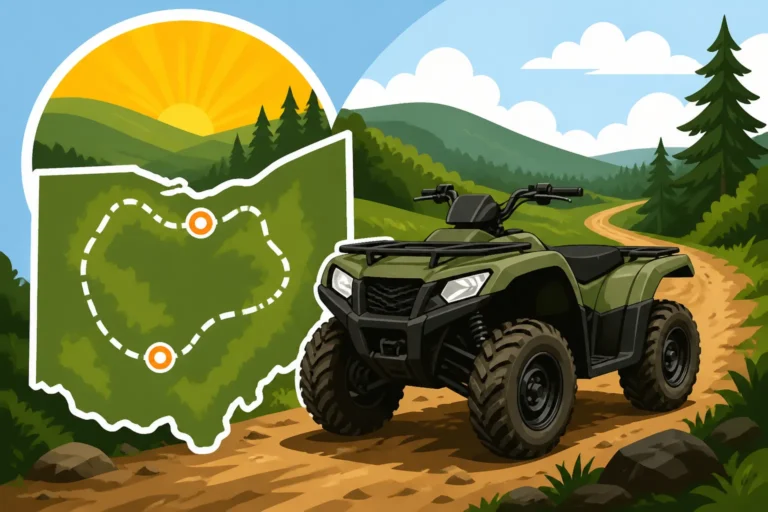
Perry State Forest is in Perry County in southeastern Ohio, within reach of communities such as New Lexington. It is a forest setting rather than a developed off-road resort: expect a ride shaped by wooded terrain, changing trail surfaces, and the conditions of the season. The system is often described as having about 16 miles of trails, but that figure should not be treated as a promise that every mile will be open on your chosen day. Closures, maintenance, weather, and posted restrictions can change what is available.
The miles are also not the only measure of whether the area suits your group. A shorter trail system can still make a satisfying day if you ride at a relaxed pace, stop to regroup, and take time to navigate carefully. On the other hand, riders expecting a large, interconnected network may want to plan a longer weekend around more than one riding area. For a broader comparison, see [Ohio's Four State Forest APV Areas](Ohio's Four State Forest APV Areas).
Keep the names straight when planning: Perry State Forest is not Perry State Park. A search result, map pin, or conversation that simply says “Perry” can send you to the wrong place. Confirm that your directions and riding information specifically refer to Perry State Forest in Perry County, then use the official forest information to identify access points and any notices that affect the ride.
How the trail mileage affects your plan
A trail system described as roughly 16 miles may sound easy to cover quickly, but the time you spend riding depends on trail conditions, group size, stops, and how comfortable everyone is with the terrain. A confident solo rider moving steadily will have a different day from a family group with a new rider, frequent breaks, and a slower machine. Build in time for regrouping instead of planning your day around a simple mileage calculation.
Before leaving home, decide what counts as a good day for your group. For some riders, that means completing the available loop without rushing. For others, it means riding a portion, taking a lunch break, and saving energy for the return drive. If a trail segment is closed or a machine needs attention, a flexible plan feels much better than one that depends on completing every mapped mile.
It also helps to set a turnaround time, especially if you are driving in from Columbus, Athens, or farther away. Agree on a meeting point before anyone rides ahead, and make sure every rider understands the route back to the staging area. On a compact system, that kind of planning may feel overly cautious; it becomes useful the moment somebody misses a turn, gets a flat, or needs to stop.
Check access, rules, and machine fit before you go
Confirm that the trails are open
Ohio state forest riding areas have seasonal operating periods and may close for weather, trail work, or other management reasons. Perry State Forest has commonly been associated with the seasonal forest riding calendar, but do not assume a trail is open simply because the date falls within the usual riding season. Check the latest posted information before you load your machine, and look again if heavy rain or other severe weather arrives close to your trip.
A closure can affect only part of an area, or it can change access to a route you planned to use. That is why it is worth checking both general forest notices and information specific to the riding area. [Ohio Trail Conditions Before You Ride] is a useful reminder that trail status is part of the trip plan, not a detail to sort out after arriving.
Pay particular attention during spring thaw, after prolonged rain, and near seasonal closing dates. Wet ground can be vulnerable to damage, and riding around a barrier or onto an unmarked route can create a safety problem as well as an access violation. If the area is closed, choose another legal place to ride rather than trying to find an unofficial way in.
Check registration, safety, and width requirements
Ohio’s state forest APV areas have rules for registration, protective equipment, rider age and supervision, operating hours, and where a machine may travel. Review the rules before the trip, and read posted notices at the forest entrance as well. Requirements can depend on the machine, rider, and riding location, so do not rely on a friend’s memory of what was accepted on a previous visit. [Ohio APV Permits Explained] gives more background on how Ohio registration relates to riding access.
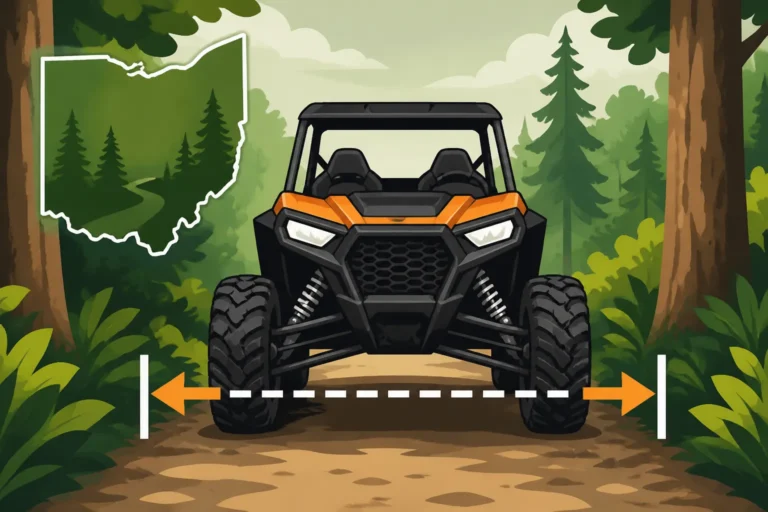
A machine’s width matters, particularly for side-by-sides. Ohio state forest trails are associated with a 62-inch width limit, but owners should confirm the applicable measurement method and posted rules for the area and machine. Measure the vehicle at its widest point rather than relying on a brochure description or a remembered model specification. The guide [Ohio's 62-Inch State Forest Width Limit] can help you understand why a machine that fits one riding area may not fit another.
Do not overlook the basics just because you are riding in a forest rather than on a road. Confirm that every rider has the required helmet and eye protection, that the machine is properly registered for the intended use, and that younger riders meet the rules for age and adult supervision. Keep your registration information accessible, carry the equipment you need for the ride, and obey posted speed and route instructions.
| Before you leave | What to verify | Why it matters |
|---|---|---|
| Trail status | Open areas, closures, maintenance notices, and seasonal dates | Prevents a wasted drive and keeps you off closed routes |
| Machine fit | Width and any other applicable vehicle restrictions | A machine may be unsuitable even if it is mechanically capable |
| Registration | Required Ohio registration and documentation | Access rules apply before the ride begins |
| Rider readiness | Helmet, eye protection, age and supervision requirements | Helps prevent avoidable safety and compliance problems |
| Route plan | Official map, access location, return route, and meeting point | Reduces confusion if riders become separated |
| Weather | Rain, heat, cold, and changing ground conditions | Conditions can alter traction and trail impact quickly |
Prepare for terrain and changing weather
Wet ground can change the ride
Rain can turn a familiar forest trail into a very different ride. Clay can become slick, ruts can hold water, and a shallow-looking puddle may hide a deeper hole or an uneven edge. In southeastern Ohio, wooded slopes and changing ground conditions make it especially important to slow down when visibility or traction drops. Resist the urge to follow tire tracks into a muddy section if you cannot see what lies beyond it.
The biggest mistake is often treating mud as a challenge to conquer rather than a reason to adjust the plan. Spinning tires can deepen ruts and damage the trail, while an abrupt throttle change can catch a rider off balance. If the trail looks unusually soft, choose a safer line only where permitted, ride gently, and turn around if continuing would mean leaving the marked route or causing damage.
After substantial rain, check for current guidance and be prepared to change destinations. [Ohio Trails After Heavy Rain] covers why a route that looked manageable on a dry weekend may not be appropriate after a storm. A second map source, such as onX Offroad, can help with general trip orientation, but it should not be treated as confirmation that a trail is open or that riding off the marked route is allowed.
Pack for a forest ride, not just a short loop
Even on a relatively compact trail system, bring enough water, food, and basic supplies for delays. A small tool kit, tire repair supplies that match your machine, a first-aid kit, and a charged phone can be helpful. Keep essentials secured so they do not shift or fall off over rough ground. If you ride with a group, decide who is carrying shared equipment and make sure the person leading knows where it is.
Dress for the forecast, but allow for conditions to feel different under tree cover. A warm day can still bring cool, damp stretches in the shade, and summer humidity can make a helmet and riding gear feel tiring. Take breaks before anyone becomes overheated or impatient. A rider who is hungry, dehydrated, or worn out is more likely to make a poor decision on a narrow or uneven trail.
Navigation is easier when you prepare before signal becomes unreliable. Save or print an official map if available, identify the access point and return route, and do not assume every rider will have phone service. onX Offroad may be useful as an additional planning and navigation reference, but compare its information with official forest maps and signs. A downloaded map does not replace trail markers, closures, or instructions from the managing agency.
Ride considerately and keep your group together
Use a pace that matches the least experienced rider
Groups tend to spread out when the front riders move at the pace they would choose alone. That can leave a newer rider feeling pressured to keep up, especially on a bend, hill, or muddy stretch. Set the pace for the least experienced person, and agree on a simple regrouping routine before starting. For instance, the lead rider can stop at a clear junction while the rear rider makes sure everyone has reached it.
On a narrow trail, give other riders room and avoid blocking the route while deciding where to go. Stop in a place where the rest of the group can see you and where you are not creating a hazard for approaching machines. Be patient around blind corners and limited-visibility sections; a quiet forest trail can still have traffic coming the other way.
Good trail manners matter even when nobody is watching. Stay on designated routes, avoid widening the trail to get around mud, and do not ride through vegetation or around a closure sign. [Ohio Trail Etiquette on Narrow Trails] is especially relevant when a group includes riders with different experience levels or machines with different handling.
Make a plan for separation or a mechanical problem
Before riding, choose a meeting point that everyone can identify, such as the staging area or a clearly marked junction. Agree that a rider who becomes separated will stop somewhere safe rather than continuing to guess at turns. Share the route plan with the whole group, not only the person carrying the map. A simple plan reduces panic and makes it easier to find one another if a rider needs to stop.
For a breakdown, think through the practical details before you leave the parking area. Can the machine be moved safely off the trail? Who has the tools or repair supplies? Does anyone in the group have a way to contact help if the phone has no service? A short conversation at the start can save a lot of frustration when everyone is tired and daylight is fading.
Do not wait until the end of the day to check how much time remains. Ohio state forest riding hours are limited, and darkness changes visibility even before the sun has fully set. Turn back with enough time to return safely, particularly if the group is unfamiliar with the route or the ground is wet. A planned early finish beats rushing through the last stretch.
Build a practical day trip around Perry State Forest
Plan the drive and arrival
Check the route to the correct forest access point before loading the trailer. A destination label alone may not be enough to guide you to the appropriate staging location, and a road that looks convenient on a map may not be suitable for a trailer. Use official access information, allow extra driving time, and avoid assuming that nearby roads are open to APVs simply because they reach the forest.
Before leaving, confirm that your trailer, tie-downs, tow vehicle, and machine are ready for the trip. Pack items you will need at the staging area where they are easy to reach, including registration documents, helmets, eye protection, water, and basic tools. If you are traveling with a group, confirm that everyone knows the meeting location and what time you plan to arrive.
For navigation, onX Offroad can be one tool for reviewing an area and organizing a route, but use official maps and on-site signs to confirm access and restrictions. Map layers can be useful for orientation; they do not give permission to ride on a closed trail, private property, or a road that is not open to APVs. If something conflicts, follow posted instructions and the managing authority’s guidance.
Decide whether to make it a longer visit
Some riders will be happy with a day trip focused on Perry State Forest. Others may want to make the drive more worthwhile by staying nearby or adding another legal riding destination to a separate day. If you are considering camping, confirm the specific site’s rules, availability, and distance from your chosen access point. Do not assume that a state forest riding area automatically provides camping at the trailhead. [Camping Near Ohio OHV Trails] can help you think through overnight logistics.
A longer trip needs more than a place to sleep. Check fuel availability, food options, trailer parking, and the time needed to travel between locations. If you plan to ride multiple systems, review their separate rules and seasons instead of assuming they all share Perry’s access requirements. [Ohio's Trail Season by Forest] is a useful starting point for comparing the timing of Ohio’s forest riding areas.
Keep the schedule realistic. A group that rides in the morning, stops for a meal, then drives to another trailhead may discover that there is not enough time to enjoy either place. It is often better to give one area a full, unhurried day than to squeeze in a second destination and finish tired or close to dusk.
A simple pre-ride checklist
Use this checklist the night before and again before unloading:
- Confirm that Perry State Forest trails are open and check for local notices.
- Verify the correct access point and review an official trail map.
- Check machine width, registration, and any applicable equipment requirements.
- Pack helmets, eye protection, water, basic tools, first aid, and a charged phone.
- Set a group pace, meeting point, and turnaround time.
- Check the forecast and be prepared to change plans after heavy rain.
- Follow trail markers and posted instructions throughout the ride.
- Leave enough time to return before the permitted riding period ends.
That preparation may feel like extra work for a short ride, particularly if you have visited before. But it prevents the most common frustrations: arriving at a closed area, discovering a machine does not fit the rules, losing time looking for the right access point, or rushing back as daylight fades. For Perry State Forest, a flexible plan and respect for the trail are just as important as a capable ATV or UTV.
Disclaimer
This article is for general informational purposes only and does not constitute professional advice. Laws, prices and regulations vary by location and change over time. Consult a qualified professional for guidance on your specific situation.