Ohio Rules for Riding to a Trailhead
It's a familiar scenario for many Ohio ATV and UTV enthusiasts: you've loaded up your machine, driven to a favorite riding spot, only to find the actual trailhead is just a short hop down a paved road. The thought of unloading your rig, riding 500 feet, and then loading it back up just to move to the official start can be incredibly frustrating. This guide will clarify the sometimes confusing landscape of Ohio's laws regarding riding your all-purpose vehicle (APV) on public roads, specifically when you're just trying to get to a trailhead.
The Nuance of Ohio's APV Road Rules
Let's be real: the idea of simply hopping on your quad or side-by-side and cruising down a public road to the trailhead, or even from one section of a trail to another, sounds like common sense to a rider. But Ohio's legal framework for All-Purpose Vehicles (APVs), which includes ATVs, UTVs, and even dirt bikes, doesn't always align with that common-sense approach. For the most part, APVs are considered off-highway vehicles and are not designed or permitted for widespread road use. This can lead to a lot of head-scratching and, unfortunately, potential citations if you're not absolutely clear on the rules.
The biggest hurdle for many riders is the lack of a blanket "street legal" designation for ATVs and most UTVs across the entire state. Unlike some other states where you might easily register your machine for full road use, Ohio's approach is much more granular and often relies on local governance. This means what's permissible in one township or county can be strictly forbidden just a few miles down the road, making that short ride to the trailhead a legal minefield if you're not informed. Many riders invest heavily in their machines, perhaps adding accessories from brands like SuperATV to enhance performance and utility, only to find they still can't legally drive them on local roads without specific local permission.
Where Riding to a Trailhead Might Actually Be Allowed
While a statewide "free pass" for APVs on roads doesn't exist, Ohio law does provide avenues for local jurisdictions—namely county commissioners and township trustees—to open their roads to APV traffic. This is where your hopes of legally riding to a trailhead or linking up trail sections truly lie.
County and Township Resolutions: The Local Lifeline
County Commissioners have the authority to pass resolutions that permit the operation of APVs on specific county roads or all county roads within their jurisdiction. Similarly, Township Trustees can vote to open township roads to APVs. This is a critical distinction because it means you need to know not just which county you're in, but also which township if you're planning to ride on a local road.
Imagine you're heading to a popular riding area like the Wayne National Forest. You might pull your trailer into a small community, only to find the forest entrance is a mile down a township road. Before you even think about unloading, you need to ask: Has this township passed a resolution? If so, what are the specific conditions? Do they only allow APVs on certain roads, or perhaps only during daylight hours, or with specific equipment requirements?
It's not always easy to find this information. You often have to contact the county engineer's office for county roads or the township fiscal officer or clerk for township roads. There isn't a single, readily available statewide map that tells you which roads are open, which is a common source of frustration for riders. For example, Washington County famously passed a resolution opening all its county roads to APVs, but that doesn't mean neighboring counties have done the same. You need to verify the local rules. Checking resources like [Ohio Counties That Allow APVs on Roads] or [Ohio Townships That Allow APVs on Roads] can provide a starting point, but always verify the most current details with local authorities.
Specific Road Types and Restrictions
Even if a county or township opens its roads, there are usually caveats. State routes and interstates, for instance, are generally off-limits for APVs, even if local roads feeding into them are open. You might be able to cross a state route, but riding along it is usually prohibited. Furthermore, many resolutions will specify speed limits for APVs, often significantly lower than the posted car speed limit, such as 35 mph. They might also require certain equipment, which we'll delve into shortly.
Consider the hypothetical situation where you're at a campground right on the edge of a trail system, but the only way to get from your campsite to the actual trail is to ride on a township road for a quarter-mile. If that township has passed a resolution, you might be in the clear, provided you meet all other requirements. But if they haven't, that short ride is technically illegal and could result in a citation under [Ohio Fines for Illegal APV Road Use]. This makes proper research paramount.
Crossing Roads Versus Riding On Them
There's a significant legal difference in Ohio between simply crossing a public road and riding along a public road, even for a short distance to reach a trailhead. Understanding this distinction is vital to staying on the right side of the law.
The Act of Crossing
Ohio law generally permits APVs to cross a highway, street, or public road, provided certain conditions are met. This is often the most common way riders interact with roads when accessing trails or moving between trail sections that are divided by a paved route.
Here's what typically applies when crossing a road:
- At a Right Angle: You must cross at approximately a 90-degree angle to the road. You can't just meander diagonally across.
- Safety First: You must yield to all vehicular traffic and proceed only when it is safe to do so. This means coming to a complete stop, looking both ways, and waiting for a clear break in traffic.
- Shortest Practical Distance: The crossing should be made along the shortest practical distance to continue your ride on the other side. You're not meant to drive down the road to find a "better" crossing point if a safe, direct option is available.
- No Riding on the Berm: While it might seem convenient to ride along the shoulder or berm for a short distance to get to a safer crossing point, this is generally not permitted unless the local resolution specifically allows for it. [Ohio Rules for Riding the Berm] often come with strict limitations.
For example, if the Monday Creek ATV Trails are split by a small county road, you'd be expected to cross directly at the marked trail intersection, not ride a half-mile down the road to get to a less steep crossing point if one exists. This emphasis on direct, safe crossing helps to minimize interaction with road traffic.
Riding Alongside or Along the Road
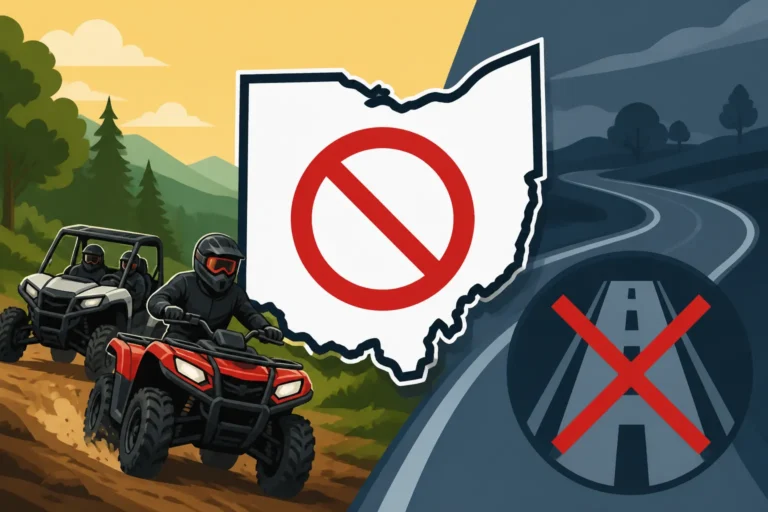
This is where things get considerably trickier for trailhead access. As we've discussed, Ohio does not have a statewide provision allowing APVs to ride along public roads, even for short distances like riding from a staging area to a nearby trailhead. For this to be legal, there must be a specific resolution from the county commissioners for county roads or township trustees for township roads.
If such a resolution exists, it will outline the conditions for riding along the road. These conditions often include:
- Specific Roads: The resolution might only apply to certain named roads, or it might exclude state routes.
- Time of Day: Some resolutions might limit APV road use to daylight hours only.
- Speed Limits: You'll almost certainly find a lower speed limit for APVs on these roads, often 35 mph or less. An unposted road defaults to 55 mph for cars, but that doesn't mean your APV can do the same. [Can You Ride an APV on an Unposted Ohio Road?] explains this in more detail.
- Lane of Travel: APVs are typically required to ride as far to the right as practicable, much like a bicycle, to allow other traffic to pass safely.
Without a local resolution, riding along any public road, even a quiet township lane for a short distance to the trailhead, is illegal. It's crucial to consult local ordinances. You can often find information on [How an Ohio Township Opens Its Roads] or [How an Ohio County Opens Its Roads] by checking their official websites or contacting their offices directly.
Equipment and Licensing for Road Use
Even if you're lucky enough to find a county or township that permits APVs on its roads for short hops to the trailhead, you're not entirely off the hook. There are specific equipment, registration, and licensing requirements that come into play when an APV ventures onto public pavement.
Ohio's Registration and Plate Requirements
First and foremost, any APV operated on public roads in Ohio, even if only for permitted crossing or short transit to a trailhead, must be registered with the Ohio Bureau of Motor Vehicles (BMV) and display a valid Ohio APV license plate. Your registration is proof that your machine is recognized by the state for off-highway and limited road use.
This isn't just a suggestion; it's the law. If a law enforcement officer sees you on a public road without a plate, even if you're crossing legally, you could be cited. The plate itself acts as your trail permit for Ohio's state forests, but on the road, it signifies your machine's legal standing. You can find detailed information on [Ohio APV Registration Paperwork] and [Ohio APV Plates and Validation Stickers].
Essential Equipment for On-Road Operations
For side-by-sides (UTVs), if a local resolution allows them on roads, they are often treated with a stricter set of equipment requirements, similar to a "low-speed vehicle" designation in some respects. This is where some riders might consider upgrading their machines with aftermarket parts from companies like SuperATV to ensure compliance.
For any APV (ATV or UTV) venturing onto an open public road, even if only briefly, common equipment requirements often include:
- Headlights and Taillights: These must be functional and illuminated when conditions require, especially after dark or in low visibility.
- Brakes: Fully operational brakes on all wheels are a must.
- Muffler and Spark Arrester: Your machine needs a proper muffler to keep noise levels down and a spark arrester to prevent forest fires, especially important when riding near dry vegetation.
- Rear-View Mirror: While not always explicitly stated for every short road crossing, a rear-view mirror is a sensible safety feature and may be required by local ordinances that permit riding along a road.
- Horn: A horn or other audible warning device can be essential for signaling other road users.
For UTVs that are allowed on roads, the requirements typically go further and can include:
- Turn Signals: Both front and rear turn signals are often mandatory for indicating your intentions to other drivers.
- Windshield: A safety glass windshield with a working wiper system is a common requirement for UTVs on public roads.
- Seatbelts: Occupants must be restrained by seatbelts if the vehicle is equipped with them (which most UTVs are).
It's crucial to check the specific resolution passed by your county or township, as they may add their own specific equipment mandates. You can learn more about general requirements in [Ohio Equipment Rules for an APV on a Road] and [Ohio UTV Road Equipment List].
Driver's License and Insurance
If you are operating your APV on any public road, even for a short trip to a trailhead where it's legally permitted, you must possess a valid Ohio driver's license. This isn't just for cars; it applies to any motorized vehicle on public thoroughfares.
Furthermore, proof of financial responsibility (i.e., insurance) is usually required. While standard APV insurance might cover off-road incidents, you need to verify if your policy extends to liability coverage for road use, even if limited. Some local resolutions specifically mandate a certain level of liability insurance for APVs on their roads. Always carry proof of your license and insurance with you when riding. [Ohio APV Registration and Insurance Proof] is just as important as the registration itself.
This table provides a quick overview of what to keep in mind for road interactions:
| Action | General State Rule | Local Resolution Needed? | Common Requirements (if allowed) |
|---|---|---|---|
| Crossing a Road | Generally permitted if safe and at right angle | No (state law allows) | Valid Ohio APV plate, Ohio driver's license, yield to traffic, proceed when safe, headlights/taillights (if applicable), proof of insurance. |
| Riding Along a Road | Generally prohibited statewide | Yes (County/Township) | Valid Ohio APV plate, Ohio driver's license, proof of insurance, headlights/taillights, brakes, muffler, spark arrester, specific UTV equipment (turn signals, windshield, horn), adherence to local speed limits/conditions. |
| Riding the Berm | Generally prohibited unless specifically allowed locally | Yes (County/Township) | (Same as "Riding Along a Road," plus specific berm riding rules if applicable). |
| State Routes | Generally prohibited for riding, crossing only permitted | No | (Crossing only: Same as "Crossing a Road") |
Always remember that even with a resolution, you're still sharing the road with cars, trucks, and other vehicles. Safety and visibility are paramount, especially when your machine might be smaller and slower than typical road traffic. Be aware of your surroundings, ride defensively, and make sure your machine is visible to others, perhaps with a flag or bright riding gear.
Disclaimer
This article is for general informational purposes only and does not constitute professional advice. Laws, prices and regulations vary by location and change over time. Consult a qualified professional for guidance on your specific situation.