Why an APV Needs a Plate and a Sticker
There's a common bit of confusion that I hear from new (and sometimes even experienced!) APV owners here in Ohio, and it often revolves around the little metal plate and that small, unassuming sticker. Many folks scratch their heads wondering why they need both, or what the real difference is between them. This guide is here to cut through that confusion, clearly explaining the distinct roles and critical importance of both your Ohio APV plate and its validation sticker, ensuring you understand exactly why each is a non-negotiable part of legal operation.
The Ohio APV Plate: Your Machine's Primary Legal Identity
When you get an all-purpose vehicle registered in Ohio, that metal plate is more than just a piece of stamped metal; it’s the state’s formal recognition of your machine. It’s the primary identifier that links your ATV, UTV, or dirt bike to you, the owner, in the official state database. This connection is absolutely critical for everything from law enforcement identification on trails or permissible roads to facilitating property recovery if your machine is ever stolen. Think of it as your APV's official identity card, much like your car has a license plate, albeit specifically tailored for off-highway use with unique markings.
What Your Plate Truly Represents
This unique identifier allows the Ohio Bureau of Motor Vehicles (BMV) to effectively track your registration status and ensure compliance with state laws governing all-purpose vehicles. Without this physical plate properly displayed, your machine is essentially operating outside the bounds of state regulation, making it illegal to operate on any public land or county/township roads where APVs are otherwise allowed. It truly is the foundational piece of your machine's legal standing in Ohio, establishing its legitimate presence.
Furthermore, the plate serves as tangible proof that you've paid the necessary [Ohio APV Registration Cost] and gone through the proper administrative channels, such as accurately completing [Ohio Form BMV 3722 Explained] at a Deputy Registrar. This isn't just a tedious bureaucratic hurdle; the fees collected through this process are vital. They contribute significantly to the State Recreational Vehicle Fund, which directly supports the maintenance, development, and improvement of off-road trails and facilities across Ohio, benefiting all riders.
The plate itself is a consistent identifier. Unlike the sticker, which changes annually or every few years, the plate number typically remains the same for the life of the machine under your ownership (unless it's lost or damaged and requires replacement). This consistency ensures long-term traceability and a stable record for your vehicle, simplifying future transactions or inquiries.
Physical Characteristics and Required Placement
The Ohio APV plate is typically a small, robust metal plate, designed to be easily recognizable and durable enough to withstand the challenging conditions these machines often encounter. It usually features the state name, a distinctive alphanumeric sequence unique to your machine, and often the designation "APV" or "All-Purpose Vehicle" to clearly differentiate it from standard passenger vehicle plates. You'll receive this crucial identifier after successfully completing the initial [Registering an APV in Ohio] process.
Ohio law is remarkably specific about the required placement of this plate: it must be clearly and securely displayed on the rear of your all-purpose vehicle. This isn't just a casual suggestion; it's a non-negotiable requirement designed to ensure that law enforcement and other trail users can easily identify your machine from a reasonable distance. Any obstructions, such as excessively muddy conditions, oversized cargo bags, or modifications that intentionally or unintentionally obscure the plate, could potentially lead to a citation for non-compliance.
As an APV owner, maintaining your plate is part of your ongoing responsibility. Ensuring it remains securely mounted and kept reasonably clean is paramount. A loose plate that rattles off during a bumpy ride or one so caked in mud that it's unreadable can cause unnecessary complications during a trail ride or a compliance check. If, despite your best efforts, your plate ever gets damaged, becomes unreadable, or is lost, understanding the process for [Ohio APV Plate Replacement Cost] is essential to quickly regain compliance.
Beyond the Trails: Road Use Implications
While an APV plate's primary role is for off-highway identification, its significance becomes even more pronounced if you intend to operate your machine on any public roads that have been explicitly designated as open to APVs by a local county or township resolution. In these specific circumstances, the plate acts as a foundational component of your vehicle's road-legal identity, working in conjunction with any other required safety equipment like headlights, taillights, and turn signals.
Without a valid, properly displayed APV plate, you simply cannot legally operate your machine on any open county or township roads, regardless of whether you meet all other equipment requirements or possess valid insurance. For any law enforcement officer, the plate serves as the very first visual confirmation that your machine has successfully navigated the basic state registration mandates, allowing for that initial lawful presence on the road.
This distinction holds particular weight for machines like side-by-sides, which riders might more frequently consider for short road crossings between trails or brief journeys on designated, low-speed roads. The presence of a current plate clearly signifies that your machine is officially recognized by the state and possesses a legitimate right to be on that road, strictly within the specific conditions permitted by local ordinances and state statutes.
The Ohio Validation Sticker: Your Proof of Current Status
If your APV plate is akin to its government-issued identity card, then the validation sticker functions as the dynamic expiration date on that card. This small, yet critical, adhesive decal prominently displays the month and year when your current registration period officially concludes. It serves as immediate, visual proof that your [Ohio's Three-Year APV Registration] is fully active and current, allowing anyone—from a vigilant park ranger to a trail warden—to quickly confirm your legal standing.
What the Sticker Signifies
Unlike the metal plate, which typically remains with the machine for its lifespan (unless replaced due to damage or loss), the validation sticker is the element that changes with each successful renewal cycle. It is the dynamic component of your registration, visually reflecting the periodic payment and re-validation process you undertake every three years. You will receive a brand-new sticker with an updated expiration date each time you renew your registration, ensuring the visible date is always current.
The immediate visibility of this sticker is particularly important for compliance checks in less formal settings, such as remote trailheads or during routine patrols. Law enforcement and trail management personnel don't have to radio in your plate number to a central database to ascertain registration validity; a quick glance at the clearly displayed sticker provides instant verification that you are riding legally. This efficiency minimizes unnecessary stops and streamlines enforcement efforts, making the experience smoother for compliant riders.
This active proof of registration is crucial for access to many riding areas. Whether you're on a state forest trail or a county-approved road, the sticker is often the first thing an official will look for. It's the quick visual "OK" that tells them you've done your part to comply with Ohio's APV laws. Without it, even if you have your physical registration card, you could be delayed or cited.
Attaching Your Sticker Correctly
Ohio law is quite precise in its directive for affixing the validation sticker: it must be placed in the upper right corner of your APV license plate. This exact placement is crucial for maintaining uniformity across all registered all-purpose vehicles, making it consistently easy for officials to locate and accurately read the expiration information. While it might seem like a minor detail, adhering to this specific rule is an integral part of demonstrating full legal compliance. For explicit visual guidance on its correct positioning, you can often find diagrams or instructions, sometimes even within a guide like [Where an Ohio Sticker Sits on the Plate].
Prior to applying your new sticker, it's vital to ensure that the surface of your APV plate is thoroughly clean, dry, and free of any dirt, grease, or old adhesive residue. This meticulous preparation guarantees optimal adhesion, preventing the sticker from peeling or bubbling prematurely. It's also a good practice to carefully remove any expired stickers from previous registration cycles, as multiple layers can not only make the new one less secure but also also make the current date harder to discern, which could be problematic.
Remember the harsh environmental elements your machine often encounters – abrasive mud, standing water, intense sunlight, and potentially scraping brush. Although the sticker is manufactured to be durable, proper application significantly contributes to its ability to last securely for the entire [How Long an Ohio APV Registration Lasts]. Taking a moment to apply it carefully and correctly after receiving your renewal can genuinely save you from the hassle and potential expense of needing a replacement down the line.
Reading the Expiration and Renewal
The month and year clearly printed on your validation sticker are your definitive indicators of precisely when your current registration period concludes. In Ohio, APV registrations operate on a consistent three-year cycle, with all registrations universally expiring on December 31st of the third year of their validity. So, for instance, if your sticker prominently displays "DEC 26," it unequivocally means your registration is legally valid and in force until the very last day of December 2026.
It's an excellent habit for any responsible rider to check their sticker at least a few months prior to the printed expiration date. Ohio law is quite accommodating in this regard, allowing you to commence the [Renewing an Ohio Registration Ninety Days Early]. This generous window provides ample time to complete the renewal process without feeling rushed, avoiding any last-minute stress, particularly around the busy year-end holiday season when Deputy Registrar offices might experience higher traffic. Don't delay in getting your updated [What an Ohio Renewal Costs].
Operating your APV with an expired validation sticker carries the same legal weight as riding without any registration at all – it signifies that your machine's registration isn't current, and you could face significant consequences, including [Ohio Fines for an Unregistered APV]. Even if you diligently completed your renewal transaction online or at the counter, you absolutely need that new physical sticker affixed to your plate as definitive and immediate proof of your current legal registration status.
The Combined System: How Plate and Sticker Work Together
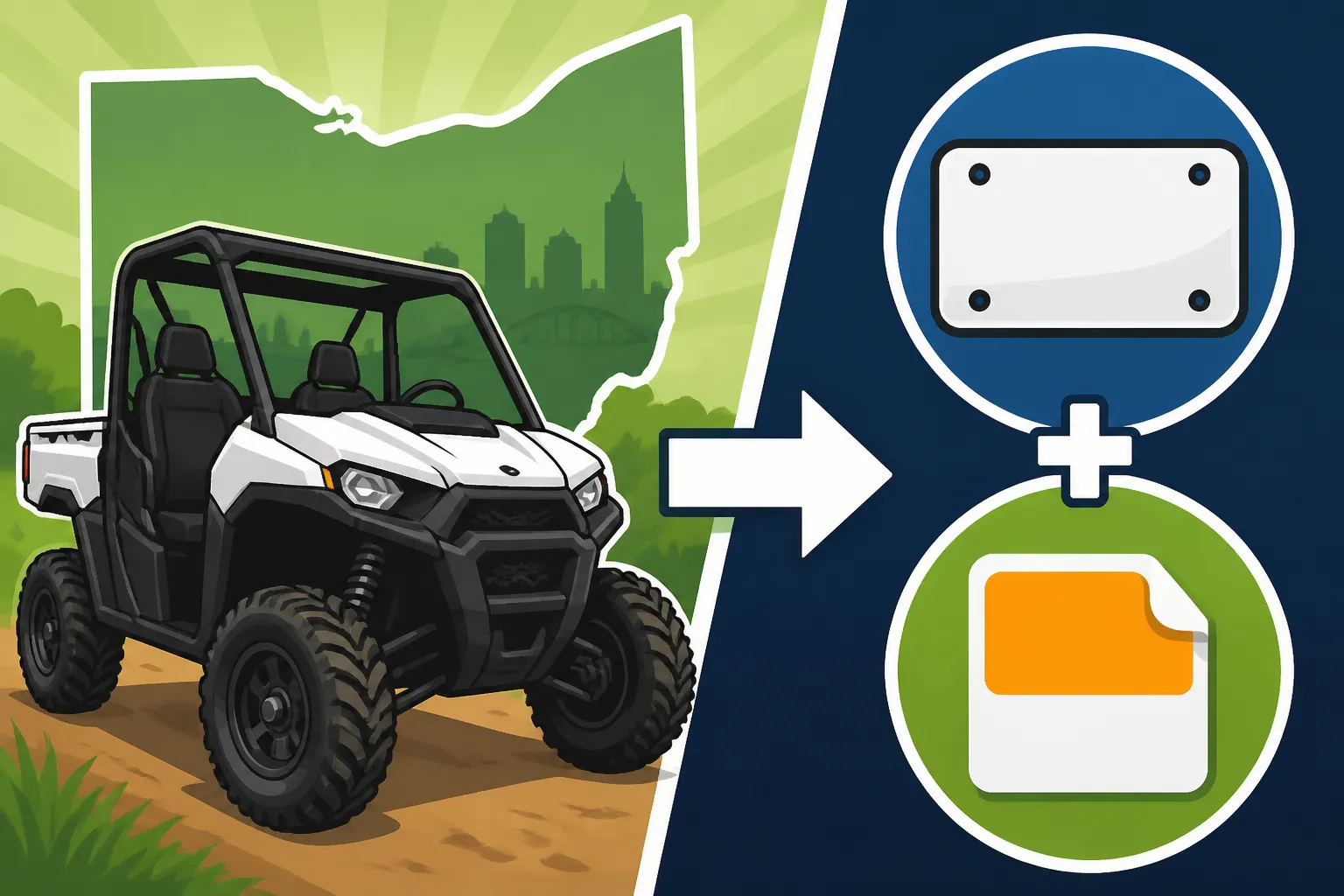
In Ohio, the APV plate and the corresponding validation sticker are meticulously designed to function as an integrated, comprehensive system of identification and continuous proof of current registration. The metal plate provides the unique, semi-permanent identifier that links the machine to its owner, while the sticker acts as the dynamic confirmation that this specific identifier is presently active, valid, and fully paid for. For legal operation on any public lands or approved roadways in Ohio, you absolutely cannot have one without the other.
The Two-Part Proof System
This thoughtfully implemented two-part system offers a robust and highly efficient method for authorities to quickly and accurately verify the legal status of your machine. It effectively prevents confusion, minimizes ambiguities, and makes enforcement efforts both straightforward and consistent. Imagine the logistical nightmare if every single officer had to radio in every plate number just to determine if the registration was current! The visual sticker makes that initial, crucial check immediate and significantly more efficient.
For your own peace of mind, and to ensure uninterrupted riding enjoyment, always make it a point to verify that both your plate is present and clearly visible, and that your sticker is current and correctly affixed. Simply possessing the plate is insufficient if the sticker has expired or is missing, and conversely, having a valid sticker attached to an incorrect or unassigned plate is equally problematic and illegal. They are, without exaggeration, two essential halves of a complete whole, meticulously engineered to provide undeniable and comprehensive validation of your APV's legal operating status.
This dual-component system ensures that both permanent identification and temporary validity are easily discernible. It's a pragmatic solution that simplifies roadside checks and minimizes disputes about a machine's legal status. Understanding that one without the other renders your registration incomplete is key to avoiding any unnecessary trouble.
The Registration Process Unpacked
When you undertake the initial process of [Registering an APV in Ohio], you'll follow a series of steps that ultimately culminate in you receiving both your distinctive metal plate and your very first validation sticker. This comprehensive process typically involves accurately completing all necessary [Ohio APV Registration Paperwork], furnishing appropriate proof of ownership (such as a manufacturer's certificate of origin for a new machine, or a properly executed bill of sale for a used one), and remitting all required fees. Sometimes, gathering and preparing these crucial documents can be streamlined and made less daunting with the assistance of online tools from reputable services like LawDepot, especially if you need to draft a custom bill of sale or other supporting legal forms to document your purchase.
The application is primarily processed at a Deputy Registrar's office, which is the local branch authorized to handle vehicle registrations. Once your application is thoroughly reviewed and approved, you'll either be issued the physical plate directly on the spot, or it will be mailed to you, along with the corresponding initial validation sticker. This ensures that from the very first day your registration is active, your all-purpose vehicle is properly equipped with both mandatory identifiers as mandated by state law.
This foundational initial registration grants you legal operating privileges for a full three-year period, specifically aligning with [Ohio's Three-Year Registration Cycle]. Gaining a clear understanding of this predictable cycle from the outset is immensely helpful, as it enables you to anticipate precisely when your next renewal will be due, thereby preventing any inadvertent instances of riding with expired or non-compliant identification.
What Happens If One Is Missing or Damaged?
It's a critical point for all Ohio APV riders: operating your machine without either a valid, clearly displayed plate or a current, readable validation sticker constitutes a direct violation of Ohio law. If your APV plate is unfortunately lost, becomes stolen, or is rendered unreadable due to severe damage or excessive wear, it is imperative that you initiate the replacement process as quickly as possible. Similarly, if your validation sticker peels off, fades beyond recognition, or is otherwise compromised, you are legally obligated to obtain a replacement to maintain continuous compliance. The state explicitly mandates the presence and readability of both for legal operation on public lands or officially approved roads.
For a lost or stolen plate, the initial crucial step often involves filing an official police report. This report is frequently a prerequisite before you can even apply for a replacement plate through the BMV. In the case of a lost or damaged sticker, you typically need to contact a Deputy Registrar's office or the BMV directly to request a new one, which usually involves a nominal replacement fee. This swift action isn't solely about sidestepping potential fines; it's fundamentally about maintaining your machine's legal identity and unequivocally proving its current registration status to any inquiring authority.
Therefore, do not underestimate the potential inconvenience and financial implications of receiving a citation or being subjected to a lengthy roadside or trailside stop by an officer. Always adopt a proactive stance to ensure both your APV plate and its accompanying validation sticker are in impeccable order and properly displayed. Keeping digital or physical copies of your most recent registration paperwork readily accessible, perhaps within a secure, waterproof compartment on your machine, can also serve as a valuable backup, especially if you leveraged a service like LawDepot to organize any specific personal legal documentation related to your APV's ownership history.
Differences from Snowmobile Registration
It's a common point of confusion for riders who own both APVs and snowmobiles in Ohio: why does one get a metal plate and a sticker, while the other just gets decals? The answer lies in the distinct nature of their primary operating environments and historical regulations. Snowmobiles, by their very design and typical use, operate almost exclusively on snow-covered terrain, often in areas where a traditional metal plate would be cumbersome or easily damaged by snow and ice.
Why Snowmobiles Get Decals Instead
This is a frequent source of bewilderment for many recreational vehicle enthusiasts in Ohio who happen to own both an all-purpose vehicle and a snowmobile: why does one necessitate a rigid metal plate and a validation sticker, while the other is identified solely by adhesive decals? The rationale behind this distinction is rooted deeply in the unique nature of their primary operating environments and the historical evolution of their respective regulatory frameworks. Snowmobiles, by their fundamental design and their almost exclusive operational domain on snow-covered terrain, often traverse areas where a traditional, protruding metal plate would be cumbersome, prone to damage from snow, ice, or deep powder, or simply less practical to mount effectively.
In contrast to the limited flat space often available on the rear of many APVs, the larger, smoother surface areas found on a snowmobile's cowl or tunnel provide an ideal canvas for decals. These decals, which are typically designed to be larger and more easily visible than a small APV sticker, provide all the necessary registration numbers and critical expiration information in a format that is far better suited for the harsh realities of winter conditions and the specific, often curved, mounting locations on a snowmobile. This intentional difference is explicitly codified within Ohio law to intelligently cater to the distinct operational characteristics and design requirements of each specialized type of recreational vehicle.
This specialized approach unequivocally reflects a deliberate and practical consideration of how each machine is predominantly utilized. While an APV is built to navigate diverse terrains—including dry dirt trails, thick mud, and occasionally even approved paved roads—thus requiring a more rigid, universally recognized identification plate, a snowmobile inherently demands an identification method that seamlessly integrates with its aerodynamic design and function for efficient operation in deep snow and frigid temperatures. For a deeper dive into these regulatory nuances, you might find valuable information in articles specifically addressing [Why a Snowmobile Gets Decals Instead of a Plate].
Implications for Multi-Sport Riders
For those of us fortunate enough to indulge in both the thrill of summer off-roading with an APV and the exhilaration of winter snowmobiling, comprehending these distinct identification differences is absolutely fundamental to maintaining continuous legal compliance. It's a common misconception, but you simply cannot affix a snowmobile decal to your quad and expect it to satisfy the law, nor can you assume your APV plate will suffice for your snowmobile. Each type of machine is endowed with its own unique and mandatory registration requirements and corresponding identification formats.
What this practically means is that if you are the proud owner of both an all-purpose vehicle and a snowmobile, you will be navigating two entirely separate, though often structurally similar, registration processes. You will be required to complete distinct sets of paperwork, pay separate and specific registration fees for each, and ultimately receive different forms of identification tailored to each machine. It is unequivocally not a one-size-fits-all regulatory system, and recognizing this crucial distinction from the outset is paramount to avoiding potential fines and ensuring seamless enjoyment of your recreational pursuits.
Keeping meticulous track of your various registrations, especially if your garage houses multiple machines or if your household has several riders, can admittedly feel like a considerable administrative task. Employing organized record-keeping systems, or even consulting reputable resources that specialize in legal forms, such as LawDepot, for assistance with documentation specific to each machine, can be incredibly beneficial. Such proactive measures help ensure that you have all your necessary legal "ducks in a row" for both your treasured APV and your high-performing snowmobile, year-round.
Plate vs. Sticker: A Quick Comparison
To help you keep these two vital identifiers straight, here's a brief breakdown of their key features:
| Feature | APV Plate | Validation Sticker |
|---|---|---|
| Purpose | Primary vehicle identifier; links machine to owner; legal recognition. | Proof of current, active registration; expiration date. |
| Appearance | Small, metal plate with alphanumeric sequence; "APV" designation. | Small, adhesive decal with month and year. |
| Longevity | Semi-permanent (replaces only if damaged/lost). | Replaced every three years upon renewal. |
| Placement | Rear of the APV, clearly visible. | Upper right corner of the APV license plate. |
| Significance | Establishes legal identity. | Confirms current payment and validity of identity. |
| Renewal Impact | Remains the same upon renewal. | New sticker issued with new expiration date. |
Disclaimer
This article is for general informational purposes only and does not constitute professional advice. Laws, prices and regulations vary by location and change over time. Consult a qualified professional for guidance on your specific situation.