What a Visitor From a Registering State Must Show
A visiting rider can arrive in Ohio with a valid registration and still be unsure what to carry or whether it counts on the trails. The key is reciprocity: Ohio recognizes proof of registration from some states, while visitors from states without reciprocity need a different permit. Here’s what to have ready and what to check before you unload.
What a visitor from a reciprocating state must show
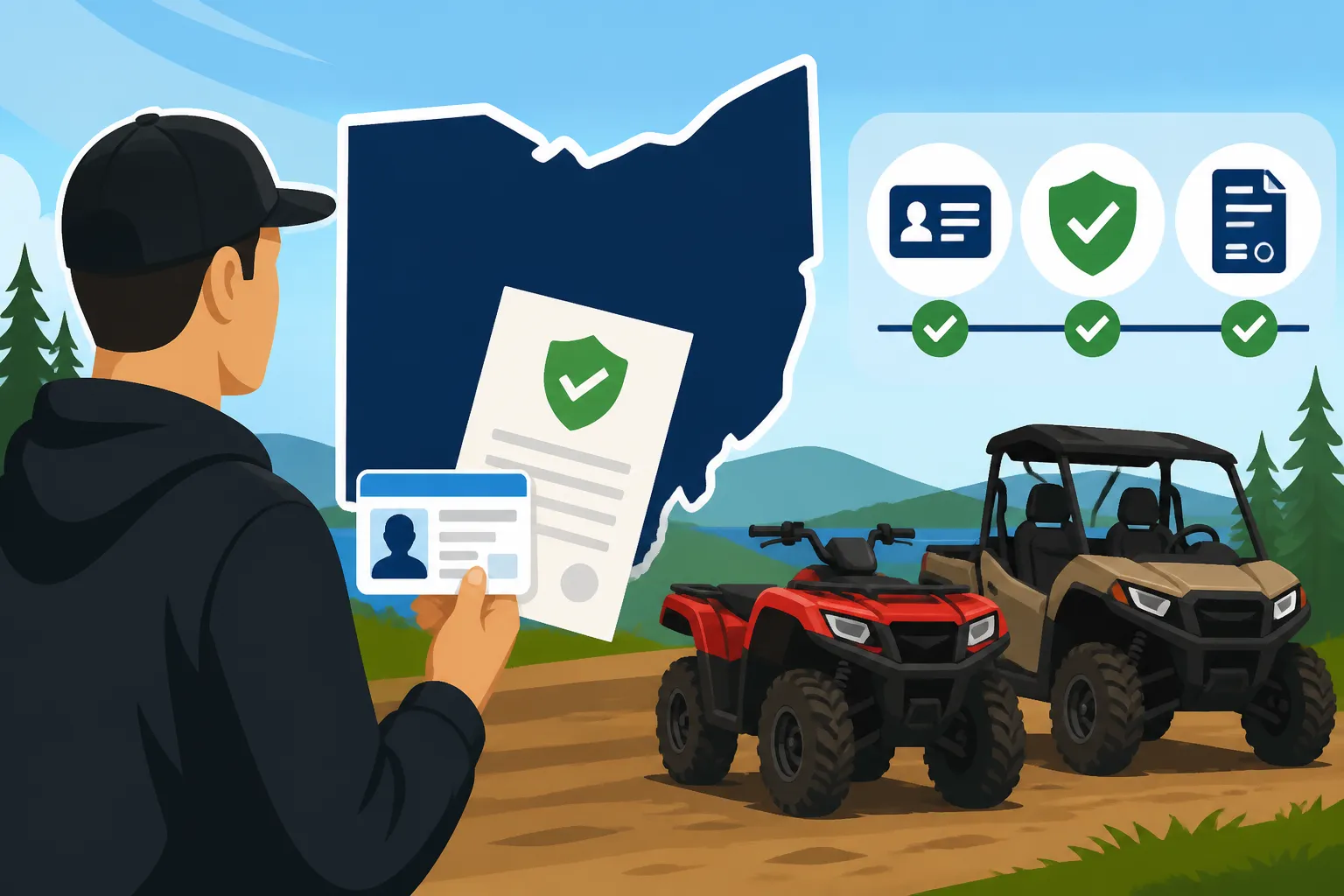
The Ohio Department of Natural Resources says out-of-state visitors from reciprocating states must bring and be able to show proof of their home-state vehicle registration. The practical takeaway is simple: carry official proof that identifies the vehicle and shows its registration is valid. Don’t assume that a title, bill of sale, insurance card, or photo of a document is a substitute for registration proof.
The agency’s requirement is to show proof of registration; it doesn’t specify in the facts available here which formats, such as a physical document or a digital record, are accepted. Before traveling, confirm the accepted format with the Ohio Department of Natural Resources and check that your proof clearly corresponds to the machine you’re bringing.
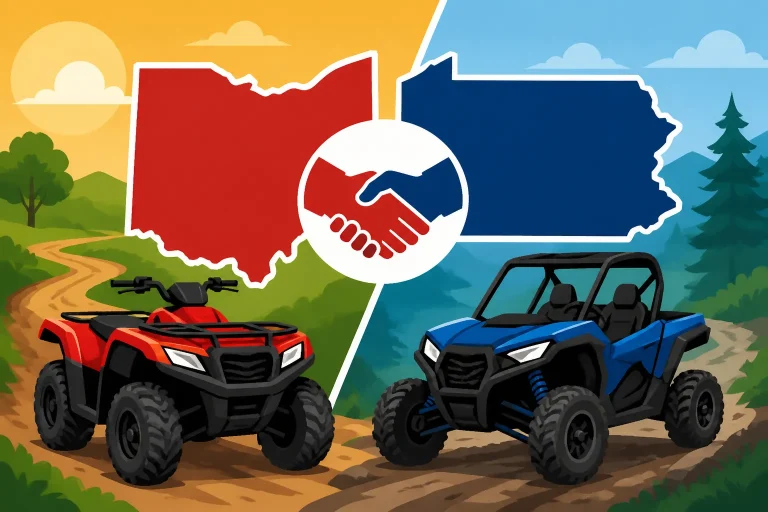
Reciprocity is not the same as having no paperwork requirement. It means a qualifying visitor can use home-state registration as proof for Ohio riding, rather than assuming that Ohio registration is needed in every case. Check whether your home state is one Ohio recognizes before relying on that arrangement. For an overview, see Ohio APV Reciprocity With Other States and Which States’ Registrations Ohio Accepts on Its Trails.
| Your situation | What to prepare | What to confirm |
|---|---|---|
| Your state has reciprocity with Ohio | Proof of your home-state vehicle registration | That your state qualifies and that your proof format is accepted |
| Your state does not have reciprocity with Ohio | The required Ohio Temporary Operating Permit | How to obtain it and whether you have the documents needed |
| You are riding in an Ohio state forest | Registration or permit documentation for the machine | How the state forest requirement applies to your out-of-state registration |
| You plan to ride on a road as well as a trail | Your registration or permit documents, plus any road-use requirements that apply | Whether the road is open to APVs and what equipment or licensing rules apply |
Use the word “registration” carefully when gathering documents. The Ohio BMV says all-purpose vehicles and off-highway motorcycles are classified as motor vehicles under Ohio law and must be titled. It also says titling an all-purpose vehicle requires completing form BMV 3722 at a county title office. Those are Ohio titling rules; they do not, by themselves, tell a visitor whether a home-state title can replace proof of home-state registration for trail use. Keep the documents distinct and confirm what the specific riding area accepts. See Ohio APV Registration Paperwork for related paperwork questions.
A snowmobile is a different category: the Ohio BMV says snowmobiles are not considered motor vehicles and do not require titles. Don’t apply that rule to an ATV or UTV simply because it is used off-road. If your vehicle’s classification is unclear, verify it before your trip.
If your state does not have reciprocity
Visitors from states without reciprocity must obtain an annual Temporary Operating Permit from the BMV, according to the Ohio Department of Natural Resources. A home-state registration document alone should not be treated as a replacement for that permit when Ohio requires one.
The permit is a state operating credential, not proof that your machine is titled in Ohio or that it meets every rule at a particular trail system. Check the process and current requirements with the BMV before you travel, and make sure the permit covers the machine you intend to ride. For a closer look at this option, see What a Visitor From a Non-Registering State Must Buy and The Ohio Temporary Permit for Visitors.
It also helps to keep three questions separate:
- Is the machine registered in your home state, or does it need an Ohio visitor permit? This is the reciprocity question.
- Does the machine need an Ohio title? The Ohio BMV’s titling rules concern ownership records and vehicle classification.
- Is the machine allowed on your chosen trail or road? That depends on the riding area and the rules that apply there.
Having the right answer to one question does not automatically settle the others. For example, a valid permit does not establish that a trail is open, that a vehicle fits its width limit, or that a road is open to APV travel. Confirm the requirements for your destination as well as your paperwork.
Ohio state forest rules deserve particular attention. The Ohio Division of Forestry says vehicles in state forest areas require a State Recreational Vehicle Registration with the BMV. Because Ohio also recognizes reciprocal home-state registration for eligible visitors and requires a Temporary Operating Permit for visitors from nonreciprocating states, check with the relevant state forest or agency about how the requirement applies to your situation before riding. Don’t assume that carrying one credential automatically satisfies every site-specific rule. Ohio Rules for Riding State Forest Land covers the broader setting.
Before riding an Ohio state forest trail
Ohio state forest riding is limited to designated areas and eligible vehicles. The Ohio Department of Natural Resources identifies Maumee, Richland Furnace, Pike, and Perry state forests as having trails accessible to specific off-highway vehicles. Check that your machine is permitted at your intended location, and don’t assume every forest road or trail is open to riding. See Ohio’s Four State Forest APV Areas for more on the locations.
The same agency sets a maximum vehicle width of 62 inches for permitted APVs on designated state forest trails. Measure the vehicle at its widest point before you leave home, especially if you have added accessories or changed the machine’s setup. A machine that is too wide may rule out a state forest trail even when its paperwork is in order.
Hours and seasonal closures can affect trip plans, too. The Ohio Department of Natural Resources says state forest APV areas are open during daylight hours, from one-half hour before sunrise until one-half hour after sunset. It also says Pike, Perry, and Richland Furnace APV areas and trails close annually during the winter season, while the Maumee state forest APV area remains open during winter to allow snowmobile use. Check current conditions and closures before loading the machine, since an open season does not guarantee that every trail is open on the day you arrive.
The agency also says state forest APV areas remain open during regular deer gun season to provide access for people with disabilities. That does not remove the need to follow trail rules or check that a particular route is open. If your visit overlaps hunting activity, plan for shared use and follow posted instructions.
Once at the trailhead, follow the site rules even if you have ridden elsewhere in Ohio before. According to the Ohio Department of Natural Resources, the maximum speed limit in the parking area is 5 mph, and accidents must be reported to the forest headquarters within 24 hours. The Ohio Division of Forestry also says operators in state forest areas must ensure firearms or other weapons are unloaded and securely encased.
Keep the different permit systems straight if hunting is part of your trip. The Ohio Division of Wildlife says there are 15 designated APV access areas statewide that it manages, and qualified APV permit holders can hunt from their APV on private property. It also says All Purpose Vehicle Use Permit holders are exempt from the firearm discharge prohibition on designated access roads. These wildlife-related permissions are not the same as the visitor Temporary Operating Permit or proof of home-state registration. Confirm the requirements for the activity and location you have in mind.
Road use is a separate question
A valid registration or visitor permit does not mean you can ride an APV on any Ohio road. The Legislative Service Commission says these vehicles may be operated on county or township road systems when local authorities permit it. Check local rules for the specific roads on your route; permission in one jurisdiction does not establish permission in another.
The Legislative Service Commission also describes limited situations for operating off or alongside a street or highway, including travel for limited distances from an unloading point and operation on a highway berm or shoulder when the terrain allows safe travel without entering traffic lanes. It says vehicles may use county or township road berms or shoulders while traveling between operation areas. These allowances are not a blanket authorization to ride along a road. Check the route and local requirements before relying on a shoulder or berm to connect to a trail.
For travel on Lake Erie island state highways, the rules are more specific. The Legislative Service Commission says operators must have a valid driver’s license, snowmobiles and all-purpose vehicles must comply with safety equipment rules, owners must maintain proof of financial responsibility for both on-road and off-road use, and operators must obey traffic rules and regulations. If your visit involves those highways, verify the applicable requirements before riding there.
A simple pre-trip routine can prevent a lot of confusion:
- Confirm whether Ohio recognizes your home-state registration.
- If your state does not have reciprocity, arrange the Ohio Temporary Operating Permit through the BMV.
- Carry proof of registration or the required permit, and confirm which document formats are accepted.
- Check the rules for the specific trail, state forest, wildlife access area, or road you plan to use.
- Confirm that your vehicle fits the area’s restrictions and that the route is open.
The main point is to match the document to the riding situation. A reciprocating-state visitor should be ready to show home-state registration proof; a visitor from a state without reciprocity needs the Ohio permit. Then check site and road rules separately, because paperwork that lets you operate does not necessarily open every trail or road.
Sources
- Ohio BMV — Ohio BMV (checked November 3, 2026)
- Ohio Department of Natural Resources — APV Trails in State Forests (checked November 3, 2026)
- Ohio Division of Wildlife — APV Riding (checked November 3, 2026)
Disclaimer
This article is for general informational purposes only and does not constitute professional advice. Laws, prices and regulations vary by location and change over time. Consult a qualified professional for guidance on your specific situation.