Turning 12 and Riding State Forest Land
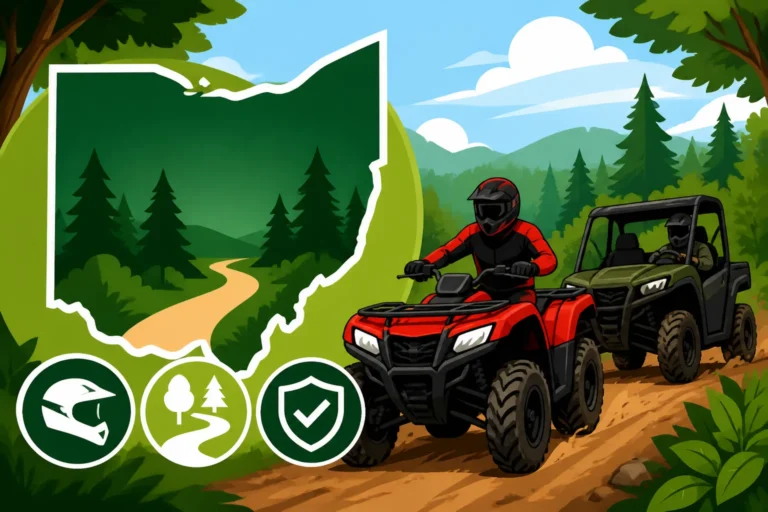
A child turning 12 may be able to ride an APV on Ohio state forest land, but age alone is not enough. The key requirement is supervision by a qualified adult, along with the right registration, a machine allowed on the trail, and a clear understanding of where and when riding is permitted.
What turning 12 means for state forest riding
Turning 12 does not create a separate permission to ride. The relevant rule covers minors under 16: according to the Ohio Department of Natural Resources, Division of Forestry, they may operate an all-purpose vehicle on state forest lands when accompanied by a licensed parent or guardian who is at least 18 years old.
That means an adult’s presence matters as much as the child’s age. The qualifying adult must be a parent or guardian, must be licensed, and must meet the age requirement. If you are unsure whether a particular adult or supervision arrangement qualifies, confirm it with the Division of Forestry before riding. Don’t assume that an older sibling, family friend, or another adult automatically meets the rule.
There is no separate safety course mandated specifically for a 12-year-old operating under these conditions, according to the Ohio Department of Natural Resources, Division of Forestry. That is a narrow legal point, not a recommendation to skip preparation. A young rider still needs practice with the machine’s controls, a safe place to learn, suitable protective gear, and an adult who can supervise closely. A course may be useful even when it is not required. See Does Ohio Require an ATV Safety Course? for more on the distinction between a legal requirement and voluntary training.
The broader rules for minors may help answer questions about supervision at different ages. Ohio Forest Access for Riders Under 16, Ohio Minimum Age for State Forest Trails, and Which Adult Can Supervise an Under-16 Forest Rider cover related details. For a practical look at how the rule applies on the trail, see An Under-16 Rider on a Forest Trail.
Before taking a young rider out, make sure the child understands that permission to ride is limited to the designated area and its rules. State forest access is not permission to ride wherever a forest road, clearing, or track looks suitable. Check the area’s current trail information and stay on authorized routes.
Check the machine and paperwork before leaving home
The state forest rule is only one part of being ready to ride. Ohio requires vehicles used in state forest areas to have a State Recreational Vehicle Registration with the BMV, according to the Ohio Division of Forestry. Registration, title, and any applicable visitor permit are separate considerations, so don’t treat one document as a substitute for another.
An APV must also be titled under Ohio law. According to the Ohio BMV, titling an all-purpose vehicle requires completing form BMV 3722 at a county title office. That title requirement applies to APVs; Ohio law treats off-highway motorcycles as motor vehicles requiring titles as well. Snowmobiles are different: the Ohio BMV says they are not considered motor vehicles and do not require titles. If you are sorting out ownership paperwork, Ohio APV Title Requirements and Ohio’s Four State Forest APV Areas are useful next steps.
If the vehicle is registered in another state, check whether Ohio recognizes that registration for the planned ride. According to the Ohio Department of Natural Resources, an out-of-state rider whose state does not have reciprocity must obtain an annual Temporary Operating Permit from the BMV. Don’t assume that a plate or registration from home automatically provides access to Ohio state forest trails. Ohio APV Reciprocity With Other States explains the issue in more detail.
The machine itself has to fit the trail rules. According to the Ohio Department of Natural Resources, the maximum width for permitted APVs on designated state forest trails is 62 inches. Measure the vehicle at its widest point rather than relying only on a model name or brochure description. A machine that is too wide may leave your family without a legal state forest trail option, even if it is properly titled and registered. Ohio’s 62 Inch State Forest Limit explains why width can determine where a machine may be ridden.
| Before the ride | What to confirm | Official rule or source |
|---|---|---|
| Adult supervision | A minor under 16 rides accompanied by a licensed parent or guardian who is at least 18 years old | Ohio Department of Natural Resources, Division of Forestry |
| Course | No separate course is mandated specifically for a 12-year-old in these circumstances | Ohio Department of Natural Resources, Division of Forestry |
| Registration | The vehicle needs State Recreational Vehicle Registration for state forest use | Ohio Division of Forestry |
| Vehicle width | The APV must be no wider than 62 inches for designated state forest trails | Ohio Department of Natural Resources |
| Out-of-state vehicle | A rider from a state without reciprocity needs an annual Temporary Operating Permit | Ohio Department of Natural Resources |
| Operating hours | The APV area is open from one-half hour before sunrise until one-half hour after sunset | Ohio Department of Natural Resources |
Keep the paperwork and a way to identify the vehicle with you. If you are buying an APV specifically for state forest riding, check title status and measure the machine before committing. A large side-by-side may be a good fit for other uses but exceed the state forest width limit. Ohio Rules for Riding a State Forest can help you review the wider set of trail rules.
Choose an eligible area and plan around its rules
Ohio state forest riding is limited to designated places, not a statewide network of open forest trails. According to the Ohio Department of Natural Resources, Maumee, Richland Furnace, Pike, and Perry State Forests have trails accessible to specific off-highway vehicles. Confirm which vehicles and trails are currently allowed before setting out; access at one forest does not establish that another forest has the same conditions.
Season matters, too. According to the Ohio Department of Natural Resources, APV areas and trails at Pike, Perry, and Richland Furnace close annually during the winter season. Maumee’s APV area remains open during winter to allow for snowmobile use. The rules also say state forest APV areas remain open during regular deer gun season to provide access for people with disabilities. That seasonal access information does not mean every trail is open to every vehicle at every time, so check the specific area before traveling.
Plan your departure and return around the permitted riding hours. The Ohio Department of Natural Resources says the APV area is open for riding from one-half hour before sunrise until one-half hour after sunset. Riding outside that window is not something to assume is allowed just because the gate or parking lot is accessible.
The parking area has its own speed restriction. According to the Ohio Department of Natural Resources, the maximum speed there is 5 mph. This matters when a young rider is leaving or returning to the trail: the parking area is not a place to practice at trail speed. Set expectations before unloading, and keep the adult close enough to supervise the transition between the lot and the riding area.
Also plan for an incident. The Ohio Department of Natural Resources requires accidents to be reported to the forest headquarters within 24 hours. Know how to contact the appropriate forest office before you ride, and make sure the supervising adult can manage the situation if the child or vehicle is involved in an accident.
A state forest trail ride is not the same as riding on a public road. Ohio’s Legislative Service Commission says these vehicles may be operated on county or township road systems when local authorities permit it, and may cross highways safely while yielding to traffic. Other limited roadside permissions also apply under specific conditions. These rules do not grant blanket permission to use roads to get between trails. For a family ride focused on state forest land, stay within the designated riding area unless you have separately confirmed the road rules that apply to the exact location. See Ohio’s Four State Forest APV Areas and Ohio Rules for Riding a State Forest when narrowing down a destination.
Make the first ride manageable and keep rules visible
For a child’s first outing, choose a plan that leaves room for careful supervision rather than trying to cover as much ground as possible. Before starting, identify the route, review any posted trail information, and agree on what the rider should do if they become separated or need to stop. The accompanying parent or guardian should be able to stay involved throughout the ride; meeting the adult requirement at the parking lot is not a substitute for supervising the child on the trail.
Keep the machine within its limits and the rider within theirs. The state forest width cap is a trail-access rule, not a measure of whether a vehicle is easy for a child to control. A narrower vehicle can still be too powerful or difficult for a young rider. Match the machine to the child’s ability, and choose a setting where the child can practice controlled starts, stops, turns, and braking before a busy trail ride.
Firearms require particular care. According to the Ohio Division of Forestry, operators of APVs in state forest areas must ensure that firearms or weapons are unloaded and securely encased. Do not treat a hunting plan as an exception to that state forest requirement. The Ohio Division of Wildlife separately says All Purpose Vehicle Use Permit holders are exempt from the firearm discharge prohibition on designated access roads, and that qualified permit holders can also hunt from an APV on private property. Those provisions concern a different permit and setting; they do not erase the state forest rule about transporting firearms or weapons on an APV.
If hunting or firearm access is part of the trip, verify which rules apply to the land, the vehicle, and the specific permit. The Ohio Division of Wildlife manages 15 designated APV access areas statewide, but those access areas should not be confused with the designated state forest trail areas. Confirm the location and permit conditions directly before planning the ride.
Use dependable gear that fits the young rider, and check it before loading. If you shop for a helmet or eye protection through Amazon, verify the product’s fit and relevant safety certification rather than relying on a listing title or a photo. Gear helps reduce risk, but it cannot make an unsuitable machine, unauthorized trail, or lack of supervision acceptable.
A simple final check can prevent avoidable problems:
- Confirm the child is accompanied by a licensed parent or guardian who is at least 18.
- Confirm the APV has the required State Recreational Vehicle Registration and that its title paperwork is in order.
- Check whether the vehicle’s width is within the state forest limit.
- Verify that the chosen forest and trail are open to that type of vehicle.
- Plan to ride only during the permitted hours and obey the parking-area speed limit.
- Review firearm transport rules and know how to contact the forest headquarters if an accident occurs.
Turning 12 can be a reasonable point to begin riding state forest trails with the right adult and preparation, but it does not remove the need to check each requirement. The safest approach is to confirm the rider, vehicle, paperwork, route, and season before leaving home.
Sources
- Ohio BMV — Ohio BMV (checked November 3, 2026)
- Ohio Department of Natural Resources — APV Trails in State Forests (checked November 3, 2026)
- Ohio Division of Wildlife — APV Riding (checked November 3, 2026)
Disclaimer
This article is for general informational purposes only and does not constitute professional advice. Laws, prices and regulations vary by location and change over time. Consult a qualified professional for guidance on your specific situation.