Why the State Sells No Separate Sticker
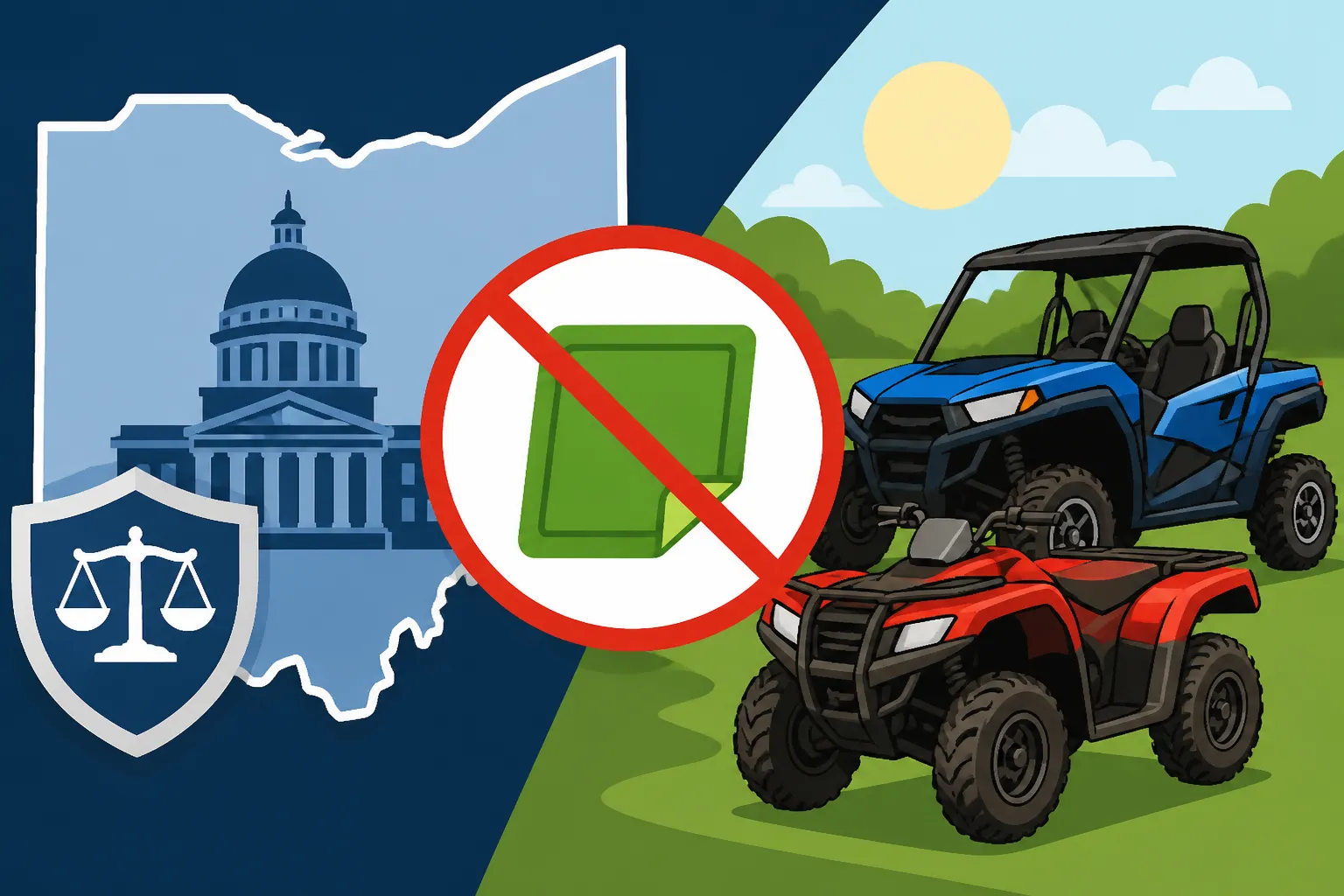
Ohio riders often look for a separate trail sticker after registering an ATV or UTV. The reason they may not find one is that Ohio uses the APV registration plate as proof of state registration and access eligibility on state forest trails. The important exception is Wayne National Forest, which has its own permit system.
Why Ohio does not sell a separate state forest sticker
Ohio’s approach ties state forest riding access to the machine’s APV registration. Instead of requiring riders to buy an additional state trail sticker, the state uses the registration plate as the visible indicator that the machine is registered. The registration paperwork and plate work together as proof; a separate sticker sold just for Ohio state forest trail access is generally not part of that system.
That does not mean a plate gives a rider permission to use every trail or road in Ohio. It addresses the state registration and state forest access side of the question. Riders still need to follow posted closures, trail rules, vehicle-width limits, operating hours, and any other requirements that apply at the riding area.
The plate should not be confused with the validation sticker that may be issued with a registration. The validation sticker is associated with the registration and belongs on the plate as directed. It is not a second, separately purchased permit for state forest trails. For a closer look at the plate and sticker themselves, see Ohio APV Plates and Validation Stickers and Where an Ohio Sticker Sits on the Plate.
This system is also why riders may hear that the plate “is the trail permit.” That phrase is a useful shorthand for Ohio state forest riding, but it can be misleading if taken to mean that the plate replaces every other requirement. The plate is not a universal pass for federal land, private parks, county parks, or roads that have not been opened to APVs.
| Where you plan to ride | What the Ohio APV plate does | What else to check |
|---|---|---|
| Ohio state forest APV trails | Serves as the machine’s registration proof for eligible riding | Trail openings, width limits, hours, equipment and rider rules |
| Wayne National Forest OHV routes | Does not replace the separate Wayne permit | Wayne permit requirements, route access and rider-specific pass rules |
| Private riding park | Does not automatically grant entry | Park admission, registration and park-specific rules |
| County or township roads | Does not make the road open to APVs | Local resolutions, road restrictions, equipment and insurance rules |
| Another state’s trails | Does not automatically determine eligibility | That state’s registration and reciprocity requirements |
The main practical takeaway is to match the paperwork to the land manager. Ohio state forest trails use the state’s registration system; Wayne National Forest has an additional federal permit system; and private or local riding areas may set their own access conditions.
What the plate covers, and what it does not
An Ohio APV registration plate is tied to the registered machine. It is not a personal pass that lets any rider use any off-road route. When planning a state forest ride, confirm that the machine is properly registered, the plate and validation sticker are current and displayed as required, and the trail system is open to that type and width of vehicle.
Ohio’s state forest areas have specific boundaries and rules. A registration plate does not authorize riding off a marked route, through a closed gate, or onto land where APV use is prohibited. Nor does it mean all state forests allow off-road machines. Check the rules for the particular forest and trail system before loading up. Ohio Rules for Riding State Forest Land and Ohio’s Four State Forest APV Areas explain the difference between registration and where riding is allowed.
The plate also does not, by itself, settle whether an APV may be driven on a public road. Road access depends on local rules and the road’s status, along with applicable equipment, licensing, and insurance requirements. A county or township may open certain roads while nearby roads remain closed. See Why Ohio Has No Statewide Road Right and How to Find an Ohio Township Resolution before treating a road connection as part of a route.
For out-of-state riders, a home-state registration may be accepted in some circumstances, while a visitor from a state that does not register the relevant machine may need an Ohio temporary permit. Those situations are different from buying a separate state forest sticker. The right question is not only “Do I need a sticker?” but also “What proof does Ohio accept for this machine, and what does the land manager require?” Ohio APV Reciprocity With Other States and The Ohio Temporary Permit for Visitors cover those distinctions.
Registration proof is not the same as a pass for every rider
The Ohio plate identifies a registered machine. It should not be treated as a personal credential for every person riding it. Some areas impose rules that apply to individual riders, including age, supervision, helmet, or pass requirements. Wayne National Forest, in particular, has its own permit requirements that may apply to each rider rather than only to the vehicle. Check the forest’s current rules before assuming one permit covers a whole group.
Keep the registration card with the machine or readily available, and make sure the plate remains visible and legible. A plate that is missing, obscured, or damaged can create avoidable problems even if the owner has completed registration. Keeping an Ohio Plate Distinctly Visible and What Happens If You Ride Without Your Registration Card offer practical reminders.
The Wayne National Forest exception
Wayne National Forest is the major reason a rider may still need to buy a separate riding permit after registering an APV in Ohio. It is federal land, with an OHV permit system separate from Ohio’s state registration. The Ohio plate does not replace that permit.
The two systems serve different purposes. Ohio registration applies to the machine under state requirements and is used for state forest riding access. The Wayne permit covers authorized OHV use on eligible routes in the national forest under federal rules. A rider planning a trip to Wayne should check which permit applies, where it can be obtained, when it is valid, and whether passengers or other members of the group need their own permits.
This distinction matters even if the same machine is used in both places. A registered quad may be ready for an eligible Ohio state forest trail but still lack the permit needed for a Wayne route. Conversely, holding a Wayne permit does not replace the Ohio registration requirements that apply to the machine. For details, see How the Wayne National Forest OHV Permit Works, Which Trails a Wayne Forest Pass Opens, and Why Every Ohio Passenger Over 16 Needs a Pass.
Before a Wayne trip, check the current official forest information rather than relying only on an older permit or a friend’s recollection. Permit terms, sales locations, access details, and route status can change. The same goes for state forest conditions: a valid plate does not mean a particular trail is open on the day you arrive.
A simple way to avoid confusion is to ask two separate questions:
- Is the machine properly registered for the state requirements that apply?
- Does the land manager require an additional permit, pass, or permission for this ride?
For state forest trails, the Ohio registration plate is the central proof. For Wayne National Forest, the separate federal permit is an additional requirement. For private land, you need the owner’s permission and must follow any park or club rules. Riding Private Ground in Ohio explains why a state plate does not replace permission from a landowner.
How to check what you need before riding
The fastest way to make sense of the rules is to start with the destination, not the equipment seller or a generic trail sticker search. Decide whether the ride is on an Ohio state forest trail, a Wayne National Forest route, a private park, or a public road. Then check the registration and access rules for that specific place.
Use this checklist before leaving:
- Identify the land manager. A state forest, national forest, private park, and township road can each have different rules.
- Confirm the machine’s registration status. Check that the registration is current and that the plate and validation sticker are correctly displayed.
- Check for an additional permit. For Wayne National Forest, confirm the separate OHV permit requirements. For a private park, check its admission and vehicle rules.
- Verify the route is open to your machine. Look for vehicle-width limits, closures, seasonal restrictions, and other access conditions.
- Check rider-specific rules. A machine’s plate does not automatically satisfy requirements that apply to an individual rider.
- Carry useful proof. Keep the registration card available and bring any additional permit or proof of purchase required for the destination.
If you are registering a machine for the first time, make sure the paperwork is complete and that you understand which office handles each step. Registration and title tasks are not always handled at the same counter. Where to Register an APV in Ohio, Where to Title an APV in Ohio, and Ohio APV Registration Paperwork can help clarify the process.
If you already have a plate but cannot tell whether the sticker or registration is current, confirm the status with the appropriate Ohio office before riding. Do not assume an old sticker, a receipt, or a plate from a different machine will work as proof. If the plate itself is lost or unreadable, use the state replacement process rather than trying to substitute a trail decal. See Replacing a Lost Ohio APV Plate.
The short answer is that Ohio does not sell a separate sticker for state forest APV access because the state uses the registered machine’s plate as its visible registration proof. That answer has an important limit: Wayne National Forest requires its own permit, and other destinations may have their own entry rules. Treat registration, trail access, and land-manager permits as related but separate checks, and confirm each one for the place you intend to ride.
Disclaimer
This article is for general informational purposes only and does not constitute professional advice. Laws, prices and regulations vary by location and change over time. Consult a qualified professional for guidance on your specific situation.