Why Your APV Plate Is Also Your Trail Permit
Ohio riders often expect a separate sticker or pass before they can use state forest trails. For many rides, the APV plate already does that job: it shows the machine is registered and serves as the state’s trail permit. The distinction matters, though, because a plate does not open every trail or replace extra passes and local rules.
What the APV plate permits
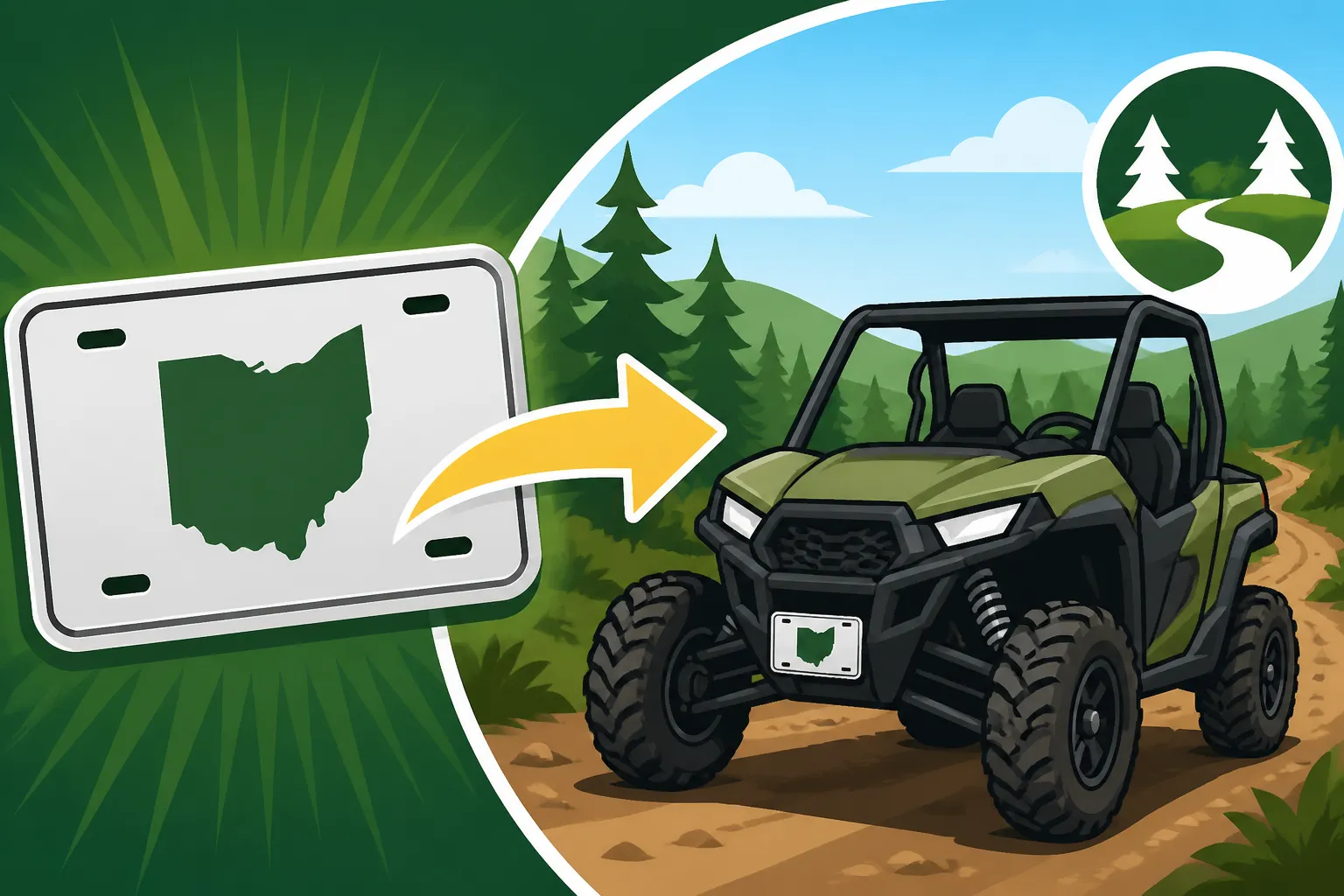
In Ohio, registering an all-purpose vehicle is more than a way to identify its owner. The registration plate also serves as the permit for riding on Ohio state forest APV trails. Riders generally do not buy a second, statewide state-forest trail sticker for the same machine. That is why the plate matters even when you plan to ride only off-road.
This setup can be confusing because other riding areas may use separate trail passes, and Ohio’s plate looks like a vehicle registration rather than a recreation permit. But for Ohio state forest trails, the registration and trail-access roles are connected. The plate is evidence that the machine has the required Ohio registration; it is not a pass granting unrestricted access to public land.
Registration applies to the machine, not just to the person riding it. A properly registered machine should display its plate as required, and the rider should carry the registration information needed to show that the plate belongs to that vehicle. For the application process and documents, see Ohio APV Registration Paperwork. For a broader explanation of how registration and trail access fit together, see Ohio APV Permits Explained.
The state’s approach also explains why riders may not see a separate state-forest access fee at the trailhead. Ohio registration fees help support the state’s recreational vehicle program, while the plate identifies a registered machine. A separate fee or pass can still apply on land managed by another agency. The distinction is covered in Why ODNR Charges No Ohio Trail Fee.
| Where you plan to ride | What the Ohio APV plate does | What else to check |
|---|---|---|
| Ohio state forest APV trail | Serves as the machine’s registration and state-forest trail permit | Trail access, operating hours, machine limits, and rider rules |
| Wayne National Forest OHV trail | Shows the machine has Ohio registration | The separate Wayne National Forest OHV permit and its requirements |
| Private riding park | Shows Ohio registration where required | The park’s entry rules, fees, and equipment requirements |
| Public road | Shows Ohio APV registration | Whether that specific road is open to APVs and whether road-use rules are met |
The table is a starting point, not a substitute for checking the rules of a particular property or trail system. A state forest plate does not establish that a route is open, that the vehicle fits the trail, or that every rider in the group meets age and safety requirements.
The plate is not a pass for every trail
The plate’s permit role is limited by the land and route where you ride. Ohio state forest APV trails are not the same as every road, path, or open area inside a state forest. Ride only on routes designated for motorized use, and follow closures, posted signs, and trailhead instructions. A route that looks rideable is not automatically open to ATVs or UTVs.
Machine size is one practical limit to check before loading. Ohio state forest trails have a width restriction, and a machine that exceeds it may not be allowed even if it has a valid plate. Measure the machine as required by the applicable rule rather than relying on the manufacturer’s model name or a rough visual estimate. See Ohio’s 62 Inch State Forest Limit for the width issue and Ohio Rules for Riding State Forest Land for the broader land-use rules.
Other conditions can affect access too. Trails may close for seasonal, weather, maintenance, or safety reasons. Riding outside posted hours or continuing past a closure can create problems that registration cannot solve. Check current trail information before making the drive; Ohio Trail Maps From ODNR is a useful place to start.
A plate also does not make an APV street legal. Road access depends on the road, local authorization, and the machine’s compliance with applicable road rules. Some roads may be open under a local decision while others remain closed. Registration alone does not grant permission to ride along a road, cross it anywhere you choose, or travel between trail systems on public streets. For road access, start with Where Ohio Law Allows APVs on Roads.
The practical rule is simple: treat the plate as necessary proof of registration and state-forest trail authorization, not as a universal access pass. Before riding, confirm three separate things:
- The machine’s registration is valid and the plate is properly displayed.
- The specific trail or road is open to the machine.
- Any additional land-manager, vehicle, or rider requirements are met.
That last check is important when a ride crosses between different kinds of land. A route may begin on a state forest trail and lead toward a road, private property, or federally managed land, where different rules apply.
When an additional pass is required
Wayne National Forest is a common source of confusion. It is in Ohio, but it is federal land, so an Ohio APV plate does not replace the separate OHV permit required for riding its designated trails. Riders should plan for both: the machine’s applicable registration and the Wayne National Forest permit requirements. The permit may have rules for individual riders as well as for the machine, so do not assume that one plate or one group member’s pass covers everyone.
Before a Wayne ride, check the current permit details, including who needs a pass, where it must be displayed or carried, which trails it covers, and how long it is valid. Rules and purchase options can change. How the Wayne National Forest OHV Permit Works explains why the federal permit is a separate step, while Where to Buy a Wayne Forest OHV Permit can help with the purchasing question.
Other riding places set their own entry rules. A private park may charge an admission fee, require a waiver, restrict machine width, or set rules for passengers and noise. A county park or wildlife area may prohibit APVs altogether, or allow them only in limited circumstances. The Ohio registration plate does not override a property owner’s decision or a land manager’s restrictions.
That is why “the plate is the trail permit” should be understood narrowly. It answers a specific question about Ohio state forest APV trails. It does not mean:
- Every public trail in Ohio is open to registered APVs.
- A separate federal or private-park pass is unnecessary.
- Registration gives permission to ride on private land.
- A plated machine may use any public road.
- A trail remains open regardless of closures or seasonal restrictions.
If a route crosses a boundary, check the requirements for each part of the trip. It can be useful to call the relevant office when a map or sign leaves something unclear. Confirm the rules before unloading rather than assuming the Ohio plate covers the entire ride.
Reciprocity and visitors riding in Ohio
For a rider who lives outside Ohio, the main question is whether Ohio accepts the machine’s home-state registration for the planned ride. Ohio’s reciprocity rules can allow a properly registered out-of-state machine to ride in qualifying situations, but the answer depends on the home state’s registration system and the type of riding. A registration card from another state is not automatically accepted for every purpose or every trail system.
Visitors should check both Ohio’s reciprocity requirements and the rules of the land they plan to ride. A home-state registration that satisfies Ohio’s state-forest requirements may still not replace a separate Wayne National Forest permit or a private park’s admission requirements. The details are covered in Ohio APV Reciprocity With Other States and Which States’ Registrations Ohio Accepts on Its Trails.
A visitor from a state that does not register the machine may face a different requirement, such as obtaining an Ohio temporary permit for eligible use. Do not assume that a lack of home-state registration means the machine can ride without paperwork. Check the visitor rules before traveling; Ohio’s Nonresident Temporary Permit explains the temporary-permit option, and What a Visitor From a Non-Registering State Must Buy addresses the situation where the home state has no applicable registration.
Keep the proof of registration or permit available while riding. If an officer or land manager asks to see it, a plate alone may not answer every question about validity, ownership, or eligibility. Carry the required documents in a secure place and make sure the information matches the machine. A phone photo can be useful as a backup, but confirm whether the official rules require the original document or accept an electronic copy.
Before a visitor heads out, it is sensible to verify:
- Whether Ohio recognizes the home-state registration for the planned kind of riding.
- Whether the machine’s plate or registration must meet specific display requirements.
- Whether the land manager requires an additional permit.
- Whether the machine fits the route’s width and equipment restrictions.
- Whether the route is currently open and whether the rider meets age or supervision rules.
These checks may feel like extra work for a short visit, but they prevent a common mistake: arriving with a valid plate and discovering that the plate covers only one part of the trip. Ohio’s registration system makes state forest trail access more straightforward for registered machines, while separate land managers retain authority over their own trails and passes.
Disclaimer
This article is for general informational purposes only and does not constitute professional advice. Laws, prices and regulations vary by location and change over time. Consult a qualified professional for guidance on your specific situation.