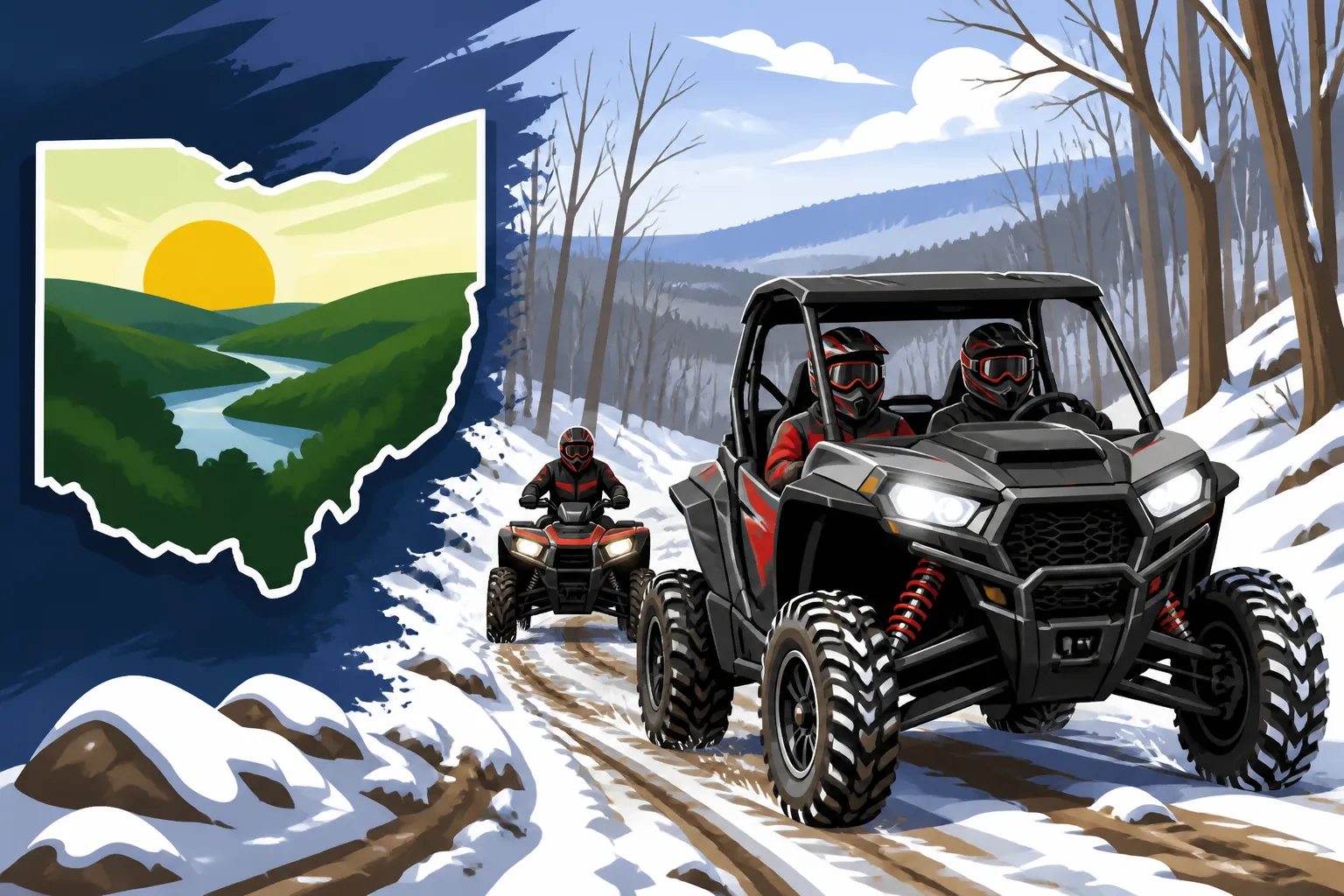
Snow on a Southern Ohio Trail
Snow can make a Southern Ohio trail look inviting, but a white layer can hide closed gates, deep ruts, slick clay, and trail markers. The key question is not just whether your ATV or UTV can handle the snow; it is whether the route is open and safe to ride. This guide helps you check conditions, prepare your machine, and decide when to turn back.
First check whether the trail is open
In Southern Ohio, fresh snow does not automatically mean a trail is open for riding. A route may be closed for the season, temporarily shut because of weather damage, or restricted for another reason. Before loading your machine, confirm the status of the specific trail system and the access rules that apply there.
Seasonal closures still apply in snow
Ohio’s state forest trails generally have a defined riding season, with closures during part of winter. A snowfall during the closed period does not create an exception. Riding past a gate or around a closure sign can damage vulnerable ground and may lead to a citation. Check [Ohio's Trail Season by Forest] and [Ohio Trail Closures to Check First] before you leave home.
Opening dates and closures can also vary by location or change temporarily when conditions require it. A trail that was open on your last visit may not be open now, and a snow-covered entrance can make signs or barriers easy to miss. Check the official trail information for the area you plan to visit, and contact the managing office if the status is unclear.
Snow can make a closed trail look newly rideable because tire tracks disappear under fresh powder. Don’t treat an untracked route as an invitation. If you cannot confirm that the route is open, choose another legal riding location or postpone the trip.
Check the specific Southern Ohio system
Southern Ohio riding areas include systems such as Monday Creek, Hanging Rock, and Pine Creek. Their routes, access points, and local conditions are not interchangeable. A report from one area may not tell you whether another has standing water, a washed-out section, a blocked entrance, or a temporary closure. For an overview of the permitted areas, start with [Ohio's Four State Forest APV Areas].
Use a current official map or trail notice to confirm the trailhead and permitted routes. [Ohio Trail Maps From ODNR] can help with route planning, but a map alone may not show a new closure or a condition that developed after the map was published. If a ranger district or trail office can answer questions, ask about the exact access point and route rather than simply asking whether “the trails” are open.
| Before you go | What to confirm | Why it matters |
|---|---|---|
| Trail status | The specific system and route are open | Seasonal and temporary closures still apply in snow |
| Trailhead access | The entrance, parking area, and approach road are accessible | Snow or ice may make the last stretch unsafe |
| Machine eligibility | Your machine meets the area’s rules | State forest routes may have width and equipment limits |
| Weather and ground | Recent snowfall, thawing, rain, and temperatures | Snow can conceal ice, water, and unstable trail edges |
| Required documents | Registration, permits, and identification required for that area | Requirements vary by land manager and location |
Separate state forest rules from other riding options
A private riding park may have different hours, conditions, and snow policies from a state forest. Don’t assume a private park is open simply because public trails are closed, or that a public trail’s rules apply at a privately managed property. Check with the specific operator before making the drive.
Also distinguish between trail riding and road riding. A snow-covered public road or forest access road is not automatically an approved ATV route. [Ohio Rules for Riding State Forest Land] explains the importance of staying on routes where riding is allowed. When a gate, sign, or official notice conflicts with what you see on the ground, follow the posted restriction.
Understand what snow changes under your tires
Snow can make familiar terrain feel entirely different. In Southern Ohio, a trail may move from packed dirt to slick clay, exposed rock, icy shade, or standing water within a short distance. Even a light snowfall can hide a rut that was easy to see on your previous ride.
Snow can conceal mud, ruts, and trail edges
The first few inches of snow often hide the features that help you judge a trail. A shallow depression may conceal a deeper rut filled with water. A soft shoulder may look like a firm passing area. A small puddle may have a thin crust on top and deeper water underneath.
This is especially important on hills and bends. If one tire drops into a concealed rut, your machine can pull sharply to one side. A UTV may feel stable until a wheel slips on ice or drops into a rut, while an ATV rider can be thrown off balance by a sudden sideways slide. Travel slowly enough to stop within the distance you can see.
Keep to the established trail. Riding around a muddy or icy section can widen the route, damage vegetation, and create a new track that other riders may mistake for an approved trail. If you cannot pass without leaving the marked route, turn around rather than cutting a new line.
Freeze-thaw conditions can change during one ride
A cold morning can leave a trail firm at the start, while afternoon sun softens exposed sections. Shaded hollows may stay icy after sunny slopes begin to thaw. On another day, a brief warm spell followed by a temperature drop can leave a slick surface that is difficult to read beneath snow.
This freeze-thaw cycle is one reason a report from yesterday may not be enough. Check the forecast for the whole day, not just the temperature when you depart. Pay attention to rain or melting snow before your ride, since water can collect in low spots and make trail surfaces unstable.
If the trail begins to soften, tires start leaving deep ruts, or your machine is digging through rather than traveling over the surface, stop. Continuing can cause damage and leave you stuck in a place where recovery is difficult. The guidance in [Ohio Trails After Heavy Rain] is also useful after melting snow or a thaw, when saturated ground can behave much like a rain-soaked trail.
Hills, bends, and bridges need extra caution
Snow and ice reduce traction while making it harder to judge the trail’s slope. Avoid sudden braking, sharp turns, and abrupt throttle changes. If a climb looks questionable, do not commit simply because another rider’s tracks appear to make it through. Those tracks may be from a lighter machine, a different tire setup, or a previous condition.
Treat bridges, shaded crossings, and compacted sections as potential ice hazards. A bridge deck may freeze before the surrounding ground, and tire tracks can polish snow into a slick surface. Approach slowly and avoid stopping on a slope or narrow crossing if you can safely wait for a clear path.
If a route feels beyond your machine or experience, turn around at a safe, suitable spot. The inconvenience of retracing your route is preferable to sliding into a tree, ditch, or steep trail edge.
Prepare your machine and riding plan for winter conditions
A winter outing calls for more than a warm jacket. Cold temperatures can affect batteries, plastics, tires, and how quickly you tire. Snow can also make a familiar trail take longer, so plan for a slower ride and an earlier return.
Check the machine before loading
Inspect your tires for damage and confirm they are appropriate for your machine and the conditions you expect. Don’t rely on aggressive-looking tread to make ice safe; no tire removes the need to ride carefully. Check the brakes, lights, controls, and battery, and make sure the machine starts reliably before you leave.
For a UTV, confirm that windows, mirrors, and lights are clear enough for the ride. Snow and moisture can reduce visibility, and a fogged or obstructed view is a serious problem on a narrow trail. For an ATV, make sure controls are not blocked by bulky gloves and that you can maintain a secure grip.
Carry basic recovery and repair supplies suited to your machine and the trip. A tow strap, tire repair items, a small tool kit, and a charged phone can be useful, but don’t assume a phone will work everywhere. Tell someone where you are going and when you expect to return.
Dress for a slow, exposed ride
Cold becomes harder to manage when you are moving slowly, stopping often, or helping with a recovery. Dress in layers that block wind and handle damp conditions. Gloves should let you operate the controls without fighting the fabric, and eye protection should stay clear enough to see trail edges and other riders.
Bring more water and food than you expect to need. A delay caused by a stuck machine, trail closure, or weather change can stretch a short outing. Keep essential items protected from moisture, and consider carrying spare dry gloves or socks.
Set a conservative turnaround time. If the snow is deeper than expected, visibility is poor, or the group is moving more slowly than planned, shorten the route. Reaching the trailhead before dark is more important than completing a planned loop.
Use maps as a planning tool, not proof of access
A mapping app such as onX Offroad can help you plan a route and understand where you are in relation to trail segments. Before leaving, save or otherwise prepare the map information you may need in case cell service is limited. Do not assume that a route shown on a screen is currently open or approved for your machine.
Compare your planned route with official information from the land manager. If a map and a closure notice disagree, follow the official closure notice. You can also use onX Offroad to help keep your group oriented, but keep an eye out for physical signs, gates, and marked routes along the way.
Review the [Ohio's 62-Inch State Forest Width Limit] if you ride a side-by-side or another wider machine. A route that appears on a map may still be unsuitable or prohibited for a machine that exceeds the area’s limits. Check the actual machine width and the specific trail rules before setting out.
Know when to cancel or turn around
A good winter ride is not measured by miles completed. It is measured by whether everyone gets home without damaging the trail or taking an avoidable risk. Snow makes it harder to judge what lies ahead, so give yourself permission to change the plan.
Cancel when access or conditions are uncertain
Postpone the trip if you cannot confirm that the trail is open, if the access road is icy or blocked, or if weather makes visibility poor. A long drive to a trailhead can make it tempting to ride anyway, but sunk travel time does not make a closed or unsafe route acceptable.
Pay attention to new snow, rain, thawing temperatures, and overnight freezing. If those conditions are likely to hide hazards or soften the trail, wait for a better day. When in doubt, contact the managing office rather than relying only on social media posts or old trail reports.
Turn around when the trail stops being manageable
During the ride, stop and reassess if you encounter repeated deep ruts, standing water beneath snow, steep icy sections, blocked routes, or trail markers you cannot identify. Don’t ride around a closure or use an unmarked bypass. Turn back along a route you know is open, if it is safe to do so.
Groups should agree beforehand that any rider can call for a turnaround. This matters when one person is on a smaller ATV, another is in a heavier UTV, or someone has less winter riding experience. A group that waits until a rider is stuck to discuss the plan has waited too long.
If the route is open, the weather is manageable, and everyone is prepared, snow can make a familiar Southern Ohio trail feel new. Just let the posted rules, current conditions, and your ability to see and control the machine set the limits of the ride.
Disclaimer
This article is for general informational purposes only and does not constitute professional advice. Laws, prices and regulations vary by location and change over time. Consult a qualified professional for guidance on your specific situation.