Closing the Second Monday in December in Ohio
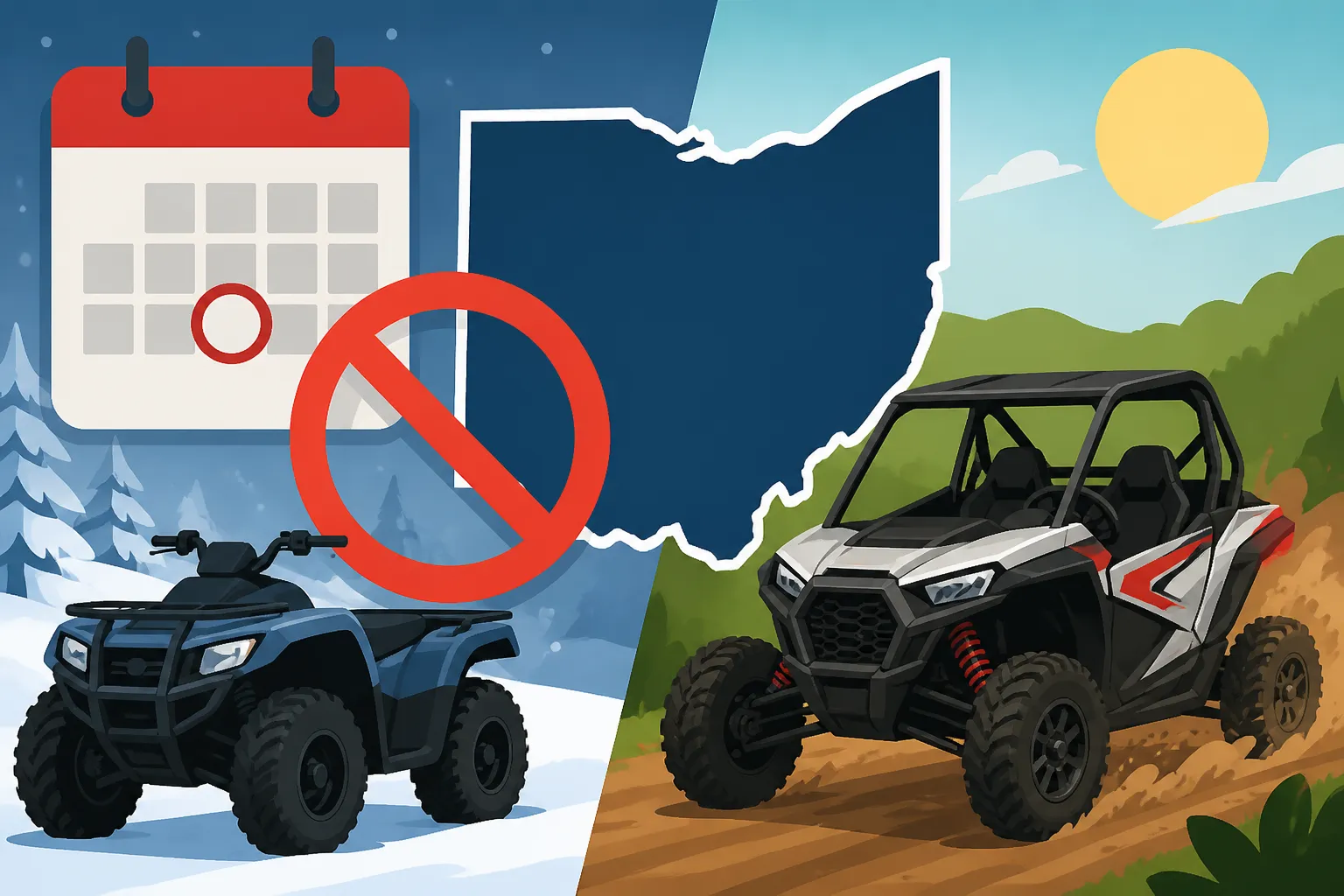
Ohio’s designated state forest ATV trails do not stay open through winter: most close on the second Monday in December and reopen on the first Friday in April. That timing can catch riders who plan around a weekend, a snowfall, or a trip to a different riding area. Here’s what the closure means, which trails it affects, and how to plan around it.
What the second Monday in December closure means
The seasonal schedule applies to designated state forest trails
Ohio’s seasonal rule is a trail-access schedule, not a guarantee that every off-road riding area in the state closes on the same day. Designated APV trails in Ohio state forests generally close for the winter on the second Monday in December and reopen on the first Friday in April. The closure is intended to protect trails during the wet, freeze-thaw period, when repeated traffic can leave ruts that are difficult to repair.
The key detail is that the closure is tied to a weekday, not a particular weekend or a snowfall. If you’re planning one last ride, don’t assume the trails will remain open through the second weekend of December just because the weather is mild. Work out the calendar date in advance, then confirm the trail’s status with the managing agency before loading your machine.
This schedule is most relevant to Ohio’s state forest riding areas, including systems in the southern part of the state. The individual areas can have different trail layouts, access points, and temporary restrictions. A seasonal opening date does not mean every trail segment is necessarily available: maintenance, weather damage, timber work, or a temporary closure can affect access.
The closure is not a statewide shutdown of every riding option
Ohio has several kinds of places where people ride, and they do not all follow the state forest calendar. A privately operated riding park sets its own schedule. A national forest trail system has its own rules and seasonal notices. Private land is governed by the landowner’s permission, while roads and other public lands have separate access rules.
That distinction matters if you’re trying to salvage a winter riding weekend. A trail that appears on a statewide map may be managed by a different agency than the state forest trail you usually ride. Don’t use the state forest closing date as proof that another location is open—or assume that a nearby road, hunting area, or park allows ATV use during the off-season.
For a broader look at which locations may be available, see [Ohio Trails Open in Winter] and [Where to Ride When the Forests Close]. Check the specific area’s current rules before setting out. The right question is not simply “Are Ohio trails open?” but “Who manages this trail, and what does that manager say about access today?”
| Riding location | Does the state forest closing date automatically apply? | What to check before riding |
|---|---|---|
| Designated Ohio state forest APV trails | Generally yes | Seasonal schedule, trail notices, and temporary closures |
| Maumee State Forest APV area | Its schedule differs from the seasonal closure pattern | Current access notices and trail conditions |
| Wayne National Forest OHV trails | Not automatically | Forest-specific season, pass rules, and current alerts |
| Private riding park | No | The park’s operating calendar, admission rules, and trail status |
| Private land | No fixed public schedule | The landowner’s permission and any conditions attached to it |
Which Ohio trails follow the seasonal schedule
Know the difference between state forest systems
The seasonal closure is particularly important for riders who use Ohio’s state forest APV areas. In southern Ohio, systems such as Monday Creek, Hanging Rock, and Pine Creek are familiar destinations, but a name on a map is not enough to establish that every route is open. Check the particular trail system and any notices for the route you intend to ride.
These areas can be a long drive from home, and a closed gate or blocked segment can turn a carefully planned day into a frustrating return trip. That is especially true if your group is meeting from different directions, staying overnight, or towing a side-by-side that takes time to unload. Confirm access before you leave rather than relying on a memory of last season’s conditions.
The broader guide to [Ohio's Four State Forest APV Areas] can help you understand how the state forest systems differ. For specific trail-season planning, [Ohio's Trail Season by Forest] is also a useful related topic. Treat any general schedule as a starting point, then look for current notices for the exact forest and trailhead.
Maumee and Wayne National Forest need separate checks
Maumee State Forest is an important exception to the usual winter closure pattern: its APV trail area is generally described as open year-round. That does not mean every ride is guaranteed to be possible. Weather, maintenance, local notices, and trail conditions may still affect access, so confirm the status before making the trip.
Wayne National Forest is a separate management area with its own OHV access requirements and seasonal information. A Wayne National Forest riding day may involve a forest pass as well as checking the applicable trail system’s rules. Don’t assume that the state forest opening and closing dates also describe Wayne’s schedule, or that a state forest registration plate replaces every separate requirement.
This distinction is one reason riders sometimes get mixed answers when they ask whether “Ohio trails” are open in winter. People may be talking about different forests or different types of riding areas. Start with the managing agency, then check the location-specific page or notice. The guide to [Wayne National Forest's Three Ohio Systems] can help separate those systems from Ohio’s state forest trails.
How to plan your final ride before the closure
Confirm the closing date and trail status before you travel
Start by marking the second Monday in December on your calendar, but don’t stop there. In the days before your planned ride, check for a current trail notice from the agency responsible for the area. If a notice is unclear, contact the relevant ranger district or forest office and ask directly whether the trailhead and the sections you plan to ride are open.
A late-season ride can be enjoyable, but it is less forgiving when plans change. Daylight is shorter, temperatures can drop quickly, and recent rain can leave clay or low-lying trail sections slick. If the forecast is poor or the trail appears vulnerable to damage, changing the date or choosing another legal riding location may be wiser than trying to squeeze in one more loop.
Mapping apps can help with orientation and route planning, but a route line is not proof of current access. For instance, onX Offroad may help you organize a route or compare mapped features, but you should still confirm closures and permitted use with the land manager. A mapped trail can remain visible even when the trail is seasonally closed or temporarily unavailable.
Build a practical end-of-season checklist
A little preparation keeps the last ride from becoming a rushed scramble. Check registration and required permits, inspect your machine, and make sure everyone in the group knows the meeting point and expected return time. If you’re riding with people who have not visited the area before, share the trailhead location and explain that posted notices take precedence over a route saved on a phone.
Before you leave, make sure you have a plan for changing conditions. Pack warm layers, water, a basic first-aid kit, and a way to contact your group if machines become separated. Phone reception can be limited in parts of the Hocking Hills and other wooded southern Ohio areas, so do not depend on a live map or a phone signal as your only navigation plan.
A simple checklist can prevent common end-of-season mistakes:
- Verify the closure date and check for temporary notices.
- Confirm that the trail system is managed by the agency you think it is.
- Check the weather and recent conditions, not just the forecast for ride day.
- Review the trail map and agree on a turnaround time with your group.
- Carry registration and any permits required for that location.
- Tell someone where you’re riding and when you expect to return.
- Respect gates and closure signs, even if a digital map still shows a route.
For more guidance on trail conditions, see [Ohio Trail Conditions Before You Ride]. A separate guide to [Ohio Trail Closures to Check First] can also help you make a habit of checking for changes instead of assuming that last month’s access information still applies.
Why trails close for winter
Wet and thawing ground is easily damaged
Ohio’s winter weather can shift between rain, freezing temperatures, and thawing conditions. That cycle can make the ground soft even when a trail looks firm at first glance. A machine’s tires can cut into the surface, and repeated passes may deepen ruts, redirect water, or damage trail edges.
The risk is not limited to a dramatic mud hole. A shallow rut can channel runoff and gradually erode a slope, while tire tracks through a wet section can widen the disturbed area as riders look for a firmer line. Repairs take time and can affect access for everyone who uses the trail after it reopens.
A seasonal closure gives the land and trail managers a chance to avoid that repeated winter wear and complete necessary work. It can feel disappointing when the weather is sunny and the trail looks rideable, but the closure is not a judgment about one rider’s machine or skill. It is a rule designed for the trail system as a whole.
Following the closure protects future riding access
When riders respect the seasonal schedule, it helps preserve trails for the spring opening and reduces pressure on managers to repair avoidable damage. Riding past a gate or around a closure sign can do more than leave a mark on the ground. It may lead to enforcement, create conflict with land managers, and put future access at risk.
If you arrive and discover that a trail is closed, do not look for an unofficial bypass through the woods, a nearby road, or a field. Those alternatives may be private property, wildlife habitat, or land where motorized use is not allowed. Turn around and choose a location whose manager confirms that riding is permitted.
For more on seasonal openings and closures, see [Closing the Second Monday in December in Ohio] and [Reopening the First Friday in April]. If you’re deciding whether to travel before the closure, the practical choice is to verify the status first and leave room in your plans for a change.
What to do when a trail is closed
Choose an alternative that is actually open to motorized riding
A closed state forest trail does not make nearby land fair game. County parks, wildlife areas, rail trails, utility corridors, and private property can each have different restrictions. A road that looks like a trail on a map may not permit ATVs, and a landowner’s permission may be limited to a particular route or date.
Look for an alternative managed by an operator or agency that explicitly allows the kind of machine you plan to bring. A private riding park may offer winter access, but its calendar, trail conditions, machine requirements, and admission rules are separate from state forest regulations. Confirm the details with the park before driving there.
If you use onX Offroad to explore alternatives, treat it as a planning aid rather than final confirmation of permission. Compare the mapped route with the land manager’s information, and call if there is any doubt about access. This extra check can save you from arriving at a locked gate—or worse, riding somewhere you do not have permission to be.
Use the closed season to prepare for spring
The off-season is a good time to service the machine and sort out gear without the pressure of a ride scheduled for the next morning. Clean mud from the frame and underbody, inspect tires and brakes, and look for damage that may be easy to miss after a long day on rough ground. Follow the machine manufacturer’s maintenance guidance for storage and battery care.
It is also a useful time to review the routes you hope to ride when trails reopen. Save official trail information, check whether your group needs permits, and make sure your machine fits the access rules for the destination. Width matters on some Ohio forest trails, so a side-by-side that fits one riding area may not be suitable for another.
Finally, keep your plans flexible as spring approaches. The first Friday in April is the general reopening date for the seasonal state forest trails, but a particular route may remain unavailable because of weather, maintenance, or a posted closure. Confirm before traveling, and use the first ride of the season to check your machine and ease back into the trail rather than trying to cover every mile at once.
Disclaimer
This article is for general informational purposes only and does not constitute professional advice. Laws, prices and regulations vary by location and change over time. Consult a qualified professional for guidance on your specific situation.