Why the Ohio Plate Is the Trail Permit
An Ohio ATV or UTV owner can easily assume a plate is just proof of registration, then discover that trail access depends on where they plan to ride. In Ohio state forests, the plate generally does double duty as the trail permit. This guide explains what that means, where it applies, how visitor reciprocity works, and when you still need a separate permit.
What It Means When the Ohio Plate Is the Trail Permit
Registration and trail access are connected
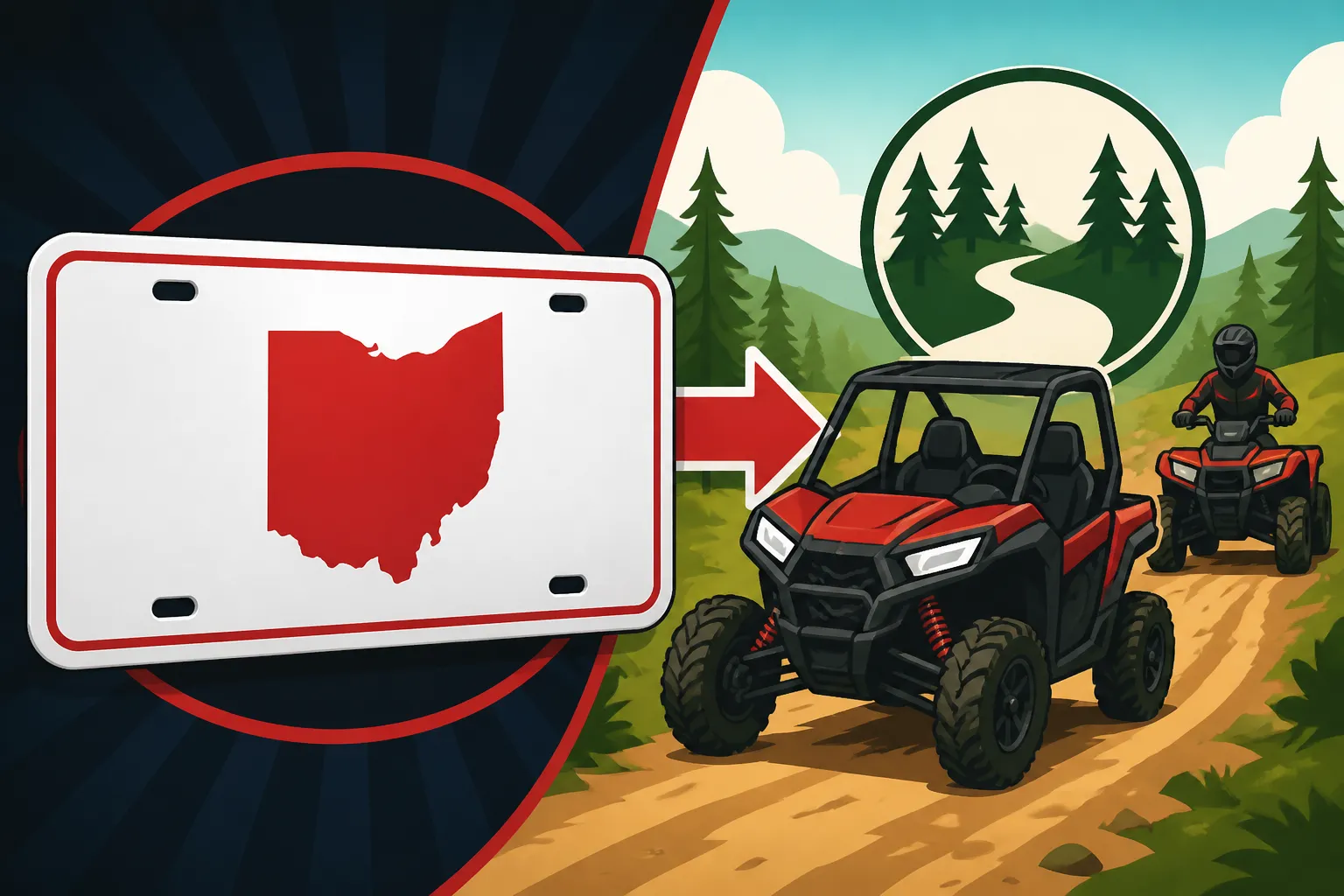
In Ohio, an all-purpose vehicle registration plate is more than a way to identify a registered machine. For riding on designated Ohio state forest trails, the registration and plate serve as the required trail authorization. That is why riders often hear that “the plate is the permit.” It means eligible, properly registered machines generally do not need a separate Ohio state forest trail sticker simply to access those routes.
That connection can be easy to misunderstand if you are used to another state’s system. Some places issue a registration plate and a separate trail decal. Ohio’s state forest system generally treats the Ohio APV plate as the permit, rather than making riders purchase a second state-issued trail sticker. For an Ohio rider planning a state forest outing, that can simplify the paperwork.
The plate does not, however, grant open-ended permission to ride wherever an ATV or UTV can physically go. It does not replace landowner permission, open a closed trail, or make a road legal for APV use. The trail-permit meaning applies within the rules and designated areas where that registration is accepted. Start by checking the particular property and trail system, not just the plate on your machine.
What the plate does not authorize
A common source of frustration is arriving at a trailhead with a valid plate and assuming every public-looking road nearby is part of the riding area. State forest APV trails are designated routes, and access can depend on trail closures, operating seasons, weather-related restrictions, and machine requirements. A plate does not override any of those limits.
Nor does an Ohio APV plate automatically grant access to federal land, a county park, private ground, or a privately operated riding park. Each land manager can set its own requirements. Wayne National Forest, for example, has a separate OHV permit system for designated routes on national forest land. That is a different permit from the Ohio registration plate.
Think of the plate as one piece of the access puzzle: it establishes the machine’s Ohio registration and can fulfill the state forest trail-permit requirement where applicable. You still need to confirm that the land is open to APVs, that your machine is permitted on the route, and that you have any additional authorization the property requires.
Why Ohio does not issue a separate state forest trail sticker
The phrase “no separate trail sticker” can sound as if Ohio has no trail rules or access controls. It does not mean that. It means the state forest trail authorization is tied to the APV registration rather than being handled through a second state trail sticker for the same access. The machine still needs to meet applicable registration and riding rules.
This arrangement can be convenient for residents who ride eligible Ohio state forest routes. It can also make the system confusing for visitors, because riders may look for a trail decal that is not the relevant document for that particular state forest trip. Visitors should check whether their home-state registration is accepted or whether they need an Ohio visitor permit.
If you want to understand the policy distinction in more detail, see Why ODNR Charges No Ohio Trail Fee and Do You Need a Permit for Ohio State Forest Trails?. The key is to separate “no separate state forest trail sticker” from “no registration or access rules.”
Where the Ohio Plate Works and Where It Does Not
Designated Ohio state forest APV trails
The plate’s trail-permit role is most directly relevant on designated Ohio state forest APV trails. These trails are managed as specific riding areas, not as general permission to roam across a forest. The route, trailhead, season, and any posted restrictions matter. A valid plate is a necessary part of the picture, but it is not a substitute for following the trail system’s rules.
Before loading your ATV or UTV, verify that the particular state forest currently has riding routes open and that your machine is allowed on them. Trail access can vary between properties. Conditions can also affect whether a route is usable, and a closure notice takes precedence over the fact that your registration remains valid.
A useful pre-ride routine is to check the land manager’s current trail information, review the trailhead rules when you arrive, and make sure the plate is visible as required. If you are new to riding on Ohio public land, [Ohio Rules for Riding State Forest Land] offers a related overview of the rules that sit alongside registration.
Wayne National Forest requires a separate check
Wayne National Forest is a frequent source of confusion because it is in Ohio but is managed as national forest land. The Ohio plate and the Wayne National Forest OHV permit are not interchangeable. Your plate may establish registration, but it does not by itself satisfy the separate permit requirement for the designated Wayne OHV routes.
That distinction matters even if you are an Ohio resident who rides state forest trails without buying another state trail sticker. A trip to a Wayne National Forest trail system calls for a separate check of the federal forest’s permit rules. The relevant pass, who must have one, and which routes it covers are determined by that system’s requirements.
Before a Wayne trip, read How the Wayne National Forest OHV Permit Works and Which Trails a Wayne Forest Pass Opens. Do not rely on advice about Ohio state forest plates when you are planning to ride on national forest land. They answer different access questions.
Other public and private land
The same boundary applies to county parks, wildlife areas, township land, private riding parks, and privately owned trails. A machine may be registered and plated yet still be prohibited on a particular property. Some places allow only certain uses or routes, while others do not allow ATVs or UTVs at all.
Private property deserves particular care. A road, field edge, or former mining road may look like a convenient route, but appearance is not permission. Get clear authorization from the landowner before riding. Registration does not grant an access right, and a trail shown on an old map may not be open to the public now.
Road use is another separate issue. Whether an APV can travel on a public road depends on the road, local rules, and the machine’s compliance with applicable requirements. The trail-permit function of a plate does not make an ATV or UTV street legal. Treat trail access, land access, and road use as three separate questions.
How Reciprocity Works for Out-of-State Riders
A home-state plate may be accepted, but check first
Reciprocity is the process by which Ohio may recognize a visitor’s valid registration from another state for certain riding purposes. The practical question is not simply whether your machine has a plate. You need to know whether your home state registers the machine, whether that registration is valid, and whether Ohio accepts it for the land and activity you have planned.
A visitor riding a machine that is properly registered in a state with an applicable registration system may be able to use that registration rather than obtaining an Ohio registration. But reciprocity is not a blanket promise that every out-of-state plate works everywhere in Ohio. Land managers may have separate requirements, and a Wayne National Forest permit remains a separate matter.
Before travelling, check Ohio APV Reciprocity With Other States and Which States’ Registrations Ohio Accepts on Its Trails. If you are coming from Pennsylvania, West Virginia, Michigan, Indiana, Kentucky, or elsewhere, verify the current rule for your specific home-state registration rather than relying on a friend’s experience from a previous season.
Visitors from states without comparable registration
Some states do not register off-highway machines in the same way Ohio does. That can leave visitors wondering whether a bill of sale, title, or home-state decal is enough. Those documents may help establish ownership or explain the machine’s status, but they do not necessarily replace the Ohio authorization required for riding.
Ohio has a temporary permit process for certain visitors whose home state does not provide an equivalent registration. The exact eligibility and documentation requirements should be checked before the trip, especially if you are transporting more than one machine or riding on different kinds of public land.
Do not wait until you reach a trailhead to sort this out. If your state does not register your ATV or UTV, read The Ohio Temporary Permit for Visitors and What a Visitor From a Non-Registering State Must Buy. Those details can determine whether you arrive ready to ride or spend the first part of your weekend looking for paperwork.
Carry documents that make your status easy to show
Even when a valid out-of-state registration is accepted, bring the documents that support it. A rider stopped at a trailhead or during a ride should be able to show that the machine is properly registered and that the registration relates to that vehicle. Keep the registration information accessible and protected from rain, mud, and accidental damage.
If you are travelling with several machines, match each registration document to the correct vehicle before leaving home. This is especially helpful when family members share similar-looking ATVs or when a trailer carries machines belonging to different owners. A photo of paperwork can be a handy backup, but do not assume a phone image replaces an original document if the rules call for the physical item.
A simple waterproof document sleeve can prevent a soggy registration card from becoming unreadable halfway through a wet ride. Amazon is one place riders look for basic storage accessories, but choose a sleeve that fits the documents and can be secured safely. Store paperwork so it is protected without obstructing controls, visibility, or required vehicle equipment.
Ohio Registration, Plate Display, and Paperwork
Registration is not the same as title
Registration and title paperwork serve different purposes. A title is generally the document that establishes ownership, while registration authorizes the machine to be operated under the applicable registration system and is associated with the plate. Having one does not automatically mean you have the other.
This distinction becomes important when buying a used machine, inheriting one, or bringing an ATV or UTV into Ohio from another state. A seller may hand over a registration card but not have completed the title transfer. A visitor may have a title from home but still need to confirm what registration or permit is required for riding in Ohio.
If you are an Ohio owner, follow the state’s title and registration steps and keep the resulting documents together. If you are a visitor, check what proof your home-state plate requires and whether an Ohio temporary permit applies. The questions “Who owns this machine?” and “Is this machine authorized for this ride?” are related, but they are not identical.
Keep the plate visible and the paperwork protected
A plate can only do its job if it is properly displayed and legible. Mount it securely in the required location and keep it free of heavy mud, cargo, or accessories that make it difficult to see. A loose plate can bend or fall off on a rough route, while a plate hidden behind gear can create an avoidable problem during a check.
Before a ride, take a moment to confirm that the plate is attached firmly and that the identifying details are readable. If you have recently installed a rack, spare tire, storage box, or other accessory, look at the machine from behind and from the angles where an officer or trail manager might view it. A five-minute inspection at home is easier than discovering a problem at the trailhead.
Keep the registration card in a protected place that is accessible if requested. Many riders carry it in a waterproof pouch or a secure compartment rather than loose in a pocket. Amazon can be a source for document pouches and small storage organizers; the important thing is to use a secure option that will not interfere with the machine or expose the paperwork to water and grit.
Separate title-office and registration-office tasks
Ohio paperwork may involve more than one counter or process. Title matters and vehicle registration are not necessarily handled in the same place, which can surprise someone who expects to finish every step at a single office. If you are preparing a newly purchased machine, make sure you understand which task comes first and what documents are needed for each.
For example, a buyer may need to establish ownership through the title process before completing registration. A machine brought from another state may involve additional checks, depending on its paperwork and history. Missing signatures, an incomplete assignment, or a mismatch between the vehicle identification number and the documents can delay the process.
Use official Ohio instructions to check the documents required for your situation before making a trip. This is particularly worthwhile if the machine is used, has a lien, came from an estate, or was purchased privately. A valid trail-permit plate depends on the machine being registered appropriately; it is not a shortcut around unresolved ownership paperwork.
A Practical Checklist Before You Ride
Confirm the land manager and the exact route
Start with the location, not the machine. Identify whether you plan to ride on an Ohio state forest trail, a Wayne National Forest route, a private park, or some other property. The answer determines which permit or access rules apply. A plate that meets one land manager’s requirement may not satisfy another’s.
Then confirm that the particular route is open and intended for APV use. A property may have hiking trails, bridle trails, service roads, and designated motorized routes in the same general area. Seeing a track on a map does not necessarily mean it is an authorized ATV or UTV trail.
Check for closures and restrictions close to your trip. Heavy rain, maintenance, seasonal schedules, fire conditions, or other management needs can change access. If you arrive and a route is closed, do not treat the registration plate as permission to go around a barrier or use an unmarked alternative.
Check the machine and rider requirements
Next, verify that your vehicle is eligible for the route. Width limits, equipment rules, age requirements, supervision rules, helmet requirements, and passenger restrictions may apply depending on the land and type of ride. A registration plate does not waive those rules.
This step is especially important for side-by-sides and modified machines. A machine that is registered may still be too wide for a specific trail system, or an added accessory may affect whether it fits the route’s requirements. Measure carefully if the land manager sets a width limit, and do not assume a machine is allowed merely because another model from the same brand is.
Also consider each rider, not just the vehicle. A family group may have a young rider, a passenger, or someone using a rented machine. Confirm age and supervision rules in advance, and make sure each person has any required permit or protective equipment. If you are renting, ask the rental provider what paperwork is included and what the rider must obtain separately.
Pack proof, safety gear, and useful trail information
Before departure, gather the registration or visitor-permit documents, any separate land-manager pass, and any other required proof. Check that the paperwork matches the machine you are bringing. If you are travelling across state lines, keep the documents where you can reach them without unloading the trailer.
A current trail map or reliable route information can save a lot of confusion once you reach the forest. A paper map is useful when cell service is poor, while an offline map can help as a backup. Amazon may offer map cases or general outdoor storage supplies, but confirm that any map you purchase actually covers the riding area and is up to date.
Pack for the conditions as well as the rules. Weather can change quickly, and a trail that is dry near home may be slick or rutted at the destination. Bring appropriate protective gear, water, basic recovery and repair items, and a way to communicate your plan to someone who is not riding with you. Good preparation makes the permit question only one part of a smoother day.
Common Mistakes That Lead to Trailhead Confusion
Assuming one plate covers every property
The most common misunderstanding is treating an Ohio plate as a universal pass. It may serve as the trail permit on designated Ohio state forest routes, but it does not automatically cover Wayne National Forest, a county park, a private trail park, or private property. The property’s own rules decide what additional authorization is required.
A rider may be fully registered and still need a separate pass for the destination. Another rider may have the right pass but be on a closed trail or using a machine that does not meet the route’s limits. These are separate compliance questions, so it helps to ask them one at a time: Is the vehicle registered? Is the property open to APVs? Is a separate permit required? Is this machine and rider eligible?
If a trip includes more than one land manager, make a short checklist for each stop. Do not assume that because the first trailhead accepted your plate, the next one will use the same permit system. This is particularly helpful on multi-day rides or trips that combine state forest and national forest routes.
Confusing a permit with permission
A permit is not the same as permission from a private landowner. A plate, decal, or pass does not authorize a rider to cross someone’s field or use an unmarked route that appears to connect two public trails. Even if a route has tire tracks, it may not be open to the public.
The same principle applies to informal advice. A neighbor may say riders have used a particular road for years, but that does not establish that it is legally open today. Check the official route information or ask the relevant land manager. When private land is involved, get permission directly from the owner before riding.
This distinction protects both riders and landowners. It also prevents a frustrating situation in which a group reaches a gate, discovers that a shortcut is off-limits, and has to backtrack. Plan routes using authorized connections rather than assuming a permit gives you broad access.
Relying on old advice or an old permit
Permit rules, trail openings, and land-manager practices can change. A forum post, old trail map, or story from a previous trip may describe a different season or a different access arrangement. Even advice that was accurate for one property may not apply to another.
Visitors should be especially cautious about relying on a past trip as proof of reciprocity. A friend’s plate may have been accepted because their home state’s registration was recognized, while your machine’s paperwork is different. A rider may also remember the state forest rule but forget that they purchased a separate Wayne pass.
Before leaving, confirm the current information with the agency or property managing the route. Keep the check focused: registration or reciprocity, any temporary permit, separate trail pass, route opening, vehicle limits, and rider rules. That small amount of preparation is usually less stressful than trying to resolve an uncertain rule at the trailhead.
Comparing Ohio’s Main Permit Situations
| Riding situation | What the Ohio plate generally does | What to check before riding |
|---|---|---|
| Ohio resident on a designated Ohio state forest APV trail | Serves as the registration and, where applicable, the state forest trail authorization | Current trail opening, route rules, machine limits, and rider requirements |
| Ohio resident on a designated Wayne National Forest OHV route | Establishes Ohio registration but does not replace the separate Wayne permit | Wayne permit requirements, covered routes, and rules for each rider |
| Visitor with a valid registration from another state | May be recognized through reciprocity for applicable Ohio riding | Whether Ohio accepts that registration and whether the land manager requires anything else |
| Visitor from a state without comparable APV registration | May need an Ohio temporary visitor permit | Eligibility, documents, and where to obtain the permit before riding |
| Rider on private property | Does not provide access permission | Direct permission from the landowner |
| Rider using a public road | Does not by itself make the machine road legal | Local road access rules, equipment, license, insurance, and other applicable requirements |
A Simple Decision Process for Ohio Riders
Work through the questions in order
If you are uncertain whether your plate is enough, begin with the destination. Name the property and land manager, then identify the exact trail or route. “Riding in Ohio” is too broad to answer the permit question; a designated state forest trail and a Wayne National Forest route can have different requirements.
Next, identify where the machine is registered. Ohio residents should confirm that their APV registration is current and properly displayed. Visitors should verify whether their home-state registration is recognized or whether Ohio requires a temporary permit. If the machine is not registered in its home state, do not assume that a title or bill of sale substitutes for the required riding authorization.
Finally, check for any additional permit and rider-specific rules. A separate land-manager pass, age requirement, helmet rule, machine-width limit, or route closure can affect the trip even when the plate itself is valid. This order helps avoid mixing up registration, access, and riding conditions.
What to do when the answer is unclear
If official information is not obvious, contact the agency or land manager responsible for the property. Ask a specific question: “I have a machine registered in this state, and I plan to ride this named route. Do I need a separate permit?” That is more useful than asking whether an ATV plate is generally accepted in Ohio.
When you call, have the home-state registration details and machine information available. If you are travelling with a group, explain whether each machine is registered in the same state and whether anyone is riding a rental. A different registration situation within the same group can mean different paperwork requirements.
Write down the answer and the name of the office or property you contacted. If the rules are available in written form, save or print them for your trip. This is not about expecting trouble; it is a practical way to avoid a last-minute disagreement over a rule that could have been clarified before you loaded the trailer.
Keep the main distinction in mind
The Ohio plate can function as the trail permit on designated state forest APV routes, but it is not a universal pass for every trail in the state. That is the central distinction behind the title: for the relevant Ohio state forest system, registration and trail authorization are connected; for other land, you must check the separate rules.
For visitors, reciprocity may mean an accepted home-state registration can stand in place of Ohio registration for an applicable ride. Visitors from states without comparable registration may need an Ohio temporary permit. In either case, the destination’s rules still matter, and a separate pass may be required on federal land.
If you remember only one practical habit, make it this: verify the exact property and route before you ride. Then confirm the machine’s registration, any separate permit, and the rules for every person in your group. That approach is more reliable than relying on a plate alone or on assumptions carried over from another state.
Disclaimer
This article is for general informational purposes only and does not constitute professional advice. Laws, prices and regulations vary by location and change over time. Consult a qualified professional for guidance on your specific situation.