Planning a Weekend Across Two Systems
A weekend across two Ohio riding systems can sound simple until you realize the trailheads may be far apart, permits may not work the same way, and a closed route can undo a carefully planned day. This guide helps you choose a sensible pairing, check access and paperwork, plan the drive between systems, and avoid arriving at a gate with the wrong expectations.
Choose two systems that make sense together
Compare the riding areas before you pick dates
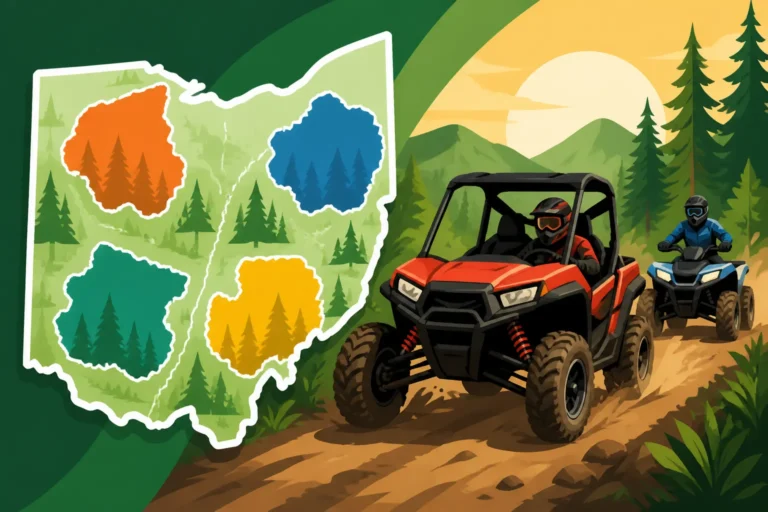
Ohio’s Wayne National Forest riding systems are not one continuous trail network. Monday Creek, Hanging Rock, and Pine Creek are separate riding areas, so a two-system weekend means trailering or driving your machine between them rather than riding directly from one to the next. That distinction matters when you’re deciding whether to stay in one base camp or move lodging midweekend.
Start by comparing the character and location of the systems, not just the mileage shown on a map. Monday Creek is near Nelsonville, while Hanging Rock and Pine Creek are farther south in the Ironton District area. If you are traveling from Columbus, Athens, or another northern starting point, Monday Creek may make a practical first stop before continuing south. If you’re coming from Kentucky or the southern Ohio River area, a southern system may be the easier place to begin.
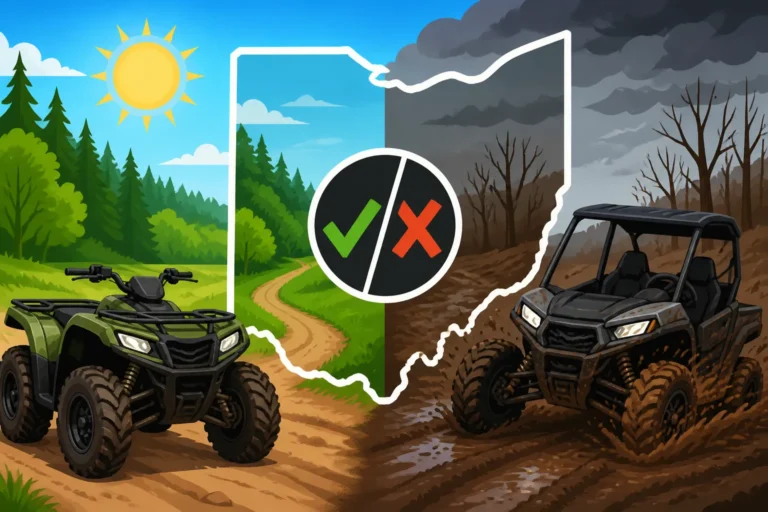
Also check whether both systems are expected to be open for your planned dates. Riding seasons, trail work, weather closures, and temporary restrictions can affect access. An area that looks close on a map may not be a good pairing if one system is closed or if the connecting drive consumes most of your riding day. For a broader look at how the systems differ, read Wayne National Forest’s Three Ohio Systems and Ohio’s Trail Season by Forest.
Match the pairing to your group and machine
A good two-system weekend is not necessarily the one that covers the most ground. It’s the one where the riding suits your group, the trailhead logistics are manageable, and nobody feels rushed to finish a loop before dark. A family with newer riders may prefer a straightforward first day near one staging area, followed by a second day on familiar or similarly manageable terrain. Experienced riders may be more comfortable changing systems and adapting to different trail conditions.
Machine size matters, too. Ohio state forest riding areas have a 62-inch width limit, but do not assume every riding location uses identical requirements or that a machine fits just because it appears compact. Measure the machine as required and check the rules for each system you plan to visit. A wide side-by-side can limit your options, while a smaller machine may make it easier to ride in places with width restrictions. See Ohio’s 62-Inch State Forest Width Limit and Ohio Trails for a Wide Machine before committing to a route.
Be honest about the group’s pace. A pair of riders who stop often for photos, lunch, or mechanical checks will cover less than a group that rides steadily. Build the weekend around a realistic day, not the maximum possible mileage. If one rider is young or inexperienced, check age and supervision requirements for the land you’ll use; those rules can differ between riding areas. [Ohio Forest Access for Riders Under 16] is a useful starting point.
| Planning question | Why it matters | What to check |
|---|---|---|
| Are both systems open? | Closures can change the whole weekend plan | Official trail updates and ranger district notices |
| How far apart are the trailheads? | The transfer may take longer than expected | Road route, trailer access, fuel stops, and unloading time |
| Does your machine fit the rules? | Width and equipment requirements can limit access | System-specific rules and machine measurements |
| Does each rider have the required permit? | A permit for one area may not cover another | Permit type, who needs one, and how to display it |
| Where will you stay? | Lodging can determine whether you move camps | Campground rules, check-in times, and trailer parking |
Sort out permits, registration, and maps
Treat each system’s access requirements separately
Before you load the trailer, distinguish Ohio registration from the permits required for a particular riding area. Ohio APV registration and a Wayne National Forest OHV permit are not interchangeable. A state registration plate does not automatically replace a forest permit, and a forest permit does not take the place of any required registration. Check the requirements for every system on your itinerary, including what each rider must carry and how the permit should be displayed.
Do this early enough to fix a paperwork problem without turning it into a last-minute scramble. Confirm that the machine’s registration is current, the plate is legible and attached as required, and the registration information is with you. If you’re visiting from another state, check whether your home-state registration is accepted for the riding you intend to do or whether a temporary permit is required. Ohio APV Reciprocity With Other States and The Ohio Temporary Permit for Visitors can help you identify the right questions.
For Wayne National Forest, check the current permit instructions before traveling. Don’t rely on an old pass, a friend’s recollection, or a listing in a trail group conversation. Confirm the permitted dates and whether each rider needs an individual permit. The rules for passengers and riders may not be identical, so clarify who needs what before you arrive. How the Wayne National Forest OHV Permit Works and Where to Buy a Wayne Forest OHV Permit provide more detail.
Prepare maps for areas with weak cell service
Download or otherwise save the maps and access information you’ll need before leaving reliable service. Cell reception can be inconsistent in wooded and hilly parts of southeastern Ohio. A map that loads perfectly at home may be frustratingly blank at a trailhead or down in a hollow if you depend on a live connection.
onX Offroad can be one planning tool for reviewing routes and saving map information for offline use. It should not be your only source for deciding whether a route is open or legal. Compare what you see in the app with official forest or state information, and pay attention to posted signs at the trailhead. A mapped line does not, by itself, prove that a route is open to your vehicle.
Before the trip, mark the staging areas, the route between systems, nearby fuel stops, and your overnight location. Save a backup copy of essential directions on another phone or in a written itinerary. If you use onX Offroad, check your saved maps while you still have service so you know they are available offline. Also set a clear meeting point in case riders become separated; “meet back at the trailhead” is more useful when everyone knows which entrance or parking area you mean.
Plan the transfer between riding systems
Decide whether to move camp or keep one base
If the systems are far enough apart that the transfer would eat into riding time, consider moving lodging or camping between days. That can mean more packing and setup, but it may let you start the second day closer to the next trailhead. If you keep one base, compare the driving route to both areas and be realistic about the early starts and return trips.
A trailer makes the transfer easier, but it adds practical details. Confirm that the overnight location can accommodate your tow vehicle and trailer, and ask about parking before you arrive. Some small lodging properties, campgrounds, and trailhead lots have limited space or specific rules for overnight parking. Do not assume that leaving a trailer at a staging lot is permitted simply because other visitors have done so.
Think through the transfer as its own part of the itinerary. Allow time to load, secure the machines, reach the next area, unload, and check in. A drive that looks short on a route planner can take longer with a trailer, narrow rural roads, a fuel stop, or a meal break. onX Offroad may help you visualize the riding areas, but use a road navigation route for the vehicle transfer and verify the route is suitable for your tow setup.
Build a flexible two-day schedule
A practical schedule gives each system a clear role. For example, arrive near the first area the evening before, ride a moderate loop the next morning, and transfer after lunch or after finishing the day’s planned ride. On the second day, start at the other system with enough time to check conditions, complete a reasonable ride, and load before dark. The exact sequence depends on your arrival direction, lodging, open trails, and the group’s experience.
Avoid planning a full day of riding at both systems plus a long transfer in between. That may look efficient on paper, but it leaves little margin for a flat tire, a blocked route, a slow lunch, or a rider who needs a break. It also encourages people to rush on unfamiliar trails. A shorter ride with time to handle the unexpected is usually more enjoyable than a packed schedule that turns every delay into a problem.
Make a primary plan and a fallback plan. If rain makes one area unpleasant or a temporary closure changes access, know whether you’ll stay at the first system, switch to a nearby alternative, or cut the weekend short. Check trail conditions shortly before departure and again at the trailhead. Ohio Trail Conditions Before You Ride and Ohio Trail Closures to Check First are useful planning reads.
Ride prepared and adjust to conditions
Check the trailhead rules before unloading
When you arrive, pause before unloading the machines. Read the posted information, confirm the entrance is open, and look for notices about closures, permitted routes, hours, or machine restrictions. Trail maps and conditions can change, and a sign at the entrance may contain information that is newer or more specific than a saved map.
Make sure every rider knows the day’s plan: which routes you intend to take, where you will stop, and when you expect to return. Agree on a simple regrouping procedure if someone gets separated. If riders use different phones or navigation apps, compare the route before setting off. onX Offroad may be useful for keeping a shared picture of the route, but everyone should know how to return to the trailhead without relying on another rider’s phone.
Carry the practical basics for a day on the trail: water, weather-appropriate layers, a first-aid kit, a charged phone, and any tools or recovery items suited to your machine and route. Check fuel before leaving the staging area, especially if you are unfamiliar with nearby services. Do not assume that a fuel station will be open or conveniently located between trail systems.
Let weather and fatigue change the plan
Southeastern Ohio trails can feel very different after a stretch of rain. Clay can become slick, ruts can deepen, and water can conceal uneven ground. On a dry day, a route may feel manageable; after heavy rain, the same section may demand more skill and time. If conditions look unsafe or are damaging the trail, turn around rather than trying to force the planned loop. Ohio Trails After Heavy Rain explains why conditions deserve a fresh check before riding.
Fatigue also changes how a route feels. A long morning, a hot afternoon, and a trailer transfer can leave even experienced riders less alert. Plan water and food breaks, and be willing to shorten the second day. Keep a clear return time in mind, particularly if the group is unfamiliar with the area or needs to travel a long distance after riding.
Finally, treat the weekend as two separate visits, not one continuous adventure. Recheck the rules, entrance information, and trail conditions at the second system rather than assuming that what applied at the first one applies everywhere. A little extra planning at the start of each day can prevent the most frustrating outcomes: arriving at a closed entrance, missing a permit requirement, or finding out too late that the chosen route does not fit your machine.
Disclaimer
This article is for general informational purposes only and does not constitute professional advice. Laws, prices and regulations vary by location and change over time. Consult a qualified professional for guidance on your specific situation.