Frozen Ruts in January
January riding in Ohio can turn a familiar trail into a patchwork of frozen grooves, slick clay, and soft spots that look solid but aren’t. The safest ride starts before you unload: confirm the trail is open, check recent weather, and plan for ruts that can steer or trap your machine. Here’s how to assess conditions, ride carefully, and know when to turn back.
Why January Ruts Are Hard to Read
A frozen surface can hide soft ground
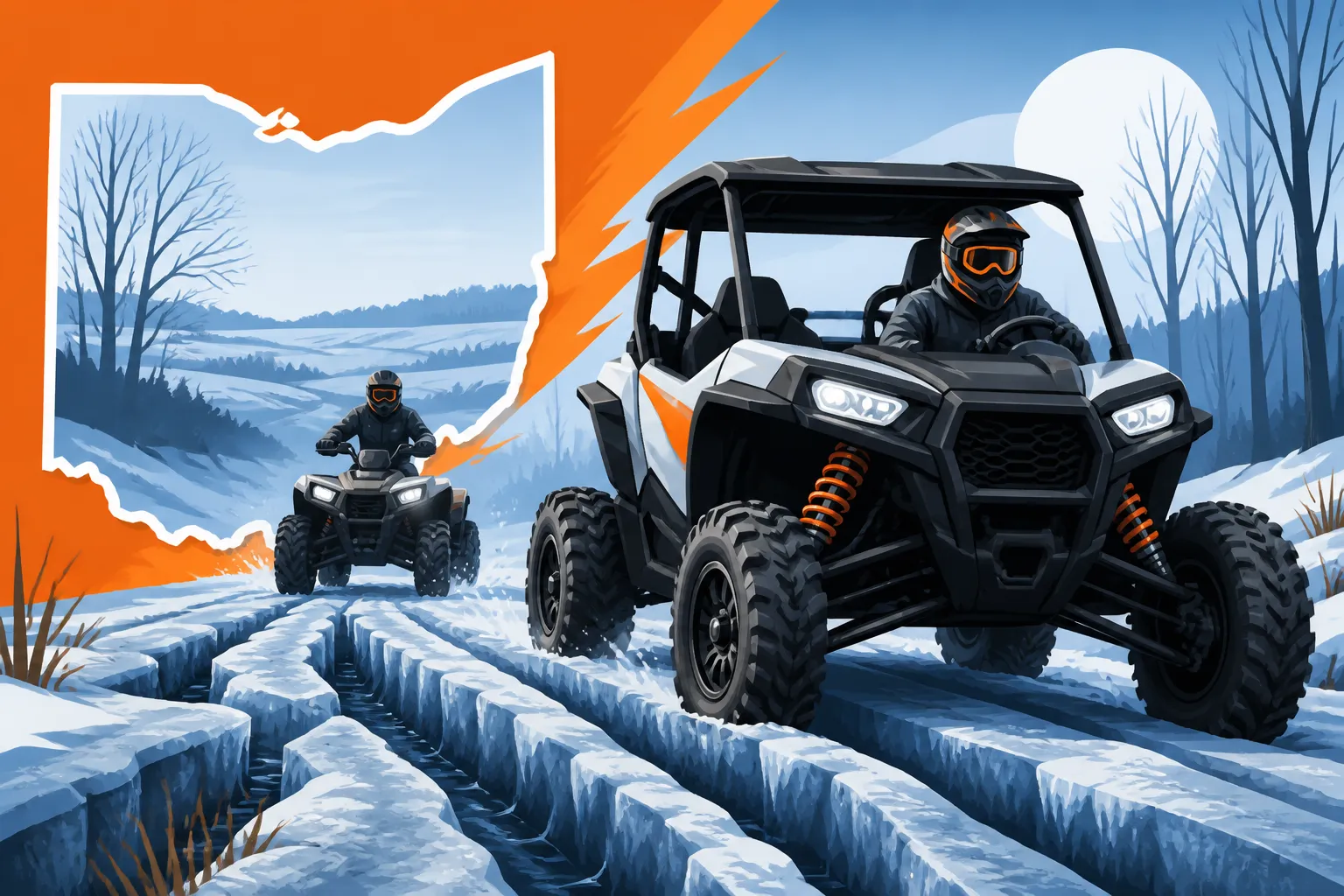
A rut that froze overnight may look firm from the trailhead, then give way once sunlight reaches it or a warm afternoon loosens the top layer. The result is an unpredictable surface: hard edges beside soft mud, ice over standing water, or a frozen crust that breaks under your tires. A machine can suddenly drop into a groove that looked shallow from a distance.
Freeze-thaw cycles make the trouble worse. Water settles into existing ruts, freezes, and expands; when it melts, the rut may become deeper or softer than it was before. A cold morning is not proof that a route will stay firm all day. A south-facing section can thaw while a shaded hollow nearby remains icy.
Pay particular attention to low points, creek approaches, shaded woods, and places where water crosses the trail. These areas tend to hold moisture and can change faster than dry, exposed ground. If you cannot tell whether a patch is solid, avoid riding straight into it just to find out. Walking a short section first—or choosing another route—is usually a better trade than getting stuck or damaging the trail.
Ruts can pull the machine off your intended line
A deep groove can steer your tires for you. On an ATV, the front wheels may follow the rut even when you are trying to angle out. A UTV can lean or drop a wheel into a rut, especially if the rut runs across a slope or one side of the trail is softer than the other. Add ice or frozen mud, and a small correction can turn into a slide.
The instinct to accelerate through a rut can make things worse. Spinning tires polish ice, dig into soft ground, and throw mud onto the trail. A sudden throttle change can also unsettle a machine when its tires are climbing uneven edges. Slow down before the rough section, keep your movements smooth, and avoid sharp steering or braking once you are in it.
If the rut is deep enough to catch a footrest, skid plate, or undercarriage, don’t treat it as a challenge to power through. Stop somewhere stable and assess the route. Backing out slowly may be safer than trying to climb a steep, slick rut wall. If you are riding with others, leave room for the next rider to stop rather than bunching up at the obstacle.
Check Trail Access Before Loading
Confirm that the route is open in winter
Frozen ground does not automatically mean a trail is open. Ohio riding areas have different operating seasons, and a trail may close because of its calendar, maintenance work, weather damage, or a temporary restriction. Check official trail information before setting out, then look again for notices close to your ride. The overview in [Ohio Trails Open in Winter] can help you identify areas to investigate, while [Ohio Trail Closures to Check First] is a useful reminder to check for restrictions rather than assume access.
Maumee State Forest is a place riders may consider for a winter outing, but verify its current access rules and trail status before you go. The practical details in [Riding Maumee in January] can help frame what to check for a cold-weather trip. Other popular areas may have seasonal closures, so do not assume that access at one forest means access at another. [Ohio's Four State Forest APV Areas] provides context for the state forest options, but the relevant agency’s latest notices should guide your final decision.
Maps can help with orientation, but they are not a substitute for official signs or closure information. An app such as onX Offroad can be useful for reviewing a route and understanding where you are, but confirm that the trail is authorized and open through the land manager. Keep the map available offline if service may be unreliable, and pay attention to posted signs even if a route appears on a digital map.
Check conditions, daylight, and the return route
Before leaving home, look at recent weather—not just the temperature at ride time. Rain followed by a hard freeze can leave slick surfaces beneath a dusting of snow. A thaw can turn a firm trail into deep mud by afternoon. Wind, precipitation, and changing temperatures can also make a long ride feel very different from the short loop you pictured while packing.
Use [Ohio Trail Conditions Before You Ride] as a prompt to check more than a general forecast. Look for trail updates, recent reports from the riding area, and any warnings about mud, ice, or maintenance. A mapping tool such as onX Offroad may help you review possible routes and keep track of your position, but rider reports can be old or incomplete. Treat them as clues, not guarantees, and be ready to change your plan when the ground tells a different story.
Set a conservative turnaround time. Winter daylight is limited, and cold hands or a slow recovery from a stuck machine can stretch a ride. Plan a route that gets you back before visibility and temperatures become a problem. The guidance in [Ohio State Forest Riding Hours] is a useful reminder to verify the hours that apply to the area you choose, rather than relying on the time you usually ride in summer.
| What you notice | Why it matters | Safer response |
|---|---|---|
| A rut has a hard, shiny surface | It may be ice rather than firm dirt | Reduce speed before reaching it and avoid abrupt steering |
| The rut edge crumbles under a boot | The ground may be thawing or waterlogged | Choose a firmer line or turn around |
| One rut wall is much higher than the other | A wheel may climb unevenly and destabilize the machine | Approach slowly only if the route is manageable; otherwise avoid it |
| Water is pooled in a low spot | Ice or deep mud may be hidden below the surface | Do not assume the center is safe; scout from stable ground |
| A sign marks a closure or reroute | Access rules override what a map or old report shows | Follow the posted direction and leave the closed section alone |
Ride Frozen Ruts With Control
Choose a line before entering the rough section
Approach ruts slowly enough to look ahead and decide where you want your tires to go. If there is a firm, permitted line beside the rut, use it rather than crossing repeatedly between grooves. Avoid riding on fragile edges that may collapse under the machine. If the trail is too narrow to choose a safe line without leaving the marked route, the right answer may be to turn back.
Keep your body relaxed and your grip steady. On an ATV, use a controlled posture that lets you respond to the machine without locking your arms. On a UTV, keep occupants seated and secured, and avoid sudden side-to-side movement. Do not hang a wheel over a rut edge just to get a better view or squeeze around another rider.
Leave space between machines. If the lead rider slows or stops, the rider behind needs enough room to react on a slick surface. On a narrow trail, pass only where the trail is wide, stable, and permitted for travel. [Ohio Trail Etiquette on Narrow Trails] offers helpful context for sharing a confined route, especially when conditions make passing and stopping harder.
Avoid spinning, rut widening, and risky recovery attempts
If a tire begins to spin, ease off rather than digging in. Spinning can deepen the rut, damage the trail, and make the machine harder to control. If the tires lose traction, stop before you bury the machine. Look for a safe way to reverse out along the track you used, or reposition only if the ground is stable and there is enough room to do so without putting anyone in the path of the machine.
Recovery equipment is useful only when it is appropriate for the situation and you know how to use it safely. A winch line can store dangerous tension, and a tow strap can snap or pull a machine unexpectedly if attached incorrectly. Keep people clear of loaded lines and moving vehicles. If the machine is high-centered, tilted, or wedged in a way that makes recovery uncertain, do not rush into a pull just because the group is eager to keep riding.
Also think about what your tires are doing to the trail. A route may feel frozen in one spot and become soft only a short distance later. Deep tire spin can turn a manageable track into a damaged, water-holding trench. Leave the trail as you found it as much as conditions allow, and obey any closure or damage-related notice. [Ohio Trails Closed in Spring] explains why seasonal restrictions matter; winter damage can affect access long after the ride is over.
Prepare for a Cold Ride and Know When to Turn Back
Pack for a slower, colder outing
Cold weather makes small hassles more serious. A glove that gets wet while clearing mud can leave your hands numb; a brief delay can feel much longer when you are exposed and not moving. Dress in layers, bring dry gloves, and keep a warm outer layer accessible rather than buried under gear. Carry water and food, and let someone at home know where you plan to ride and when you expect to return.
Check your machine before leaving. Inspect tires, brakes, lights, and controls, and make sure your battery and fuel situation suit the route. Mud and ice can collect around moving parts or block areas that need to stay clear. After the ride, check for packed material around the wheels, underbody, and radiator area where applicable, and clean the machine in a way that does not force debris deeper into components.
Bring the essentials you would want if the ride took longer than planned: a charged phone, a way to navigate if cell service drops, basic tools, and recovery gear suited to your machine. A mapping app such as onX Offroad can support route awareness, but keep a backup plan for navigation and do not rely on a signal being available everywhere. Follow official signs and your planned route even when a digital track seems to offer a tempting shortcut.
Call off the ride when the ground is changing
A good winter ride is not measured by how many difficult ruts you conquer. It is measured by getting everyone and every machine home safely without turning a trail into a deeper, muddier problem. Turn around if the route is thawing quickly, if ruts are deepening under repeated passes, or if ice makes steering and braking unpredictable. The same goes for worsening visibility, cold that is affecting your concentration, or a machine problem you cannot confidently manage.
Be especially cautious when the group includes newer riders, young riders, or machines with different capabilities. A rut that is manageable for one experienced rider may be intimidating or unsafe for another. Agree on a simple turnaround plan before entering a difficult section, and make sure nobody feels pressured to continue because the rest of the group has already committed.
Most importantly, respect the land manager’s rules. Ride only on authorized routes, stay off closed sections, and do not create a new path around a muddy or icy obstacle. Winter conditions can make a trail look inviting while hiding both safety risks and access restrictions. Checking the official status, riding conservatively, and turning back early are not overreactions—they are part of riding responsibly in Ohio.
Disclaimer
This article is for general informational purposes only and does not constitute professional advice. Laws, prices and regulations vary by location and change over time. Consult a qualified professional for guidance on your specific situation.