Where to Ride a Side-by-Side Over 62 Inches Wide
A side-by-side wider than 62 inches can turn a fun Ohio trail day into a frustrating trip back to the trailer. Many state forest riding trails have a width limit, so a machine that fits the family and gear may not fit the route. This guide explains where to look instead, what to verify before you travel, and how to avoid confusing public trails with private riding areas.
Why a side-by-side over 62 inches has fewer trail options
The state forest width limit is the first thing to check
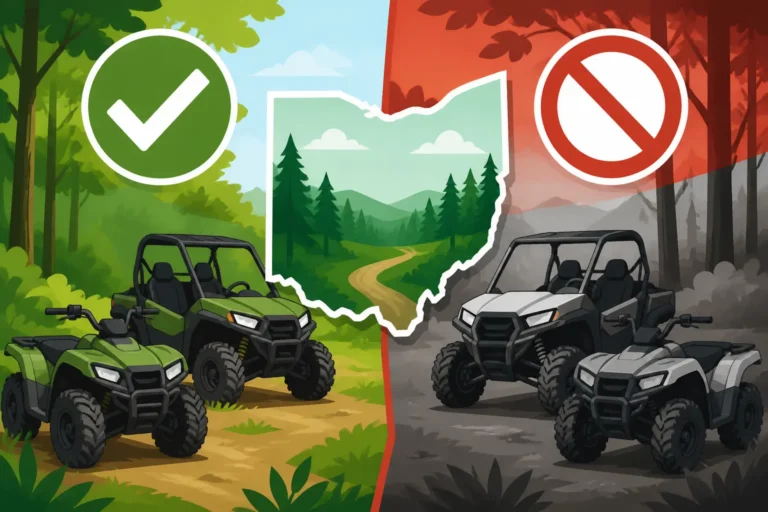
Ohio’s state forest riding trails are not a safe bet for a side-by-side wider than 62 inches. That limit is a practical access rule, not a suggestion about whether a particular machine can squeeze between trees. A wider vehicle may be turned away even if the trail looks open at the entrance or you have seen other side-by-sides nearby.
Before planning around a forest system, check the rules for that specific trail area and the machine’s actual width. Manufacturer specifications can be useful, but accessories such as wider tires, wheel spacers, or aftermarket parts may change the measurement. For background on the distinction, see [Ohio's 62-Inch State Forest Width Limit](Ohio's 62-Inch State Forest Width Limit).
A familiar trail name does not mean every machine is allowed
Ohio has several well-known public riding areas, including trail systems in the Wayne National Forest region and state forest riding areas such as Maumee, Perry, Pike, and Richland Furnace. A scenic trailhead or a long advertised trail network does not automatically mean the route accommodates a wide UTV. Public land rules are specific to the system and can differ from the rules at a private park nearby.
That matters especially if you are hauling from a distance. You may pass attractive trails around Nelsonville or drive toward the Ironton area expecting to unload, only to find that the trail restrictions exclude your machine. Check official maps and area rules before loading; do not rely on a social media photo, a trail review, or a map line alone. [Ohio Trail Maps From ODNR](Ohio Trail Maps From ODNR) can help you start checking public trail information.
Do not treat a road route as a substitute trail
Some townships or counties may allow APVs on certain roads under local rules, but that does not create permission to ride every road or connect roads as if they were an off-road trail system. Road access is separate from trail access, and the machine may need to meet additional equipment, licensing, and insurance requirements.
If you are considering a road connection, verify the rules for each jurisdiction and road segment. A route that crosses a township boundary can change from permitted to prohibited with little visual warning. The key point is simple: public-road permission does not make a wide side-by-side eligible for a state forest trail.
Where to ride a wide side-by-side in Ohio
Start with private off-road parks
For many owners of side-by-sides over 62 inches, a private off-road park is the most realistic place to investigate. Private facilities set their own access rules, trail layouts, vehicle limits, and operating conditions. Some may have routes suited to wider machines, while others may impose a width cap or restrict certain vehicle types. Never assume that “UTVs welcome” means every width is accepted.
Look for a park that clearly describes side-by-side access, then contact the operator before booking or driving out. Ask whether your exact make, model, tire setup, and measured width are allowed on the trails you plan to ride. Private riding areas may also have separate requirements for helmets, sound levels, passengers, spark arresters, insurance, or machine condition. For a broader overview, see [Ohio Private Trail Parks](Ohio Private Trail Parks) and [Ohio Pay-to-Ride Parks](Ohio Pay-to-Ride Parks).
Ask about the route, not just the entrance
A park might admit your machine but still have sections that are too narrow, steep, muddy, or otherwise unsuitable for it. Ask whether the facility has routes specifically open to wider side-by-sides and whether those routes are marked separately. If you are riding with a mixed group, find out whether the group can stay together or whether narrower machines will have to use different loops.
It also helps to be specific about how you ride. A long, wide machine with a roof and doors may handle differently from a compact sport UTV, even if both are within a park’s stated limit. Ask about turning room, passing space, trail surface, and any known restrictions on tight wooded routes. A quick call can prevent the aggravation of paying or traveling only to discover that the available riding is not a good match.
Private land requires permission and clear boundaries
Another possibility is riding on private property with the landowner’s permission. Permission should be explicit and should cover where you may ride, when you may ride, and whether guests are allowed. A visible trail, an old access road, or an unlocked gate is not permission. Do not assume that a route through farmland, reclaimed ground, or a utility corridor is open to the public.
If you have permission to ride a large parcel, agree on boundaries before unloading. A property line can be difficult to spot once you are on a machine, and accidentally crossing onto neighboring land can create a serious problem. Keep the landowner’s instructions accessible, stay on approved routes, and ask before bringing a group or returning on another day.
How to confirm a riding area fits your machine
Measure the machine as it is set up to ride
Measure the widest point of the vehicle, including tires and any parts that extend beyond the body. Do not rely only on a brochure measurement if you have installed wider wheels, tires, spacers, or accessories. If the park uses a particular measurement method, ask whether it measures tire edge to tire edge, body width, or another point.
Write down the measurement and share it when you contact a riding area. A useful call might sound like this: “My UTV measures just over 64 inches at the outside edges of the tires with its current setup. Are there trails where that width is permitted?” That gives the operator something concrete to answer instead of leaving both of you to interpret “wide” or “full-size.”
Confirm rules directly before you make the drive
Use a checklist when contacting a park or land manager:
- Is a side-by-side of my measured width allowed?
- Are all trails open to that width, or only certain routes?
- Are there machine-type, passenger, or equipment restrictions?
- What registration, plate, permit, or insurance documents should I bring?
- Are there seasonal closures or conditions that could affect access?
- Where should a trailer be parked, and is the unloading area suitable for my rig?
A mapping app such as onX Offroad can help you orient yourself, compare route information, and keep track of your trip planning. Treat any digital map as a planning aid, not proof that a road, trail, or parcel is open to your machine. Confirm access with the park or land manager, especially where a route approaches private property or a public-land boundary.
| Riding option | Why it may work for a wide UTV | What to confirm first |
|---|---|---|
| Private off-road park | The operator may have routes designed for wider machines | Width limit, eligible trails, fees, equipment rules, and closures |
| Private land with permission | The landowner can authorize riding on specified routes | Written or clearly documented permission, boundaries, dates, and guests |
| Public state forest trails | Often attractive riding, but the 62-inch limit can rule out a wider machine | Current width rule and trail-specific access before traveling |
| Public roads open to APVs | May provide a legal connection in some places | Local ordinance, road segment, equipment, license, and insurance rules |
Check conditions and access again close to ride day
A route that is normally open may be affected by maintenance, weather, land access, or seasonal restrictions. Mud can make a route difficult for a heavy or wide vehicle, while a downed tree or temporary closure can change what is reachable. Check the operator’s latest notices and contact the riding area again if your plans depend on a specific trail or facility.
onX Offroad can be useful for organizing a route and reviewing map context, but do not treat a line on the screen as current permission. Compare mapping information with the park’s own directions and access rules. Before you leave, save the address, confirm the entrance, and make sure the route you intend to ride is actually open to your machine’s width. [Ohio Trail Conditions Before You Ride](Ohio Trail Conditions Before You Ride) is also a useful topic to review when preparing for a trip.
Make the trip work for a wide machine
Compare public forest trails with private parks honestly
Public forest riding can be appealing because of the scenery and established trail systems, but a width restriction can make it a poor fit for a wider UTV. A private park may be a better match if it explicitly allows your machine and has routes designed for it. The trade-off is that private facilities have their own policies, access arrangements, and costs, which you need to check directly.
| Factor | Public forest system | Private riding park |
|---|---|---|
| Width access | May be limited by a firm trail-width rule | Set by the individual operator |
| Route information | Often published through public-land resources | Usually provided by the park |
| Access conditions | Can be affected by public-land closures and seasonal rules | Can change with park schedules and local conditions |
| Best first step | Check the official rules and trail map | Call the operator with your measured width |
This comparison is not a claim that private parks always accept wide vehicles. It is a reminder to choose based on the actual rules, not on the general label “ATV trail” or “UTV park.” For more on the differences, see [Comparing a Forest Trail to a Private Park](Comparing a Forest Trail to a Private Park).
Keep plates, permits, and park rules separate
Registration and riding-area access are related but not interchangeable. A valid Ohio registration or plate does not necessarily grant permission to ride a particular trail, and a private park’s admission process does not automatically settle every state requirement that may apply to your machine. Ask the operator what documentation is required, then confirm any separate state or land-manager rules that apply to your trip.
For a private riding facility, check whether the park requires proof of registration, an admission pass, a waiver, or other paperwork. Ask whether every rider needs individual documentation and whether a passenger is covered by the same rules. [Ohio Plate Rules at a Private Riding Park](Ohio Plate Rules at a Private Riding Park) is a helpful related topic, but the park’s own instructions should guide your visit.
Pack for a longer day than you expect
Wide side-by-sides are often used for family or group rides, which makes preparation more important. Bring water, weather-appropriate layers, a charged phone, and basic recovery or repair gear suited to your machine. Share the destination and expected return time with someone who is not on the ride. If your route has limited cell service, agree on a meeting point and a plan in case the group gets separated.
Before departure, inspect tires, brakes, lights, belts, and tie-downs, and secure loose cargo. Keep a copy of the park’s directions and rules where you can reach them. onX Offroad can support navigation planning, but carry the information you need in a way that remains available if your phone loses service. A little preparation is much easier than sorting out a breakdown, wrong turn, or access dispute after you have unloaded.
A side-by-side over 62 inches is not necessarily out of riding options in Ohio, but it does call for more careful planning. Treat state forest width limits as a real access boundary, look first for private facilities that explicitly accept your measured machine, and confirm every detail before you tow. The best ride is the one where the machine, the route, and the land rules all match.
Disclaimer
This article is for general informational purposes only and does not constitute professional advice. Laws, prices and regulations vary by location and change over time. Consult a qualified professional for guidance on your specific situation.