Riding Richland Furnace on a Weekend
Richland Furnace makes a satisfying southern Ohio weekend ride, but a good day depends on more than showing up with a fueled machine. Trail conditions, seasonal closures, machine width, registration, and where you can park all affect the plan. This guide walks through how to prepare, what to expect on the trails, and how to make the most of a weekend without rushing.
Plan your Richland Furnace weekend
Know where you are going and what kind of riding to expect
Richland Furnace State Forest is in Lawrence County, in the hills near Pedro and south of Ironton. The area is known for off-highway vehicle riding in a wooded, hilly setting. Expect a mix of turns, elevation changes, and natural-surface trail rather than a paved route or a smooth, uninterrupted loop. A trail that looks short on a map can take longer than expected when the ground is uneven or you stop to regroup.
Before leaving home, check the official trail map and confirm the access point you plan to use. Forest roads, trail entrances, and nearby public roads are not interchangeable: a machine being allowed on an OHV trail does not mean it can continue along every road outside the trail area. [Ohio Trail Maps From ODNR] is a useful starting point for understanding the marked system, while [Ohio's Four State Forest APV Areas] helps put Richland Furnace in context with other state forest riding areas.
It is also worth confirming that the area is open for the dates you have in mind. Ohio’s state forest riding season is seasonal, and trail access can be affected by closures, maintenance, or ground conditions. Check before loading the trailer, especially if your weekend falls near the beginning or end of the riding season. [Ohio Trail Conditions Before You Ride] offers a useful checklist for making that last-minute decision.
Build the weekend around travel time and daylight
A weekend trip can feel surprisingly compressed once you factor in the drive, unloading, registration checks, trail time, meals, and loading back up. If you are coming from farther away, consider arriving early enough to unload and organize before you begin riding. That leaves less pressure to rush through the first loop and gives everyone time to check helmets, goggles, communication plans, and machine controls.
Think about the return trip before you set off. Ohio state forest riding hours are limited by daylight; plan to finish and be heading back toward your staging area before the end of the permitted riding period. [Why Ohio Riding Ends a Half Hour After Sunset] explains why “one more loop” can be a poor plan when daylight is fading. It is much easier to enjoy the final hour when you are not watching the clock or trying to navigate unfamiliar trails in failing light.
If your group is meeting at the forest, agree on a precise meeting point and a backup plan in case someone loses cell service or arrives late. Tell a person who is not riding where you expect to be and when you plan to return. Cell reception can vary in wooded, hilly terrain, so do not make a mobile signal your only way to regroup.
Get your machine and paperwork ready
Check registration, width, and required riding gear
Before the trip, confirm that the machine is properly registered and that the plate is readable and securely attached. Ohio’s APV plate serves as the trail permit for state forest riding, so do not assume a registration card in a glove box is a substitute for the required plate. If you are visiting from another state, check whether your home-state registration is accepted for the kind of riding you plan to do. [Ohio Reciprocity for Out-of-State Machines] explains why visitors should sort out this question before reaching the trailhead.
Machine width matters at Ohio state forest riding areas. The state forest limit is 62 inches, and a side-by-side that exceeds it may not be allowed on the trails even if it is otherwise registered and trail-ready. Measure the machine at its widest point rather than relying on a model name or an old specification sheet. Accessories, wheel changes, and other modifications can affect the actual measurement. See [Ohio's 62 Inch State Forest Width Limit] and [Measuring Against the 62 Inch Limit] if you are unsure how to check.
Bring a properly fitting helmet and eye protection, and make sure each rider knows the basics of operating the machine they will use. Riders in a group may have different experience levels, but trail pace should be set by the least experienced person, not the fastest machine. If a child or teenager is riding, check the applicable age and supervision rules before the trip rather than trying to sort them out at the forest entrance.
Inspect the machine before the drive
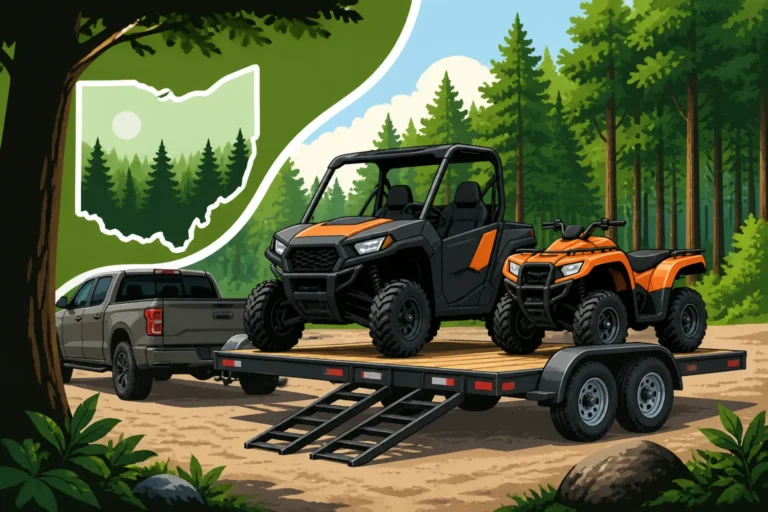
A short garage check can prevent a frustrating weekend interruption. Look over tires for visible damage and correct inflation, test the brakes and lights, and check fluid levels according to the machine’s manual. Inspect the steering, controls, and any racks or cargo boxes. If you use a trailer, check the hitch, tires, lights, tie-downs, and the machine’s attachment points before setting out.
Mud, water, and hills put extra demands on a machine. A loose battery connection or tired belt may seem minor at home but become a bigger problem miles from the staging area. Pack basic tools, a tire repair kit appropriate for your tires, a tow strap, drinking water, and a small first-aid kit. Keep anything you may need during the ride accessible rather than buried under luggage.
Do not treat a winch as a reason to attempt every obstacle. A recovery can become risky when riders attach a line to an unsuitable point or stand in the line’s path. If a machine is stuck, pause, assess the ground, and choose a safe recovery plan. Sometimes the best decision is to turn around rather than dig deeper into a muddy section.
| Before you leave | Why it matters | What to check |
|---|---|---|
| Trail status and map | Access and conditions can change | Official map, closure notices, recent conditions |
| Registration and plate | Required for lawful trail use | Current registration, visible plate, paperwork |
| Machine width | Ohio state forest trails have a width limit | Measure at the widest point |
| Gear | Protects riders and supports safe riding | Helmet, eye protection, suitable clothing |
| Trailer and tie-downs | A breakdown can start before the ride | Tires, lights, hitch, straps, attachment points |
| Group plan | Helps everyone stay together | Meeting point, pace, emergency contact |
Ride the trails with a weekend strategy
Start with a conservative first loop
When you arrive, take time to read posted signs and trailhead information. Confirm the route, any restrictions, and whether conditions have changed since you last checked. If it is your first visit, start with a manageable loop instead of trying to cover as much ground as possible. A relaxed first ride helps you learn the terrain, see how the group handles the surface, and decide whether to adjust the day’s plan.
Choose a lead rider and a sweep rider, with everyone else riding between them. The lead can set a steady pace and watch for turns or changing trail conditions; the sweep can make sure nobody is left behind. Agree on a simple regrouping rule, such as stopping at marked junctions. This is especially helpful when the group includes riders on different machines or people who have not ridden together before.
On narrow trails, leave enough room to react to a stopped rider, a rough patch, or someone approaching from the other direction. Keep to the marked route and avoid widening turns by riding off the trail edge. [Ohio Trail Etiquette on Narrow Trails] is worth reviewing if your group is used to wider private-park routes or open riding areas.
Adjust for rain, mud, and changing ground
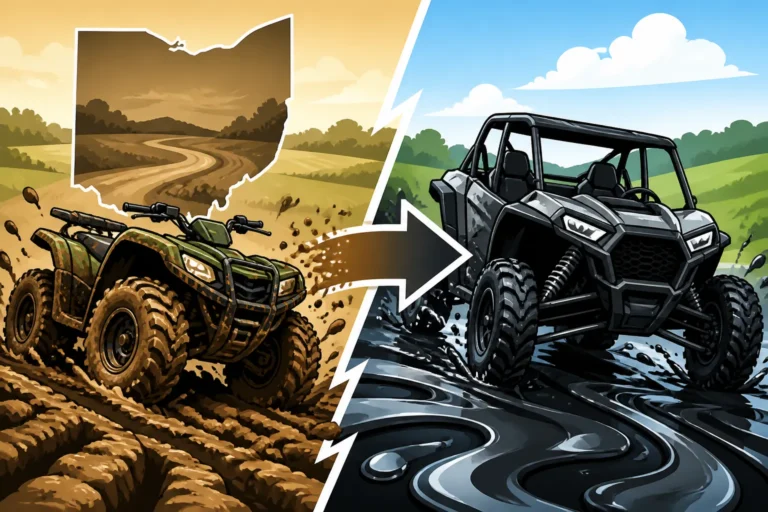
A trail that felt manageable during a dry visit can become slippery after rain. Clay may get slick, ruts can deepen, and water may hide uneven ground. The safest response is to slow down, leave more space between machines, and avoid charging into a section simply because another rider made it through. If the surface is deteriorating, consider turning back or ending the ride early. [Ohio Trails After Heavy Rain] explains why wet conditions can change both traction and trail impact.
Avoid spinning tires in a rut. Repeated wheelspin can make the hole deeper, damage the trail, and leave the machine harder to recover. If you are unsure whether a muddy section is safe, stop somewhere with room, look at the route, and talk through your options. A detour on a marked trail is better than making a new one.
Take breaks before riders are tired, thirsty, or frustrated. A quick stop gives everyone a chance to check gear, drink water, and confirm that the group is still together. If a machine develops a new noise, handling issue, or warning light, do not ignore it just to reach a planned destination. The aim is a good weekend, not a forced mileage target.
Make the weekend comfortable and finish safely
Sort out parking, fuel, and overnight plans
Plan where your trailer will be parked before you arrive, and follow posted directions at the access area. Do not block gates, forest roads, or space needed by other visitors. If you are uncertain about overnight parking or camping, confirm the rules for the specific location rather than assuming a trailhead lot is intended for overnight use. [Parking a Trailer at a Forest Lot] and [Camping Near an Ohio Trailhead] can help you think through those practical details.
Fuel planning deserves the same attention. Do not count on finding fuel at the trailhead or just around the corner. Start with a full tank, estimate fuel use conservatively, and identify a suitable place to refuel during the trip if your route requires it. [Finding Fuel Between Ohio Trailheads] is a helpful reminder to plan this before you are deep into a ride.
For navigation, download or save the information you need before entering an area where reception may be unreliable. Some riders use a GPS device or an offline mapping app such as onX Offroad to keep track of their route when a phone has no signal. Treat digital maps as a planning aid, not permission to leave marked trails or enter land where riding is prohibited. Carrying a paper map or knowing the trail layout can be a useful backup if a device runs out of battery.
Leave time for cleanup and the trip home
Reserve time at the end of the day to check the machines, secure the load, and make sure nobody has left tools or personal gear behind. Remove mud from the parts that need attention, but avoid washing sediment into places where it can cause damage. After a wet ride, check the machine for packed mud around the radiator, brakes, and moving components. A quick post-ride inspection can reveal a loose strap, damaged tire, or problem that should be handled before the next day.
If you are riding both Saturday and Sunday, do not assume the second day should simply repeat the first. A wet night, changing temperatures, or tired riders can make the same route feel different. Recheck conditions in the morning, choose a pace that suits the whole group, and be willing to shorten the plan.
For a weekend at Richland Furnace, preparation is what makes the riding feel easy. Confirm access and rules, bring a machine that fits the trail area, keep the group together, and leave yourself enough daylight to return without rushing. That approach gives you room to enjoy the hills and wooded trails while looking after the people and place you came to ride.
Disclaimer
This article is for general informational purposes only and does not constitute professional advice. Laws, prices and regulations vary by location and change over time. Consult a qualified professional for guidance on your specific situation.