Riding Perry State Forest for a Day
A day at Perry State Forest can be a satisfying ride, but the experience depends on more than showing up with a fueled machine. Trail access, changing conditions, width limits, permits, and the right map all matter. This guide walks through how to plan your day, ride considerately, and avoid the common last-minute surprises that can cut a trip short.
Plan your Perry State Forest ride before you leave
Check access, trail conditions, and riding hours
Perry State Forest is in Perry County, within reach of communities such as New Lexington. The trails take riders through forest and reclaimed-mining terrain, where the surface and feel can change from one section to the next. Hills, turns, loose ground, and ruts can make a route more demanding than it looks on a map—especially after rain.
Before loading your machine, check official Ohio Department of Natural Resources information for trail access and closures. Weather can change the ride quickly: a dry stretch may be easy to follow, while wet clay can become slick and deep ruts can make a familiar route more difficult. A trail closure, maintenance work, or a temporary condition may also affect where you can ride. [Ohio Trail Conditions Before You Ride] and [Ohio Trail Closures to Check First] are useful topics to review when planning.
Confirm the permitted riding hours as well. State forest riding hours are not necessarily the same as daylight hours, and an access gate or trailhead notice may give important local instructions. Check [Ohio State Forest Riding Hours] and read any posted signs when you arrive. If your plans involve riding near sunrise or late in the day, leave enough time to return before riding is no longer allowed.
Choose a realistic route for your group
A day ride is more enjoyable when the plan leaves room for breaks, slower riders, and unexpected trail conditions. Instead of assuming you will cover every available route, agree on a manageable loop or an out-and-back plan before starting. Decide where the group will regroup if someone falls behind, and make sure every rider understands what to do if the group gets separated.
If the group has different experience levels, let the least experienced rider help set the pace. A steep or rough-looking section that feels routine to an experienced rider can be stressful for someone new to off-road trails. It is fine to pause, assess the ground, and turn back if conditions feel beyond the group’s ability. The goal is a safe day, not a completed route at any cost.
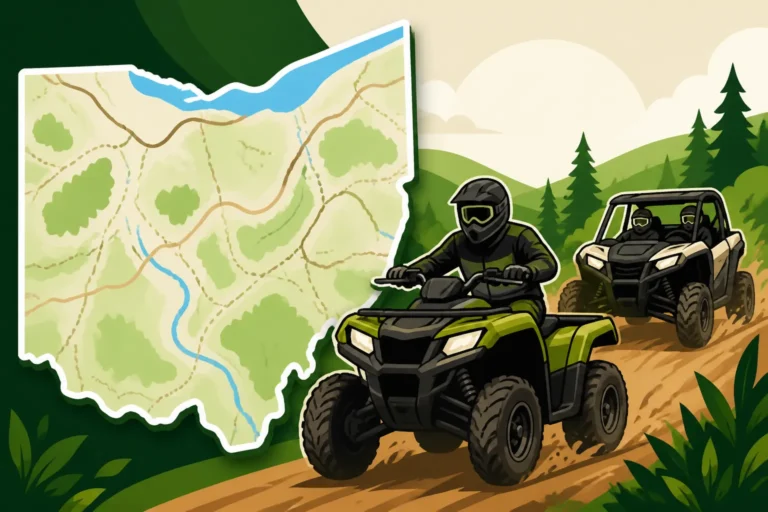
A useful planning reference is [Ohio's Perry State Forest Trails]. Pair that with [Ohio Trail Maps From ODNR] so you can study the official trail information before leaving home. An offline map app such as onX Offroad may also help with orientation when phone service is weak, but treat it as a supplement rather than a replacement for official maps, trail signs, or closure notices. Download what you need before you reach the forest, since a phone that cannot load map data in the field is not much help.
Get your machine and paperwork ready
Check registration, plate, and width
Before you travel, make sure your machine has the required Ohio registration and that its plate is present and clearly visible. Ohio’s APV registration also serves as access authorization for state forest trails; riders should understand the requirements before arriving rather than assuming a trail pass can be sorted out at the gate. [Ohio APV Permits Explained] covers the relationship between registration and trail access.
Width is especially important if you ride a side-by-side. Ohio state forest trails have a width limit, and a machine that exceeds it may not be suitable for these routes. Measure the machine as it is actually set up for riding, including accessories that affect its overall width. Do not rely on a brochure measurement or assume that a machine will fit because it looks narrow in a driveway. Review [Ohio's 62-Inch State Forest Width Limit] before making the trip.
Also check that your registration card and other required documents are with you. Keep them somewhere protected from mud and rain, such as a sealed pouch in a storage compartment. A phone photo can be useful as a backup, but it is sensible to carry the required paperwork in the form the rules call for.
Inspect the machine and pack for the day
A quick inspection at home can prevent a frustrating problem at the trailhead. Check tire pressure and condition, brakes, throttle operation, lights, steering, and fluid levels. Look for loose straps, damaged racks, or anything that could work free over rough ground. On a side-by-side, check the seat belts and make sure every passenger has a proper seat.
Pack for a day in the woods, not just the time you expect to spend riding. Bring drinking water, food, basic first-aid supplies, a charged phone, and weather-appropriate layers. A small tool kit and a way to manage a minor tire or mechanical issue can be useful, but do not let a tool kit create false confidence about taking on a repair beyond your skill or equipment.
A map should be available even if you use onX Offroad. Download the area in advance and confirm that you can locate your planned start point without a signal. Save the official trail map separately, and consider carrying a paper copy if you have one. Marking a meeting point before the ride can also help if riders become separated or need to return to the staging area independently.
| Before you go | What to check | Why it matters |
|---|---|---|
| Trail access | Official notices, closures, and current conditions | A planned route may not be open or suitable that day |
| Machine eligibility | Registration, visible plate, and width | Not every vehicle setup is permitted on state forest trails |
| Equipment | Brakes, tires, controls, lights, and restraints | A simple fault can become a serious problem on the trail |
| Navigation | Official map and an offline backup | Phone service may be unreliable in wooded areas |
| Group plan | Route, pace, and regrouping point | Riders can stay together without rushing or guessing |
Make the day ride comfortable and safe
Start with a clear group plan
At the staging area, take a few minutes to confirm the route and the order of riders. Agree on a lead rider and a sweep rider, then make sure everyone knows where the planned breaks will happen. The lead should choose a pace that allows the group to stay together; the sweep rider can watch for anyone who needs to stop.
Set simple expectations before the machines start moving. For example, agree that riders will wait at major turns and that nobody will pass the lead without permission. If someone needs to stop, the group should stop in a safe place rather than continuing until the rider is out of sight. These small habits reduce confusion on winding trails, where a missed turn can quickly split a group.
Parents and guardians riding with young people should check the rules that apply to the rider’s age and the land they are using. A child’s confidence, size, and ability to control the machine matter as much as enthusiasm. Choose a pace and route that allow the young rider to stop, turn, and respond without pressure.
Ride for the ground you have, not the ground you expected
Perry’s terrain can feel different after rain, during a dry spell, or as the trail surface changes. Keep a steady speed that gives you time to respond, and leave enough room between machines to avoid dust, thrown debris, or a sudden stop. On a hill or blind curve, do not assume the trail ahead is clear.
Mud is a common temptation on an off-road ride, but charging into a deep rut can turn a fun outing into a recovery job. If you cannot judge the depth or firmness, stop somewhere safe and assess it. Avoid riding around a wet or muddy section in a way that widens the trail or damages vegetation. Staying on the designated route helps protect the forest and keeps the trail usable for everyone.
Be considerate when encountering other trail users or work crews. Slow down, give people space, and follow any temporary directions or signs. Keep noise and speed under control near parking areas and access points. If you encounter a rider who needs help, stop only where it is safe to do so and make sure the rest of your group is accounted for.
Finish the ride without a scramble
Leave time to return and load up
A common planning mistake is to begin a long ride late in the day, then feel rushed when the group is farther from the staging area than expected. Choose a turnaround time before you start. Leave margin for a slower rider, a brief repair, or a route that takes longer than planned. [Ohio Trails With a Staging Lot] can help you think through the practical side of starting and ending a ride, but verify the specific access arrangements for Perry before setting out.
Make sure the whole group is back at the vehicles before packing up. Count riders, check that no one has left gear behind, and look over the machines for damage or loose parts. If your group has used a meeting point or split into smaller parties, confirm that everyone has returned before leaving the area.
If you are staying nearby, confirm lodging, food, fuel, and camping arrangements ahead of time rather than assuming they are available at the trailhead. For trip planning ideas, see [Camping Near an Ohio Trailhead]. Keep expectations flexible: facilities and services may be some distance from the riding area, so arrive with fuel, water, and a plan for what you will need after the ride.
Clean up and prepare for the next trip
Before driving home, remove loose mud and debris where practical, and check that the machine is secured for transport. Once home, inspect the tires, brakes, undercarriage, and air filter. Mud and grit can hide damage or work into parts that need attention. Cleaning the machine also makes it easier to spot a new leak, bent component, or loose fastener before the next outing.
Think about what worked and what you would change. Was the route too ambitious? Did the group need more water or a longer break? Was the map easy to use offline? A few notes after the ride can make the next visit smoother, particularly if you are bringing new riders or testing a different machine.
The best day at Perry State Forest is not necessarily the one with the most miles. It is the one where everyone knows the plan, has a suitable machine, respects the trails, and returns without feeling hurried. Checking access and conditions before you leave, then staying adaptable on the trail, gives you the best chance of enjoying the day as it unfolds.
Disclaimer
This article is for general informational purposes only and does not constitute professional advice. Laws, prices and regulations vary by location and change over time. Consult a qualified professional for guidance on your specific situation.