Ohio Trails for a Wide Machine
A wide side-by-side can look perfectly suited to Ohio’s hills and wooded trails, then turn out to be too wide for the route you planned. The key is checking the rules for the specific land and trail system before loading up. This guide explains Ohio’s common width limit, how to assess alternatives, and what to verify before you ride.
Start with the width limit, not the trail name
How Ohio’s 62-inch limit affects wide machines
Ohio’s state forest ATV trail systems commonly have a maximum machine width of 62 inches. That can rule out many larger side-by-sides, even if they are registered, insured, and otherwise ready to ride. A machine that measures over the limit should not be treated as acceptable just because it fits down a road or has previously been used on another trail.
Measure the machine at its widest point, including parts that affect its actual width, such as tires or accessories. Check the measurement with the machine set up for riding. A side-by-side advertised as “around 60 inches” may be wider once it has different wheels, tires, or attachments installed. If the result is close to the limit, ask the land manager how the width is measured rather than assuming a borderline machine will pass.
The 62-inch limit is associated with Ohio state forest riding, not a blanket promise that every Ohio trail has the same rules. Trail access depends on who manages the land, what type of trail you want to ride, and any restrictions posted for that route. Read [Ohio's 62-Inch State Forest Width Limit] before planning around a state forest system, and check the individual trail information for the area you intend to visit.
Why a legal machine may still be too wide for a route
Registration and physical access are separate questions. An Ohio plate may be necessary for riding in certain places, but it does not override a trail’s width restriction. Likewise, a side-by-side that is allowed on one property is not automatically allowed on a nearby forest trail, road, or private riding area.
It helps to think of your machine and the route as two pieces that must match. Imagine hauling a 64-inch-wide UTV to the Wayne National Forest area near Nelsonville, only to find that the particular trail system you planned to ride has a narrower limit. The drive, fuel, and unloading are already behind you, but the relevant question is still the same: does the land manager permit this machine on that route?
Keep the exact machine width, its model, and any modifications handy when checking. If you need a general starting point for alternatives, [Where to Ride a Side-by-Side Over 62 Inches Wide] focuses on the issue of finding places that may suit a machine beyond the state forest width threshold. Treat that as a lead to investigate, not as permission to ride any particular property.
Find riding areas that fit your machine
State forests, national forests, and private parks are not interchangeable
Ohio has several kinds of places riders may consider, including state forest trails, national forest routes, and private riding parks. They can have different access rules, permits, seasons, machine limits, and trail conditions. A route appearing on a map does not by itself establish that a wide UTV is allowed to ride it.
State forest areas such as Monday Creek, Hanging Rock, Pine Creek, Maumee, Perry, Pike, and Richland Furnace are familiar names to Ohio riders. But knowing the forest name is only the beginning: confirm the current trail rules for the specific system and the machine you plan to bring. For land managed by Wayne National Forest, check that land manager’s separate requirements rather than assuming that state forest rules apply there.
Private parks can be a practical alternative for wider machines, but each property sets its own rules. Some may have routes or riding areas that accommodate larger vehicles; others may have restrictions, designated routes, or limited access. Before making a reservation or driving out, confirm the permitted machine width, whether your UTV type is accepted, and any required documents or equipment. The differences between public and private options are explored in [Comparing a Forest Trail to a Private Park] and [Ohio Private Trail Parks].
Confirm what “wide” means to the property
When you contact a park or land manager, provide the actual width rather than just the model name. Model-year specifications can differ from the measurements of a modified machine, and accessories may affect the answer. Mention any larger tires, wheel spacers, aftermarket suspension, mirrors, or other equipment that could change the width or the machine’s ability to fit between obstacles.
Ask direct questions: Is there a maximum machine width? Does it apply to every trail or only certain routes? Are side-by-sides allowed, and are there separate rules for passengers? Does the property require advance reservations, a permit, or a specific type of registration? Getting clear answers before departure is much easier than trying to resolve a restriction at the gate.
Mapping tools can help you compare areas and organize a trip, but they are not a substitute for permission from the land manager. For example, onX Offroad can be useful for looking at mapped routes and planning where to investigate, while the official property information should be used to confirm access rules and closures. Check [Ohio Trail Maps From ODNR] alongside the rules for the specific land you want to ride.
| Riding option | What to verify for a wide machine | Why it matters |
|---|---|---|
| Ohio state forest trail | Maximum permitted width, trail status, operating season, and vehicle rules | A machine over the applicable limit may not be allowed, even if it is registered |
| Wayne National Forest route | The rules for the specific system, permit requirements, and route restrictions | National forest rules are not automatically the same as state forest rules |
| Private riding park | Maximum width, permitted vehicle types, reservations, and property-specific rules | Private parks set their own access requirements |
| Local road or connecting route | Whether APVs are permitted on that exact road and what equipment is required | Road access does not necessarily grant trail access |
Plan the trip around access, conditions, and paperwork
Check the route and closures before loading
Trail access can change with seasons, maintenance, weather, or land-management decisions. A route that appears on an older map may be temporarily closed, and a trail system may have individual sections with separate restrictions. Check for updates shortly before leaving, especially after heavy rain or when the area is approaching a seasonal opening or closing period.
Ohio’s southern trail areas can include steep grades, tight turns, uneven ground, and muddy sections. Even where a machine’s width is permitted, its size may make some routes uncomfortable or impractical. A wide UTV may have difficulty turning around on a narrow trail, passing another group, or moving safely around a fallen limb. Think beyond the posted maximum: ask whether the route’s character suits your machine and your group’s experience.
Use official land-manager information to confirm trail access, and use maps as a planning aid rather than the final authority. If you use onX Offroad or another mapping app, compare the mapped route with current notices from the property manager. For a pre-trip routine, [Ohio Trail Conditions Before You Ride] and [Ohio Trail Closures to Check First] are useful topics to review.
Check permits, registration, and what each rider needs
The machine’s width is only one part of a ride plan. Depending on where you ride, you may also need to meet registration, permit, helmet, passenger, or other requirements. Visitors should check whether their home-state registration is accepted for the place they plan to ride and whether a separate permit applies. For Wayne National Forest riding, confirm the applicable permit requirements directly rather than assuming an Ohio plate covers every access requirement.
Make a small pre-departure checklist: verify the machine is allowed, confirm that the route is open, check what registration or permits are required, and make sure required safety gear is available for every rider. If the UTV will use a road to reach a trail or connect between permitted sections, check that road’s rules separately. Road legality and trail permission are different questions.
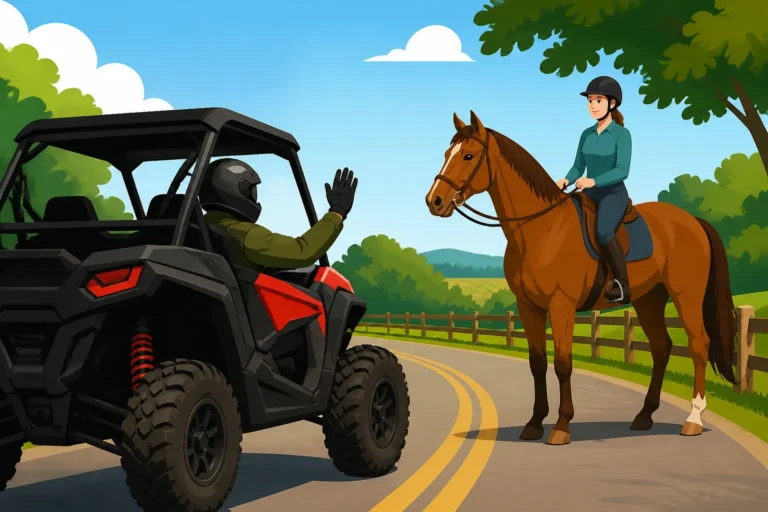
Bring the documents and equipment the land manager requires, and make sure your group knows where it is allowed to ride. When trails are narrow, slowing down and leaving room for other users can prevent stressful encounters. [Ohio Trail Etiquette on Narrow Trails] offers relevant guidance for sharing tight routes respectfully.
Make a practical choice for your UTV
When to choose another trail or property
If your machine exceeds a trail’s width limit, the safest plan is to choose a place that confirms your machine is allowed. Do not rely on the hope that nobody will check, or that a wide trail entrance means all sections are open to your vehicle. A restriction may be enforced at the trailhead or along the route, and a machine that cannot turn around safely can create problems for the rider and other trail users.
Sometimes the best option is to use a narrower machine for a particular public trail system and save the larger UTV for a property that explicitly allows it. Another option is to select a private park that confirms access for your machine and offers routes appropriate for its size. If you are riding with friends, compare everyone’s machine dimensions before choosing a destination so the group does not arrive with vehicles that have incompatible access.
A short phone call or message to the land manager can prevent a long, disappointing drive. Give them the machine’s measured width, the property or trail system you are considering, and your intended date. Ask for the exact rule and whether it applies to the whole property or only certain routes. Save the reply or note the office you contacted, especially if you are coordinating a group trip.
A simple pre-ride decision process
Use this order when deciding whether a wide machine can ride a particular Ohio route:
- Measure your UTV as equipped. Include modifications and accessories that affect its actual width.
- Identify who manages the land. State forest, national forest, county property, and private parks may each have different rules.
- Check the specific route’s restrictions. Confirm machine width, vehicle type, season, and any permit requirements.
- Look for current closures. Recheck notices close to your planned ride, particularly after severe weather.
- Confirm with the land manager if anything is unclear. Share the machine’s exact width and model, but treat the measured width as the important detail.
- Choose a different area if the answer is no or uncertain. Do not assume that a route is suitable simply because another UTV has ridden there.
A little homework may feel tedious when you would rather be on the trail, but it is far less frustrating than reaching a gate and discovering that your machine cannot legally or comfortably continue. For a wide UTV, the best destination is not simply the closest trail system. It is the place that confirms your exact machine is welcome, the route is open, and the ride fits your group.
Disclaimer
This article is for general informational purposes only and does not constitute professional advice. Laws, prices and regulations vary by location and change over time. Consult a qualified professional for guidance on your specific situation.