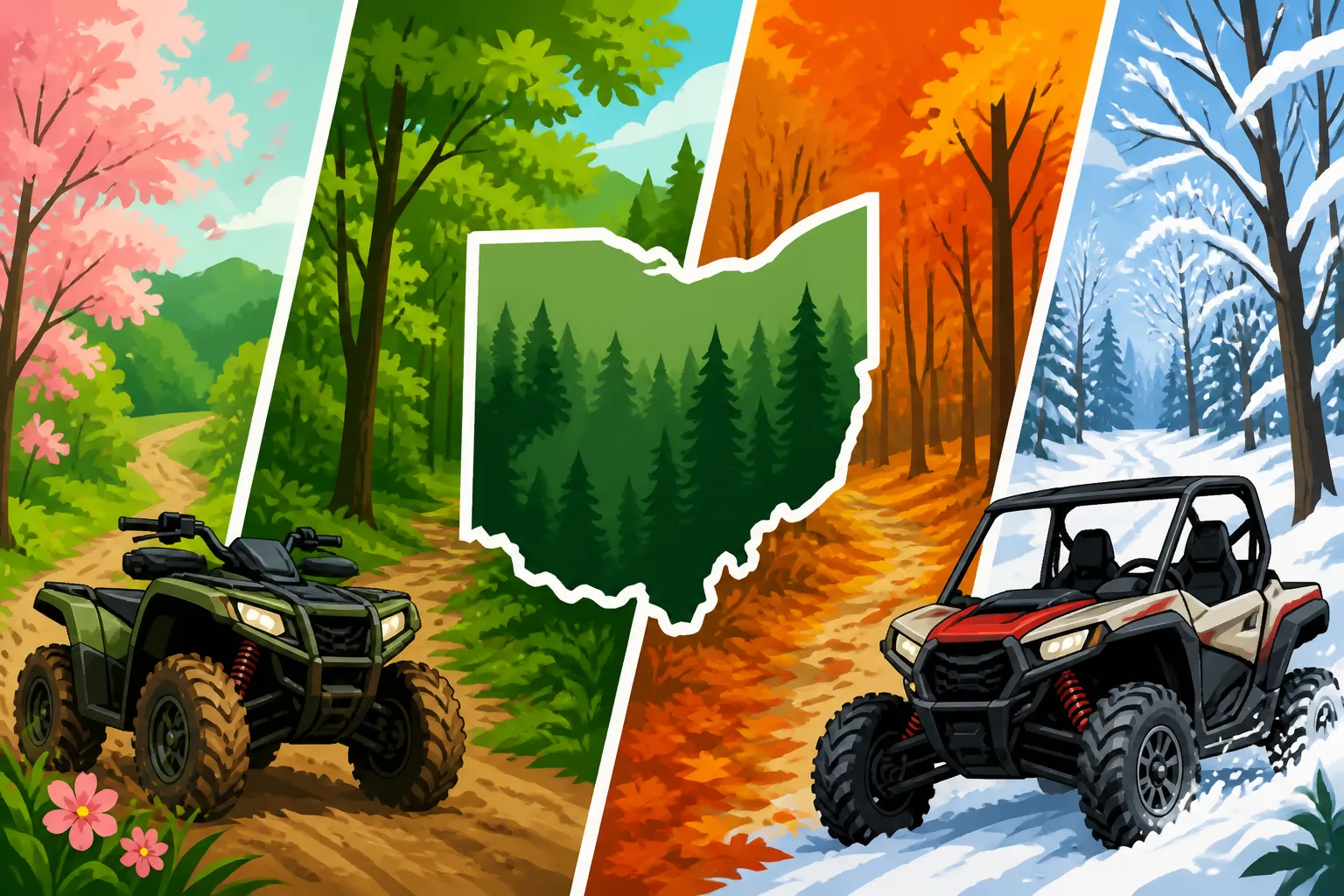
Ohio’s Trail Season by Forest
Ohio’s riding season does not open and close on one shared calendar: Maumee State Forest follows a different pattern from most southern Ohio state forests, and Wayne National Forest has its own trail schedule. That can turn a carefully planned weekend into a closed-gate surprise. This guide explains the usual seasonal pattern, what changes by forest, and how to check conditions before you haul your machine.
How Ohio’s trail season works
Different land managers mean different calendars
The first thing to know is that “Ohio trail season” is not one statewide opening date. Ohio’s state forest riding areas and Wayne National Forest are managed separately, so they may use different operating dates, access rules, and closure notices. A date that works for one trail system is not a safe assumption for another.
For many Ohio state forest trails, the regular season generally runs from the first Friday in April through the second Monday in December. Maumee State Forest is a notable exception, with a year-round riding season. Wayne National Forest has a separate seasonal schedule, commonly running from mid-April into mid-December. These are useful planning patterns, not a substitute for checking the specific trail system before you leave home.
That distinction matters when you are planning a trip around work, school, lodging, or a group of friends driving in from different parts of the state. Someone who has ridden Maumee in winter may reasonably expect to ride elsewhere in January, only to find that the gates are closed. Likewise, an April trip to Wayne may need to wait until its season begins even if another forest has already opened.
For a wider overview of the places and dates involved, see [Ohio's Four State Forest APV Areas] and [The Wayne Forest Season in Ohio]. Use each area’s posted notices to confirm the actual dates and any temporary restrictions for your planned visit.
Seasonal dates are only part of the answer
An open season does not promise that every trail is ready for riding on every day within it. Heavy rain, saturated soil, maintenance work, storm damage, timber operations, and other land-management needs can all affect access. Sometimes a full system is open while a particular trail segment or access point is temporarily unavailable.
It is easy to underestimate how much conditions can vary across Ohio. A dry stretch around the Oak Openings region in northwest Ohio does not tell you whether clay trails in the southern hills are firm enough to ride. Even within a single forest, a shaded hollow can stay slick long after exposed ground has dried. Treat the calendar as the first check, not the final one.
A closure notice can also be more specific than “open” or “closed.” It may apply to one trail, one entrance, a bridge, or an entire riding area. Read the notice closely, including its effective dates and any instructions about alternate staging areas. If the wording is unclear, contact the relevant forest office or ranger district rather than guessing at the gate.
A practical habit is to check the season dates, the trail-system status, and the latest conditions separately. That extra few minutes can save you a long drive with a trailer, a wasted day, or the frustration of discovering that your preferred loop is unavailable.
Ohio trail season by forest
Maumee State Forest in northwest Ohio
Maumee State Forest is known for having a different seasonal pattern from the southern Ohio state forest systems: its riding area is generally available year-round. That makes it a useful option for riders hoping to get out beyond the main spring-to-fall season. Year-round access still depends on trail conditions and any posted closure, so confirm the status before planning a winter or early-spring visit.
The setting feels different from the steep, wooded riding country farther south. In northwest Ohio, the Oak Openings region has a landscape shaped by sandy ground, wetlands, and relatively level stretches. That does not mean every ride is easy or that weather cannot make the trails challenging. It does mean the scenery and terrain can feel quite different from the hills and reclaimed mine ground associated with southern systems.
Maumee’s riding area is often described as a short system compared with the larger southern destinations. A shorter trail network can suit riders who want a local outing or a first taste of Ohio forest riding, but it also means you should set expectations before making a long trip specifically for mileage. Check the official trail map and current access information to understand the available routes and staging.
Winter riding can bring its own practical headaches even when access is allowed. Frozen ground may be firm in one section and slick in another, while thawing weather can leave soft spots that are easy to damage. Bring suitable clothing, check daylight hours, and be prepared to turn around if conditions are poor. For a closer look at the area, see [Maumee State Forest's 8 Miles] and [Why Maumee Stays Open Year Round in Ohio].
Perry, Pike, and Richland Furnace state forests
Perry, Pike, and Richland Furnace are southern Ohio state forest riding destinations that generally follow the spring-to-December seasonal pattern. They offer a different feel from Maumee, with wooded hills, winding routes, and terrain that can become especially demanding after rain. Their season makes spring, summer, and autumn the main windows for planning a visit.
Perry State Forest is a popular choice for a day ride, but a familiar name does not guarantee that every trail is open or suitable on a particular date. Look at current conditions and the posted map before loading up. A loop that feels manageable in dry weather may become tiring when the ground is wet, rutted, or coated in slick clay.
Pike State Forest brings a more rugged southern Ohio character. Elevation changes and narrow, twisting routes can make a ride feel longer than the mileage suggests, especially for newer riders or a group with mixed experience. Allow time for breaks and make sure everyone in the group knows the plan for regrouping if the machines become separated on the trail.
Richland Furnace is another option to consider when planning around the regular seasonal window. Its conditions can change with rain and maintenance, as they can at any forest trail system. Check access information for the specific day rather than relying on a past visit or an old social media post. The related guides [Ohio's Perry State Forest Trails], [Ohio's Pike State Forest Trails], and [Richland Furnace State Forest] can help you compare the areas before settling on one.
Wayne National Forest riding systems
Wayne National Forest is not a single compact trailhead. Its Ohio riding opportunities include separate systems in different parts of the forest, including Monday Creek, Hanging Rock, and Pine Creek. The distance between areas means a rider should choose a system first and then plan the drive, staging location, and lodging around that choice.
The trail season for Wayne is separate from the state forest schedule. Its riding season generally runs from mid-April into mid-December, but a planned trip should always be checked against current forest information. A statewide state forest opening date does not automatically open a Wayne route, and a system-specific closure may affect access even while the broader season is underway.
Wayne also has access requirements that differ from the state forest setup. Riders should confirm which pass or permit applies to their visit, whether each rider needs an individual pass, and where passes can be obtained. Do not assume an Ohio registration plate by itself covers every requirement on national forest land. See [How the Wayne National Forest OHV Permit Works] and [Why Every Rider Needs Their Own Wayne Forest Pass] for more detail.
The terrain and trail character can vary between Wayne systems, so match the destination to your group’s experience and the kind of ride you want. Monday Creek, Hanging Rock, and Pine Creek each have their own access points and route layouts. Before you go, consult the forest’s current map and notice board information; a broad map app can help with road navigation, but it should not replace official riding-area directions. onX Offroad can be useful for reviewing route context and organizing a plan, but confirm that the route you intend to ride is officially open.
| Riding area | Typical seasonal pattern | What to check before leaving |
|---|---|---|
| Maumee State Forest | Generally year-round access | Current trail status, weather, and any temporary closure |
| Perry State Forest | Generally first Friday in April through the second Monday in December | Seasonal dates, trail conditions, and staging access |
| Pike State Forest | Generally first Friday in April through the second Monday in December | Seasonal dates, weather-related closures, and route suitability |
| Richland Furnace State Forest | Generally first Friday in April through the second Monday in December | Current system status and trail conditions |
| Wayne National Forest systems | Separate season, generally mid-April into mid-December | Wayne-specific dates, system notices, pass requirements, and access points |
How weather changes the ride
Spring trails can be open but still difficult
Spring is when many riders are eager to get back on the machine, but an open gate does not mean the ground is ready for heavy traffic. Ohio’s spring weather can swing from dry, firm stretches to several days of rain. In the southern hills, clay and shaded hollows may stay wet when exposed sections look rideable.
Wet soil is not just an inconvenience. Deep ruts can make steering harder, increase the chance of a machine getting stuck, and leave damage that persists after the weather improves. If the trail is saturated, slow down, avoid widening the route around mud, and turn back when conditions no longer feel safe or sustainable. Riding through a bad patch simply because it is technically open can make the experience worse for everyone.
For a spring outing, check the forecast for the trail area rather than only your hometown. A storm over Athens County may affect your plan even if Columbus is dry. If your group is travelling from Cleveland, Cincinnati, or Toledo, build in enough time to check the local status before you commit to the drive.
Pack as though the weather may change during the day. Waterproof layers, dry gloves, food, water, and a basic recovery plan can make a damp ride manageable. But gear does not turn an unsafe trail into a good choice. When the ground is badly saturated or a closure is posted, postpone the ride instead of trying to find a way around it.
Summer brings heat, dust, and busy weekends
Summer usually offers longer daylight and more dependable trail conditions, but it brings a different set of challenges. Heat and humidity can make a ride physically tiring, especially on a slow route with limited airflow. Dust can build on dry trails and reduce visibility when several machines are travelling together, so leave enough space between riders.
A summer plan should include frequent water breaks and a pace that suits the least experienced person in the group. It is tempting to keep moving because the weather looks ideal, but fatigue can lead to poor decisions late in the day. Choose a sensible turnaround time, especially if the group is unfamiliar with the trail system or staging area.
Weekends and holiday periods may bring more traffic. That can mean waiting at narrow sections, meeting other riders around blind corners, or having fewer convenient places to park a trailer. Arrive with a clear meeting plan and keep the group together without blocking access for others. Review [Ohio Trail Etiquette on Narrow Trails] before a busy outing.
Summer also rewards a little research into the area around the trailhead. Check whether fuel, food, water, and lodging are close enough for your needs rather than assuming they will be available right beside the riding area. A map app such as onX Offroad may help you understand the surrounding roads and organize a route plan, but use official trail information for legal access and closures.
Autumn and winter demand a different kind of preparation
Autumn is a favourite season for many riders because cooler temperatures make long outings more comfortable and the landscape changes colour. It is also a period when daylight shortens and trail conditions can shift quickly. Wet leaves may hide ruts or loose ground, and a route that was easy to follow in summer can feel less obvious under leaf cover.
Hunting activity is another reason to plan carefully in autumn. Check rules and notices for the land you intend to ride, wear appropriate visible clothing where required, and avoid assuming that a familiar trail is free of other users. Keep your group on marked routes and do not ride into an area simply because the entrance looks open.
When the regular southern Ohio season ends, Maumee’s year-round pattern may make it an option for riders looking for an outing. But winter is not automatically an easy or comfortable riding season. Ice, frozen ruts, snow, wind, and rapidly changing temperatures can make a short ride tiring. Confirm access, inspect the forecast, and decide in advance when the group will turn around.
If the machine has been stored for several weeks, take time to check it before setting out. Inspect tires, brakes, lights, battery condition, fluids, and any recovery equipment you expect to use. See [Ohio Trails After Heavy Rain], [Ohio Riding in Summer Heat], and [Ohio Riding in Hunting Season] for more season-specific planning.
Choose a trail system that suits your trip
Match the area to your experience and machine
The best destination is not necessarily the one with the most miles. A newer rider may have a better day on a shorter, less demanding outing than on a long route with steep climbs, tight turns, or difficult mud. An experienced rider may enjoy technical terrain, but the group still needs to agree on the level of challenge before leaving the staging area.
Consider the machine as well as the rider. Ohio state forest trails have a width limit that is commonly described as 62 inches, so measure your machine rather than estimating from memory. A side-by-side that works perfectly on private property may not fit the restrictions of a particular forest trail. Check the rules for the exact area you plan to visit. [Ohio's 62-Inch State Forest Width Limit] and [Measuring Against the 62 Inch Limit] explain why this detail can determine where you can ride.
Think about ground clearance, tires, turning room, and the weight of the machine. A setup designed for deep mud can feel cumbersome on a narrow, twisting route, while a stock machine may be entirely adequate for a well-chosen trail. Avoid modifying your plans around what a machine might be able to force its way through; the goal is to ride the marked route without damaging the trail or putting the group in a bind.
If your group includes youth riders, passengers, or people who have not ridden together before, check the relevant age, supervision, equipment, and trail rules in advance. A destination that suits one adult rider may not suit a mixed group. Give each person a chance to say what they are comfortable with before the ride, not halfway up a steep hill.
Choose a route length that leaves room for surprises
A trail map can make a loop look shorter and simpler than it feels from the seat. Stops, slow sections, traffic, weather, and navigation checks all add time. Build a plan around the group’s actual pace instead of assuming that everyone will maintain the speed of the most experienced rider.
Mark the staging area and a clear regrouping point before you begin. If the group becomes separated, riders should know where to wait and how to avoid turning a minor delay into a search. Agree on a final turnaround time that leaves daylight for returning to the staging area, loading, and handling an unexpected repair.
For a first visit, choose a conservative route and leave the longer loop for a return trip. That is especially useful at a place like Wayne National Forest, where separate systems have different access points and a wrong turn can cost time. Use the official trail map as your primary guide, and use digital tools for supplemental planning rather than as proof that a route is open.
onX Offroad can help some riders review surrounding roads, save planning notes, and keep a group’s intended route organized. Still, no mapping app should override posted signs, a current closure notice, or an official trail map. If your map shows a road or track that is not marked as an authorized riding route, do not assume it is open to ATVs or UTVs.
Plan around the whole day, not just the ride
A successful trail day begins before the first engine starts. Confirm where the group will meet, where trailers can be parked, what time the riding area opens, and how long the drive takes. A late start can turn an easy loop into a rushed ride, particularly in autumn when the available daylight is shorter.
Check the route from your home or lodging to the correct staging area. Ohio forest names can refer to large areas, and entering a forest name into a navigation app may not take you to the correct trailhead. Save the precise access point and a backup plan in advance, especially if cell coverage may be limited.
Bring the basics for the conditions and the length of your outing: water, food, weather-appropriate clothing, a first-aid kit, a charged phone, and any machine-specific tools or recovery gear. Tell someone who is not riding with you where you plan to go and when you expect to return. That simple step is easy to skip when the group is excited to get moving.
If you are camping, check whether the campsite is on forest land, a nearby private campground, or another property with separate rules. Being near a trail does not automatically mean you can ride directly from a campsite onto a trail. Plan the legal connection between the camping area and the riding system rather than assuming that proximity equals access. See [Camping Near Ohio OHV Trails] for more trip-planning ideas.
Check access, rules, and closures before you ride
Confirm the exact trail status
Before travelling, check the official information for the specific forest and riding system. Look for seasonal dates, temporary closures, trail conditions, maintenance notices, and any restrictions affecting your intended entrance. If the information is outdated or unclear, contact the managing office rather than treating silence as confirmation that the route is open.
Check again on the day of travel if weather has changed or your trip depends on a particular loop. A notice posted after your first planning check may change where you can ride. This is especially important in spring after heavy rain and in autumn when timber work or other land-management operations can affect access.
At the trailhead, read the posted signs and follow the route markings even if they differ from a map you saved earlier. A sign may reflect a temporary closure or a reroute that has not appeared on a third-party map. Do not ride around a barrier, move a closure sign, or use a closed trail as a shortcut.
For help understanding trail status and weather-related restrictions, see [Ohio Trail Conditions Before You Ride] and [Ohio Trail Closures to Check First]. If an office confirms that one system is closed, ask whether there is an approved alternate area rather than trying to find an informal route nearby.
Keep permits and registration straight
Trail access rules depend on who manages the land. Ohio’s state forest riding rules and Wayne National Forest requirements are not interchangeable, so confirm what documents or passes apply to your chosen destination. A registration plate, a forest pass, or a temporary permit may serve different purposes; do not assume that one item automatically covers every location.
Visitors riding in Ohio should also check how their home-state registration is treated and whether a temporary permit is needed for their circumstances. The answer can depend on the state the machine is registered in and the land where the rider plans to go. [Ohio APV Reciprocity With Other States] and [The Ohio Temporary Permit for Visitors] are useful starting points.
Carry required documents in a secure, accessible place and make sure the information matches the machine and rider. If your group includes passengers or multiple machines, check whether a pass requirement applies to each person or each vehicle. Confirm the details before the trip so nobody discovers a missing requirement after unloading.
A little paperwork planning prevents a frustrating situation at the trailhead. Verify the rules for your exact destination, keep proof available, and respect any limit on where the permit or registration is valid. For the broader distinction between state forest access and Wayne National Forest access, see [Do You Need a Permit for Ohio State Forest Trails?].
Ride in a way that protects access
Ohio’s trail systems depend on riders staying on marked routes and following seasonal closures. Riding around a muddy section can widen the trail, damage vegetation, and create a new route that other riders may follow. If a trail is too wet or blocked, stop and use the posted guidance rather than cutting a bypass.
Be considerate on narrow trails. Reduce speed when visibility is limited, leave space between machines, and give other users room to pass where the route allows. Keep noise under control and take litter with you, including small items that are easy to overlook after a muddy day.
Pay attention to signs, gates, and land boundaries. A road that looks like a convenient connection may be closed to recreational machines or may cross private property. Do not treat old tracks, mining roads, utility corridors, or logging routes as permission to ride. Access is determined by the rules and posted routes, not by whether a path looks drivable.
A good group ride also respects the limits of the least experienced rider. Stop before someone feels pressured to attempt an obstacle they are not comfortable with, and keep the group together through confusing sections. Responsible behaviour protects both the riders and the future availability of Ohio’s riding areas.
Build a season-aware Ohio riding plan
For spring, start conservatively
Spring is a good time to choose a system with clear access information and a route that can be shortened if conditions are poor. Confirm the opening date for that specific forest, check recent rainfall, and call or consult the managing agency if the ground may still be saturated. Do not let a long drive or a booked campsite pressure you into riding a closed or damaged trail.
Set a simple first-day goal: unload, complete a manageable route, and learn how the system is marked. That gives the group a chance to understand the terrain and staging area before attempting a longer loop. If the trails are firm and the group is comfortable, you can consider a fuller outing on a later visit.
After riding, inspect the machine for mud packed around the radiator, brakes, and suspension. Clean it carefully and check for damage before storing it. A wet spring ride can leave problems that are easy to miss until the next weekend, when a small maintenance task has become a trailhead breakdown.
For summer, plan for heat and crowds
For a summer trip, start early enough to avoid the hottest part of the day and leave time for rest stops. Carry more water than you expect to need, and make sure everyone in the group can access it without unpacking a trailer or opening a sealed storage box. If someone feels unwell, stop riding and address it rather than trying to complete the loop.
Choose a staging area and backup destination before the weekend. If your preferred system is crowded or temporarily restricted, a pre-checked alternative can save a lot of last-minute frustration. Do not switch to an unverified trail simply because it appears on a map or is mentioned in an old online post.
Dust and traffic call for patience. Keep a generous following distance, slow down around blind corners, and wait for visibility to improve if a group ahead has stirred up dust. A smooth, considerate ride is safer and more pleasant than trying to push through a busy weekend at a pace that does not suit the conditions.
For autumn and winter, leave extra margin
Autumn outings benefit from an earlier start and a firm return time. Shorter daylight, cooler temperatures, fallen leaves, and hunting activity all affect how you plan. Check the current season end date for your destination and do not assume that an area remains open through the end of the calendar year.
Winter planning is different again. Maumee’s year-round pattern can offer a riding option, but access and conditions still need to be confirmed. Dress in layers, protect hands and face from wind, check the machine’s cold-weather readiness, and keep the planned route modest. Snow or ice can hide hazards and make recovery more difficult.
Whichever season you choose, leave room for a change of plan. That may mean riding a shorter route, choosing a different open system, or postponing the trip. If you want to compare seasonal opportunities across the state, [Ohio Trail Opening Day], [Ohio Trail Closing Day], and [Ohio Trails Open in Winter] offer useful related reading.
Disclaimer
This article is for general informational purposes only and does not constitute professional advice. Laws, prices and regulations vary by location and change over time. Consult a qualified professional for guidance on your specific situation.