Finding Out Which Roads Are Open
It can be incredibly frustrating to own an ATV or UTV in Ohio, eager to explore, only to feel utterly lost about where you're legally allowed to ride on public roads. The laws aren't always clear, and what's okay in one township might get you a hefty fine just across the county line. This guide will help you cut through the confusion, offering practical steps to find out exactly which roads in Ohio are open for your all-purpose vehicle, and what you need to know before you hit the pavement.
The Frustrating Patchwork of Ohio Road Access
Let's be honest, trying to figure out where you can legally ride your ATV or UTV on Ohio roads can feel like navigating a maze blindfolded. Unlike some states with clearer statewide regulations, Ohio's approach is, well, local. This means you can't just assume that because your buddy is riding his side-by-side down the road in Washington County, you can do the same in your own backyard. This localized control creates a confusing patchwork that often leaves riders scratching their heads and, unfortunately, sometimes facing unexpected citations. It's a source of constant frustration for many of us who just want to enjoy our machines responsibly.
Why There Isn't a Simple Statewide "Yes" or "No"
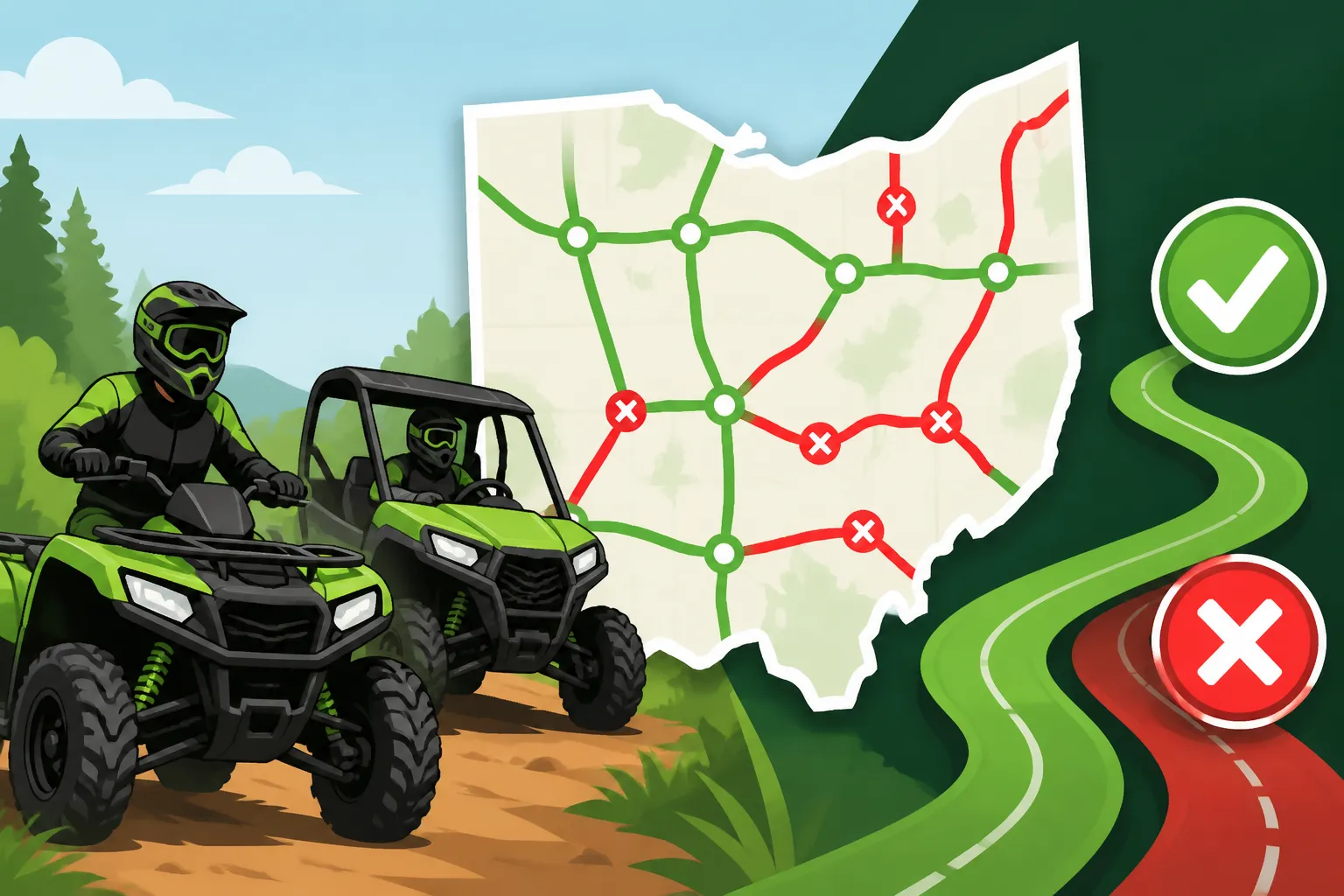
The biggest hurdle for Ohio riders is the lack of a single, definitive "yes" or "no" answer from the state itself regarding road access for ATVs and UTVs. The state law largely leaves it up to local jurisdictions – specifically counties and townships – to decide whether to open their roads. This devolution of power means that riding permissions can change dramatically from one community to the next, sometimes even within the same county. You might be able to ride legally on a township road for miles, then suddenly cross an invisible line into a different township or municipality where such activity is strictly prohibited. It's not just annoying; it requires riders to be diligent detectives about local ordinances. This piecemeal approach is largely why we have to dig deep into local resolutions rather than just glancing at a state-level rulebook.
Who Holds the Power: County Commissioners and Township Trustees
So, if the state isn't dictating every road rule, who is? In Ohio, the authority to open public roads to all-purpose vehicles (APVs), which include ATVs and UTVs, typically rests with two main bodies: County Commissioners and Township Trustees.
- County Commissioners: These elected officials govern at the county level. They have the power to pass resolutions that open county roads to APV traffic. This can be a huge boon for riders, as county roads often connect townships and provide longer stretches for exploration. When a county passes a resolution, it usually applies to all unincorporated areas within that county's jurisdiction, though specific exclusions might exist. For example, some counties have passed broad resolutions opening many of their roads, creating larger, more connected riding opportunities. Finding [Washington County Resolution 2024-1114] is a good start for riders in that area, showing how broad resolutions can be.
- Township Trustees: Even more localized, township trustees can pass their own resolutions or ordinances to open township roads. Townships are smaller geographical units within counties, and their decisions apply only to the roads they maintain. This means that even if a county hasn't opened its roads, individual townships within that county might have. Conversely, a county might open its roads, but a specific township might choose not to, or to impose additional restrictions. This is where the real granular research comes into play, as you might ride through several townships on a single outing, each with its own set of rules. This creates the situation where [Why One Township Says Yes and the Next Says No] is a very real challenge for riders.
Understanding this dual layer of authority is crucial. You might need to check both county and township legislation to get a complete picture of where you can and cannot ride. It’s a bit of extra homework, but it’s absolutely essential to avoid breaking the law.
| Authority Level | Governs Which Roads | How to Find Information | Common Scope |
|---|---|---|---|
| County | County Roads (usually designated CR) | County Commissioner meeting minutes/website | Often broader, connecting multiple townships |
| Township | Township Roads (usually designated TR) | Township Trustee meeting minutes/website/clerk | More localized, specific to that township's roads |
How to Research Open Roads in Your Area
Now that we know who makes the rules, let's talk about how you can actually find out which roads are open. This isn't always as simple as looking for a sign on the side of the road, unfortunately. It often requires a bit of proactive research, but it’s worth the effort to ensure your rides are legal and worry-free. Many riders skip this step and just assume, which is a recipe for trouble. Being prepared and informed means you can enjoy your machine without the constant fear of a citation.
Checking County Commissioner Resolutions
Your first stop should be the county level. Many counties, like Washington County, have taken the initiative to pass resolutions that open their roads to APVs. Here's how to investigate:
- Visit the County's Official Website: Most Ohio counties have a website for their County Commissioners. Look for sections related to "Resolutions," "Ordinances," or "Meeting Minutes."
- Search for Keywords: Use the website's search function (if available) with terms like "all-purpose vehicle," "APV," "ATV," "UTV," "side-by-side," "off-highway vehicle," or "OHV." Sometimes, resolutions might be under less obvious headings.
- Review Meeting Minutes: If you can't find a dedicated resolution section, browse through recent meeting minutes. Important decisions like opening roads are often recorded there. You might find a discussion about the pros and cons of allowing APVs, leading to a vote and a resolution number.
- Contact the County Clerk's Office: If online searching proves fruitless, don't hesitate to call the County Clerk's office. They are the official record-keepers and can tell you if any such resolutions exist and direct you to where you can read them. They often deal with these inquiries and can be a valuable resource.
Remember, a county-level resolution often means a wider network of roads is open to you, but it's still crucial to understand the specifics of that resolution, including any speed limits or equipment requirements.
Contacting Township Clerks for Local Ordinances
Once you've checked the county, it's time to drill down to the township level. This is where many riders get tripped up, assuming county rules cover everything. Township roads often make up the bulk of the rural road network, and their decisions can vary wildly.
- Identify the Townships: Before you hit the trails, figure out exactly which townships your intended route will cross. A good map or GPS can help you define these boundaries.
- Find Township Contact Information: Each township usually has a clerk or administrative office. Their contact information can often be found on the county's website under a "Townships" section, or with a quick search for "[Township Name] Ohio Clerk."
- Make the Call: This is often the most direct and reliable method. Call the Township Clerk and politely ask about ordinances or resolutions regarding APV use on township roads. Be specific: "Are ATVs and UTVs permitted on township roads in [Township Name]?" Ask if there are any restrictions, such as speed limits, hours of operation, or specific roads that are excluded. You might want to jot down the name of the person you spoke with and the date for your records.
- Check for Posted Resolutions Online: Some townships might post their resolutions on their own small websites or via the county site, similar to county commissioners. However, many smaller townships may not have a robust online presence, making a phone call essential.
For example, when looking at [Muskingum Township Roads], [Newport Township Roads], [Salem Township Roads], or [Warren Township Roads], a call to the respective township clerk is your best bet to confirm local access. Even if you see other riders, it's always best to get official confirmation for your own peace of mind and legal safety.
Understanding Road Designations: What "Unposted" Means
One crucial aspect of Ohio road laws for APVs revolves around speed limits and how roads are designated. This can be a major point of confusion and a common reason for citations if misunderstood.
Ohio law regarding APVs on public roads, where allowed by local resolution, often includes a critical clause: the APV itself cannot exceed a maximum speed (often around 35 MPH, as detailed in [Why an Ohio UTV Stops at Thirty-Five]), and it can only be operated on roads where the posted speed limit is also at or below a certain threshold.
The problem arises with "unposted" roads. In Ohio, if a road doesn't have a specific speed limit sign, it generally defaults to a statutory speed limit. For roads outside a municipal corporation, this default is typically 55 miles per hour. This creates a significant conflict for APV riders.
- The Default Dilemma: If your county or township resolution permits APVs on roads with a speed limit of 35 MPH or less, and you encounter an unposted road, that unposted road defaults to 55 MPH. Suddenly, even though there's no sign, that road becomes off-limits to your APV because its default speed limit exceeds the legal threshold. This is why [Why Fifty-Five Closes an Unposted Road] is a critical piece of knowledge for Ohio riders.
- Always Check for Signs: Always assume a road is 55 MPH unless you see a sign explicitly stating a lower speed. This means that [Can You Ride an APV on an Unposted Ohio Road?] is likely "no" if the local resolution specifies a 35 MPH maximum posted limit.
- The "Thirty-Five or Less" Rule: Many local resolutions specify that APVs can only operate on roads posted 35 MPH or less. This is a common requirement to balance safety with access.
This subtle but critical detail about unposted roads is vital. Always look for explicit speed limit signs. When in doubt, it’s best to avoid unposted roads unless you have confirmed that the specific local ordinance clarifies their eligibility for APV use.
Recognizing Key Road Restrictions and Signage
Even when a county or township opens its roads to APVs, there are almost always specific restrictions you need to be aware of. It's not a free-for-all, and understanding these limitations is just as important as knowing where you can ride. Ignoring these can quickly turn a fun outing into a costly mistake. Law enforcement officers are well-versed in these nuances, and ignorance is rarely a valid excuse.
Speed Limits and APV Road Use
As touched upon earlier, speed limits are a primary restriction for APVs on Ohio roads. For most all-purpose vehicles, especially UTVs, the state law, when applicable, often caps their operating speed at 35 miles per hour, even if the road's posted limit is higher.
- Your Machine's Max vs. Road's Max: Even if a county road is posted at 45 MPH and your UTV can easily go faster than 35 MPH, you are still typically limited to 35 MPH on your machine. This isn't just a suggestion; it's a legal requirement designed for safety and integration with other traffic.
- The "Posted Speed Limit" Hurdle: Beyond your machine's operational limit, most local ordinances opening roads for APVs specify that these machines are only allowed on roads with a posted speed limit of 35 MPH or less. This is crucial for distinguishing between slower-traffic roads and higher-speed thoroughfares. If you're on [An Ohio Road Posted Thirty-Five or Less], you're likely in the clear (assuming local permission). If the sign says 45 MPH, even if you travel at 35 MPH, you might still be in violation of the local ordinance.
- The Unposted Road Reality: This is where [Why Fifty-Five Closes an Unposted Road] becomes a major factor. If a road doesn't have a speed limit sign, the default 55 MPH state limit often makes it off-limits for APVs under many local resolutions. Always check for a physical sign.
These speed restrictions are put in place for safety, recognizing that APVs handle differently than traditional cars and often lack the same protective features for occupants. Always adhere to both your machine's operational limit and the road's posted limit as dictated by local law.
State Routes and Interstates: The Universal "No"
This is perhaps the clearest and most universal rule: you absolutely cannot ride an ATV or UTV on Ohio State Routes (marked with a "SR" or a shield number, like SR-16, SR-78, etc.) or Interstate highways (I-70, I-77, etc.). There are no local resolutions or county ordinances that can override this state-level prohibition.
- No Exceptions: This rule is ironclad. It doesn't matter if it's a short hop, if traffic is light, or if you're just trying to get to another trail system. These roads are designed for high-speed, conventional vehicle traffic, and APVs are simply not permitted. [Why State Routes Stay Closed in Ohio] and [Why Interstates Stay Closed in Ohio] boil down to fundamental safety and traffic flow considerations.
- Crossing is Different: While you cannot travel on these roads, in areas where local laws permit APV use, you are often allowed to cross a state route at an intersection, provided it's done safely and in compliance with all traffic laws. This is a quick perpendicular crossing, not traveling any distance along the state route itself. [Crossing a State Route Safely] is essential, ensuring you yield to all traffic and make the crossing as direct as possible.
- High Risk, High Fines: Getting caught on a state route or interstate on an APV can lead to significant fines, points on your license, and possibly even impoundment of your machine. It's simply not worth the risk.
Signs to Look For (and Why You Might Not See Them)
When riding your APV on roads, you'd hope for clear signage indicating where you can and cannot go. Unfortunately, this is often not the case.
- Lack of Explicit "APVs Allowed" Signs: Unlike some dedicated trail systems, you'll rarely see signs that explicitly say, "ATVs and UTVs Welcome" on local roads. The absence of a prohibition sign doesn't automatically mean permission.
- "No Off-Road Vehicles" Signs: What you might occasionally see are signs prohibiting off-road vehicles. These are clear indicators that APVs are not allowed beyond that point. Always heed these signs.
- Default Prohibitions: In the absence of a specific local resolution opening roads to APVs, the default stance under Ohio law is that they are not permitted on public roads. This means that if you don't find a resolution allowing them, you should assume they are not allowed. This is the opposite of how you might think about it for cars.
- Posted Speed Limit Signs: These are your most important visual cues. As discussed, the posted speed limit is often the determining factor for APV access. Look for signs indicating 35 MPH or less.
- Township Boundary Signs: Keep an eye out for township boundary signs. These are critical because the rules can change immediately upon crossing into a new township. Without clear signage about APV access, you need to rely on your prior research for that specific township.
Given the typical lack of explicit signage, your pre-ride research using county and township resources is paramount. Don't rely solely on what you see (or don't see) on the roadside.
Equipping Your Machine for Road Use (Where Allowed)
So, you've done your homework, and you've found an Ohio county or township that welcomes APVs on certain roads. That's fantastic! But before you hit the blacktop, you need to ensure your machine is properly equipped and that you, as the operator, meet all legal requirements. This isn't just about avoiding a ticket; it's about safety for yourself and others sharing the road. Many riders choose to upgrade their machines with aftermarket parts from reputable brands like SuperATV to ensure they meet or exceed road-legal standards.
UTV Inspection Requirements for Road Use
For UTVs, specifically, Ohio has a critical step before you can legally operate them on public roads: a physical inspection. This isn't just a formality; it's a detailed check to ensure your UTV meets minimum safety standards for on-road operation.
- The "Low-Speed" Exemption (Mostly Gone for UTVs): While some might remember a time when UTVs were treated more like "Low-Speed Vehicles," current interpretations and enforcement in Ohio often require UTVs to meet specific criteria for road use, including an inspection for certain equipment. The idea is to ensure they are safe enough to share the road, even at lower speeds.
- What Inspectors Look For: During an inspection, the deputy registrar or authorized inspector will be checking for items typically found on street-legal vehicles. This includes functional headlights (high/low beam), taillights, brake lights, turn signals, a horn, a working muffler, a rearview mirror, and sometimes a windshield with wipers and safety glass. [The Ohio Inspection a UTV Must Pass] is thorough, so don't cut corners.
- Why ATVs Skip This: Interestingly, traditional ATVs typically do not require this same pre-registration inspection, largely because their design (single rider, straddle seating, smaller profile) is generally not conducive to extensive road use and they are classified differently under Ohio law. [Why a Quad Skips the Inspection] compared to a UTV is a common point of confusion.
- Preparation is Key: Don't show up for an inspection hoping for the best. Make sure all your required equipment is installed and fully functional. Brands like SuperATV offer a wide range of aftermarket parts, from turn signal kits to mirrors and windshields, that can help you meet these requirements. Many riders rely on these types of accessories to transform their off-road machines into road-ready vehicles.
Passing this inspection is a prerequisite for getting your UTV properly registered and plated for road use. It's an essential step that shows you're taking road safety seriously.
Essential Equipment for Any APV on Open Roads
Regardless of whether you're riding an ATV or a UTV (where permitted), certain basic equipment is universally required for safe and legal operation on any public road.
- Lighting: Your machine must have functional headlights (that illuminate the road for a sufficient distance) and taillights (visible from the rear). For riding after dark, this is non-negotiable. Many riders upgrade their stock lighting with brighter, more reliable options, which often include products from companies like SuperATV.
- Brakes: A fully operational braking system, capable of stopping your machine safely and effectively, is a given.
- Muffler: Your APV needs an effective muffler that prevents excessive or unusual noise. Loud exhaust systems can attract unwanted attention and may violate local noise ordinances. [Ohio Muffler Requirements for APVs] are in place for a reason.
- Spark Arrester: While more critical for trail use to prevent wildfires, a spark arrester is often a general requirement for off-road machines and helps prevent dangerous sparks from exiting the exhaust system.
- Mirrors: At least one rearview mirror is typically required, allowing you to see traffic approaching from behind. Many UTVs already have them, but ATVs might need an aftermarket addition.
- Helmet and Eye Protection: While not directly "vehicle equipment," these are crucial for rider safety. Ohio has helmet laws that apply to APV riders, especially those under 18, and eye protection is generally recommended for all riders to shield against debris. Always wear a DOT-approved helmet. [Ohio Helmet Rules for APV Riders] and [Ohio Eye Protection Requirement] are important personal safety laws to follow.
Think of it this way: if you're going to share the road with cars, your machine needs to have the basic safety features that make it visible and controllable. A quick check of [Ohio APV Road Equipment List] can help you confirm your machine is ready.
The Importance of Insurance and a Driver's License
Finally, even if your machine is fully equipped and you're on an approved road, you need to ensure you're legally prepared as a rider.
- Valid Driver's License: If you're operating an APV on any public road in Ohio, you must possess a valid driver's license. This means a standard automobile driver's license; an off-road safety certificate alone is not sufficient for road use. This ensures you've passed basic driving tests and understand traffic laws. [Ohio Driver's License Rules for APVs] are pretty straightforward on this point.
- Proof of Insurance: Just like with cars, operating an APV on public roads in Ohio requires proof of financial responsibility, meaning you need to have appropriate liability insurance. This protects you and others in case of an accident. Carrying your insurance card with you is essential. Many insurance companies offer specific policies for ATVs and UTVs. [Ohio APV Insurance Requirement] is a mandatory component of responsible road use. Without it, you could face penalties if stopped or involved in an incident.
Always carry your driver's license and proof of insurance with you when riding on public roads. These documents are routinely checked by law enforcement, and being unprepared can lead to unnecessary hassle or fines.
Disclaimer
This article is for general informational purposes only and does not constitute professional advice. Laws, prices and regulations vary by location and change over time. Consult a qualified professional for guidance on your specific situation.