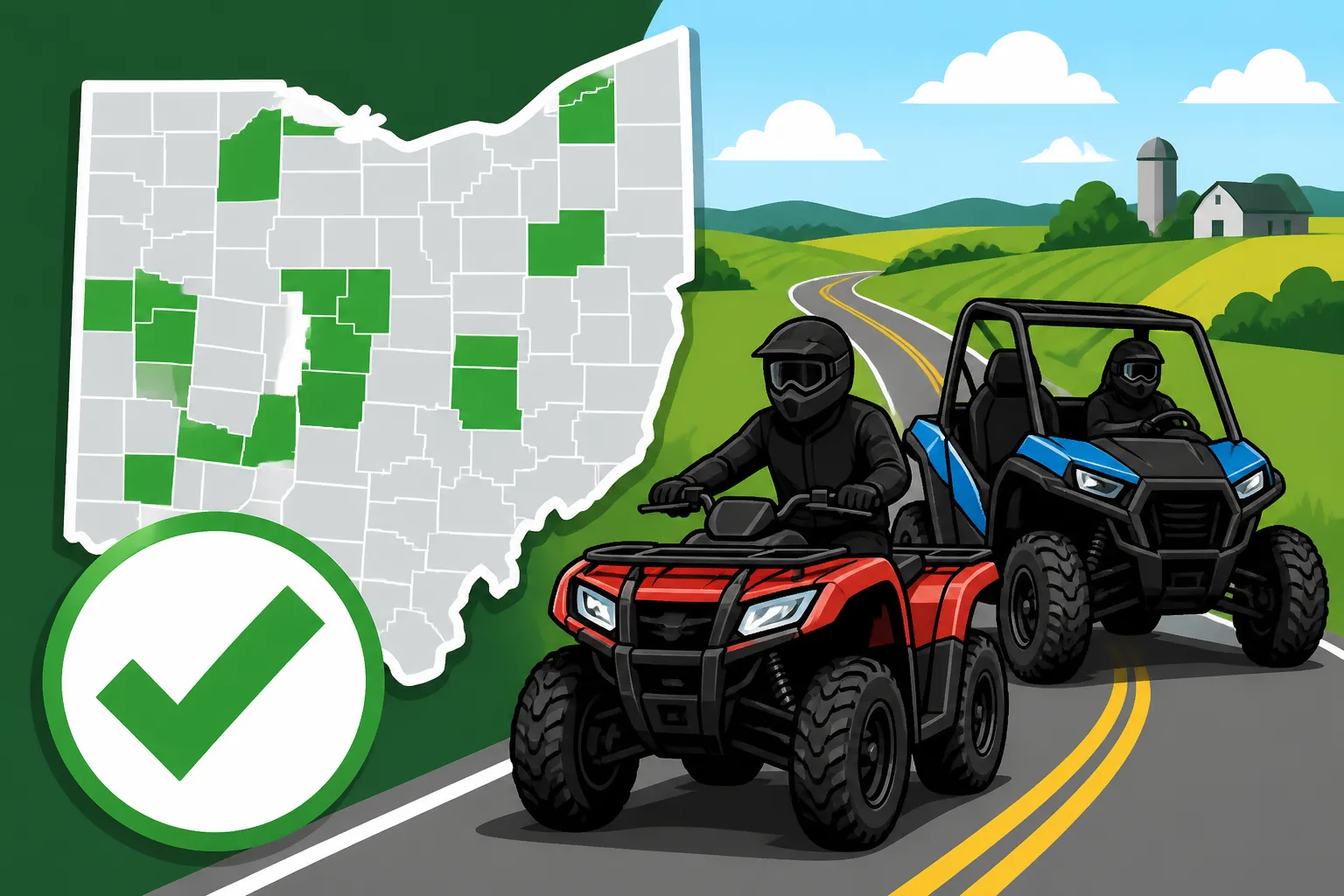
Ohio Townships That Allow APVs on Roads
It's incredibly frustrating, isn't it? You've got your ATV or UTV ready for a ride, maybe even invested in some great upgrades, but trying to figure out where you can legally take it on public roads in Ohio feels like navigating a maze blindfolded. Many folks assume all public roads are off-limits, or they hear rumors about certain areas and end up guessing. This guide is here to clear up that confusion, specifically focusing on how Ohio townships can open their roads to All-Purpose Vehicles (APVs) and how you, as a rider, can confidently find out where it's okay to ride.
The Power of Local Decision-Making: How Ohio Townships Open Roads
When it comes to hitting the open road with your APV in Ohio, a lot of the power actually rests closer to home than you might think: with your local township. This isn't a statewide blanket rule that you can look up in one place; it's a carefully considered decision made by community leaders who understand the unique needs and characteristics of their specific area.
Understanding Township Trustees' Authority
In Ohio, townships are governed by a board of three elected trustees. These individuals are deeply ingrained in their communities, living and working alongside their constituents. It's their responsibility to make decisions that impact local infrastructure, public safety, and quality of life – and that includes regulating vehicle use on the roads they maintain. Ohio law specifically grants these township trustees the authority to pass resolutions that allow APVs on certain township roads.
This isn't a quick, off-the-cuff decision. Typically, the process involves public meetings where residents can voice their opinions, concerns, and support. There might be discussions about safety, road wear, noise, and how it impacts the overall community. After gathering input and deliberating, the trustees will then vote on a formal resolution. If passed, this resolution becomes the local law of the land, detailing exactly which roads, and under what conditions, APVs are permitted. It's a crucial piece of paper that gives you, the rider, legal access, but it's vital to remember that each township acts independently. What's allowed in one township might be strictly prohibited just across the border in the next. To dive deeper into this process, you can explore [A Township Trustees' Resolution in Ohio] and [How an Ohio Township Opens Its Roads].
What a Resolution Typically Specifies
So, what exactly does one of these township resolutions look like? They're not just a simple "yes" or "no." A well-crafted resolution will lay out specific guidelines that riders must adhere to, ensuring clarity for everyone involved. Without these details, it would be a free-for-all, which nobody wants.
Firstly, the resolution will clearly define which roads are open. This might be all "unimproved roads" or "secondary roads" within the township, or it could be a specific list of named roads. Don't assume that if one road is open, all of them are. Sometimes, there are specific stretches where APVs are permitted to connect trails or access certain areas, while others remain closed. Secondly, resolutions often include operational specifics like time-of-day restrictions (e.g., no riding after dark, though lighting requirements still apply if permitted) or even seasonal limitations. More commonly, they will specify equipment requirements for the APV itself, which often mirror some of the state's broader guidelines for vehicles on public roads. This could include requirements for headlights, taillights, brake lights, mirrors, and even turn signals, especially for UTVs. Lastly, and very importantly, most resolutions will set a maximum speed limit for APVs on these roads, often much lower than the standard posted speed limits for cars, perhaps 35 miles per hour or less. Knowing these details is your responsibility before you ever turn the key.
Finding Out Which Ohio Township Roads Are Open to APVs
Knowing that townships can open roads is one thing; actually finding out which specific roads are open in a township you want to ride in is another challenge altogether. This isn't information that's always readily available on a single state website, which can make it feel like a real scavenger hunt. But with a bit of effort, you can find the definitive answers.
The Importance of Due Diligence
Before you ever load your machine onto a trailer or even contemplate riding it onto a public road in Ohio, performing your due diligence is absolutely non-negotiable. Why? Because the consequences of riding an APV illegally on a public road can be swift and costly. You could face significant citations, hefty fines, and potentially even have your machine impounded. Beyond the legal repercussions, you risk damaging the reputation of all APV riders in the area, which can lead to townships reversing their resolutions or becoming even stricter. No one wants to be the reason that others lose their riding privileges. It's about respecting the law and the community you're riding in. To understand the potential penalties, take a look at [Ohio Fines for Illegal APV Road Use].
Imagine pulling up to a trailhead, seeing other riders heading down a paved lane, and assuming it's okay. You follow suit, only to be stopped by a local deputy who informs you that you're in a different township where APV road use is strictly forbidden. Ignorance of the law is never an excuse. Always verify, verify, verify. This commitment to checking the rules beforehand is what separates responsible riders from those who create problems for everyone.
Resources for Checking Township Road Status
So, how do you actually figure out which township roads are open? It takes a bit of legwork, but the information is out there. Your best and most authoritative source will always be the township itself. The most direct method is to contact the Township Clerk. This is the individual responsible for maintaining all official township records, including resolutions. A simple phone call or email asking about APV road use can get you the official answer straight from the source. Be prepared to ask for a copy of the resolution if one exists, so you have it for your records.
Many townships now have official websites where they post meeting minutes, resolutions, and other important public notices. A quick search for the specific township's website might turn up the information you need. While local riding clubs or online forums can be great starting points for general information and community chatter, always use them as tips, not definitive proof. Always, always verify with the township clerk directly. You might even find that some aftermarket parts providers, like SuperATV, offer resources or guides that touch on local regulations, though again, their information should always be cross-referenced with official township sources. Understanding [Finding Out Which Roads Are Open] and even [Calling a Township Clerk About APVs] can guide you through this process.
Key Considerations for Riding on Open Township Roads
Alright, so you've done your homework, confirmed that a particular Ohio township does permit APVs on its roads, and you even have a copy of the resolution in hand. Fantastic! But your preparation isn't over yet. Riding on public roads, even those opened specifically for APVs, comes with a whole host of responsibilities and specific requirements that you absolutely must meet. It's not just about having the right paperwork; it's about being properly equipped and riding safely and considerately.
Essential Equipment and Rider Requirements
When an Ohio township opens its roads to APVs, it’s not a free pass to drive anything, anywhere. There are usually very specific equipment requirements for your machine and rules for the rider. First and foremost, you, as the operator, will almost certainly need a valid driver's license. This isn't just a suggestion; it's a legal requirement for operating any motor vehicle on public roads. You'll also need proof of insurance. Just like with cars, if you're on a public road, you need to be insured. Make sure your policy specifically covers APV use on public roads, as standard off-road policies might not. Details on these can be found in [Ohio Driver's License Rules for APVs] and [Ohio APV Insurance Requirement].
Beyond your personal documentation, your APV itself will likely need specific equipment to be road-legal in that township. This typically includes working headlights, taillights, brake lights, and at least one rearview mirror. For UTVs, the requirements can be even more stringent, often demanding turn signals, a horn, and sometimes even a windshield with a wiper, depending on how closely the township aligns with state UTV road-use regulations. Companies like SuperATV offer a wide range of accessories, from turn signal kits to mirrors and DOT-approved tires, that can help you meet these critical requirements. Finally, don't forget helmet laws. While Ohio's statewide helmet law is focused on riders under certain ages, local resolutions might extend helmet requirements to all riders on their open roads. Always check the specific township's resolution and refer to [Ohio Helmet Law for APV Riders] and [Ohio Equipment Rules for an APV on a Road] for comprehensive details.
Understanding Speed Limits and Road Types
One of the biggest pitfalls for riders on open township roads is misunderstanding speed limits and the types of roads that are actually open. It's easy to see a paved road and assume the standard 55 mph speed limit applies, but that's rarely the case for APVs. Townships that open their roads to APVs almost universally impose a specific, lower maximum speed limit for these vehicles, often around 35 miles per hour or less. This is for safety, considering the different handling characteristics of APVs compared to regular cars. You absolutely must adhere to these lower limits. Riding faster not only puts you and others at risk but can also jeopardize the township's decision to keep its roads open. For specific insights, check out [Why an Ohio UTV Stops at Thirty-Five] and [Why an Unposted Ohio Road Defaults to Fifty-Five].
It's also crucial to remember the hierarchy of roads. A township resolution only applies to roads within that township's jurisdiction. It does not extend to county roads (which are governed by county commissioners) or state routes (governed by the Ohio Department of Transportation). So, while you might be legally riding a township road, that access can suddenly end where it intersects with a county road or a state route. You need to know the boundaries and understand that you often cannot continue directly onto those higher-level roads unless separate county or state regulations specifically permit it. Always consult [Ohio Rules for Riding a Township Road] for more information.
Respecting the Rules and Local Residents
Riding responsibly on open township roads goes beyond just adhering to legal requirements; it also involves being a good neighbor and ambassador for the APV community. Remember, the decision to open these roads was made by local trustees, often after considering community input. Maintaining that privilege means respecting the residents whose homes line those roads.
Noise is a significant factor. While your machine might have an aftermarket exhaust system that sounds great on the trail, it can be a nuisance in residential areas. Ensure your APV has a properly functioning muffler and a spark arrester. Many townships and state rules will specify decibel limits. Check out [Ohio Muffler Requirements for APVs] and [Ohio Spark Arrester Requirement] for more details. Dust can also be an issue, especially on gravel or unimproved roads. Ride at a reasonable speed to minimize kicking up excessive dust near homes. Always yield to other traffic, including pedestrians, cyclists, and horse-drawn buggies, if present. These are shared roads, and common courtesy goes a long way. Finally, and perhaps most importantly, stay on the designated roads. These resolutions are for road use, not for impromptu off-roading in someone's yard or the adjacent fields. Veering off the road is trespassing and can quickly lead to the closure of APV access for everyone.
What Happens When Townships Disagree or Roads Are Adjacent?
One of the most perplexing and often frustrating aspects of navigating APV road access in Ohio is the fragmented nature of the regulations. It’s not uncommon to find yourself in a situation where you’re legally riding in one township, but the moment you cross an invisible line into the next, you’re suddenly breaking the law. This creates a real challenge for planning rides and can lead to unexpected encounters with law enforcement.
The Patchwork Quilt of Ohio Road Access
Imagine setting out for a scenic ride, cruising down a beautifully maintained gravel road, only to realize that the township just ahead has a completely different stance on APV access. This "patchwork quilt" of regulations means that one township might have enthusiastically opened all its unimproved roads, while its immediate neighbor has chosen to keep them all closed. This can be incredibly frustrating for riders who just want to enjoy their machines without constantly worrying about legal boundaries. [Why One Township Says Yes and the Next Says No] perfectly captures this dynamic.
The key takeaway here is that you, the rider, bear the responsibility of knowing exactly where you are and what the local rules are for that specific location. Relying on GPS apps that show road names but not jurisdictional boundaries isn't enough. You need to understand the local maps, know your route, and be absolutely certain of the regulations in every township you plan to traverse. This might mean your planned ride needs to be adjusted, or you might have to trailer your machine for a short distance to reach an area with more permissive rules.
County vs. Township vs. State Routes
Adding another layer of complexity to the Ohio road access puzzle is the distinction between county, township, and state routes. A township’s resolution only grants permission for APVs on roads that are under that township's direct control and maintenance. It holds no sway over county roads, which are managed by the county commissioners, or state routes (like US highways or Ohio State Routes), which fall under the jurisdiction of the Ohio Department of Transportation.
This means that even if a township road you’re on connects directly to a county road or a state route, you cannot automatically continue riding your APV onto those higher-tier roads. County commissioners have their own process for opening county roads to APVs, which often involves separate resolutions and specific criteria. Similarly, state routes and interstates are almost universally closed to APV traffic in Ohio. While you might be able to cross a state route at an intersection, riding on it is typically prohibited. It's crucial to understand these distinctions to avoid inadvertently breaking the law. For more clarity on crossing state routes, refer to [Ohio Rules for Crossing a State Route], and for understanding how county roads might be opened, consider [How County Commissioners Vote to Open Roads to APVs]. Remember, even if your path seems clear, [Why State Routes Stay Closed in Ohio] is a critical piece of information to keep in mind.
Here's a quick overview of how road access often plays out:
| Feature/Scenario | Common Township Approach | Rider Implication |
|---|---|---|
| Road Type | Often allows APVs on "unimproved" or "secondary" roads. | You need to know which specific roads are designated. Paved main roads might still be off-limits. |
| Speed Limit | Usually specifies a maximum speed, often 35 mph or less for APVs. | Always adhere to the APV-specific speed limit, which is typically lower than the posted car speed. |
| Equipment | Requires basic road safety equipment: lights, mirrors, insurance. | Ensure your APV is equipped for road use; consider aftermarket parts from providers like SuperATV. |
| Adjacent Townships | Each township makes its own decision; no uniformity. | Always verify the rules for each township you plan to enter. Carry confirmation if possible. |
| County Roads | Township resolution does not apply to county-maintained roads. | You might need a separate county resolution to ride on county roads. Do not assume access. |
| State Routes/Interstates | Township resolution does not apply; generally closed to APVs. | Use extreme caution at intersections; crossing might be allowed, but riding on these roads is almost always illegal. |
| Enforcement | Local sheriff's deputies or township police enforce their rules. | Law enforcement is aware of local resolutions and will issue citations for violations. |
Disclaimer
This article is for general informational purposes only and does not constitute professional advice. Laws, prices and regulations vary by location and change over time. Consult a qualified professional for guidance on your specific situation.