Buying a Quad With No Title
You've found what looks like an absolute steal on a quad, the perfect machine to hit those Ohio trails, but then you realize it's missing a crucial piece of paper: the title. It's a common dilemma that leaves many riders scratching their heads, wondering if that amazing deal is actually too good to be true. This guide is here to walk you through the serious risks and very limited options when you're considering buying an ATV or UTV in Ohio that doesn't come with a proper title.
The Harsh Reality of No Title in Ohio
In Ohio, the title for an All-Purpose Vehicle (APV), which is what the state calls ATVs, UTVs, and similar off-road machines, is more than just a piece of paper; it's the bedrock of ownership. It's the official document that proves who legally owns the machine, much like the title to your car. Many riders, especially those new to the off-road scene or just looking for a bargain, often overlook this critical document, assuming a simple handshake and cash transaction is enough. However, ignoring the title can lead to a world of headaches, legal complications, and financial losses down the road. It's designed to protect both the buyer and the seller, ensuring a clear chain of ownership and preventing fraud.
When a quad doesn't come with a title, it's a giant red flag that should immediately give you pause. While it's tempting to think you can simply get one yourself or that it's "not a big deal" for an off-road machine, Ohio law is quite clear. Every APV, regardless of whether it's an ATV, UTV, or dirt bike that meets the APV definition, needs to be titled. If you’re looking to legally ride on public lands or even just want peace of mind regarding your purchase, that title is non-negotiable.
Why Ohio Demands a Title
Ohio's Bureau of Motor Vehicles (BMV) requires a title for APVs primarily to establish and track legal ownership. Think of it as the ultimate proof that you are the rightful owner, protecting you from claims by previous owners or, worse, from the police if the machine turns out to be stolen. Without a title, verifying who truly owns the quad becomes incredibly difficult, if not impossible. The title also serves as a crucial document for tracking liens, meaning if the previous owner financed the machine and still owes money on it, the lien would be noted on the title. This prevents someone from selling a quad that still has money owed to a bank or financial institution, which could leave you holding the bag for their debt.
Beyond ownership and liens, the title is absolutely essential for the registration process. You can't [Registering an APV in Ohio] without first having a valid title in your name. This means that if you buy a quad without a title, you won't be able to get a plate or a registration, which legally prevents you from riding on designated state trails, county roads where permitted, or any public land. It also creates a huge hurdle if you ever try to sell the machine yourself, as most reputable buyers will demand a clear title. It boils down to this: the title is the machine's official identity, and without it, you're essentially buying a ghost.
Common Scenarios for Title Absence
It's understandable to wonder why a quad might not have a title, especially if the price seems appealing. Often, sellers might offer what sounds like a reasonable explanation, but it's crucial to approach these stories with extreme skepticism. One common scenario you might hear is that the machine was "farm use only" and therefore never needed a title. While Ohio does have some specific exemptions for farm machinery, these are often misunderstood or misrepresented. A quad used exclusively for farm work on private land, never on public roads or trails, might not have been titled, but as soon as it leaves the farm or changes hands, the title requirement usually kicks in. It's not a free pass to avoid the title process.
Another less common but sometimes legitimate reason is that the machine is extremely old, predating title laws for ATVs. However, for most modern quads and UTVs, this is very unlikely. If you're looking at a machine from the last few decades, it almost certainly would have been titled when new. Unfortunately, the most concerning reason a quad might lack a title is that it's stolen. A thief won't have a title to provide, and they'll often try to sell the machine quickly and cheaply, hoping a buyer won't ask too many questions. Other times, the owner simply lost the title and never bothered to get a duplicate, or they bought it without a title themselves and are now trying to pass on the problem. These situations, while not always malicious, still leave you in a very vulnerable position as the buyer.
Navigating the Risks: What Could Go Wrong?
Thinking about buying a quad without a title can feel like a tempting gamble, especially when the price is right. You might imagine that you can just ride it on your own property or that you’ll somehow figure out the paperwork later. However, the reality of purchasing a title-less APV in Ohio is far more perilous than most people realize. The risks involved are significant, ranging from legal battles to financial ruin, and they can quickly turn that "great deal" into a costly nightmare. It’s important to fully understand the potential pitfalls before you even consider such a purchase. The state takes ownership seriously, and bypassing the proper titling process exposes you to a multitude of dangers that often outweigh any initial savings.
One of the biggest frustrations riders face when they buy a machine without a title is the inability to enjoy it legally. Imagine saving up, finding what you think is a perfect quad, only to discover you can’t actually take it out on the trails with your friends. This isn't just a minor inconvenience; it's the core purpose of owning an APV for many people. Without a title, you're essentially restricted to private land where you have explicit permission to ride, and even then, the shadow of potential legal issues looms large.
The Legal Minefield
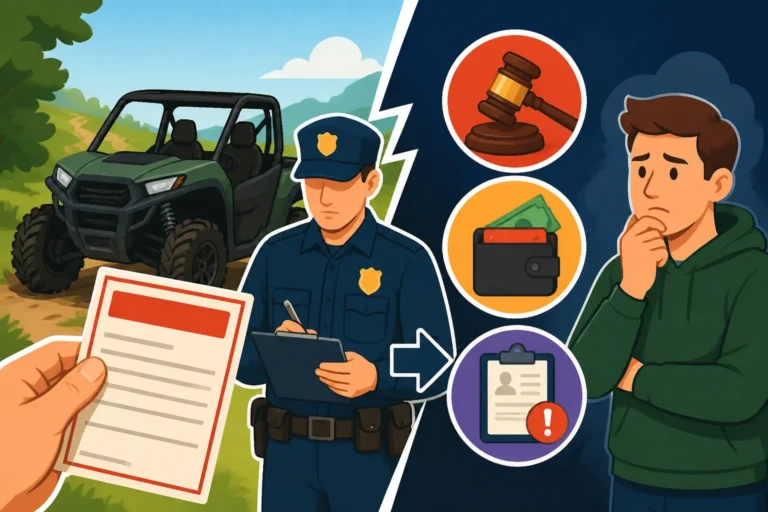
The most immediate and severe risk of buying a quad without a title is falling into a legal minefield. If the machine turns out to be stolen, you could face serious consequences, even if you bought it unknowingly. Police can, and often do, seize stolen property. This means you lose both the quad and all the money you paid for it, with little to no recourse. You could even find yourself facing charges for possessing stolen property, depending on the circumstances, which is a far cry from a fun day on the trails. This is why a thorough [Checking a VIN Before an Ohio Purchase] is paramount, even if the seller claims to have a lost title. A VIN check might reveal if the machine has been reported stolen or has a lien against it, providing crucial information that a missing title hides.
Even if the quad isn't stolen, simply not having a title in your name can lead to fines and legal complications. If you get caught riding an unregistered APV on public land or a county road, you could face [Ohio Fines for an Unregistered APV]. Without a title, you won't be able to register it, leaving you constantly exposed to citations. Proving ownership without a title can also be a long, arduous, and expensive legal process if a previous owner suddenly comes forward with a title claiming it's theirs. The courts in Ohio rely on these official documents to resolve ownership disputes, and if you don't have one, your position is incredibly weak.
Registration Roadblocks
As mentioned, one of the biggest practical frustrations for any new APV owner is the inability to register their machine without a title. In Ohio, getting your quad or UTV registered means you first need to properly [Titling an APV at an Ohio Clerk of Courts]. The clerk of courts will not issue a title in your name unless you can provide sufficient proof of ownership, which almost always means a previously issued, properly transferred title. If you show up with just a bill of sale and no title, you're going to hit a brick wall.
Without registration, you cannot legally operate your APV on public trails, state forest lands, or any county or township roads where APVs are permitted. This severely limits where you can ride and effectively defeats the purpose of owning an off-road vehicle for many people. You're stuck to private property, and even then, having an unregistered machine can be problematic if local authorities become involved for any reason. The lack of a title creates a perpetual problem, as you'll never be able to get that coveted Ohio APV plate and validation sticker.
Financial Pitfalls
Beyond the legal and registration hurdles, buying a quad without a title presents significant financial pitfalls. The most obvious is the risk of losing your entire investment. If the machine is seized as stolen, or if you can never get it titled and registered, its value plummets to essentially nothing more than parts. You won't be able to legally sell it to another informed buyer, either, trapping you with a machine that has no clear market value. You might be able to offload it for parts, but that's a fraction of what you paid.
Furthermore, trying to obtain a title for a machine that never had one or has a complicated ownership history can be an expensive, drawn-out process, often involving legal fees, surety bonds, or court petitions. These costs can quickly outweigh any initial savings you gained by buying the title-less machine. You might spend hundreds, if not thousands, just trying to resolve the paperwork, with no guarantee of success. When you consider [What an Ohio APV Title Costs] normally, which is a fairly modest fee, the cost of trying to fix a title problem can be astronomical by comparison. It's a gamble that rarely pays off in the long run.
Strategies for a Title-Less Quad (If You Absolutely Must)
While the strong recommendation is always to avoid buying a quad without a title in Ohio, there are a few very specific, limited circumstances where someone might consider it, or at least attempt to mitigate the immense risks. It’s critical to understand that these are not guarantees, and they involve significant effort and uncertainty. If you find yourself in this incredibly difficult position, having the right documentation, even if it’s not an official title, becomes your only lifeline. You’re essentially trying to build a paper trail from scratch to prove your legitimate claim to the machine.
Even if a seller insists the title is "just lost" or "not needed," proceed with extreme caution. The burden of proof will fall squarely on you to establish ownership if questions arise. It’s a situation fraught with potential for disappointment and financial loss. Most importantly, never assume that because a seller gives you a story, it makes the transaction legitimate in the eyes of the law. You are taking on all the risk.
The Critical Importance of a Bill of Sale
If you absolutely, positively decide to proceed with a title-less quad purchase (which again, we strongly advise against), a meticulously crafted bill of sale is your absolute minimum requirement. It's not a substitute for a title, but it's the strongest piece of documentation you can get to prove the transaction occurred and who was involved. This document needs to be far more comprehensive than a simple scribble on a napkin. It should explicitly state that the machine is being sold without a title, and ideally, include a clause where the seller affirms they are the legal owner and have the right to sell the machine, free of liens or encumbrances.
A solid bill of sale must include:
- Full legal names and addresses of both the buyer and the seller.
- Contact information for both parties (phone number, email).
- Detailed description of the APV: Make, model, year, color, and most importantly, the full Vehicle Identification Number (VIN).
- Purchase price and the date of sale.
- Statement of "as-is" condition if applicable, which protects the seller from claims about the machine's mechanical condition after the sale.
- Signatures of both buyer and seller, and ideally, witnessed by a third party, or even notarized for extra legitimacy.
Platforms like LawDepot can be incredibly helpful for generating a robust, legally sound bill of sale. They offer templates and guidance that ensure all the necessary legal language and critical details are included, providing a far more professional and defensible document than something you might scribble out yourself. While it won't magically produce a title, it's a vital piece of evidence if you ever need to prove you legitimately purchased the machine. It’s a crucial step in trying to protect yourself, even in a risky transaction, and forms the basis of [Ohio APV Bill of Sale Requirements].
Exploring Alternatives Very Limited
For machines that genuinely never had a title, such as extremely old models (and we're talking pre-1980s, often) or machines that were truly purchased new for exclusive farm use before current titling laws, there might be an incredibly slim chance to obtain a title. This usually involves petitioning the court for a "quiet title" action, or working with the BMV on a "title bond" process. These are complex, time-consuming, and expensive legal procedures that require extensive documentation, affidavits, and often a court hearing to prove legitimate ownership. You'll need to demonstrate a clear chain of custody, show you've made efforts to locate the original owner, and present compelling evidence that the machine is not stolen.
The process for [Registering an Inherited Machine in Ohio] is much more straightforward, for example, because there's a clear legal mechanism for transferring ownership through an estate. For a regular private sale with no title, these "alternatives" are not quick fixes. They're last resorts for genuinely unique situations and often require legal counsel. For the vast majority of cases involving a recently manufactured quad sold without a title, these options are practically non-existent or prohibitively expensive. It's often cheaper and less stressful to simply walk away from the deal and find a machine with proper documentation, following the advice for [Buying a Used APV in Ohio] with a clear title.
VIN Verification and Lien Checks
Even when there's no title to hand over, you absolutely, unequivocally must perform a thorough VIN verification and a lien check. This is your last line of defense against buying a stolen machine or one with outstanding debt. The Vehicle Identification Number (VIN) is stamped on the frame of every APV, and it's a unique identifier. Before you hand over any money, verify that the VIN on the machine matches any VIN listed on a bill of sale (if one exists). Make sure the VIN on the machine doesn't look tampered with—no grinding, re-stamping, or signs of alteration.
You can often perform a basic VIN check through various online services (some free, some paid) or by contacting local law enforcement agencies to see if the VIN comes back as stolen. This is a critical step in [Checking a VIN Before an Ohio Purchase]. Additionally, you need to inquire about lien information. While a missing title usually means you can't verify a lien directly, a comprehensive bill of sale (perhaps one created with the help of a service like LawDepot) should include a clear statement from the seller confirming the machine is free of liens. This doesn't guarantee it, but it provides a legal basis for recourse if they lie. Without these checks, you're buying blind, and the consequences can be severe.
The Safest Path: Don't Buy a Quad Without a Title
After exploring the complexities and significant risks involved, the clearest and most straightforward advice remains: do not buy a quad without a title in Ohio. While the allure of a low price can be incredibly tempting, the potential for legal headaches, financial loss, and endless frustration far outweighs any initial savings. Think of the title as the machine's birth certificate and deed of ownership all rolled into one. Without it, you're investing in something whose identity and legal status are ambiguous at best, and potentially criminal at worst.
It’s easy to get caught up in the excitement of a new ride, but a smart buyer prioritizes peace of mind and legal security. You want to know that the money you’re spending is going toward a legitimate purchase that you can legally own, register, and enjoy without constantly looking over your shoulder. The Ohio BMV and Clerk of Courts offices are set up to handle titling and registration in a specific, lawful manner precisely to protect buyers and prevent fraud. Circumventing this system, even inadvertently, puts you at significant personal risk.
Prioritizing a Clear Title
For a truly hassle-free experience, prioritizing a clear, properly transferred title is non-negotiable. When you're in the market for an APV, make the presence of a title in the seller's name a fundamental requirement. A legitimate seller will have the title readily available and will be willing to meet you at the local Clerk of Courts title office to facilitate the transfer. This ensures that the title is properly signed over to you, any existing liens are cleared, and a new title can be issued in your name, all in one smooth transaction.
A clear title means you can confidently proceed with [Registering an APV in Ohio], get your plate, and hit the trails without worry. It means you own the machine free and clear, can sell it easily when the time comes, and have a clear paper trail for insurance purposes or any other official needs. Don't let a seller convince you that a title isn't important or that you can get one later. In Ohio, a clear title is the cornerstone of responsible APV ownership and should be at the top of your checklist. Understanding [Ohio APV Title Requirements] from the outset can save you a lot of grief.
What to Look for When Buying Used
When you are ready to purchase a used APV in Ohio, there are a few key steps to ensure a smooth and legal transaction. Always verify the seller's identity by checking their driver's license against the name on the title. Ensure that the VIN on the title matches the VIN stamped on the machine's frame. This simple step can prevent you from buying a mismatched or potentially stolen vehicle.
Insist on a detailed bill of sale, even when a title is present. This document should supplement the title transfer, clearly outlining the terms of the sale, the "as-is" condition, and any warranties (or lack thereof). You can use a resource like LawDepot to help you create a professional and legally sound bill of sale. Finally, and perhaps most importantly, complete the title transfer at an Ohio Clerk of Courts title office. This protects you by ensuring the title is legally transferred into your name, and allows you to pay the sales tax and applicable title fees right then and there. It's the same advice you'd follow when [Selling an APV in Ohio] to ensure a clean transaction. This careful approach not only secures your investment but also ensures you comply with all Ohio laws, setting you up for countless hours of legitimate and enjoyable riding.
Disclaimer
This article is for general informational purposes only and does not constitute professional advice. Laws, prices and regulations vary by location and change over time. Consult a qualified professional for guidance on your specific situation.