Organizing a Ride on Forest Land
An organized ride on Ohio forest land takes more than choosing a trail and setting a meeting time. You need to confirm that the land manager allows your event, determine whether special approval is required, and make sure each rider meets the rules for that riding area. Here’s how to plan responsibly without confusing an event permit with an individual rider’s permits.
Start by identifying who manages the land
“Forest land” can mean different things in Ohio, and the process depends on who owns or manages the ground. A ride on Wayne National Forest land is not handled in exactly the same way as a ride on Ohio state forest land. A private parcel, park, or trail system has its own rules again.
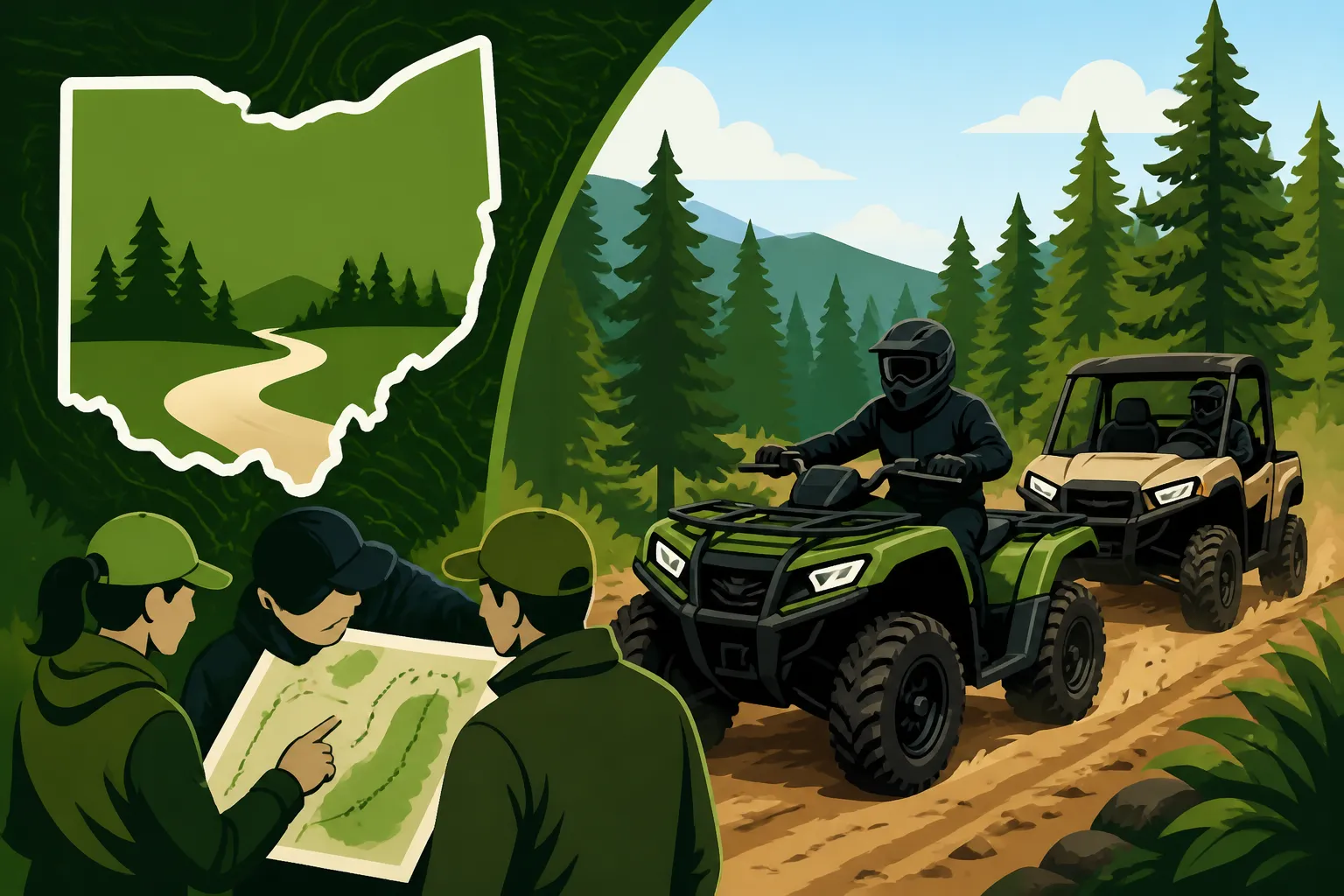
Before advertising the ride or collecting commitments, identify the land manager and the exact routes or trail areas you hope to use. If you are not sure who manages a trail, check the official trail information or contact the relevant office. A route that crosses more than one property may involve more than one land manager.
| Where you plan to ride | First planning step | What to verify |
|---|---|---|
| Wayne National Forest | Contact the ranger district responsible for the riding area | Whether your group’s activity needs an event or special-use authorization, plus current route access and pass requirements |
| Ohio state forest | Contact the forest office or appropriate state land manager | Whether organized group use needs approval and which routes are open to APVs |
| Private land | Get permission from the owner or authorized manager | Allowed dates, routes, group size, parking, liability arrangements, and any conditions |
| Multiple properties | Contact every land manager involved | Whether each manager allows the event and what separate approvals apply |
Do not assume that an open trail is automatically available for a group event. A land manager may allow individual recreation on designated trails but still require advance coordination for an organized ride. Group size, promotion, fees, commercial activity, support vehicles, temporary signs, or expected effects on other visitors can all make an event different from a casual ride with friends.
For background on the difference between land access and rider requirements, see Ohio APV Permits Explained and Ohio Rules for Riding State Forest Land. For a route on national forest ground, check Ohio Rules for Riding a National Forest as well.
Separate event approval from rider requirements
An event authorization, if required, applies to the organized activity. It does not replace each participant’s responsibility to meet the rules for riding there. Riders may still need an acceptable registration or permit, a forest pass where applicable, required safety gear, and compliance with age and supervision rules.
The reverse is also true: every rider having the right individual permits does not necessarily mean the organizer has permission to conduct an event. Treat these as two separate checks:
- Event access: Is the organizer allowed to bring the planned group and activity onto this land, on these dates and routes?
- Individual access: Does each rider have the documents, pass, equipment, and supervision required for that area?
This distinction matters on Wayne National Forest land, where riders may have an individual pass requirement in addition to any event-related authorization. Do not assume a group purchase, event fee, or organizer’s approval covers every participant. Confirm the current arrangements directly with the land manager and explain them clearly to riders before the event.
Contact the right office before setting a date
A general question such as “Can we bring a group?” may not give the land manager enough information to answer. Have a workable plan ready. Include the riding area, proposed date or date range, approximate number of machines and participants, whether the ride is public or private, and whether you will charge a fee or promote it commercially.
Ask directly whether your planned activity needs a permit, written authorization, or other coordination. If no formal permit is required, ask whether any limits or advance notice still apply. Keep the response and any conditions with your event records.
For Wayne National Forest, the district office responsible for the proposed area is a sensible starting point. The guidance in How to Get a Wayne Forest Special Use Permit can help you understand what to ask about, while Lead Time on a Forest Event Permit is relevant if your event has a fixed date. Contact the office early rather than planning around an assumed approval timeline; review, conditions, or available dates can vary.
Build an event plan the land manager can evaluate
A useful event plan is specific enough to show how the ride will work, but it does not have to be elaborate. The goal is to make the proposed use understandable and identify problems before they happen. A land manager may ask for more detail or different documents, so treat your plan as a starting point, not a substitute for the office’s instructions.
Define the event clearly
Describe what participants will do and how the event is organized. A small invited group riding existing routes may raise different questions from a public event with registration, sponsors, fees, vendors, or guided services. Be candid about the format. Calling something an informal ride does not make it informal if it is promoted to the public or operated as a paid activity.
Include practical details such as:
- The purpose and format of the ride
- Expected number of riders, machines, and support vehicles
- Proposed dates and hours
- Trailheads or staging areas
- Planned route or permitted route options
- How participants will check in and receive instructions
- Whether the event is open to the public, invitation-only, or commercial
- Whether you expect to place signs, set up tables, or provide other event infrastructure
Do not promise access to a trail or facility until the land manager confirms it. A map from an old ride or a route shared by another group may not reflect current closures, restrictions, or ownership.
Use only routes that are currently allowed
An event plan should stay within routes open to the type and size of machines involved. Ohio’s state forest system has riding-specific rules, and a route suitable for a quad may not suit a wider side-by-side. A trail’s appearance is not proof that it is open to motorized use. Confirm the area, route, seasonal status, machine-width limits, and any restrictions with current official information.
On national forest land, distinguish between the forest boundary and the designated riding area. Being inside the forest does not mean every road, trail, or connecting route is open to APVs. Keep the group on permitted routes, and give the route plan to participants before they arrive. For broader access context, see Ohio’s Four State Forest APV Areas and Wayne National Forest’s Three Ohio Systems.
Make a backup plan for closures or poor conditions. A route may be closed because of weather, maintenance, resource protection, or another land-management need. The organizer should be ready to cancel, reroute only with approval, or postpone instead of improvising onto an unapproved road or trail.
Address insurance and responsibility
Ask the land manager what insurance or liability documents are required for the event. Requirements can depend on the land, event format, and level of organized activity. Do not assume your personal policy, club coverage, or participants’ individual policies satisfy a land manager’s conditions.
If coverage is requested, confirm who must be insured, what activity and dates must be covered, and whether the land manager needs to be listed in a particular way. Ask the insurer to explain the coverage rather than relying on a policy name or a verbal assumption. Insurance an Organizer Carries offers related planning context.
Also decide how the event will handle participant acknowledgments, emergency contacts, and basic incident reporting. A waiver or sign-in sheet does not replace an insurance requirement, permission to use the land, or a rider’s duty to follow the law. If you use a waiver, get appropriate professional advice about its wording and use.
Plan parking, check-in, and group control
A ride can create problems at the trailhead even if the route itself is suitable. Estimate how many trailers and tow vehicles will arrive, and ask whether the staging area can accommodate them. Do not direct overflow parking onto a shoulder, private driveway, closed area, or unapproved lot.
Set a clear check-in point and a start procedure that does not block access for other visitors. Give participants the rules before unloading, not after the group reaches the first junction. For a large or mixed-experience group, divide riders into manageable groups and identify a lead and sweep rider for each one. The role is logistical: keep the group together, notice problems, and prevent riders from setting their own routes.
The trailhead board can contain current directions or restrictions that should be shared with the group. Check What the Trailhead Board Tells You Before a Ride and, when conditions or access are uncertain, Calling a Ranger District Before You Load.
Prepare riders before the event
An organizer can make a ride safer and smoother by checking requirements in advance and explaining them plainly. Do not leave riders to discover at the trailhead that they need a different pass, their machine is too wide for the route, or their registration is not accepted.
Tell each rider what to bring
Send participants a short checklist with the event details. Depending on the riding area and their circumstances, riders may need to bring proof of registration, an individual land-use pass, identification, and required safety equipment. Explain which items the organizer has confirmed and which each rider must obtain personally.
For a Wayne National Forest ride, verify the current pass rules, the routes the pass covers, and whether every participant needs a separate pass. Do not treat a leader’s pass as a group pass unless the forest office explicitly confirms that arrangement. Riders arriving from another state should check whether their home-state registration is accepted for the specific use planned. Ohio APV Reciprocity With Other States and What a Visitor From a Registering State Must Show cover related questions.
Make clear that a ride invitation is not proof of legal access. Each participant remains responsible for meeting applicable requirements, including those involving registration, passes, helmets, eye protection, age, and supervision. The details can differ between state forest and national forest riding, so do not send one generic checklist if your group will use both.
Set expectations for machine and rider eligibility
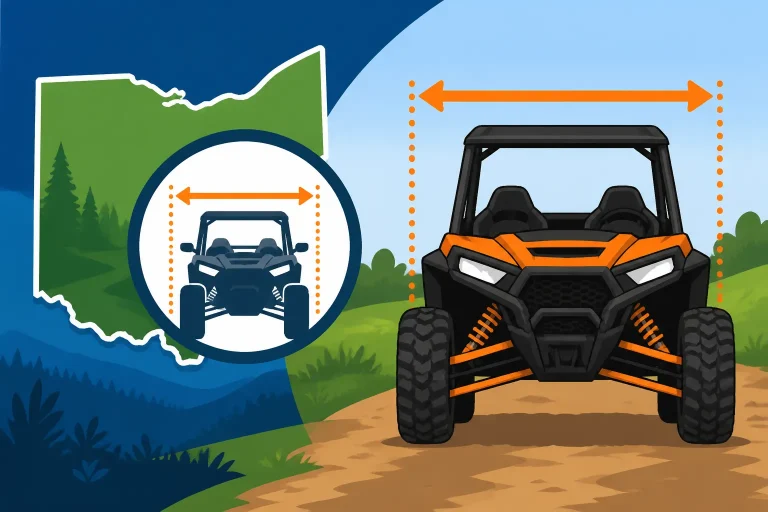
Ask participants to confirm that their machines are eligible for the selected routes. Width is especially important for state forest trails with a machine-width limit. A side-by-side that fits on a road or private trail may still be too wide for a particular forest riding area. A machine that cannot use the planned route should not be included on the assumption that the group can find a workaround on site.
If minors may attend, check the age and supervision rules for the specific land and riding area. Do not rely on the rules for a different trail system or on what a parent believes is permitted. Tell families exactly what the organizer has verified, and direct them to the land manager if their circumstances are unusual.
For a public or club event, communicate that riding off marked routes, damaging trails, disturbing other visitors, or ignoring closures can put the event and future access at risk. Use Ohio Rules for an Organized Ride to review the broader responsibilities that apply to a group activity.
Give riders a realistic event briefing
Send a concise briefing before the ride and repeat the essentials at check-in. Include the meeting location, arrival window, route boundaries, expected pace, regrouping points, emergency plan, and a contact method that works where cell service may be limited. Make clear that participants must follow posted signs and ranger or forest staff instructions, even if those differ from a message sent earlier.
Set a no-pressure policy for riders who are uncomfortable with a trail section or whose machine develops a problem. A group ride should not encourage someone to continue beyond their ability or equipment. Designate a safe place to stop or regroup if the route and land manager’s instructions allow it.
A simple written briefing also helps avoid confusion about passes and route permissions. It should distinguish between what the organizer has arranged for the event and what each rider must handle individually. Keep copies of any approval, route map, event conditions, and participant communications accessible during the ride.
Run the event within the approval and the rules
Once approval is in place, treat its conditions as the limits of the event. If the land manager approves a particular date, location, route, group size, or activity, do not expand the plan on the day because more people show up or a different trail looks appealing. Ask for a change before the event if the plan needs to change.
Before departure, check for current closures and notices. A previous approval does not guarantee that every route remains open on the event date. Weather and land-management conditions can change access. If the planned route is closed, follow the land manager’s instructions rather than substituting an unofficial route.
During the ride, keep the group on authorized routes and avoid blocking other users. Do not leave event signs, materials, or equipment behind unless the land manager approved them. Keep noise, speed, and stopping practices appropriate to the posted rules and conditions. If there is an incident, follow the event’s emergency plan and any reporting instructions from the land manager.
Afterward, remove any approved temporary materials, make sure the staging area is clean, and report problems as required. If the land manager requests a follow-up, provide it promptly. A well-run event is not just one that finishes without trouble; it is one that stays within its authorization and respects other visitors and the land.
A practical planning sequence
- Identify the land manager and the exact riding area.
- Contact the appropriate office with the date, group size, event format, and route idea.
- Ask whether formal event authorization or other coordination is required.
- Confirm current routes, closures, machine limits, staging arrangements, and rider-pass rules.
- Obtain any required approval and meet its conditions, including insurance or other documentation.
- Send participants an individual requirements checklist and event briefing.
- Recheck official notices before departure and stay within the approved plan.
- Close out the event by removing materials and following any reporting instructions.
The most important planning rule is to get the land manager’s answer before treating a ride as confirmed. Individual rider permits, a trail’s general availability, and an organizer’s event approval are separate issues. Checking each one early can prevent a cancelled event, an access problem, or a group arriving with the wrong expectations.
Disclaimer
This article is for general informational purposes only and does not constitute professional advice. Laws, prices and regulations vary by location and change over time. Consult a qualified professional for guidance on your specific situation.