An Under-16 Rider on a Forest Trail
A forest ride with a child takes more than picking a trail and loading the machine. Ohio allows riders under 16 on designated state forest trails only under specific supervision rules, and the machine, protective gear, and registration must also be in order. Here’s how to check the key requirements and prepare before heading out.
Who can accompany an under-16 rider
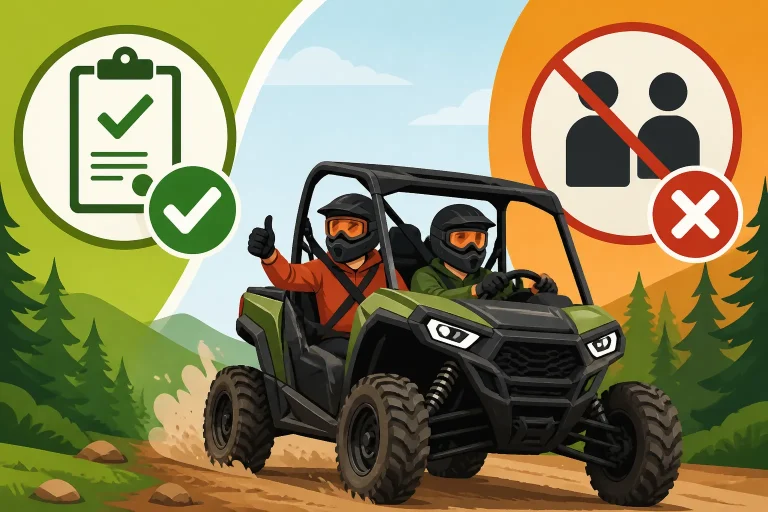
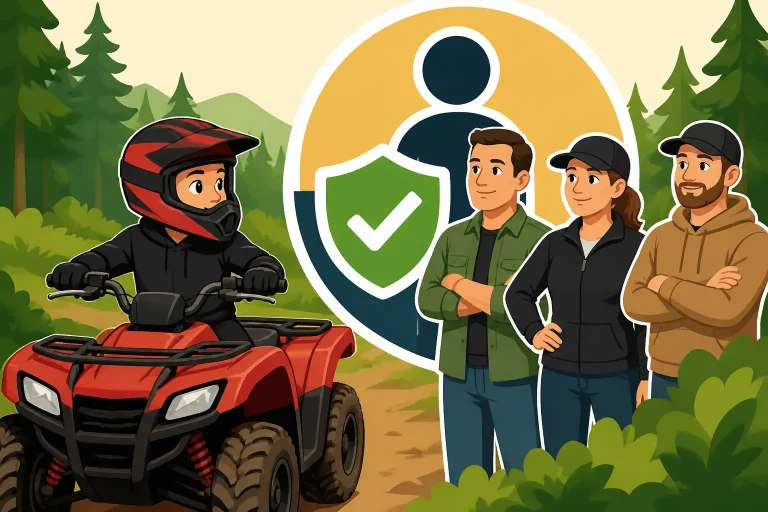
According to the Ohio Department of Natural Resources, a minor under 16 may operate an all-purpose vehicle on designated state forest trails when accompanied by a licensed parent or guardian who is at least 18 years old. The rule is specific: the accompanying adult must be both licensed and the rider’s parent or guardian.
That means a child should not set off on a designated state forest trail alone, or with an adult who does not meet those conditions. If another adult is supervising, do not assume that the person qualifies; confirm the applicable rule with the Ohio Department of Natural Resources before planning the ride. For a closer look at the supervision requirement, see Ohio Supervision Rules on Forest Trails and Ohio Forest Access for Riders Under 16.
The rule concerns the minor operating an APV on a designated state forest trail. It does not mean every forest road, wildlife area, private trail, or public road has the same access rules. Confirm that the route is an approved APV trail and that the machine is allowed there. Ohio Rules for Riding a State Forest and Ohio Trail Maps From ODNR can help you check the type of riding area and find relevant trail information.
Keep the distinction between supervision and permission clear. A parent’s presence does not make a closed route or an unauthorized trail available. It also does not replace required registration or protective equipment. Before leaving, verify that the riding area is open and that the planned route is designated for APV use.
| Before the ride | What to confirm |
|---|---|
| Adult supervision | The rider is accompanied by a licensed parent or guardian who is 18 or older, as required by the Ohio Department of Natural Resources. |
| Trail access | The route is a designated state forest APV trail and is open for riding. |
| Protective gear | Operators and passengers wear helmets and eye protection, as required by the Ohio Department of Natural Resources. |
| Registration | The vehicle has the required State Recreational Vehicle Registration, as specified by the Ohio Division of Forestry. |
| Machine size | The APV meets the 62-inch maximum width for designated state forest trails, according to the Ohio Department of Natural Resources. |
Registration, gear, and machine checks
Ohio’s age and supervision rule is only one part of getting a machine ready for a forest trail. The Ohio Division of Forestry says vehicles in state forest areas require a State Recreational Vehicle Registration with the BMV. Check that the machine has the appropriate registration before transporting it to the forest; a child’s age or the presence of a supervising adult does not waive that requirement.
For an Ohio APV, titling and registration are separate steps. The Ohio BMV says an all-purpose vehicle must be titled, and titling an APV requires completing form BMV 3722 at a county title office. For help distinguishing the paperwork, see Ohio APV Title Requirements, Ohio APV Registration Paperwork, and Filling Out Form BMV 3722.
Out-of-state families should check reciprocity before arriving. According to the Ohio Department of Natural Resources, riders from states without reciprocity must obtain an annual Temporary Operating Permit from the BMV. Do not assume an out-of-state plate or registration is accepted for every Ohio trail. Ohio Reciprocity for Out-of-State Machines and The Ohio Temporary Permit for Visitors cover the visitor questions to resolve before travel.
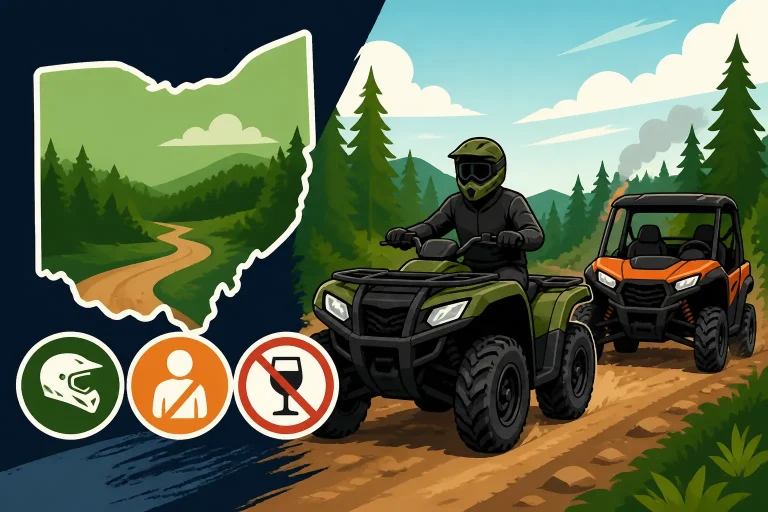
Protective gear applies to both the young operator and any passenger. The Ohio Department of Natural Resources requires operators and passengers on designated state forest trails to wear protective headgear, meaning helmets, and eye protection. Make sure the equipment fits the person who will wear it and is ready before the ride, rather than treating it as something to sort out at the trailhead. The rule applies even when a child is riding as a passenger rather than operating the APV.
Check the vehicle against the forest’s size limit as well. The Ohio Department of Natural Resources sets a maximum width of 62 inches for permitted APVs on designated state forest trails. A machine that is too wide may not be suitable for that trail system, regardless of who is riding it. Measure the machine using the method specified by the responsible agency if its width is close to the limit; do not rely on a model name or a rough estimate.
A practical pre-ride check includes confirming that the registration is current, the required protective equipment is available for everyone, and the machine fits the trail’s restrictions. Check the route and access information again before departure, because registration alone does not establish that a particular trail is open.
Choosing an open trail and following forest rules
Ohio has designated APV trail areas in Maumee, Richland Furnace, Pike, and Perry State Forests, according to the Ohio Department of Natural Resources. Access is not identical across those areas or available in every season. The department says the APV areas and trails at Pike, Perry, and Richland Furnace close annually during the winter season. Maumee remains open during winter to allow snowmobile use, so do not treat that winter access as confirmation that every type of vehicle or route is open.
The Ohio Department of Natural Resources also says state forest APV areas remain open during regular deer gun season to provide access for people with disabilities. That statement does not eliminate the need to follow posted access conditions or confirm the rules for the particular forest and route. Check current information before loading the machine, especially if the visit falls during a seasonal closure or a hunting period.
The department sets riding hours in APV areas from one-half hour before sunrise until one-half hour after sunset. It also sets a maximum speed of 5 mph in parking areas. These are operational rules to build into the plan: allow enough time to finish the ride within the permitted hours, and slow down when entering or moving through the parking area.
Accidents must be reported to the forest headquarters within 24 hours, according to the Ohio Department of Natural Resources. Know which forest you are visiting and how to contact its headquarters before the ride begins. If an accident happens, follow the agency’s reporting instructions rather than waiting until the next visit.
A simple route plan can help keep a family ride manageable:
- Choose a state forest with designated APV trails and verify that the specific area is open.
- Check that the APV’s registration and width meet the forest requirements.
- Confirm that the supervising parent or guardian meets the licensing and age rule.
- Make sure every operator and passenger has a helmet and eye protection.
- Plan the ride around the posted riding hours, parking-area speed limit, and the group’s comfort.
If you are unsure whether a route is open to APVs, do not infer access from a trail’s appearance or from the fact that another vehicle is using it. Check the forest’s official information before riding. The Ohio Department of Natural Resources’ page for APV trails in state forests does not provide content in the supplied information, so rely on current forest guidance for route-specific details rather than assuming that an old map or general description settles the question.
Avoiding common misunderstandings
A frequent mistake is to treat the under-16 rule as a blanket permission to ride anywhere in Ohio. It is narrower: the Ohio Department of Natural Resources describes operation by a minor under 16 on designated state forest trails with a licensed parent or guardian who is at least 18. Other places can have different access rules, and local road permissions are separate from forest-trail access.
Another misunderstanding is that a child only needs protective gear when driving. The Ohio Department of Natural Resources requires helmets and eye protection for operators and passengers. Check the gear for every person riding on the machine, including a passenger who is not operating it.
Do not confuse a title with trail registration, either. The Ohio BMV says APVs must be titled, while the Ohio Division of Forestry requires State Recreational Vehicle Registration for vehicles in state forest areas. These requirements serve different purposes, so confirm that both the ownership paperwork and the forest-use registration are handled. Do You Need a Permit for Ohio State Forest Trails? explains the permit question, while Ohio’s 62 Inch State Forest Width Limit focuses on the size restriction.
Finally, an out-of-state registration does not automatically prove that a visitor can ride in Ohio. The Ohio Department of Natural Resources says visitors from states without reciprocity need an annual Temporary Operating Permit from the BMV. Check whether the home state’s registration is accepted before the trip, and arrange any required permit in advance.
When the rules are uncertain, pause the plan and confirm them with the agency responsible for that part of the trip. The BMV handles title and registration matters; the Ohio Department of Natural Resources provides forest riding rules and access information. Keeping those roles straight makes it easier to arrive with the right paperwork, choose an open route, and focus on supervising the young rider.
Sources
- Ohio BMV — Ohio BMV (checked November 3, 2026)
- Ohio Department of Natural Resources — APV Trails in State Forests (checked November 3, 2026)
- Ohio Department of Natural Resources — Pike State Forest APV Area APV Area Rule Summary (checked November 3, 2026)
Disclaimer
This article is for general informational purposes only and does not constitute professional advice. Laws, prices and regulations vary by location and change over time. Consult a qualified professional for guidance on your specific situation.