Ohio Forest Access for Riders Under 16
Taking a rider under 16 to an Ohio forest trail can raise more questions than packing the trailer: Is the child old enough to operate a machine, does an adult have to ride alongside, and does an out-of-state plate count? This guide explains the age and supervision basics, trail access, registration and permits, protective gear, and practical checks to make before you set out.
Start with the age and supervision rules
The minimum age is only part of the answer
Ohio’s designated state forest APV trails have a minimum age rule, but age alone does not determine whether a young person may ride. Riders from age 12 to 15 may be allowed on these trails only when they meet the applicable adult-supervision requirements. A child who is younger than the minimum age should not be treated as eligible simply because a parent is nearby or the machine is small.
It helps to think of access as a set of conditions rather than a single age cutoff. The rider must be old enough for the specific riding area, properly supervised where required, equipped for the ride, and using a machine that is permitted on that trail. The rules for a state forest trail may not be identical to those at a private riding park or in Wayne National Forest.
The distinction matters when a family plans a trip from a cabin, campground, or trailhead. A child who can ride on private land with permission does not automatically qualify to operate an APV on public forest trails. Before loading up, check the rules for the precise place you intend to ride and review Ohio Minimum Age for State Forest Trails alongside the location’s posted requirements.
What adult supervision should look like
For a rider under 16 who is permitted to operate on a state forest trail, supervision is not a technicality to satisfy from the parking lot. The accompanying adult should be able to keep track of the young rider, respond if the child falls behind or has a problem, and make sensible decisions when trail conditions change. Riding together is safer and makes it easier to stop before a minor reaches a difficult section.
Parents sometimes assume that a licensed adult in the same riding group is enough, even if that person is several turns ahead. That can leave a young rider effectively alone on a narrow trail, especially where sightlines are short or the route branches. Agree on a pace, stopping points, and a simple plan for what to do if the group becomes separated before anyone starts the engine.
Confirm who qualifies as the supervising adult for the area you plan to visit. Requirements can involve the adult’s age, relationship or authorization, and driver’s-license status. Don’t assume that a helpful family friend meets every requirement just because they are experienced. For a closer look at the supervision question, see A Licensed Parent With an Under-16 Rider in Ohio.
A child riding alone is different from a child riding with a parent
A young person’s eligibility to operate an APV is not the same as eligibility to ride as a passenger. A child might be too young to operate on a forest trail but still be permitted to ride as a passenger on a suitable machine, subject to applicable rules and the vehicle manufacturer’s passenger requirements. Conversely, being old enough to operate does not mean a child is ready to ride without close adult supervision.
Think through the actual machine and the child’s ability to use it. Can the child reach and operate the controls while seated correctly? Can they understand how to brake, stop, and respond to a hand signal? If the machine is a single-rider ATV, do not turn it into a two-person vehicle by carrying a passenger where the manufacturer does not allow one. A ride that starts as a family outing can become dangerous quickly if a passenger shifts weight or cannot hold on securely.
A child seated in a side-by-side may face different equipment and passenger questions from a child operating a quad. Check the seating, restraint system, age guidance, and rules for the particular vehicle. A passenger still needs properly fitted protective gear and a clear understanding of when to stay seated and keep hands and feet inside the vehicle.
Choose the right riding area before leaving home
State forests, national forests, and private parks are not interchangeable
“Forest riding” can mean several different things in Ohio. The rules for a designated Ohio state forest trail are not automatically the rules for a trail in Wayne National Forest, a private off-road park, or a private parcel. Each location can have its own access limits, hours, permit requirements, machine restrictions, and rules for minors.
That difference is especially important for families. A child may meet the age and supervision requirements at one location but not another. A permit that allows access to one trail system may not be valid somewhere else, and a state forest plate does not necessarily replace a separate federal forest pass. A friend’s recollection from a different riding area is a useful prompt to investigate, not a substitute for checking the destination.
Before choosing a trailhead, identify the land manager and the exact riding area. Then look up that area’s rules for age, supervision, machine width, permits, open dates, and any temporary closures. The guide [Ohio Rules for Riding a State Forest] can help you understand the state-forest context, while the destination’s own posted rules should settle the final details for the day.
Public trail access depends on staying on designated routes
Being allowed onto a forest does not mean every road, clearing, or visible track is open to APVs. Riders should use designated routes and obey gates, signs, and closures. A track that looks well used may be a service route, a closed section, or an unofficial path; following tire marks is not a reliable way to establish that a route is legal.
This is a common source of confusion for visitors. A family may see an inviting road near a staging area and assume it connects to the trail system. If it is not marked as an authorized riding route, taking it could create a safety problem and a citation risk. The young rider may also learn the wrong lesson about how to handle boundaries and trail signs.
Review a trail map before unloading and check the information at the trailhead. Pay attention to one-way markers, closures, and restrictions that apply to the machine. If rain, maintenance work, or another temporary issue closes a segment, adjust the route rather than trying to get around a barrier. For route-planning context, Ohio Trail Maps From ODNR is a useful related topic.
A state forest visit and a Wayne National Forest visit need separate planning
Families sometimes use “Ohio forest trails” as if it were one unified system. In practice, state forest riding areas and Wayne National Forest OHV routes have different land managers and can have distinct access arrangements. Check the relevant requirements for the place you will actually ride, even if you have already registered the machine or bought a pass for another Ohio trail system.
This is also where out-of-state visitors can get tripped up. The home-state registration question and the local trail-pass question are separate. A plate or registration accepted for one kind of Ohio riding access does not necessarily satisfy a separate national forest requirement. Do not assume that reciprocity for registration means every fee or permit requirement has been handled.
Make a short destination checklist for each trip: land manager, trailhead, current route status, age and supervision rules, registration or permit, machine width, operating hours, and safety equipment. If your family plans to ride in multiple systems during a visit, check each one separately instead of carrying one set of assumptions from the first trail to the next.
Understand registration, permits, and reciprocity
The plate and the trail-access question are related but distinct
For Ohio state forest APV riding, registration and plate requirements are part of lawful access. The plate is not simply a decorative identifier to leave in the garage; it is tied to the state’s registration system and trail use. Make sure the registration is valid, the plate is displayed as required, and the rider has the documentation needed for the outing.
The fact that a machine has a plate does not answer every question about where it can go. It does not make a closed route open, waive age requirements, permit an over-width machine onto a restricted trail, or replace any separate pass required by another land manager. Registration is one piece of a larger access check.
For a clear explanation of how Ohio’s plate works in the state forest context, see Why the Ohio Plate Is the Trail Permit. Keep the registration information with the machine or in a secure place that is readily available, and make sure the supervising adult knows where it is. A minor should not be left to solve a paperwork question alone at a trailhead.
Out-of-state registration does not automatically settle every requirement
Visitors often ask whether a plate from their home state is enough to ride in Ohio. The answer depends on the machine’s registration status, the home state’s rules, Ohio’s reciprocity rules, and the particular land manager’s requirements. A state may not register the same categories of off-road vehicles as Ohio, which can change what a visitor must show or obtain.
Do not rely on a general statement such as “Ohio accepts out-of-state plates” without checking how it applies to your machine and destination. Registration recognition is not a blanket pass for every Ohio trail, nor does it exempt riders from age, supervision, helmet, or route rules. If the home state does not require registration, the visitor may face a different permit process than someone arriving with a valid registration.
Before traveling, confirm what the machine’s home-state documents prove and what Ohio requires at the specific riding area. The topic Ohio Reciprocity for Out-of-State Machines is a useful starting point. If a temporary visitor permit may be required, review The Ohio Temporary Permit for Visitors and verify the current instructions with the appropriate Ohio office or land manager before the trip.
A permit for one location may not cover another
Permit mix-ups are particularly frustrating when the family has already paid for access or driven several hours. The simplest way to avoid that disappointment is to match each permit to its issuer and land area. A permit issued for a national forest is not automatically a state forest registration, and a state registration is not automatically a federal recreation pass.
Keep separate records for separate requirements. If more than one machine is in the trailer, check each machine’s registration and plate individually. If a rider under 16 is operating, also confirm that the adult supervision requirement is satisfied; a permit belongs to the access process, not to the child’s eligibility to ride.
A practical comparison can help keep the terms straight:
| Question | Ohio state forest trail | Wayne National Forest OHV area | Private riding park |
|---|---|---|---|
| Who sets the local access rules? | Ohio land manager | Federal land manager | Park operator |
| Does registration matter? | Yes, confirm the applicable Ohio APV requirements | Confirm both registration recognition and forest-specific access rules | Follow the park’s stated entry and machine requirements |
| Is a separate access pass possible? | Check the state forest rules for the area | A separate OHV pass may apply | Park admission or a park-specific pass may apply |
| How should a parent check minor access? | Confirm age and supervision requirements for the trail | Confirm rules for that national forest system | Ask the park about its age, supervision, and machine policies |
| Does a pass make every route open? | No | No | No; closed routes and park rules still apply |
Match the machine to the rider and the trail
Machine width can rule out an otherwise suitable ride
Some Ohio state forest trail areas have a machine-width limit. The commonly cited state forest limit is 62 inches, but families should check the specific area and current rules rather than relying on a memory or a measurement from a sales listing. A side-by-side that is too wide may be excluded even if it is registered, mechanically sound, and suitable for the child as a passenger.
Measure the machine at its widest point as the trail manager defines it. Accessories, tires, or other modifications can affect the real measurement. A model described as “trail friendly” by a dealer may still exceed a local limit once it has different wheels or add-ons. If the machine is close to the threshold, measure it carefully before making the drive.
Width is not the only fit question. A child should be able to sit securely and use controls correctly if operating, while passengers must fit the seating and restraint system as designed. Read [Ohio’s 62 Inch State Forest Limit] before planning around a wide UTV, and never assume that an open-looking trail is wide enough just because a machine passed through once.
Choose a machine the young rider can control
A child’s physical size and judgment matter as much as the engine’s displacement. If a young rider cannot reach the controls comfortably, steer without stretching, or brake with confidence, the machine is not a good fit for that rider on a forest trail. An adult’s ability to follow behind does not make an oversized or poorly controlled vehicle safe.
Families sometimes mistake “the child has ridden it before” for proof that the machine is appropriate. A short ride in a yard or on a flat private lane does not prepare a young rider for hills, loose gravel, ruts, blind corners, or a sudden stop in a group. Build experience gradually, and be willing to choose an easier route or postpone the trail day.
For a UTV passenger, confirm that the seating position, seat belt, door or net, and other restraint features are appropriate for the child. Do not let a child ride in a cargo area or on an improvised seat. Explain that hands, arms, and legs stay inside, and that the child should remain buckled even when the group is moving slowly.
Trail difficulty can change within a short distance
A forest trail that starts smoothly near the parking lot can become rough, narrow, steep, or muddy after a few turns. Conditions also change with weather and traffic. A young operator may be comfortable on dry, level ground but struggle when tires slip on clay or a rut pulls the front end sideways.
For a first outing, choose a manageable route and agree on a turn-around point before the child gets tired. A parent can be tempted to keep going because the trail looks close to the next junction, but fatigue and frustration can make a young rider’s decisions less steady. Take breaks before the child is worn out, not after a mistake signals that it is time to stop.
If the route becomes more difficult than expected, turn back or take an authorized easier option. Do not pressure a child to tackle a steep climb or obstacle to keep up with older riders. Trail access is a privilege; a conservative decision can protect the young rider and keep the group from becoming stranded.
Prepare protective gear and family procedures
Helmets and eye protection are essential planning items
Do not make the helmet decision at the trailhead. Riders should have properly fitted protective helmets and suitable eye protection, with the exact requirements confirmed for the riding location and rider. A loose helmet can shift or come off during a fall, while poorly fitting goggles may fog, press painfully, or leave dust and debris exposed.
A helmet should fit the young rider now, not be purchased oversized in the hope that the child will grow into it. Check the manufacturer’s fit guidance and make sure the strap closes correctly. Protective gear is not a substitute for meeting the legal requirements, but it is one of the most important parts of preparing a minor for a ride.
Families comparing gear may look at local powersports shops or browse options on Amazon, but the key is to check the helmet’s certification, fit, condition, and suitability rather than choosing by appearance. For a fuller gear overview, see Helmets and Eye Protection on Ohio Forest Trails. Recheck fit as a child grows, and replace damaged equipment rather than relying on a helmet that has taken a hard impact.
Dress for weather, dust, and the chance of a fall
A forest ride can involve flying grit, branches, mud, changing temperatures, and long periods of sitting still. Closed-toe footwear, gloves, long sleeves, and durable long pants help reduce scrapes and discomfort. Dress the child for the weather at the trail, not just for the temperature beside the house or at the hotel.
Eye protection matters even when the route seems slow. Dust from the rider ahead can make it difficult to see a turn or hand signal. A spare pair of goggles or clean eye protection can be more useful than a bag of extras the family never touches. Store gear so it stays clean and accessible, rather than buried under luggage in the trailer.
If you are shopping for a child’s gloves or goggles, Amazon may be one place to compare product descriptions, but check sizing and intended use carefully. A low-cost item that does not fit or stay in place is not a practical substitute for dependable gear. Try the equipment on before the trip, when there is time to make a different choice.
Make a simple riding plan the child can remember
Before starting, explain a few rules in plain language: stay with the adult, stop when signaled, do not pass unless told, and do not leave the marked route. Choose signals that everyone understands, especially if engines make conversation difficult. A young rider should know where to pull over safely and how to wait for the group without wandering.
Agree on what happens if the child cannot see the adult. For example, the child should stop in a safe place and wait rather than continuing down an unfamiliar branch. The adult should also know how to respond if the child’s machine stops, gets stuck, or has a mechanical issue. A basic plan can keep a small separation from turning into a frightening search.
Pack water, snacks, a first-aid kit, basic tools, and a way to contact help where service is available. Tell the child to speak up early if they feel tired, cold, nervous, or uncomfortable. A minor may hide a problem because they do not want the group to stop; make it clear that asking for a break is a good decision, not a failure.
Handle common family situations carefully
A 12-year-old who is new to trail riding
Being old enough to meet a minimum age does not mean a 12-year-old is automatically ready for every trail or every machine. A child who has never ridden on uneven ground may need practice on easier terrain before a forest outing. Start with steering, braking, stopping on command, and keeping a steady distance from the adult.
If the child is nervous, do not try to solve that by increasing speed or placing the child between faster riders. Let the young rider become familiar with the machine and gear, then make a realistic decision about whether to continue. Turning around early can be the best outcome of a first ride if the child has learned to communicate and follow directions.
Parents looking for age-specific context can review [Ohio Rules for a Rider Aged 12]. Treat the page as a prompt to confirm the exact location’s requirements, not as permission to skip the trail manager’s own rules. Keep in mind that age eligibility and practical readiness are two different decisions.
A teenager riding with a parent who is not operating
A parent may wonder whether they can meet a supervision rule while riding as a passenger in a UTV or staying at the trailhead. The answer depends on the particular legal and location requirements. Do not assume that being somewhere on the same property is equivalent to accompanying the young rider on the trail.
If the supervising adult plans to ride in a separate machine, stay close enough to maintain meaningful supervision and communicate. A group leader several vehicles ahead may not be in a position to respond promptly if the young rider gets stuck or takes a wrong turn. If the child is riding in the same UTV as the parent, verify that the adult’s role and the vehicle’s passenger setup meet the relevant rules.
When the situation does not fit neatly into the posted guidance, ask the land manager before riding. It is much easier to clarify an adult-supervision question by phone or at the office than to discover at a trailhead that a family has misunderstood the requirement. Carry any necessary proof of registration or authorization so the responsible adult can answer questions clearly.
Renting a machine for a young rider
Rental rules add another layer. A rental business may set age or operation requirements that are stricter than what a rider might otherwise be allowed to do on a particular trail. A parent should ask who may operate the rental machine, whether the child is allowed to be a passenger, what protective equipment is supplied, and whether trail access is included.
Do not assume that a rental company’s permission resolves public-land rules. The rental may be legally available to the family while the child still fails the destination’s age or supervision requirement. Likewise, a rental may include registration but not a separate forest pass or park entry fee. Ask these questions before the reservation is final.
If the child has never used that model, request a proper orientation and make sure the controls are comfortable. A machine that feels unfamiliar can overwhelm a young rider before the trail even becomes difficult. Families can also find general guidance in Ohio Rules for a Rented Machine, then confirm the rental company’s terms and the destination’s rules directly.
Use a before-you-go checklist
Confirm the rules for the exact trail system
The most reliable preparation starts with the destination, not a general online discussion. Confirm which land manager operates the trail, whether the area is open, and what it requires for riders under 16. Ask whether the child’s age is eligible, what adult supervision means there, and whether any additional conditions apply to the machine.
Check the registration and access requirements separately. Confirm that the machine’s Ohio or out-of-state documents are accepted for the intended location, and determine whether a separate visitor permit or forest pass is needed. If you have two machines, check both; a family’s paperwork is not automatically valid for every vehicle in the trailer.
Also check width, trail hours, route conditions, and temporary closures. A legal machine can still be turned away if it exceeds a width limit or arrives when the area is closed. Save the relevant trail information on a phone, but do not rely on cell service once you are deep in the forest.
Inspect the machine and gear before loading
A quick inspection can prevent a small mechanical issue from becoming a difficult problem for a young rider. Check tires, brakes, throttle return, lights where needed, fuel, battery, and visible damage. Make sure the machine is suitable for the rider and route, and that the child can operate the controls while seated normally.
Fit helmets, goggles, gloves, and other clothing before departure. If the child’s helmet is new, allow time to adjust it and confirm the fit. Pack water, snacks, basic repair supplies, a first-aid kit, and any required documents where the supervising adult can reach them without unloading the trailer.
For families who shop online for replacement protective gear, Amazon can be a comparison stop, but inspect the product details and sizing rather than assuming a listing suits a young rider. Keep the focus on verified fit and condition. Buying equipment early enough to test it at home is much less stressful than discovering a problem at the trailhead.
Make a go-or-no-go decision as a family
On the day of the ride, reassess conditions and the child’s readiness. Heavy rain, poor visibility, fatigue, illness, or a machine that is acting unpredictably can change a plan that looked reasonable at home. The fact that the family has driven to the trailhead does not mean it must ride.
Set expectations for the day before engines start. Tell the child that the group may take breaks or turn around, and explain that stopping is part of responsible riding. Adults should also agree not to pressure the young rider to keep up with faster or more experienced people.
A useful final check is to ask: Is the child legally eligible at this location, properly supervised, equipped, comfortable on this machine, and ready for this route today? If any answer is uncertain, pause and clarify it before riding. That small delay can save a family from a wasted trip—or a preventable accident.
Frequently misunderstood access questions
Does a valid plate mean a minor may ride anywhere?
No. Registration and plate display address only part of the access picture. The rider still has to meet age and supervision requirements, use an allowed route, follow machine-width limits, wear required gear, and comply with the rules of the land manager. A valid plate does not grant permission to ride on every forest road.
This distinction is easy to miss because the plate is visible and feels like proof that the machine is “legal.” But access is location-specific. A machine can be properly registered and still be barred from a particular trail because of its width, a closure, a permit requirement, or the rider’s age.
Keep the paperwork and the trail information together when planning. If a family member says the plate is enough, ask which land manager’s rules they are referring to and whether a separate pass or minor-supervision condition applies. That question often uncovers the exact point that needs checking.
Can a parent rely on rules from a neighboring state?
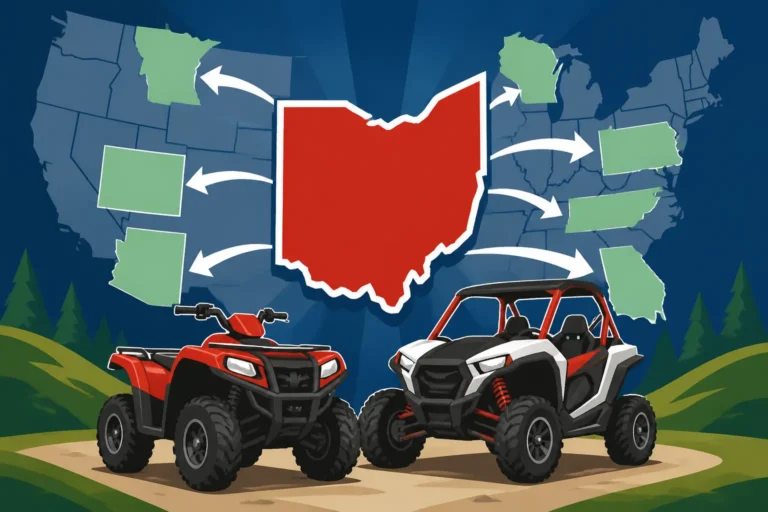
Not safely. Age thresholds, supervision requirements, registration systems, and trail permits can differ across state lines. A child’s eligibility to ride at home does not automatically transfer to an Ohio state forest, and a neighboring state’s plate does not automatically satisfy Ohio or federal access requirements.
This is especially relevant to families traveling from Pennsylvania, West Virginia, Michigan, Indiana, or Kentucky. Reciprocity may address whether a registration is recognized, but it does not erase local rules for minors or machine restrictions. Check the state where the riding takes place and the specific land manager, not only the rules printed on the home-state registration.
For out-of-state planning, start early enough to obtain any required documents and ask questions before the trip. Bring the actual registration or ownership records, not just a photo of the plate. If the machine is from a state that does not register that type of vehicle, find out what alternate proof or permit is needed.
What should a family do if posted information seems unclear?
Do not guess, especially when the uncertainty concerns a minor’s eligibility or adult supervision. Contact the trail manager or the office responsible for the riding area and describe the exact situation: the child’s age, whether the child will operate or ride as a passenger, the supervising adult’s relationship and license status, the machine type, and its registration state.
Write down the answer and the name or office you spoke with. If the answer depends on a particular permit or document, ask what the family should bring. If staff point you to a posted rule or official form, review that material before departure rather than relying only on memory of a phone conversation.
A clear answer before leaving makes the day easier for everyone. The child knows what to expect, the adult can focus on supervising, and the family is less likely to discover a preventable problem at the gate. For related registration questions, Ohio APV Registration Help is another useful topic to consult.
Disclaimer
This article is for general informational purposes only and does not constitute professional advice. Laws, prices and regulations vary by location and change over time. Consult a qualified professional for guidance on your specific situation.