Riding in August Humidity
August humidity can turn an Ohio ATV ride from a fun day outdoors into a tiring slog, especially when the trail is muddy, the air is still, and your gear holds in heat. This guide helps you plan around heat and moisture, choose a manageable route, recognize when to slow down, and prepare your machine and group for safer summer riding.
Why August Humidity Changes an Ohio Trail Ride
Heat, moisture, and exertion add up
Humid air can make it harder for sweat to evaporate, which is one of the body’s main ways of cooling itself. On a trail, that can matter even when the temperature does not seem extreme. You may be working hard to steer through ruts or climb a hill while wearing a helmet, gloves, boots, and protective clothing. Add direct sun, slow-moving air beneath the trees, and a warm engine nearby, and a short ride can feel more demanding than expected.
The strain often sneaks up on riders. Someone who feels fine while unloading may become unusually tired an hour later, especially after a long stretch with few places to stop. A passenger can also be affected by heat while sitting relatively still, and younger riders may not recognize or explain early symptoms clearly.
Treat August riding as an effort you need to manage, not a race to cover the most miles. Take breaks before anyone feels wiped out, drink regularly, and be willing to shorten the loop. For more seasonal context, see [Ohio Riding in Summer Heat] and [Ohio Trail Conditions Before You Ride].
Trail surfaces can feel different in summer
Ohio’s wooded trails can offer shade, but shade does not guarantee cool conditions. Air may feel heavy in a sheltered hollow, while an exposed section or staging area can feel much hotter. In southeastern Ohio, rolling terrain and repeated climbs can add physical effort, particularly when you are navigating uneven ground at low speed.
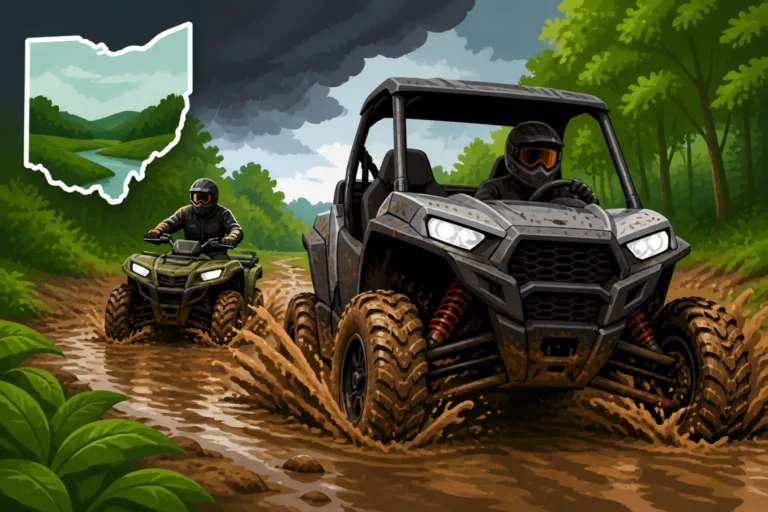
Moisture changes the riding surface, too. A shower can leave some sections slick, while a dry spell may make dusty stretches uncomfortable for riders following close together. Clay can become especially slippery when wet, and ruts that look manageable from the seat may conceal a deeper or softer section. If a route has recently had heavy rain, reconsider whether your group and machine are suited to the conditions. [Ohio Trails After Heavy Rain] and [Clay That Turns to Grease] offer useful reminders about how quickly trail footing can change.
Do not assume that a familiar trail will ride the same way every weekend. Recent rain, vegetation, maintenance, and the number of riders ahead of you can all affect the day. Check for closures and current trail guidance before loading up, then make a new plan if conditions have changed.
Recognize the signs that the ride needs to pause
Heat-related problems can begin with symptoms that are easy to dismiss as ordinary tiredness. A rider may develop a headache, feel weak or dizzy, become nauseated, sweat heavily, or have trouble concentrating. Confusion, fainting, or a sudden change in behavior deserves immediate attention. Do not keep riding in the hope that the person will feel better once the group reaches the next destination.
If someone feels unwell, stop somewhere safe, get them out of direct sun when possible, loosen unnecessary layers, and offer small sips of water if they are alert and able to drink. Seek urgent medical help for severe symptoms, fainting, confusion, or a condition that is getting worse. Do not leave the rider alone while the rest of the group continues.
It is easier to respond early when your group agrees in advance that anyone can call for a break without needing to justify it. A relaxed plan prevents riders from pushing through discomfort just to avoid slowing everyone down.
How to Plan a More Comfortable August Ride
Choose a route that fits the group
A good summer ride is not necessarily the longest one. Match the route to the least experienced rider, the slowest machine, and the person most affected by heat. If you are riding with children, older adults, or anyone returning after a long break, plan a shorter outing with an easy way to turn back. A group that expects to ride at a steady pace can stay together more comfortably than one trying to keep up with an ambitious mileage target.
Ohio’s forest riding areas differ in terrain and layout. Before choosing a destination, review the rules and trail information for the specific area rather than relying on a general impression of “Ohio trails.” For a broad starting point, explore [Ohio's Four State Forest APV Areas]. A route such as [Monday Creek Near Nelsonville] may be a better fit for one group than another, depending on riders’ experience, machine width, and the day’s conditions. Confirm current access and trail details before you travel.
Use a map to understand where your group is going, but keep a backup plan. A paper map or downloaded information can be useful if phone reception is unreliable. onX Offroad can help riders review mapped routes and plan around the area they intend to visit; check that the information you rely on matches current land-manager guidance and posted signs. A map is a planning aid, not permission to ride a closed or restricted route.
Pick timing and breaks with heat in mind
If your schedule allows, avoid making the hottest part of the day your longest riding block. Starting earlier may reduce exposure to the strongest afternoon heat, but it does not remove the need to pace yourself. Check the forecast before leaving home and reassess when you arrive. Humidity, cloud cover, wind, and recent rain can make the conditions feel different from what you expected.
Plan rest stops at safe, appropriate locations rather than waiting until someone is exhausted. Use breaks to drink, check in with everyone, and notice whether anyone is becoming unusually quiet, irritable, dizzy, or unsteady. In a group, the person who says “I’m fine” may simply be reluctant to hold others up, so ask specific questions: Do you have a headache? Are you feeling nauseated? Are you thinking clearly?
Build flexibility into the day. If heat or trail conditions are worse than expected, shorten the loop, take a longer break, or call it early. The goal is to return safely, not to complete a route at all costs. [Ohio Trail Loops You Can Ride Before Sunset] can help you think about manageable outings, while [Ohio Trail Difficulty Ratings] is a useful reminder to choose terrain that suits the riders actually coming along.
Prepare water, clothing, and communication
Bring more drinking water than you expect to need, and make it easy to reach during breaks. Do not wait until you are very thirsty to take a drink. A hydration pack can make sipping convenient, but it should not replace carrying enough water for the planned outing and a reasonable delay. Consider the group’s needs, the length of the ride, and the possibility that you may have to wait for assistance.
Wear protective riding gear that fits properly, but make sensible choices for hot weather within the rules for the place you are riding. A helmet, gloves, eye protection, and suitable footwear still matter. Avoid treating light clothing as a reason to ride without protection. Take breaks in the shade when possible, and keep spare dry clothing available for the drive home if someone gets soaked with sweat or rain.
Before setting out, tell someone where you plan to ride and when you expect to return. Keep your phone charged, but do not assume it will have service throughout a wooded route. onX Offroad may be useful for preparing a route and viewing mapped areas, but riders should not rely on any single app as their only navigation or emergency resource. Learn the official access points, carry what you need to orient yourself, and know how your group will respond if a rider becomes separated.
| Before the ride | What to check | Why it matters |
|---|---|---|
| Weather | Heat, humidity, rain, and changing conditions | Helps you adjust timing, route length, and gear |
| Trail access | Current closures, rules, and posted signs | Prevents riding somewhere that is closed or restricted |
| Group readiness | Experience, health, hydration, and machine capability | Keeps the plan realistic for everyone |
| Navigation | Route details, access points, and backup information | Helps the group stay oriented if service is limited |
| Emergency plan | Check-in contact, meeting point, and response plan | Makes delays or separation easier to manage |
Ride Safely When Heat or Conditions Shift
Keep the group together and communicate
A group ride needs a pace that allows everyone to stay comfortable and in control. Agree on where to stop, how riders will signal a problem, and what to do if the group becomes separated. Keep enough space between machines to avoid dust and give each rider room to respond to a rut, branch, or sudden stop. On narrow trails, pass only where it is safe and permitted.
Pay attention to changes in the people as well as the trail. A normally talkative rider who becomes quiet, a person who starts making uncharacteristic mistakes, or someone who falls behind may need a break. Check in without making it a challenge. “Want to stop in the shade and drink?” is easier to answer honestly than “You can keep going, right?”
Do not pressure a rider to continue because the group has already covered most of the route. If someone feels unwell, stop and reassess. If a rider cannot safely continue, the group’s plan should prioritize getting them help rather than preserving the day’s itinerary.
Adjust your riding to the ground beneath you
Humid weather can arrive with rain or leave trails damp for longer in shaded areas. Reduce speed when visibility is limited, the surface is slick, or the trail is unfamiliar. Avoid sudden throttle or braking inputs on slippery ground, and leave extra room on hills and around corners. Do not ride around a closure, bypass a barrier, or create a new route to avoid a wet section.
Water crossings and muddy depressions deserve special caution. What looks shallow from the trail may conceal a soft edge, a rut, or a drop. If you cannot judge the crossing safely, do not enter it. Turning around is a sound decision, not a failure. Likewise, do not follow another machine into a feature simply because it made it through; different tires, ground clearance, load, and rider skill can change the outcome.
Stay on the designated route and respect other trail users. A trail can be shared with people moving at different speeds or on foot, and wet or dusty conditions can make it harder to see them. Slow down early, keep control of your machine, and give others room.
Inspect the machine before and after the outing
A quick pre-ride check helps catch issues before heat and rough terrain make them harder to manage. Look over the tires, controls, brakes, lights, and visible fluid levels, and confirm that the machine is carrying its load securely. Check that the cooling system and air intake are not blocked by debris, following the owner’s manual for inspection and maintenance. If warning lights appear or the machine behaves unusually, stop and address the problem rather than pushing farther into the trail system.
Mud, dust, and plant debris can collect in places that are easy to overlook. After the ride, inspect the machine and clean it according to the manufacturer’s recommendations. Look for damaged tires, loose fasteners, leaks, or debris around hot components. If the engine overheated or a warning appeared, let it cool safely and consult the manual or a qualified service professional before riding again.
A little preparation can make August riding far more enjoyable, but weather and trail surfaces are not fully predictable. Choose a route that fits the group, carry what you need, watch for signs of heat strain, and be ready to change plans. Those choices leave more room to enjoy the ride—and make it easier to come back for another one.
Disclaimer
This article is for general informational purposes only and does not constitute professional advice. Laws, prices and regulations vary by location and change over time. Consult a qualified professional for guidance on your specific situation.