Ohio Private Trail Parks
Ohio’s public trail systems can be seasonal, narrow, or busy, and a machine that fits one area may not suit another. Private ATV and UTV parks offer a different kind of ride, but each property sets its own rules for access, machine types, noise, camping, and safety. This guide explains how to choose an Ohio park and plan a day that fits your group.
What to Expect at Ohio Private Trail Parks
Private parks offer a different kind of ride
A private riding park can be a useful alternative when you want a planned outing without relying on public trail access. Some properties have marked trail networks, open riding areas, mud features, hills, or designated routes for different vehicles. The layout and atmosphere vary widely, though: one park may suit a family looking for a casual day, while another may be aimed at experienced riders and modified machines.
That variety is exactly why it pays to look beyond a park’s name or a few photos. Ask what kinds of machines are allowed, whether trails are marked by difficulty, and whether the property has separate routes for ATVs and larger side-by-sides. A place that welcomes off-road vehicles in general may still restrict particular machine types, widths, or modifications.
For a broader overview of how paid private riding differs from other options, see [Ohio Pay-to-Ride Parks] and [Ohio Private Riding Parks]. If you’re weighing a private outing against public land, [Comparing a Forest Trail to a Private Park] can help you think through the tradeoffs.
Private property does not mean a free-for-all
A private park controls access to its land, and its own rules may cover registration, waivers, helmets, passengers, speed, trail direction, and where riders can stop. The rules may be stricter than what you’re used to at home or on a different property. Follow the park’s posted requirements even if your machine is already registered or you have ridden elsewhere without the same conditions.
It’s also important to separate a park’s rules from public-land requirements. An Ohio plate or a pass associated with another riding area does not necessarily replace the admission, waiver, or equipment rules set by a private operator. Conversely, a park’s permission to ride on its land does not automatically authorize you to use nearby roads, trails, or adjoining property to reach it.
Before loading up, ask the park which documents and equipment each rider should bring. If you’re unsure what your registration allows in other riding areas, [Ohio APV Reciprocity With Other States] offers useful background on a separate question: riding Ohio public areas with an out-of-state registration.
The park’s layout matters as much as its reputation
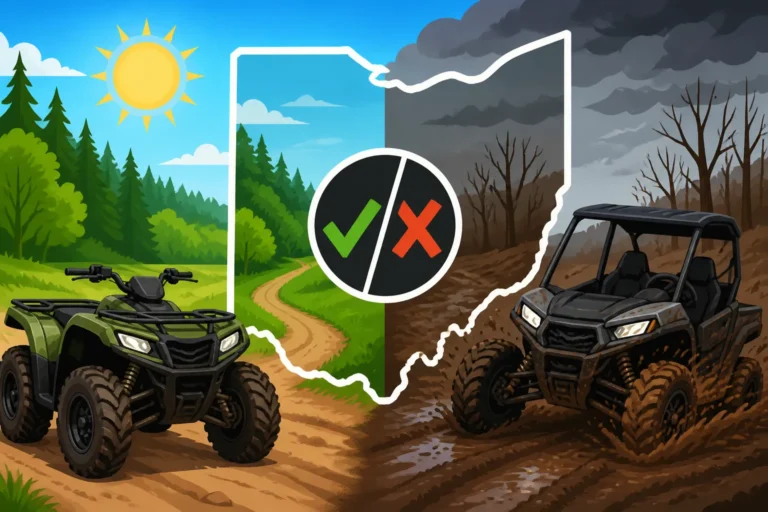
A park may be known for challenging terrain, but that doesn’t mean every route is equally difficult—or that every route suits every rider. Look for a trail map or a clear description of the terrain. Ask whether there are easier loops, how routes are marked, and whether there are sections that become especially demanding after rain.
Consider the whole group, not just the most experienced rider. A confident driver may enjoy steep climbs or deep mud, while a newer rider may feel more comfortable on a wider, easier route. If everyone is expected to ride the same loop, an awkward mismatch can turn a fun day into a stressful one. The park’s staff can often clarify whether riders can choose routes independently and meet at a designated location later.
How to Choose a Park That Fits Your Machine and Group
Check machine access before you leave home
Never assume that a park allows every ATV or UTV just because it’s an off-road venue. Confirm the permitted vehicle types, minimum or maximum widths, age requirements, passenger rules, and any restrictions on tires, exhaust, or other modifications. A wide side-by-side may be welcome on some routes but unsuitable for a narrower trail network.
For example, imagine a family planning a trip with a full-size UTV and two smaller quads. The park might allow all three types of machines but route them differently, or it may have rules that make one vehicle a poor fit. Asking ahead avoids discovering at the entrance that a machine can’t use the trails your group came to ride.
If width is a key concern, compare the park’s own limits with the state-forest rules discussed in [Ohio's 62 Inch State Forest Width Limit]. Public-forest limits and private-park policies are not interchangeable, but understanding the distinction can help you choose a venue that fits your machine.
Match the terrain to the least-experienced rider
Be honest about who is coming along. A first-time rider may be nervous around deep ruts, steep descents, or fast-moving groups, even if an experienced family member sees those features as ordinary. Look for a park that can explain route difficulty in practical terms rather than relying only on labels such as “easy” or “advanced.”
Ask questions like these before booking:
- Are there routes suitable for beginners or younger riders?
- Can a group choose different routes and regroup?
- Are there steep slopes, deep mud, water crossings, or narrow passages?
- What does the park recommend after heavy rain?
- Is there a place to stop safely if someone needs a break?
If your group has mixed experience, agree in advance that nobody has to prove anything. A new rider who wants to turn around should be able to do so without being teased or pressured. For more on riding together safely, [Ohio Trail Etiquette on Narrow Trails] covers habits that matter when people meet on shared routes.
Compare the practical details, not just the trail footage
Videos and social posts can make a park look exciting, but they rarely tell you everything you need for a comfortable day. Check whether the property offers restrooms, changing areas, food, fuel nearby, trailer parking, or camping. Ask about the check-in process, whether you need a reservation, and what happens if weather affects access.
This is especially useful for families and groups traveling from farther away. A park with a suitable route may still be inconvenient if you have no clear place to park a trailer or if your group needs services the property does not provide. Keep a backup plan for fuel, food, and overnight accommodation rather than assuming everything will be available on-site.
If renting a machine is part of your plan, verify what is included and what each rider must bring. [Ohio Private Parks That Rent Machines on Site] is a helpful next read for that scenario. To compare admission structures and the questions worth asking, see [Paying a Day Rate at a Private Park].
| What to check | Why it matters | What to ask the park |
|---|---|---|
| Allowed machine types and widths | Your vehicle may not fit every route or property rule | Are ATVs, UTVs, youth machines, and modified vehicles allowed? |
| Trail difficulty | The group’s least-experienced rider needs a comfortable option | Are there beginner routes, and how are routes marked? |
| Weather and trail conditions | Rain can change traction, mud depth, and route access | Which routes are likely to close or become difficult after rain? |
| Access and check-in | Some parks may require advance planning or paperwork | Do riders need a reservation, waiver, or documents at arrival? |
| Parking and amenities | A long drive is easier with a plan for trailers, restrooms, and fuel | Where can trailers park, and what facilities are available? |
| Camping and overnight plans | On-site camping may have separate rules or availability | Is camping allowed, and does it need to be arranged separately? |
Plan the Ride Before You Get to the Gate
Confirm the rules directly with the park
Park policies can change, and a comment from another rider may describe an older visit or a different event. Check the park’s own information before you go, then contact staff if an important detail is unclear. Focus on the essentials: operating days, admission process, required paperwork, machine restrictions, safety equipment, and whether trails are open under the expected conditions.
If you’re organizing a group, share the rules with everyone before departure. It’s frustrating to reach the entrance and find that one rider hasn’t completed a required waiver or brought an item the park expects. A quick message to the group with the park’s requirements can prevent a delay and keep the first part of the day calm.
Group trips may need more coordination than a family outing. Ask whether the park has special procedures for large groups, separate arrangements for camping, or limits on how many machines can ride together. [Booking a Private Park for a Group] is a useful related topic when you’re handling the logistics for several households.
Use maps for planning, but follow the park’s directions
A map app can help you understand the drive to the property, locate nearby services, and keep track of your general location. Tools such as onX Offroad can be useful for pre-trip planning and for seeing how roads and mapped routes fit together. Still, a third-party map should not replace the park’s current trail map, instructions, or signs on the property.
That distinction matters because a route shown on a map may be outdated, closed, private, or unsuitable for your machine. Download or save the park’s official information if cell service may be unreliable, and agree on a meeting point before splitting into smaller riding groups. If the park provides a map at check-in, use it to confirm the route names and markers you’ll actually see.
onX Offroad can also help you plan the drive and note nearby fuel or services, but treat the property’s posted rules as the final word on where you may ride. Do not use a mapped line as permission to cross onto neighboring land or leave a marked route.
Pack for a full day, not just the ride itself
A little preparation makes a noticeable difference when the weather shifts or a ride takes longer than expected. Bring water, suitable clothing, basic first-aid supplies, a charged phone, and any tools or recovery equipment appropriate for your machine and experience. Keep the items you’ll need at the trailhead easy to reach rather than buried beneath luggage in a trailer.
For a group, agree on a simple check-in plan. Decide where to regroup, what to do if a machine has a problem, and who should contact park staff if someone gets separated. Riders should know the park’s emergency procedures and should avoid attempting a recovery that exceeds their equipment or skills.
Weather deserves special attention. A dry route can become slick after rain, while heat can make a long ride tiring faster than expected. Check the park’s conditions before leaving and again before unloading. [Ohio Trail Conditions Before You Ride] offers additional planning guidance, and [Riding a Private Park in Winter] is worth reviewing if you’re considering a cold-weather outing.
Make the Day Safer and More Enjoyable
Ride within your comfort level
Private parks can bring together riders with very different machines, speeds, and experience. Stay on designated routes, follow signs, and leave room for the rider ahead. On a narrow trail, don’t assume the person in front can see or hear you; wait for a safe place before passing, and slow down when visibility is limited.
If a trail feels beyond your ability, stop somewhere safe and choose another route or turn back if the park permits it. There is no benefit to pushing through a section that feels unsafe. A cautious decision can save your group from a rollover, a damaged machine, or a long recovery in a place where help may take time to reach you.
Riders with children should be especially clear about boundaries before starting. Explain where they can ride, when they need to stay with an adult, and what to do if they can’t see the group. A simple plan is much easier to follow than shouted instructions once engines are running.
Respect other riders and the property
Keep noise, speed, and dust in mind around other visitors, staff, and nearby homes. Do not create new trails, bypass a closure, or ride into areas that are not marked as open. These choices can damage the property and may jeopardize access for everyone who uses it.
Take trash with you, secure loose gear, and follow the park’s instructions for parking and unloading. If you see a hazard or a damaged sign, notify staff rather than trying to fix it or marking a new route yourself. Being considerate makes a private park more enjoyable for the next group as well as your own.
Have a backup plan for weather or closures
A trip can change quickly if a park closes a route, conditions worsen, or a machine develops a problem. Before driving, know the park’s process for checking conditions and any policies that may apply if your plans have to change. Keep the day flexible enough to choose an easier route, take a longer break, or call it early.
For travel planning, onX Offroad can help you keep track of the surrounding area, but it cannot tell you whether a private park has opened a specific route that day. Confirm closures and access with the park itself. If you are comparing several options, look at the full experience—machine fit, terrain, group needs, and logistics—not just the promise of a challenging trail.
A good Ohio private-park outing starts with a realistic match between the property, the machines, and the people riding. Confirm the rules, choose routes that suit everyone, and follow the park’s directions once you arrive. Those small steps help prevent the most common trip-day frustrations and leave more room to enjoy the ride.
Disclaimer
This article is for general informational purposes only and does not constitute professional advice. Laws, prices and regulations vary by location and change over time. Consult a qualified professional for guidance on your specific situation.