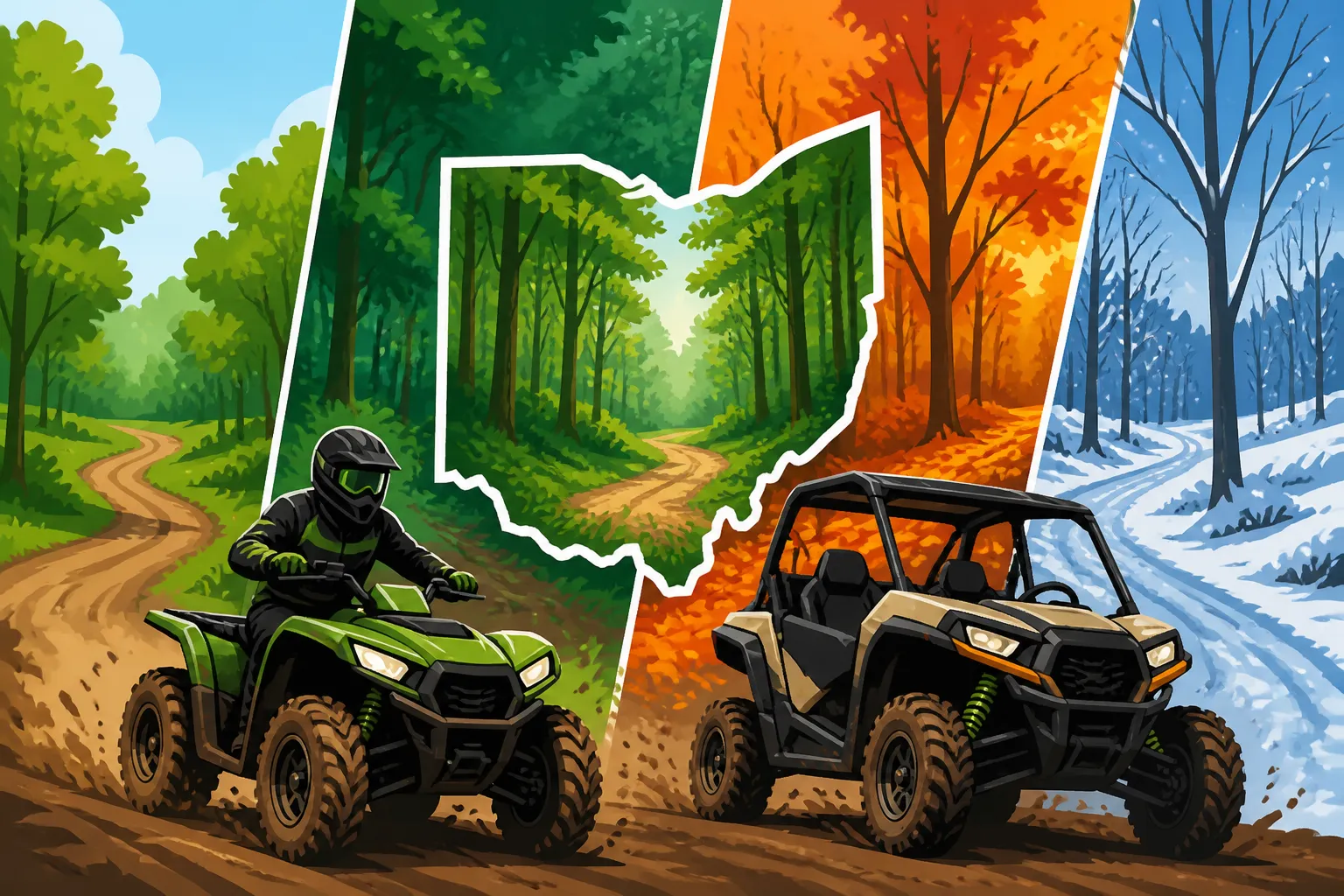
The Wayne Forest Season in Ohio
Ohio’s Wayne National Forest riding season is limited, and a trail that looks rideable on a sunny spring afternoon may still be closed or too wet for safe riding. This guide explains the usual season, what changes between spring and fall, how to choose a trail system, and what to check before loading your ATV or UTV.
Understanding the Wayne National Forest Riding Season
When the trails are generally open
The Wayne National Forest’s designated off-highway vehicle trails generally operate on a seasonal schedule from April 1 through November 30. The trails are closed outside that window to reduce damage when the ground is vulnerable and to give the trail system a recovery period. Those dates are a useful planning baseline, but they do not guarantee that every trail will be open on a particular day.
Weather, maintenance, logging activity, storm damage, and other forest-management needs can affect access during the regular season. A trail may be closed temporarily even when the broader season is underway. Before leaving home, check current alerts from the Forest Service and read notices posted at the trailhead. A map showing a route does not necessarily mean the route is open that day.
It also helps to distinguish Wayne National Forest from Ohio’s state forest riding areas. The two systems have different land managers and may use different seasonal schedules. For a broader comparison, see [Ohio's Trail Season by Forest]. Assuming all Ohio trails open and close on the same dates is an easy mistake, especially if you ride multiple areas.
Why the season has a defined start and end
Ohio’s wooded trails can be especially fragile during freeze-thaw cycles and long stretches of rain. When soil is saturated, tires can cut deep ruts, push mud onto the trail, and damage drainage features. Those ruts may remain long after the weather dries, making the route rougher and increasing the amount of maintenance needed before the next riding season.
The end-of-season closure gives the ground time to recover and allows crews to handle maintenance without regular OHV traffic. It also means that a warm, dry weekend in December does not automatically make a closed trail available for riding. Seasonal access is governed by the land manager, not just by how rideable the surface appears.
For riders, the practical takeaway is to plan around the posted season rather than treating the calendar as a suggestion. If you are close to the opening or closing dates, confirm the status before making a long drive. That is particularly important when coordinating a group, renting a machine, or booking lodging near Nelsonville or in southern Ohio.
Choosing a Wayne National Forest Trail System
Monday Creek near Nelsonville
Monday Creek is one of the best-known Wayne National Forest riding areas, with access in the Nelsonville area. Its trail network gives riders a chance to explore wooded terrain and reclaimed mining ground, and its size can make it appealing for a longer day. But mileage alone should not determine whether it suits your group. Consider your machine, experience level, weather, and the time you have available.
The ride can feel very different after rain than it does during a dry spell. Clay and disturbed soil may become slick, while ruts and uneven sections can be harder to manage for newer riders. Before setting out, check the trail system’s current conditions and plan a route that leaves enough time to return to the staging area before closing hours. More detail on the area is available in [Monday Creek Near Nelsonville].
If your group includes riders on different machines, agree on a comfortable pace before starting. A narrow quad, a wide side-by-side, and a youth machine can encounter the same terrain differently. Keep the group together at junctions, avoid riding around closed sections, and give yourself time to stop for breaks rather than treating the posted mileage as a simple estimate of how long the outing will take.
Hanging Rock and Pine Creek
Hanging Rock, in southern Ohio, offers a very different setting from a quick ride close to Nelsonville. Its forested hills and winding trails can make for a memorable day, but elevation changes and surface conditions may demand more attention than an easy, flat route. Check the system’s rules and trail information before choosing it, particularly if your group has newer riders or machines that are not suited to narrow or uneven terrain. See [Hanging Rock in Southern Ohio] for a closer look.
Pine Creek is another southern Ohio option, in the Ironton District. Riders often use access points such as Lyra or Wolcott, so it is worth confirming which starting point best fits your route and plans. If you are unfamiliar with the area, leave extra time to find the correct entrance, unload safely, and review the trail map before heading out. The guide [Pine Creek and the Ironton District] can help you understand the area’s layout.
The three systems are not interchangeable just because they are all part of the Wayne National Forest. Distances, terrain, access points, and the feel of a ride vary. Choose based on the actual day you want to have: a shorter visit, a long loop, a ride with less challenging terrain, or a trip that pairs trail time with camping. Then verify that the system and access point are open.
| Trail system | General location | Planning considerations |
|---|---|---|
| Monday Creek | Nelsonville area | Check current conditions, route length, and access before a longer ride |
| Hanging Rock | Southern Ohio | Account for hills, changing surfaces, and your group’s experience |
| Pine Creek | Ironton District | Confirm the access point, such as Lyra or Wolcott, and plan your route |
How Conditions Change Through the Season
Spring opening and wet trails
The first weeks after the seasonal opening can be exciting: machines are ready, riders are eager to get out, and the woods are waking up. But early spring is also when a trail can remain soft beneath a surface that looks dry. Water may collect in shaded sections, and a few wet days can make exposed clay slick. If the route is muddy, pushing through can turn a short ride into trail damage that lasts well beyond the weekend.
A responsible spring plan starts with checking conditions, not just the opening date. Look for closure notices, recent rain, and reports of maintenance work. If conditions are poor, choose a different activity rather than trying to find a way around a closed or damaged section. The guidance in [Ohio Trails After Heavy Rain] is useful for thinking through how rain affects trail surfaces and why waiting can be the better choice.
It is also sensible to build flexibility into your first ride of the season. Have a backup plan if the system is closed or too wet, and avoid inviting a large group before you know what conditions are like. A shorter outing lets you check how your machine and gear feel after winter storage without committing to a full day on unfamiliar trails.
Summer heat and autumn riding
Summer brings longer daylight and more opportunities to ride, but heat and humidity can make a long day tiring. Carry water, take breaks, and pay attention to how everyone in the group is doing, especially younger riders. A shaded forest route may feel cooler than an open area, but it is still possible to become dehydrated when you are concentrating on uneven terrain and wearing protective gear.
Autumn often offers comfortable temperatures and attractive scenery, but shorter days make timing more important. Start early enough to complete your ride and return to the staging area before the system’s posted closing time. Hunting activity and seasonal land-management work may also affect nearby areas, so do not assume a familiar route is unchanged simply because you have ridden it before.
Weekends can be busy during pleasant fall weather. If you want to avoid a rushed start or a crowded lot, arrive with time to unload, check your equipment, and review the route. See [Ohio Trails That Fill Up on Weekends] for more planning context. Whether it is July or October, check the latest [Ohio Trail Conditions Before You Ride] rather than relying on a report from a previous visit.
Preparing for a Safe and Well-Planned Ride
Check maps, closures, and access details
Before you leave, confirm three separate things: that the riding season is open, that your chosen trail system is open, and that the specific route or access point you plan to use is available. These checks are not redundant. A system can be in its seasonal window while one section is temporarily closed, or an approach road can be affected by work or weather.
Use official forest information for closures and rules, and bring a trail map that you can consult without cell service. A navigation app such as onX Offroad can be useful for reviewing routes and helping your group understand where it is in relation to mapped trails. Still, treat any digital map as a planning aid, not as proof that a trail is open. Posted signs and current land-manager notices take priority.
A simple pre-ride routine can prevent a frustrating trip: confirm the trailhead address, check the forecast, review the route, and tell someone where you are going. Save important details before you reach a dead zone. If your group is splitting up, agree on a meeting point and a time to regroup so nobody has to guess which direction the others took.
Permits, equipment, and group decisions
Wayne National Forest OHV riding has permit requirements that differ from simply having a machine with an Ohio registration plate. Understand what applies to each rider and machine before arrival, and do not assume a permit is included with registration or a rental. The details are covered in [How the Wayne National Forest OHV Permit Works]. If you are renting, ask the rental provider what is included and what you must arrange yourself.
Check your machine before loading it. Inspect tires, brakes, lights, steering, and essential fluids, and make sure any tools or recovery equipment are secured. Carry drinking water, a basic first-aid kit, and a charged phone, while recognizing that service may be limited. Protective gear should fit properly and be suitable for the kind of riding you are doing.
Group planning matters just as much as machine preparation. Choose a route that matches the least experienced rider, agree on stopping points, and make sure everyone knows how to respond if someone gets separated or has a mechanical problem. If the group includes children, explain trail etiquette and the plan in plain language before the engines start. A slower, coordinated ride is usually more enjoyable than trying to keep up with the fastest machine.
Making the Most of a Wayne National Forest Trip
Plan the day around the trail, not just the drive
A trail trip involves more than riding time. You may need to drive a considerable distance, unload, secure a trailer, organize helmets and permits, and find the correct trail entrance. Give yourself enough time for those tasks so you are not trying to rush through safety checks or begin a ride late in the day.
If you are coming from outside the area, research food, fuel, and lodging before you set out. Trailhead areas do not always have the services a visitor expects, and cell coverage can be unreliable. Consider whether you want a day ride or a longer visit with overnight lodging nearby. The overview [Camping Near Ohio OHV Trails] can help you think through options and the extra preparation that comes with staying overnight.
A map app such as onX Offroad can help with route planning, but download or save what you need before heading into areas with weak service. Share the planned route with someone who is not riding with you, and keep a paper map or another backup if practical. That small bit of preparation can make a major difference if your phone battery dies or the group needs to change plans.
Be ready to adjust when conditions change
The best plans are flexible. If rain arrives, a trail becomes muddy, a closure notice appears, or a rider in the group is uncomfortable, change the route or stop. Continuing because you have already driven to the trailhead can be tempting, but it does not improve the ride—and pressing on can create safety problems or damage the trail.
Respect signs, barriers, and marked routes. Do not ride around a closure, make a new path through the woods, or assume that a nearby unmarked track is part of the OHV system. Staying on designated routes protects the land and helps preserve access for other riders. If a route is unclear, stop and check the map or ask the appropriate forest office rather than guessing.
A thoughtful Wayne National Forest ride is one that ends with everyone and every machine back safely, the trails no worse for your visit, and enough time left to unload without a last-minute scramble. Check conditions before departure, ride within your group’s abilities, and treat the seasonal schedule as one part of a broader access plan. Those habits make it easier to enjoy Monday Creek, Hanging Rock, Pine Creek, and other Ohio riding opportunities responsibly.
Disclaimer
This article is for general informational purposes only and does not constitute professional advice. Laws, prices and regulations vary by location and change over time. Consult a qualified professional for guidance on your specific situation.