Buying a Machine at an Ohio Auction
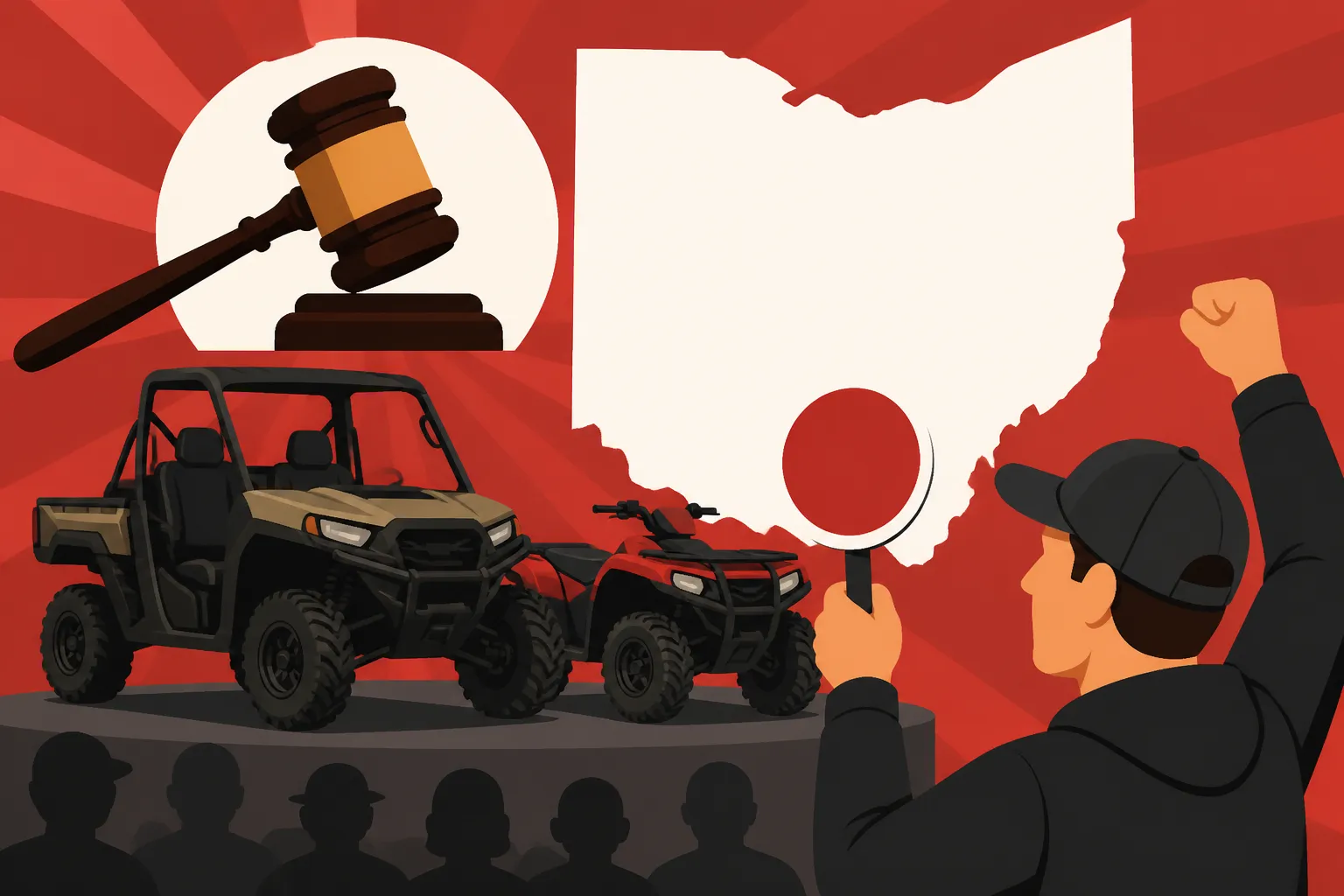
Oh, the thrill of the auction! There’s nothing quite like the rush of bidding on an all-purpose vehicle (APV) in Ohio, hoping to snag a fantastic deal. But let's be real, that excitement can quickly turn into a headache if you don't know what you're getting into. Many folks dive in, see a shiny machine, and forget that auctions come with their own unique set of challenges, especially when it comes to getting that machine legally on the trails. This guide is going to walk you through everything you need to know about buying an APV at an Ohio auction, from the initial research to finally getting your new-to-you quad or side-by-side ready to ride.
The Allure and Risks of Buying an APV at Auction in Ohio
There’s a certain magic to auctions. You can often find incredible deals, unique machines that aren't readily available at dealerships, and sometimes even a diamond in the rough. But just like any treasure hunt, there are traps. Understanding both the appeal and the inherent risks is your first step to a successful auction purchase in Ohio.
Why Auctions Are So Appealing and Why They're Risky
Let's start with the good stuff: the potential for a bargain. Auctions can be a fantastic way to acquire an ATV or UTV at a price significantly lower than retail. You might stumble upon an older model that’s a classic, a custom-built machine with features you wouldn’t find anywhere else, or even a low-hour unit that someone just needed to offload quickly. The competitive atmosphere, the fast pace, and the sense of possibility all add to the excitement. It’s easy to get swept up in the moment, imagining yourself tearing down a trail on your new acquisition.
However, that excitement can blind you to the very real risks involved. The biggest and most often overlooked phrase at an auction is "as-is, where-is." This means exactly what it sounds like: what you see is what you get, and once the hammer falls, it’s yours, no returns, no guarantees. You might be buying a machine with hidden mechanical issues – a failing transmission, a blown engine, or electrical gremlins that aren't apparent during a quick walk-around. Without the ability to test ride or even thoroughly inspect the machine, you’re often taking a significant gamble. Beyond mechanical concerns, the biggest headache for APV buyers at auction in Ohio often revolves around proper documentation, particularly the lack of a clear title or the presence of an undisclosed lien.
Types of Auctions You'll Encounter in Ohio
Ohio hosts a variety of auctions where you might find an APV, and understanding the differences can help you prepare. Each type comes with its own quirks and potential finds.
First, there are public auctions, often run by local governments or state agencies. These might include auctions of impounded vehicles from law enforcement, surplus property from state departments, or even seized assets. For instance, a county sheriff's office might auction off an ATV that was recovered after being stolen or used in a crime, if the owner can't be found. These can sometimes yield fantastic deals, but the documentation might be sparse, and the machines might have been sitting for a while, leading to maintenance issues.
Then you have private auctions. These are typically estate sales, bankruptcy auctions, or farm equipment auctions. An APV might be part of a larger liquidation, like when a farm is selling off all its machinery. Sometimes, specialized equipment auctioneers will hold events featuring powersports vehicles, though these are less common as exclusive events for ATVs and UTVs. These auctions might offer a better chance for communication with the seller's representatives about the machine's history, but again, the "as-is" rule almost always applies.
Finally, we have online auction platforms. These platforms, while convenient, present their own set of challenges. You might be able to bid from the comfort of your home, but your ability to physically inspect the machine is severely limited, often relying solely on photos and descriptions provided by the seller or the auction house. This makes the risk of hidden problems even higher. While some platforms offer buyer protection, it's usually for severe misrepresentation, not for typical "as-is" mechanical failures or missing paperwork. Always consider whether the convenience outweighs the loss of direct inspection.
Pre-Auction Homework: What to Do Before You Bid
Before you even think about raising your hand or clicking that "bid" button, you need to do your homework. This preparatory phase is critical to protecting yourself from a costly mistake and ensuring you can actually use your new machine once you get it home.
Researching the Auction House and Its Rules
The first step in your pre-auction preparation is to thoroughly research the auction house itself. Not all auctioneers operate with the same level of transparency or buyer protection. Look for reviews, check their website, and see how long they've been in business. A reputable auctioneer will provide clear terms and conditions. These terms are vital, as they outline everything from payment methods to buyer's premiums, which are additional percentages added to the hammer price. It's not uncommon for a buyer's premium to be 10% or even higher, significantly increasing your actual cost.
Beyond buyer's premiums, pay close attention to payment deadlines, pick-up schedules, and any storage fees that might apply if you can't retrieve your APV immediately. Some auctioneers require cash or certified funds only, while others accept credit cards (sometimes with an additional fee). The fine print can be dense, but taking the time to read it will prevent nasty surprises. For example, if you win a bid on a Saturday but the pick-up window closes Monday afternoon, and you're out of town, you could incur daily storage fees or even forfeit your purchase. Many auction woes stem directly from bidders not fully understanding the rules before they participate.
The Critical Importance of Pre-Inspection and Documentation Check
This is arguably the most crucial part of buying an APV at auction in Ohio. You must conduct a thorough pre-inspection, even if it's only a visual one. Get down on your hands and knees. Look for signs of damage, rust, fluid leaks (oil, coolant, brake fluid), and excessive wear on tires, suspension components, and drive shafts. Check the frame for bends, cracks, or amateur weld repairs, which could indicate a prior major accident. If possible, try to turn the engine over by hand or see if the starter engages, even if you can’t fully start it. Does it feel seized? Are there any obvious missing parts?
Next, and equally important, is VIN verification. Locate the Vehicle Identification Number (VIN) on the APV, usually stamped on the frame or a permanent component. Compare this VIN to any paperwork the auction provides. A missing, tampered, or mismatched VIN is a massive red flag and should be a deal-breaker. You won't be able to register it in Ohio if the VIN is questionable. For a deeper dive into this, check out [Checking a VIN Before an Ohio Purchase].
Title status is often the biggest hurdle at auction. Many ATVs and older UTVs might not have a formal title, especially if they were used exclusively on farms or private land. Ohio law generally requires an APV title for registration and legal ownership transfer. If the auction house states there's no title, or only a bill of sale, understand that you're taking on a significant challenge. You'll need to research what steps are involved in [Do You Need a Title for an ATV in Ohio?] if you plan to get a plate. Sometimes, the auction provides a title, but it might be a salvage title or have a lien recorded against it. This brings us to another critical step: a lien check. Even with a title in hand, a previous owner might have an outstanding loan on the machine. You need to ensure the title is clear of any liens. Guidance on how to do this can be found in articles like [Checking a Title Before You Pay] and [Buying a Quad With a Lien on the Title]. While LawDepot offers templates for creating legal documents, it's the Ohio Clerk of Courts that will be your primary resource for actually verifying lien status.
Finally, scrutinize any auction sheet or manifest provided. Does it list mileage or hours? Are there any known issues disclosed? While an auction house isn't typically liable for undisclosed problems, sometimes they'll list major known defects to manage expectations. Don't assume anything; confirm every detail you can.
The Bidding Process and Post-Auction Steps in Ohio
You've done your homework, inspected the machine, and set your budget. Now comes the exciting part: the actual bidding. But once the adrenaline fades, the real work of securing your ownership begins.
Strategic Bidding and What Happens When You Win
Approaching the bidding process with a clear strategy is vital. First and foremost, stick to your budget. It's incredibly easy to get caught up in the competitive spirit and overbid, especially when you see others showing interest in "your" machine. Your budget should factor in the hammer price, the buyer's premium, Ohio sales tax, and an allowance for potential repairs or the costs associated with getting a title if one isn't provided. Remember that this initial cost is just the beginning.
Understand the different bidding increments and how the auctioneer conducts the sale. Some auctions move very quickly, especially for lower-priced items, while others might slow down for larger, more expensive equipment. If you win the bid, congratulations! The auctioneer will typically acknowledge your winning bid, and you'll be directed to a registration desk or cashier to complete the payment immediately. Be prepared to pay on the spot, usually within minutes of your winning bid, with the payment methods specified by the auction house. This often means having cash, a certified check, or a pre-approved line of credit ready. If you fail to pay, you could forfeit your right to the machine and potentially be banned from future auctions.
Securing Your Ownership: Titling and Registering Your Auction Find
Once you've won and paid, the next crucial step is securing legal ownership and making your APV trail-ready in Ohio. This process largely depends on what documentation the auction provided.
If the auction house provided a clear, assigned title, you're in a relatively good position. You'll need to take this title, along with your proof of purchase (auction receipt), to your local [Titling an APV at an Ohio Clerk of Courts] office. There, you'll transfer the title into your name. Be prepared to pay the Ohio title fee, which is a flat rate. For more details on these costs, you can look into [What an Ohio APV Title Costs].
However, scenarios where the auction provides no title are incredibly common, especially for older ATVs or machines that have historically been used only on private property. If you purchased the machine with just an auction receipt or a simple bill of sale, the path to obtaining a title in Ohio becomes much more complex. You might need to contact previous owners (if identifiable), apply for a bonded title, or even go through a court process to prove ownership. This can be a lengthy, frustrating, and potentially expensive endeavor, and it's not always guaranteed to succeed. Always inquire about [Ohio APV Title Requirements] before you bid if a title is a concern.
Regardless of whether a title was provided, you will almost certainly owe Ohio sales tax on your purchase. This tax is typically calculated on the final hammer price, including any buyer's premium. Your county of residence will also likely have a permissive tax on top of the state rate. For specifics, consult [Ohio APV Sales Tax Rate]. This tax is usually paid at the title office.
Once you have a valid Ohio title in your name, you can proceed to register your APV with the Ohio Bureau of Motor Vehicles (BMV). This involves taking your new title and proof of sales tax payment to a Deputy Registrar's office. The Deputy Registrar will issue your APV plate and validation sticker. For a complete guide to this process, refer to [Registering an APV in Ohio]. You'll need to provide certain [Ohio APV Registration Paperwork] during this step. If you're dealing with the Ohio BMV for the first time on an APV, it might be helpful to review [The Ohio BMV and All-Purpose Vehicles].
Avoiding Post-Purchase Headaches and Legality
Buying an APV at an Ohio auction is only half the battle. The true victory is ensuring you can legally own, title, and ride your machine without constant worry. This often comes down to meticulous documentation and understanding your rights – or lack thereof – after an "as-is" sale.
The Importance of a Clear Bill of Sale (Even from an Auction)
Even if an auction house provides you with a receipt, it's often a bare-bones document primarily focused on the financial transaction. For your records and for future legal necessities in Ohio, a more detailed bill of sale is absolutely crucial. This document serves as your undeniable proof of purchase and can be a lifesaver if any questions about ownership arise later.
A robust bill of sale should include specific details: the full legal names and addresses of both the seller (the auction house acting on behalf of the original owner) and the buyer (you), the date of the sale, the final sale price, and, most importantly, the machine's full Vehicle Identification Number (VIN). It should also clearly state that the vehicle is being sold "as-is" to manage expectations. While the auction house isn't typically going to sign a separate bill of sale for you, you should create one for your records that clearly references the auction's sale number and receipt. This is where resources like LawDepot can be incredibly useful. They offer templates for comprehensive bills of sale that you can customize to include all necessary information, ensuring you have a legally sound document for your records, even if the primary "seller" is an auction. This detailed document is often required for [Ohio APV Registration Paperwork] and is indispensable if you ever decide to [Selling an APV in Ohio].
What to Do If the Title is Missing or Problematic
This is perhaps the most common and frustrating scenario for auction buyers in Ohio. You’ve got your new APV, but no title, or a title that has issues like an undischarged lien or an incorrect previous owner. Acknowledge right away that this situation can be a significant headache, and there's no single easy fix.
Your first step is to contact the auction house to see if they can provide any further documentation or contact information for the previous owner. Sometimes, they might have more on file than initially provided. If that doesn't yield results, you'll need to navigate the Ohio Bureau of Motor Vehicles (BMV) and Clerk of Courts system. If the title is simply "lost," the previous titled owner (if known) might be able to apply for a duplicate title. If there was never a title, or you can't contact the previous owner, you might be looking at applying for a bonded title. This involves purchasing a surety bond for a certain value of the vehicle and submitting it with your title application, essentially guaranteeing to protect previous owners or lienholders if a claim arises. This process can be lengthy, costly, and requires diligence on your part. In extreme cases, proving ownership might even require a court order, which means legal fees and significant time investment. This is why thorough [Ohio APV Title Requirements] investigation before you bid is so critical. Always treat a missing title as a major red flag, unless you are absolutely prepared for the potential bureaucratic battle ahead.
Understanding the "As-Is" Clause and Your Limited Recourse
Let's circle back to that phrase: "as-is, where-is." When you buy an APV at an Ohio auction, this clause is almost universally applied. What it means for you, the buyer, is that you are purchasing the machine with all its existing defects, whether apparent or not, and without any warranties, express or implied, from the seller or the auctioneer. There is no guarantee that the machine is fit for a particular purpose or that it will even start.
This absolute lack of recourse is precisely why the pre-inspection is so critically important. Once the hammer falls and you pay, that machine is yours, complete with any hidden engine problems, rusty frames, or electrical shorts. You cannot return it, you cannot demand a refund, and you generally cannot sue the auction house or the previous owner for undisclosed issues. The burden of discovery falls entirely on you, the buyer, before the sale is finalized. While there are extremely rare exceptions for situations involving outright fraud or misrepresentation by the auction house, these are incredibly difficult to prove in a court of law. For the vast majority of auction purchases, "as-is" truly means "as-is," so bid wisely and be prepared for what you take home.
| Feature | Public/Government Auction | Private/Estate Auction | Online Auction Platform |
|---|---|---|---|
| Typical Items | Impounded vehicles, surplus, seized property | Estate liquidations, farm equipment, business assets | Wide variety, often from private sellers |
| Inspection | Often limited, specific viewing times | Varies, usually more access provided | Highly dependent on seller, often just photos |
| Documentation | Can be problematic (missing titles, liens) | Varies, sometimes clear, sometimes absent | Varies widely, verify before bidding |
| Pricing | Potential for extreme bargains | Can be good deals, but market-driven | Can range from bargain to retail, plus shipping |
| Payment | Usually immediate, strict terms | Varies, often cash or certified funds | Credit card, wire transfer, specific platform rules |
| Recourse | Almost always "as-is," very limited | "As-is" common, some negotiation possible for clear errors | "As-is," platform may offer limited buyer protection |
Disclaimer
This article is for general informational purposes only and does not constitute professional advice. Laws, prices and regulations vary by location and change over time. Consult a qualified professional for guidance on your specific situation.