Ohio Rules for Riding a Club Trail
A club trail can look like an ordinary path, but the club’s permission to ride is only one part of the picture. In Ohio, your machine’s registration, the land’s status, and the club’s own access rules can all matter. Here’s how to check what applies before you unload, especially if you’re visiting from another state.
First find out what the club means by “club trail”
A club trail is not a single legal category. The route might cross land owned by the club, private land leased with permission, or public land that is open to riding under separate rules. A club may also organize a ride on land that is not generally available to members outside that event. The name on the trail or the fact that a local club maintains it does not tell you which rules apply.
Start by asking the club or event organizer who controls the route and what access permission covers your ride. A landowner’s permission is important, but it does not necessarily authorize riding on neighboring parcels, using a public road, or continuing past a closed gate. If a route crosses several properties, access arrangements may apply only to the marked trail and only during specified times.
Club rules can be stricter than the basic rules that apply to the land. The club might limit machine width, require a particular kind of registration or proof of insurance, restrict passengers, or close trails after rain. Treat those conditions as part of your permission to ride. A state registration does not give you a right to enter private land, and club membership alone does not make a closed or unapproved route open.
| What to check | Why it matters |
|---|---|
| Who owns or manages the trail land | Private, club-managed, and public land can have different access rules |
| Whether permission covers your ride date | A lease, event authorization, or seasonal opening may be limited |
| Which routes are open | Permission for one trail does not necessarily cover connecting roads or parcels |
| Club equipment and conduct rules | Trail operators can set conditions for access |
| State registration or visitor requirements | Club approval may not replace applicable Ohio registration requirements |
| Public-road crossings | A trail pass or club invitation does not automatically authorize road use |
If the club cannot tell you whether the route is private, public, or a mix, ask for a route map and clarification before traveling. For a broader overview of access on private ground, see Ohio Rules for Riding Private Property and Ohio Landowner Permission Rules. For a club ride that is organized as an event on public land, the organizer may need to meet additional requirements; Ohio Rules for an Organized Ride explains why the event itself can matter.
Check registration and reciprocity before you go
Do not assume that a club trail waives Ohio’s registration rules. A club can decide who may use its route, but it cannot necessarily exempt a rider from state requirements that apply to the machine or the place where it is operated. The rules may differ depending on whether the trail is on private property, public land, or part of a state forest trail system. When the land status is unclear, ask both the club and the relevant land manager what documentation riders must carry.
Ohio riders should check that their machine’s registration is current and that the plate or other required identification is displayed as instructed. A club may ask to see proof at check-in, and a plate that is hidden by a rack, mud, or cargo can cause problems even when the paperwork is valid. For help understanding how registration and trail access fit together, see Ohio APV Permits Explained and Why Your APV Plate Is Also Your Trail Permit.
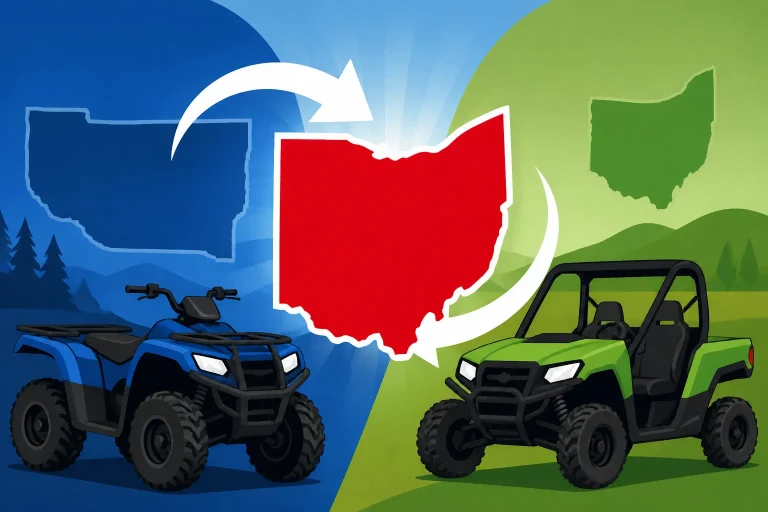
Out-of-state riders should verify reciprocity rather than relying on a friend’s experience or assuming that any home-state registration will be accepted. Ohio’s treatment of a visiting machine can depend on whether the home state registers that type of vehicle and whether the rider has the required evidence of registration. A visitor whose home state does not register the machine may face a different process from a visitor with a valid home-state registration. Check the current rules for your specific state and machine before setting out. Ohio Reciprocity for Out-of-State Machines gives more detail on that distinction.
A private club may also set its own documentation requirement. It could ask visiting riders to show proof of valid registration, a club permit, an event confirmation, or another document required by its land-use agreement. That club check is separate from the state’s requirements: meeting one does not automatically satisfy the other.
Use this sequence when checking your paperwork:
- Identify the machine’s home state and confirm that its registration is current.
- Ask the club what proof it requires from Ohio residents and visitors.
- Confirm whether the trail crosses public land or connects to an Ohio state forest area.
- Check whether Ohio recognizes your home-state registration for the place you plan to ride.
- If your state does not register the machine, ask whether an Ohio visitor permit or another authorization applies.
- Carry the required documents and make sure the machine’s plate or identifying mark is visible.
Do not rely on an old permit, a registration card for a different machine, or a photo that does not show the information an officer or trail manager may need. If the club has specific check-in instructions, follow them as well as the state requirements.
Follow the rules for the land and the route
A club trail can pass through more than one kind of land, and the rules can change as the route changes. On private property, ride only where the owner or authorized club has given permission. Stay on marked routes, respect barriers, and do not treat an unmarked connecting path as part of the trail. Permission to ride one parcel is not permission to cross another.
Public land brings its own restrictions. A trail that appears to be maintained by a club may still be subject to the land manager’s hours, route boundaries, closures, and vehicle limits. A state forest trail, for example, is not interchangeable with a private club trail. Check the official trail information for the specific area rather than assuming that club permission covers all nearby routes. Ohio Rules for Riding a State Forest is useful if your planned ride includes state forest land.
Pay particular attention to width limits and vehicle eligibility. A route suitable for a quad may not be open to every side-by-side. Confirm the trail operator’s measurement method and the applicable land manager’s limit rather than relying on a manufacturer’s model description. If your machine is close to a limit, measure it as it is configured for the ride, including any attachments that affect its overall width.
Roads are another common point of confusion. A club route that reaches or crosses a road does not automatically let riders travel along that road. Road access depends on the road’s status and applicable state, county, or township rules. Follow posted signs and the organizer’s route instructions, and do not assume that a trail map is permission to ride a public roadway. See Ohio Rules for Riding a County Road or Ohio Rules for Riding a Township Road if your route uses those roads.
Closures matter even when a club normally allows access. A gate may be shut for weather, maintenance, hunting activity, timber work, or a landowner’s request. A route map can be out of date, so check for current notices before loading. Never bypass a closed gate or ride around a barrier. A marked detour is the safer choice; an improvised detour can leave the permitted route and put you on land where you have no access.
Confirm club conditions and prepare for check-in
Before the ride, ask the club for its current rules in writing or through an official club channel. The useful details are practical: where to park, which trail entrances to use, whether the ride is open to guests, how to register for an event, and what happens if weather changes. If the club gives you a map, check that it identifies the route you are allowed to ride rather than nearby roads or unofficial connectors.
Club rules may cover items beyond registration. Ask whether the operator requires helmets, eye protection, insurance, a sound limit, a spark arrester, or other equipment. Ohio law and a land manager’s rules may independently require certain safety measures. Carrying what the club asks for does not guarantee that every legal requirement is met, so check the rules that apply to the land and machine too.
A straightforward pre-ride check helps prevent a wasted trip:
- Confirm that the ride is open to you, including whether guests or nonmembers may attend.
- Verify the address, parking area, permitted entrance, and check-in procedure.
- Ask whether the route is private, public, or a combination.
- Confirm your machine is eligible for the trail, including its width and configuration.
- Check registration, visitor reciprocity, and any club-issued permit requirements.
- Ask about road crossings, passenger rules, age limits, and required safety equipment.
- Check for weather closures and any route changes on the day of the ride.
- Carry proof of permission or event registration if the club asks riders to show it.
At check-in, be ready to show the documents the club requests and listen for changes to the route. Keep the club contact information available in case you encounter a locked gate, a confusing junction, or a trail closure. If a route marker conflicts with the map or an organizer’s instruction, stop and ask rather than guessing.
The main point is simple: there is no universal “club trail permit” that automatically covers every Ohio ride. Access depends on who controls the land and what permission they have granted. Your registration and any visitor requirements are a separate question, and club conditions can add further limits. Confirm all three before you ride: land access, legal paperwork, and the trail operator’s rules.
Disclaimer
This article is for general informational purposes only and does not constitute professional advice. Laws, prices and regulations vary by location and change over time. Consult a qualified professional for guidance on your specific situation.